
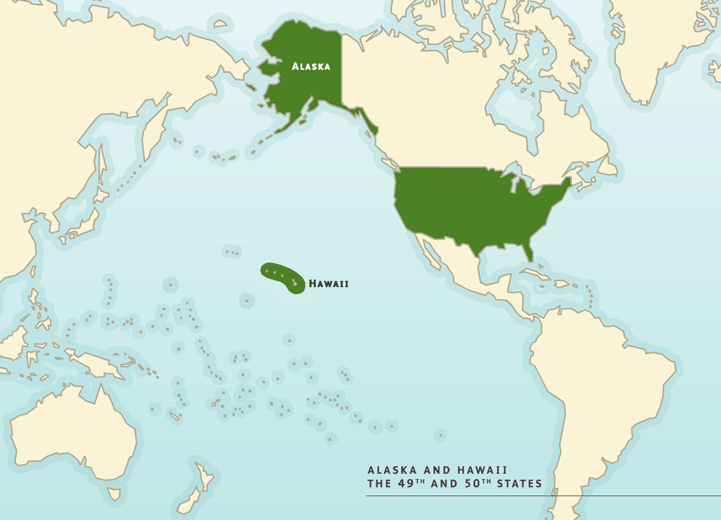
The admission of Alaska and Hawaii into the United States in 1959 marked a pivotal moment in American history, completing the contiguous nation’s expansion and extending its reach across the Pacific Ocean and into the Arctic Ocean. These two non-contiguous territories, vastly different in their geography, culture, and historical trajectories, became the 49th and 50th states, respectively, fundamentally reshaping the geopolitical map and solidifying America’s global presence. Understanding the specific timelines and the intricate historical, political, and economic factors that led to their statehood offers profound insights into the nation’s evolving identity and its relationship with its diverse territories.
The Path to Statehood: A Defining Moment for the United States
The journey for both Alaska and Hawaii from remote territories to full-fledged states was complex and protracted, spanning decades of political maneuvering, economic development, and cultural integration. Each had a unique narrative shaped by its origins and strategic importance.
Alaska: From Russian America to the 49th State
The story of Alaska’s statehood begins long before it was even an American territory. Its immense landmass, rich in natural resources and strategic location, made it a coveted possession.
Early History and Purchase
Originally known as Russian America, the vast northern territory was primarily explored and exploited for its fur trade by Russia starting in the 18th century. However, maintaining such a distant and sparsely populated colony proved increasingly challenging and costly for the Russian Empire. In a landmark deal, the United States Secretary of State William H. Seward negotiated the purchase of Alaska from Russia for $7.2 million in 1867. Initially derided by critics as “Seward’s Folly” or “Seward’s Icebox,” this acquisition was, in hindsight, one of the most astute territorial expansions in American history, adding an area twice the size of Texas to the nation.
Territorial Growth and Economic Drivers
For decades after the purchase, Alaska remained largely undeveloped, administered first by the military, then as a district, and finally as an organized territory in 1912. The discovery of gold in the late 19th and early 20th centuries, particularly during the Klondike Gold Rush, sparked an influx of settlers and economic activity. Further development was driven by the burgeoning fishing industry, timber, and later, significant oil discoveries. These economic booms, coupled with the territory’s growing population and the establishment of key cities like Anchorage, Juneau (the capital), and Fairbanks, fueled a desire for greater political autonomy and representation.
The Push for Statehood
The formal push for Alaska statehood intensified after World War II. Alaskans felt burdened by federal control and taxation without full representation in Congress. They argued that statehood would bring economic benefits, local control over resources, and bolster national security. Despite initial resistance from some members of Congress who feared the costs and the impact of adding such a vast, sparsely populated area, the strategic importance of Alaska during the Cold War ultimately swayed public and political opinion. Its proximity to the Soviet Union made it a crucial military outpost. Finally, on January 3, 1959, President Dwight D. Eisenhower signed the proclamation admitting Alaska as the 49th state.
Hawaii: From Kingdom to the 50th State
In stark contrast to Alaska’s acquisition, Hawaii’s path to statehood involved the complex dissolution of a sovereign monarchy and a prolonged period as a U.S. territory.
A Rich Polynesian Heritage and Monarchy
The Hawaiian Islands possess a vibrant history dating back centuries with Polynesian voyagers. By the late 18th and early 19th centuries, under the leadership of King Kamehameha I, the islands were unified into a prosperous kingdom. Its strategic location in the central Pacific Ocean made it a vital port for whaling ships and later, for trade routes between Asia and the Americas. American missionaries and businessmen began to establish a significant presence, influencing the kingdom’s economy and politics.
Annexation and Territorial Status
By the late 19th century, American economic interests, primarily in the sugar and pineapple industries, held considerable sway in Hawaii. This influence culminated in a coup d’état in 1893, led by American and European residents, which overthrew Queen Liliʻuokalani, the last monarch of Hawaii. Though controversial and viewed by many as an illegal act, the new provisional government pursued annexation by the United States. Driven by imperial ambitions and the strategic necessity of a naval base at Pearl Harbor, Hawaii was formally annexed in 1898 and became a U.S. territory in 1900.
The Journey to Statehood
For over half a century, Hawaii operated as a U.S. territory. Its population grew dramatically, becoming a melting pot of various ethnicities, including Japanese, Chinese, Filipino, and Portuguese, alongside Native Hawaiians and Caucasians. The devastating attack on Pearl Harbor in 1941, which thrust the United States into World War II, underscored Hawaii’s undeniable strategic importance to national defense. Following the war, the push for statehood gained unstoppable momentum. Hawaiians argued for equal rights, self-governance, and an end to their colonial status. Despite concerns from some in Congress regarding its non-white majority population and potential political leanings, the tide had turned. On August 21, 1959, President Dwight D. Eisenhower signed the proclamation making Hawaii the 50th state, a mere seven months after Alaska’s admission.
The Strategic Importance and Unique Challenges
The admission of Alaska and Hawaii was not merely an administrative formality; it reflected and reinforced the United States’ growing role as a global superpower, particularly in the post-World War II era. Their statehood was deeply intertwined with geopolitical realities and unique integration challenges.
Geopolitical Significance
The timing of Alaska and Hawaii’s statehood cannot be divorced from the broader global context of the mid-20th century.
Cold War Context

During the height of the Cold War, the United States sought to bolster its defenses against the Soviet Union. Alaska, sharing a maritime border with Russia across the Bering Strait, became a critical front-line for defense, surveillance, and air power projection. Its strategic location for radar installations, air force bases, and missile defense systems was paramount. Similarly, Hawaii, with Pearl Harbor serving as the headquarters for the U.S. Pacific Fleet, cemented America’s naval dominance and projection of power across the vast Pacific Ocean. Granting statehood to these territories reinforced their permanent commitment to the United States and provided a stronger basis for federal investment in military infrastructure.
Pacific and Arctic Influence
Statehood allowed the United States to exert greater influence in both the Pacific Rim and the Arctic regions. Hawaii became the primary civilian and military gateway to Asia and the rest of Oceania, fostering trade, diplomatic ties, and cultural exchange. Alaska emerged as a key player in Arctic policy, providing a platform for scientific research, resource management, and international cooperation in a region of increasing global interest due to climate change and resource potential. These new states were not just additions to the map, but strategic anchors for American foreign policy and economic engagement.
Overcoming Distance and Disparity
Integrating two geographically remote and culturally distinct territories into the federal system presented unique challenges.
Cultural Integration
Hawaii’s diverse, multicultural population and its unique Polynesian heritage required careful consideration, as did Alaska’s indigenous peoples, including Inupiaq, Yup’ik, and Athabascan communities. Statehood promised to extend full civil rights and political representation to these populations, albeit with ongoing challenges related to preserving indigenous cultures and land rights. The process highlighted the ongoing evolution of the American identity, embracing a broader spectrum of cultural backgrounds.
Economic Development and Federal Support
Both states faced the challenge of developing sustainable economies that could thrive without complete federal dependence. Statehood allowed them to establish their own state governments, manage local affairs, and attract investment more effectively. Federal aid and infrastructure projects, particularly in Alaska for resource extraction and in Hawaii for tourism and military installations, helped to spur economic growth. The transition from territorial to state status brought increased autonomy but also greater responsibility for managing their unique environmental and economic landscapes.
Celebrating Statehood: A New Era for Two Distinctive Lands
The admission of Alaska and Hawaii initiated a new era for these lands and for the United States, marking a definitive shift in their political, economic, and social fabric.
The Impact on Local Populations
Statehood fundamentally altered the lives of residents in both Alaska and Hawaii.
Indigenous Rights and Representation
For indigenous populations in both states, statehood brought complex outcomes. While it promised full citizenship and the right to vote in federal elections, it also meant navigating the state and federal legal systems to protect ancestral lands, cultural practices, and self-determination. In Alaska, the Alaska Native Claims Settlement Act (ANCSA) of 1971, enacted years after statehood, was a monumental piece of legislation that addressed land claims, creating native corporations and granting significant land and monetary settlements. In Hawaii, the struggle for recognition of Native Hawaiian rights and sovereignty continues to be a central issue, stemming from the contested overthrow of the monarchy.
Demographic Shifts
Statehood contributed to continued demographic shifts in both states. Increased federal investment, military presence, and economic opportunities attracted new residents from the contiguous United States. This led to further diversification of populations but also placed pressure on local resources and cultural identities. The unique ethnic tapestry of Hawaii and the growing diversity of Alaska became integral to their modern identities as states.
Legacy and Modern Significance
More than six decades later, the decision to grant statehood to Alaska and Hawaii continues to resonate, shaping their economic contributions and global appeal.
Economic Contributions
Today, Alaska’s economy is heavily reliant on oil and gas, fishing, and tourism, while Hawaii’s thrives on tourism and its robust military presence. Both states provide critical resources and services to the national economy, demonstrating the foresight of their admission into the union. Their distinct economies, though often challenging to sustain given their remote locations, contribute uniquely to the overall prosperity of the United States.
Tourism and Conservation
Statehood also brought heightened awareness and protection for the unparalleled natural beauty and cultural heritage of both states. Hawaii, with its pristine beaches, volcanoes, and lush landscapes, became a world-renowned tourist destination, driving significant economic activity in cities like Honolulu. Alaska, with its vast wilderness, glaciers, and abundant wildlife, attracts adventurers and nature enthusiasts from across the globe, supporting a growing ecotourism industry. Along with this development came a greater emphasis on environmental conservation and the preservation of their unique ecosystems, with national parks and protected areas safeguarding these natural wonders for future generations.

Conclusion: Completing the American Mosaic
On January 3, 1959, Alaska joined the union as the 49th state, followed by Hawaii on August 21, 1959. These two dates mark the completion of the contemporary United States as we know it, expanding its geographic and cultural tapestry to its fullest extent. Their journey from distinct entities to integral parts of the nation reflects a complex interplay of historical events, strategic imperatives, and the evolving ideals of American democracy. Both states, with their unique historical landmarks, rich cultural traditions, and breathtaking natural environments, stand as enduring testaments to the diverse and dynamic character of the United States, forever enriching the American mosaic.
LifeOutOfTheBox is a participant in the Amazon Services LLC Associates Program, an affiliate advertising program designed to provide a means for sites to earn advertising fees by advertising and linking to Amazon.com. Amazon, the Amazon logo, AmazonSupply, and the AmazonSupply logo are trademarks of Amazon.com, Inc. or its affiliates. As an Amazon Associate we earn affiliate commissions from qualifying purchases.