
The journey to statehood for any American territory is a fascinating chronicle of exploration, conflict, migration, and political ambition. For Mississippi, this path was particularly rich, shaped by its strategic location along the mighty Mississippi River and its fertile lands that promised agricultural prosperity. Understanding when Mississippi officially joined the United States as a state requires delving into the colonial rivalries that preceded it, the establishment of its territorial government, and the specific socio-political factors that propelled it toward self-governance. On December 10, 1817, Mississippi achieved its long-sought goal, becoming the 20th state to be admitted into the Union. This moment marked a pivotal point in the expansion of the young American republic, solidifying its claims in the Southwest and opening up new frontiers for settlement and development.

The Formative Years: From European Claim to Territorial Status
The land that would eventually become Mississippi was a contested prize for centuries, reflecting the broader geopolitical struggles among European powers in North America. Its fertile soil, abundant natural resources, and access to crucial waterways made it highly desirable, setting the stage for a complex colonial history before its eventual integration into the United States.
Early European Interests and Colonial Struggles
The first Europeans to explore the region were the Spanish, with Hernando de Soto leading an expedition through what is now Mississippi in 1540-1541, searching for gold. While the Spanish established no permanent settlements, their presence marked the beginning of European contact. Later, in the late 17th century, French explorers, most notably René-Robert Cavelier, Sieur de La Salle, claimed the entire Mississippi River basin for France, naming it Louisiana in honor of King Louis XIV. The French established early settlements like Fort Maurepas (near modern-day Ocean Springs) in 1699 and Fort Rosalie (present-day Natchez) in 1716.
However, French dominance was short-lived. Following their defeat in the French and Indian War (also known as the Seven Years’ War) in 1763, France ceded its territories east of the Mississippi River to Great Britain. The British organized part of this land as West Florida, which included the valuable Natchez District. During the American Revolution, Spain recaptured West Florida, including Natchez, and maintained control even after the United States gained independence. This overlapping claim between the United States and Spain over the Natchez District was a significant point of contention until the Treaty of San Lorenzo (Pinckney’s Treaty) in 1795, which finally recognized the 31st parallel as the southern boundary of the United States and compelled Spain to evacuate its forts by 1798.
The Mississippi Territory’s Creation
With Spanish claims finally resolved, the United States moved swiftly to organize the newly acquired territory. On April 7, 1798, the U.S. Congress established the Mississippi Territory. Initially, its boundaries were modest, extending from the 31st parallel north to the Yazoo River (roughly 32°28′ N latitude) and from the Chattahoochee River in the east to the Mississippi River in the west. Winthrop Sargent, a veteran of the Revolutionary War, was appointed the first territorial governor, tasked with establishing order and governance in a region still raw from decades of colonial disputes and populated by a diverse mix of American settlers, former British loyalists, and indigenous communities like the Choctaw and Chickasaw. The creation of the territory signaled a clear intent from the United States to integrate this strategic region fully into its expanding domain, setting the stage for rapid growth and the eventual push for statehood.
Growing Pains and the Path to Statehood
The establishment of the Mississippi Territory ushered in an era of dramatic transformation. Population numbers surged, economic activity boomed, and the demand for greater political autonomy intensified, all against a backdrop of ongoing challenges related to land claims, native relations, and territorial expansion.
Population Growth and Economic Development
The promise of rich agricultural land, particularly for growing cotton, served as a powerful magnet for settlers. Throughout the early 19th century, thousands of individuals and families migrated to the Mississippi Territory from older states such as Virginia, the Carolinas, and Georgia. This influx was spurred by the invention of the cotton gin by Eli Whitney in 1793, which made short-staple cotton cultivation highly profitable and dramatically increased the demand for fertile land in the Southwest. The Mississippi River and its tributaries provided essential transportation routes for agricultural produce, particularly cotton, to markets in New Orleans and beyond. Towns like Natchez quickly grew into bustling commercial centers, reflecting the territory’s burgeoning economy. This rapid demographic and economic expansion fueled a strong desire among the settlers for full statehood, believing it would bring greater representation, stability, and control over their own destiny.
Political Agitation and Boundary Disputes
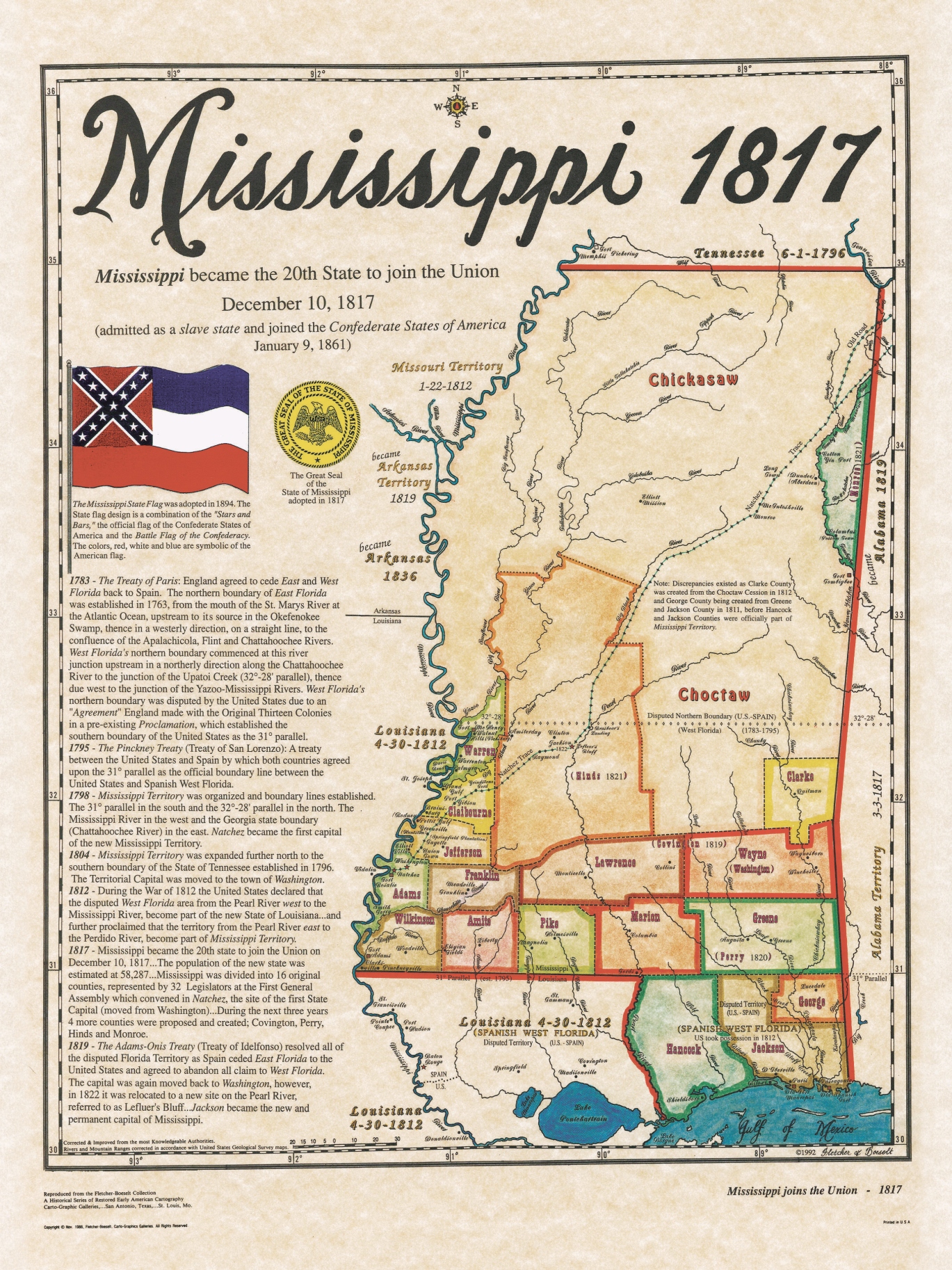
The territorial period was marked by significant political agitation and complex boundary issues. The original territorial limits proved insufficient for the ambitions of the growing population, particularly as more land was needed for cotton plantations. Through a series of treaties, the United States pressured the Choctaw and Chickasaw nations to cede vast tracts of their ancestral lands, further fueling westward expansion. A major expansion occurred in 1804 when Congress extended the territory northward to the Tennessee line. Even more significantly, following the War of 1812 and the subsequent weakening of Spanish influence, the United States seized and annexed additional portions of West Florida in 1810 and 1813, including the Mobile area, adding it to the Mississippi Territory. This expansion brought increased calls for statehood, but also created a dilemma: the vast size of the territory, coupled with the differing interests of its eastern and western sections, made a single state unwieldy. The solution ultimately reached was to divide the territory, with the eastern portion becoming the Alabama Territory in 1817, paving the way for the western section, Mississippi, to proceed directly to statehood.
December 10, 1817: A New Star in the Union
The division of the Mississippi Territory cleared the final hurdle, setting a clear course for Mississippi to achieve statehood. This moment was the culmination of decades of effort, political maneuvering, and the determined will of its growing population.
The Enabling Act and Constitutional Convention
The formal process for Mississippi’s statehood began with an Enabling Act passed by the U.S. Congress on March 1, 1817. This act authorized the people of the western part of the Mississippi Territory to form a constitution and state government. In July 1817, delegates gathered for a constitutional convention in the town of Washington, then the territorial capital, located a few miles east of Natchez. These delegates, representing the diverse interests and regions of the territory, embarked on the crucial task of drafting a framework for their new state. Among the prominent figures involved were George Poindexter, who played a significant role in shaping the document. The constitution they produced was largely modeled after those of other southern states, establishing a bicameral legislature, an executive branch headed by a governor, and an independent judiciary. It reflected the prevailing democratic ideals of the era while also protecting the institution of slavery, which was central to the state’s economic model.
Formal Admission to the United States
Upon completion, the proposed constitution was submitted to the U.S. Congress for review. After careful deliberation, Congress found the constitution to be in compliance with the provisions of the Enabling Act and the principles of the United States Constitution. On December 10, 1817, President James Monroe signed the resolution admitting Mississippi to the Union, making it the 20th state. This act was celebrated throughout the newly formed state and across the nation, symbolizing the continued westward expansion of the United States and the fulfillment of the nation’s manifest destiny. The admission of Mississippi not only added a new star to the American flag but also cemented the importance of the lower Mississippi River basin to the national economy and political landscape. It marked the transition of a frontier outpost into a sovereign entity with its own voice in the national government.
The Early Years of Statehood and Enduring Legacy
With statehood achieved, Mississippi immediately faced the challenges and opportunities of self-governance, embarking on a path that would profoundly shape its identity and contribute significantly to the broader narrative of American history.
Establishing Government and Early Challenges
The new state government quickly began to take shape. David Holmes, the last territorial governor, was elected as the first state governor. The initial state capital remained at Washington, but within a few years, due to increasing demands for a more centrally located seat of government, the capital was moved to a new site on the Pearl River, which was named Jackson in honor of General Andrew Jackson. Early challenges for the state included establishing a functional bureaucracy, developing infrastructure, particularly roads and waterways, and managing ongoing relations with indigenous peoples. The state also had to address issues of land speculation, law enforcement in sparsely populated areas, and the creation of an education system. The period immediately following statehood saw a rapid increase in economic activity, primarily driven by the cotton boom, but also intensified social and political divisions, particularly concerning the institution of slavery, which would become a defining feature of Mississippi’s identity.

Mississippi’s Place in American History
Mississippi’s entry into the Union was more than just a procedural act; it was a crucial step in the territorial expansion of the United States and the development of the American South. As a state, Mississippi quickly became one of the wealthiest states per capita in the antebellum period, thanks to its immense cotton production and the labor of enslaved people. This economic prosperity, however, came at a profound moral cost and cemented Mississippi’s position at the heart of the “Cotton Kingdom” and the slavery debate that ultimately led to the Civil War.
Beyond its economic and political roles, Mississippi has also made indelible contributions to American culture, from its foundational influence on blues music, which emerged from the fertile lands of the Mississippi Delta, to its rich literary tradition, boasting Nobel laureates like William Faulkner and acclaimed authors such as Eudora Welty and Richard Wright. The historical journey of Mississippi from a contested colonial frontier to a vibrant and complex state illustrates the evolving fabric of the United States, reflecting both its triumphs and its enduring struggles.
In conclusion, Mississippi officially became a state on December 10, 1817. This date marks the culmination of centuries of diverse cultural influences, geopolitical shifts, and the determined efforts of its residents to establish their place within the expanding American republic. Its story is a microcosm of the larger American experience, rich with historical significance that continues to resonate today.
LifeOutOfTheBox is a participant in the Amazon Services LLC Associates Program, an affiliate advertising program designed to provide a means for sites to earn advertising fees by advertising and linking to Amazon.com. Amazon, the Amazon logo, AmazonSupply, and the AmazonSupply logo are trademarks of Amazon.com, Inc. or its affiliates. As an Amazon Associate we earn affiliate commissions from qualifying purchases.