
The history of [Texas] is a tapestry woven with threads of exploration, revolution, and political maneuvering, culminating in its momentous entry into the [United States]. For travelers seeking a destination rich in historical significance, cultural depth, and breathtaking [landmarks], understanding this pivotal chapter is essential. From its days as a Spanish frontier to its independent [Republic of Texas] era, the journey of the Lone Star State is one of the most compelling narratives in [American] history, offering endless opportunities for immersive [tourism] and unforgettable [experiences].
This article delves into the critical events and key figures that shaped [Texas]’s destiny, leading to the precise moment it became the 28th state in the [Union]. Beyond the historical facts, we’ll explore how this vibrant past continues to influence its unique culture, economy, and the many attractions that draw millions of visitors each year, from luxurious [hotels] in bustling cities to tranquil [resorts] nestled near historic battlefields. Prepare to embark on a journey through time that reveals not just when [Texas] joined the [United States], but why its story remains so captivating for history buffs and casual travelers alike.
The Lone Star’s Long Road to Union: A Historical Overview
The path that led [Texas] to join the [United States] was long, complex, and marked by a series of dramatic shifts in sovereignty. This intricate history is what gives [Texas] its distinct character and offers visitors an unparalleled opportunity to explore a layered heritage.
From Spanish Frontier to Mexican Territory
The story of [Texas] begins long before its annexation, deep in the colonial ambitions of [Europe]. The first Europeans to significantly claim the region were the Spanish, who established missions and presidios in the late 17th and early 18th centuries. Iconic sites like [the Alamo] in [San Antonio], originally [Mission San Antonio de Valero], stand as enduring testaments to this era. The Spanish influence introduced ranching, the mission system, and a foundational cultural layer that persists today.
By the early 19th century, events far beyond the [Tejas] frontier began to reshape its future. In 1821, [Mexico] successfully achieved independence from [Spain], and the vast territory of [Tejas] became part of the new Mexican nation. Eager to populate and develop its northern frontier, [Mexico] welcomed settlers, primarily from the [United States]. One of the most prominent figures in this period was [Stephen F. Austin], who led hundreds of [American] families to establish colonies along the [Brazos River] and [Colorado River], promising loyalty to the Mexican government in exchange for land. This influx of Anglo-American settlers, however, brought with it cultural and political differences, particularly concerning slavery and local governance, which would soon sow the seeds of discontent.
The Texas Revolution and the Birth of a Republic
The growing friction between the Mexican government and the Anglo-American colonists, exacerbated by changing Mexican policies, eventually ignited the [Texas Revolution]. This pivotal period, from 1835 to 1836, is filled with legendary tales of courage and sacrifice that resonate deeply within [Texas] today.
Key battles and events shaped this struggle for independence. The Battle of the Alamo in March 1836 saw a small group of Texan defenders, including legendary figures like [Davy Crockett] and [James Bowie], make a heroic last stand against a much larger Mexican army led by General [Antonio López de Santa Anna]. Though a defeat for the Texans, the sacrifice at [the Alamo] became a powerful rallying cry. Shortly after, the Goliad Massacre further fueled the Texans’ determination.
The turning point came on April 21, 1836, at the Battle of San Jacinto. Under the command of General [Sam Houston], the Texan army decisively defeated Santa Anna’s forces in a swift, eighteen-minute battle, capturing the Mexican general himself. This victory secured [Texas]’s independence, and on March 2, 1836, even before the victory at [San Jacinto], delegates at [Washington-on-the-Brazos] had already declared the formation of the [Republic of Texas]. [Sam Houston] became its first president, ushering in an era of self-governance that lasted nearly a decade.
The Path to Annexation: Political Debates and Delays
The establishment of the [Republic of Texas] was a monumental achievement, but its leaders immediately recognized the precariousness of their independence. Border disputes with [Mexico] loomed, and the young republic faced significant financial challenges. Annexation by the [United States] was seen by many Texans as the most viable path to security and prosperity. However, the decision on the [American] side was far from straightforward, revealing deep political divisions.
For nearly ten years, the question of annexing [Texas] remained a contentious issue in [Washington, D.C.]. Several factors contributed to this delay:
- The Slavery Question: Perhaps the most significant hurdle was the issue of slavery. [Texas] was a slaveholding territory, and its admission as a slave state would upset the delicate balance of power between free and slave states in the [United States Congress]. Abolitionist sentiments in the North strongly opposed annexation, fearing it would expand the institution of slavery.
- Fear of War with Mexico: [Mexico] still considered [Texas] a rebellious province and warned that annexation by the [United States] would be an act of war. [American] presidents like [Andrew Jackson] and [Martin Van Buren] were hesitant to provoke a conflict with their southern neighbor.
- Balance of Power and Geopolitical Concerns: Some feared that adding such a vast territory would disrupt the existing political equilibrium and potentially lead to further expansionist ambitions, straining relations with other global powers, notably [Great Britain], which also held interests in the region.
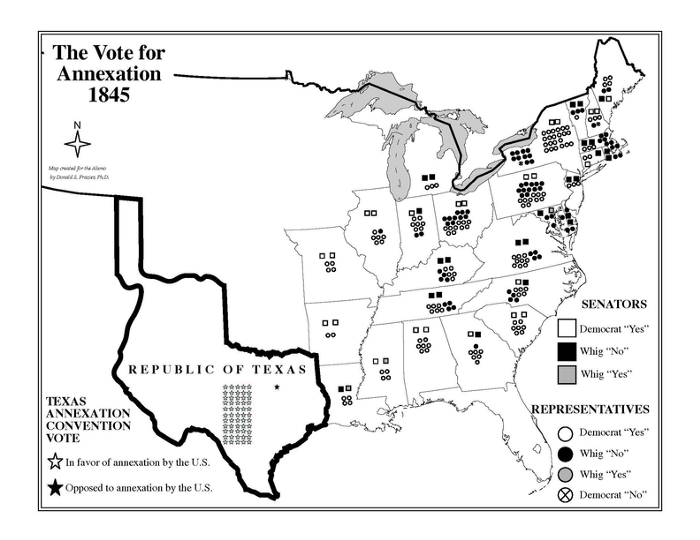
Throughout the 1830s and early 1840s, [Texas] presidents, including [Mirabeau B. Lamar] and later [Anson Jones], continuously sought annexation, at times even exploring diplomatic relations with [Britain] and [France] to pressure the [United States]. The political landscape in the [United States] began to shift in the early 1840s. President [John Tyler], a proponent of expansion, brought the issue back to the forefront. However, a treaty of annexation he negotiated was rejected by the [Senate] in 1844, largely due to ongoing sectional divisions.
The turning point came with the 1844 presidential election and the rise of [James K. Polk]. Running on a platform of “Manifest Destiny”—the belief that the [United States] was divinely ordained to expand across the North American continent—Polk’s victory signaled a clear mandate for expansion. He pushed for annexation through a joint resolution of [Congress], a legislative maneuver that required only a simple majority in both houses, rather than the two-thirds [Senate] majority needed for a treaty.
December 29, 1845: Texas Joins the United States
The culmination of decades of struggle, negotiation, and political maneuvering arrived in 1845. The joint resolution for annexation, passed by the [United States Congress] in February of that year, offered [Texas] statehood. Texans overwhelmingly approved annexation in a referendum held in October.
The final act of independence for the [Republic of Texas] occurred on December 29, 1845. On this historic day, President [Anson Jones] symbolically lowered the Lone Star flag and raised the [American] flag over the provisional capitol in [Austin], declaring, “The final act in this great drama is now performed; the [Republic of Texas] is no more.” With this momentous ceremony, [Texas] officially became the 28th state of the [United States].
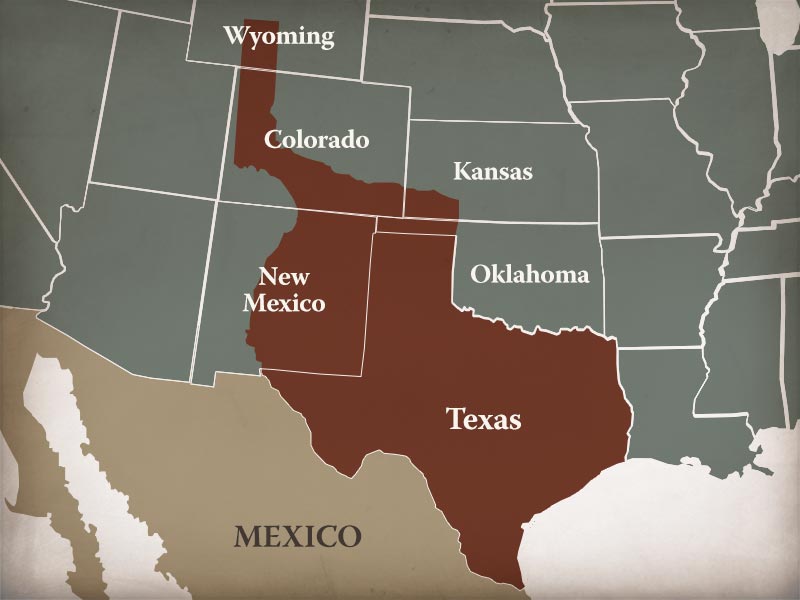
The annexation, while celebrated by many, was not without immediate consequences. True to [Mexico]’s warnings, it directly contributed to the outbreak of the [Mexican-American War] in 1846, as boundary disputes and lingering resentment over [Texas] fueled the conflict. The war ultimately led to the [United States] acquiring vast new territories in the Southwest through the [Treaty of Guadalupe Hidalgo] in 1848, forever changing the map of North [America] and solidifying the concept of Manifest Destiny. For [Texas], statehood brought a period of growth, although it would soon face the turmoil of the Civil War just over a decade later.
Experiencing Texas History Today: Travel, Culture, and Landmarks
The rich and dramatic history of [Texas] is not confined to textbooks; it lives on in its vibrant cities, revered [landmarks], and the unique culture that defines the state. For travelers, this means an abundance of opportunities to explore, learn, and experience a pivotal piece of [American] heritage firsthand. [Texas]’s commitment to preserving its past makes it an ideal destination for history buffs, families, and anyone interested in delving into the origins of a truly distinctive state.
Iconic Historical Destinations and Landmarks
No historical journey through [Texas] would be complete without visiting its most significant sites. These [landmarks] offer tangible connections to the events and figures that shaped its destiny:
- San Antonio: A cornerstone of [Texas] history, [San Antonio] is a must-visit. The legendary [Alamo] stands proudly in the city center, a powerful symbol of courage. Beyond [the Alamo], the city boasts several other historic missions, part of the [San Antonio Missions National Historical Park], including [Mission San José], a beautifully restored “Queen of the Missions.” After a day of exploring, visitors can unwind along the picturesque [River Walk], enjoying the unique blend of Texan and Mexican culture, perhaps staying at an elegant accommodation like the [Mokara Hotel & Spa] or the [Hotel Emma].
- Austin: The state capital, [Austin], offers a blend of historical gravitas and a vibrant, modern lifestyle. The magnificent [Texas State Capitol], a National Historic Landmark, provides guided tours that delve into the state’s political history. Nearby, the [Bullock Texas State History Museum] offers comprehensive exhibits tracing the state’s story from indigenous peoples to the present day. For [accommodation], the [JW Marriott Austin] offers a central base for exploring the city.
- Houston: While renowned for its space industry, [Houston] also plays a crucial role in [Texas]’s revolutionary past. The [San Jacinto Battlefield State Historic Site], located just outside [Houston], commemorates the decisive battle that won [Texas] its independence. Visitors can climb the [San Jacinto Monument] for panoramic views and explore the museum. Nearby, the [Battleship Texas State Historic Site] (currently undergoing extensive restoration) adds another layer of military history.
- Washington-on-the-Brazos State Historic Site: Often called the “Birthplace of [Texas],” this site allows visitors to step back in time to where the Declaration of Independence was signed. It features a replica of the Independence Hall and offers insights into daily life in the [Republic of Texas] era.
These destinations are not just static museums; they are living narratives, offering educational programs, reenactments, and interactive displays that bring history to life.
Immersive Cultural Experiences and Local Flavors
[Texas]’s journey from a Spanish frontier to an independent republic and finally to a U.S. state has forged a culture unlike any other. Travelers can immerse themselves in this unique blend through various experiences:- Culinary Adventures: Taste the history of [Texas] through its food. Indulge in authentic [Texas BBQ], slow-smoked meats that are a testament to ranching traditions. Explore vibrant Tex-Mex cuisine, a delicious fusion of Mexican and American flavors that originated along the borderlands. From high-end restaurants in [Dallas] to charming diners in small towns, the food scene is a direct reflection of its diverse heritage.
- Music and Arts: [Texas] boasts a rich musical heritage, from country and western to blues and Tejano music, all influenced by its multicultural past. Live music venues across the state, especially in Austin, offer a taste of this vibrant tradition.
- Rodeo and Cowboy Culture: Experience the enduring legacy of the cowboy, a figure synonymous with [Texas]. Attend a local rodeo, visit a historic ranch, or explore museums dedicated to the cattle industry to understand this quintessential aspect of Texan identity.
- Festivals and Events: Throughout the year, numerous festivals celebrate [Texas]’s heritage, from [Fiesta San Antonio] commemorating the Battles of the Alamo and San Jacinto, to [German] heritage festivals in towns like [Fredericksburg] and [New Braunfels], reflecting various waves of immigration.
Planning Your Historical Texas Getaway
Planning a trip to explore [Texas]’s history offers diverse options for every [lifestyle] and budget.
- Accommodation: From luxury [resorts] with full amenities in [Houston] or [Dallas] to charming boutique [hotels] in historical districts, [Texas] offers a wide range of [accommodation] options. Consider booking a stay at a historic inn for an authentic experience or choose modern [apartments] for longer stays. Many [hotels] in cities like [San Antonio] are within walking distance of key historical sites, enhancing the travel experience.
- Travel Guides and Tours: Utilize comprehensive [travel guides] to plan your itinerary, or consider hiring a local tour guide for in-depth insights into specific historical periods or [landmarks]. Many destinations offer self-guided audio tours accessible via smartphone.
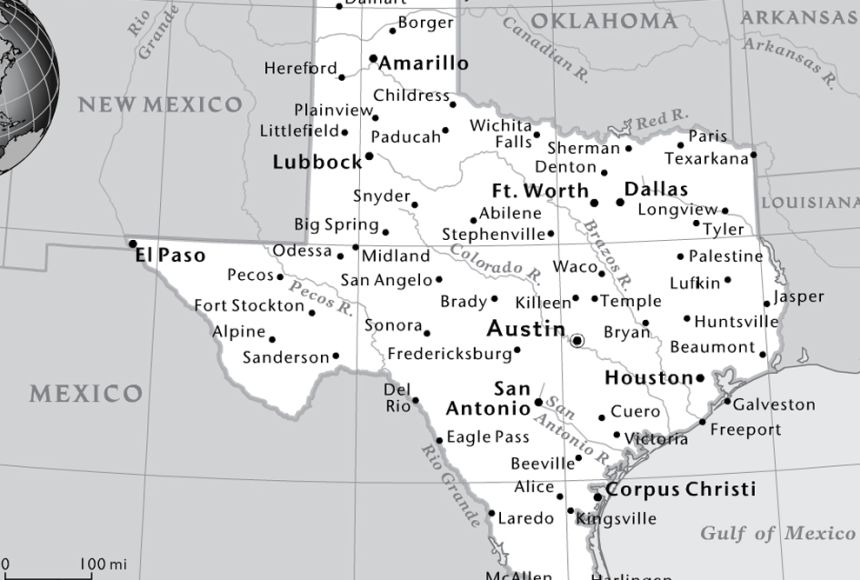
- Road Trips: Given the vastness of [Texas], a road trip is an excellent way to connect historical sites across different regions, allowing for flexibility and discovery. Whether it’s a [family trip] focused on educational experiences or a solo adventure, the open roads of [Texas] beckon.
In conclusion, the question “When Did [Texas] Become Part Of The [United States]?” points to a specific date—December 29, 1845—but it truly unlocks a much broader narrative. This story of independence, annexation, and cultural fusion makes [Texas] an unparalleled destination for [travel]. By exploring its battlefields, missions, capitols, and vibrant cultural expressions, visitors can connect deeply with the spirit of the Lone Star State and appreciate its enduring legacy within the [United States].
LifeOutOfTheBox is a participant in the Amazon Services LLC Associates Program, an affiliate advertising program designed to provide a means for sites to earn advertising fees by advertising and linking to Amazon.com. Amazon, the Amazon logo, AmazonSupply, and the AmazonSupply logo are trademarks of Amazon.com, Inc. or its affiliates. As an Amazon Associate we earn affiliate commissions from qualifying purchases.