
The question of “When did Texas join the United States?” delves into a pivotal moment in American history, shaping not only the geopolitical landscape of North America but also defining the unique cultural and historical identity of the Lone Star State itself. This event, occurring on December 29, 1845, was the culmination of decades of tumultuous change, revolution, and political maneuvering, leaving an indelible mark that continues to resonate through the state’s many historical landmarks and its enduring spirit. To fully appreciate this significant date, one must journey back through the intricate tapestry of Texas’s past, from its colonial origins to its brief but impactful period as an independent republic. Understanding this annexation is crucial to comprehending the historical landmarks that dot the Texan landscape, each telling a piece of the story of how this vast territory transitioned from an independent nation to a powerful state within the American union.
A Legacy Forged in Independence: From Spanish Colony to Lone Star Republic
The path that led Texas to join the United States is a narrative rich with ambition, conflict, and the relentless march of expansion. Before its annexation, Texas existed as a fiercely independent republic, a status it achieved through a revolutionary struggle that etched its name into the annals of global history.
Early Encounters and Mexican Rule
For centuries, the land that would become Texas was part of the vast colonial empire of Spain. Sparse Spanish missions and presidios were established, but the region remained largely undeveloped and sparsely populated by European settlers. This changed dramatically in the early 19th century. After Mexico achieved independence from Spain in 1821, its government sought to populate and develop its northern territories. They encouraged immigration, primarily from the United States, offering generous land grants. One of the most prominent impresarios was Stephen F. Austin, who led hundreds of Anglo-American families to settle along the Brazos River.
These new settlers, largely Protestant and English-speaking, often found themselves at odds with the predominantly Catholic, Spanish-speaking Mexican government. Cultural differences, coupled with disagreements over political autonomy and, crucially, the legality of slavery (which Mexico had abolished), created a fertile ground for dissent. As Mexico’s central government grew more authoritarian under President Antonio López de Santa Anna, tensions escalated, eventually erupting into armed conflict.
The Texas Revolution and Birth of a Republic
The Texas Revolution, spanning from October 1835 to April 1836, was a watershed moment. It began with skirmishes like the Battle of Gonzales and rapidly escalated into a full-blown war for independence. Iconic events such as the siege of the Alamo in San Antonio, where a small band of Texan defenders fought to the last man against Santa Anna’s overwhelming forces, became enduring symbols of courage and sacrifice. Though a military defeat, the Alamo’s legacy ignited a fierce desire for vengeance among Texans. Shortly thereafter, another tragedy unfolded at Goliad, where hundreds of Texan prisoners were massacred.
However, the tide turned decisively at the Battle of San Jacinto on April 21, 1836. Led by General Sam Houston, the Texan army launched a surprise attack, decisively defeating Santa Anna’s forces and capturing the Mexican president himself. With Santa Anna’s capture, Mexico was forced to sign the Treaties of Velasco, which recognized Texas’s independence. On March 2, 1836, even before San Jacinto, delegates at Washington-on-the-Brazos had formally declared the creation of the Republic of Texas. This new nation, with its “Lone Star” flag, immediately set its sights on joining the United States.
The Path to Annexation: A Decade of Deliberation
The nine years between Texas’s independence in 1836 and its annexation in 1845 were marked by complex political negotiations, international intrigue, and heated domestic debates within the United States.
The Young Republic’s Predicament
The Republic of Texas faced immense challenges from its inception. Financially, it was deeply in debt, having borrowed heavily to fund the revolution. Militarily, despite its independence, Mexico never truly recognized the new republic, continuing to assert its claim over the territory and launching occasional incursions. The fear of renewed conflict with Mexico was a constant threat. Economically, the republic needed stability and access to larger markets. From the perspective of many Texans, joining the United States offered a clear solution to these problems, promising financial security, military protection, and economic integration. Indeed, a significant portion of the Anglo-American population in Texas had always intended for the territory to become part of the United States.
The American Debate: Manifest Destiny, Slavery, and Geopolitics
While Texas eagerly sought annexation, the United States was initially hesitant. The primary sticking point was the issue of slavery. Texas was a slaveholding territory, and its admission as a state would upset the delicate balance of power between free and slave states in the U.S. Congress. Abolitionists in the North vehemently opposed annexation, fearing it would expand the institution of slavery and increase the South’s political influence.
Another major concern was the potential for war with Mexico. Mexico had made it clear that the annexation of Texas would be considered an act of war. The United States, still recovering from internal divisions and navigating its own expansionist ambitions, was wary of provoking a conflict. However, the concept of Manifest Destiny—the belief that the United States was divinely ordained to expand westward across the North American continent—was gaining traction. Many Americans saw Texas as a natural extension of their nation’s territory and a vital component of its future.
Shifting Tides and Political Will
Despite initial reluctance, the political landscape in the United States began to shift. President Andrew Jackson, a close friend of Sam Houston, recognized the Republic of Texas on his last day in office in 1837 but did not pursue annexation. Subsequent administrations also demurred. However, by the early 1840s, geopolitical concerns added urgency. Both Great Britain and France were showing increasing interest in forging alliances and trade agreements with the Republic of Texas, which raised concerns in Washington D.C. about European interference in North America. This fear that Texas might become a pawn in European power struggles spurred American leaders to reconsider annexation.
President John Tyler, a states’ rights advocate, became a strong proponent of annexation, seeing it as an opportunity to secure the southwestern border and expand the nation. He negotiated a treaty of annexation in 1844, but it was rejected by the Senate due to the slavery issue and fears of war. The 1844 presidential election, however, proved to be a turning point. James K. Polk, an ardent expansionist, campaigned on a platform that included the annexation of Texas and the acquisition of Oregon. His victory was widely interpreted as a mandate from the American people for expansion.
The Moment of Union: December 29, 1845
Following Polk’s election, the political momentum for annexation became unstoppable. The stage was set for Texas to shed its independent status and join the burgeoning American union.
The Annexation Resolution
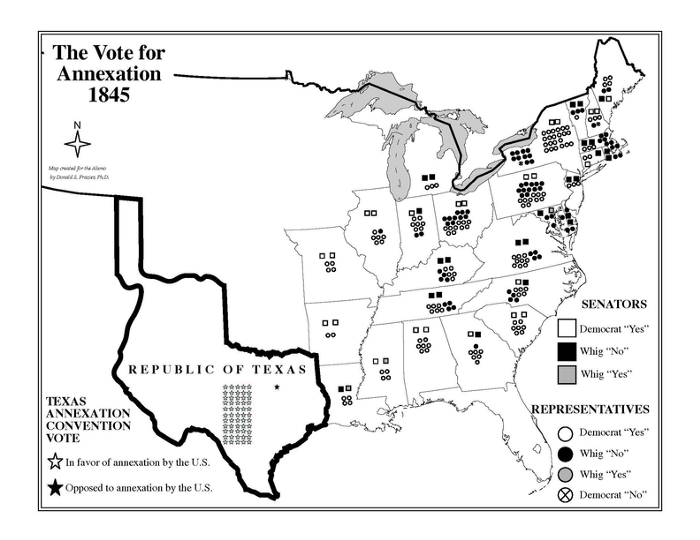
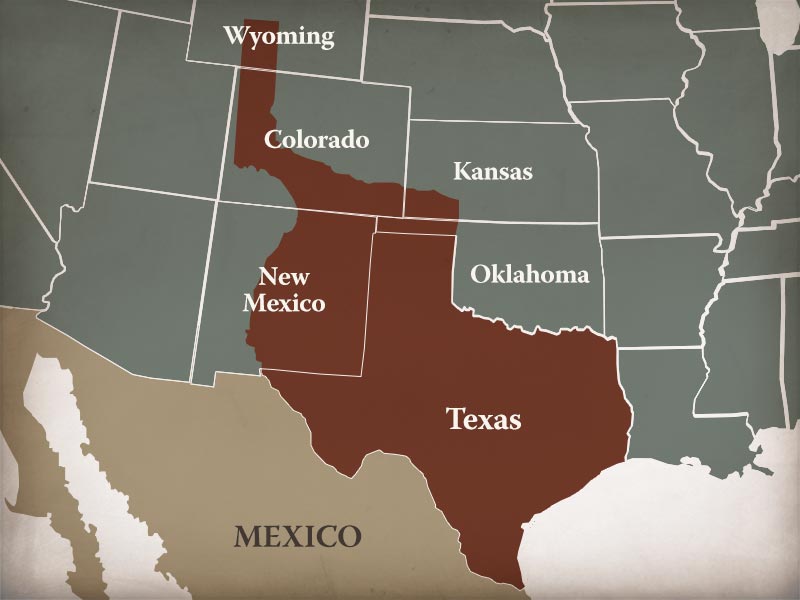
Rather than pursue another treaty, which required a two-thirds majority in the Senate, President Tyler, in his final days in office, decided to push for annexation through a joint resolution of Congress. A simple majority in both the House and the Senate was all that was needed for this legislative maneuver. This strategy proved successful. On February 28, 1845, the U.S. Congress passed the joint resolution offering annexation to the Republic of Texas. The resolution stipulated that Texas would retain its public lands and its state debt, and it would have the option to divide into as many as four additional states in the future, if it so chose.
Texas’s Ratification and Statehood
Upon receiving the offer, the Republic of Texas swiftly acted. A special convention was called, and on July 4, 1845, the delegates unanimously voted to accept the U.S. offer of annexation. They then drafted a new state constitution, which was ratified by popular vote in October 1845. With these formalities completed, Texas officially became the 28th state of the United States on December 29, 1845, when President James K. Polk signed the act admitting Texas to the Union. This date marked the formal end of the independent Republic of Texas and the beginning of its new chapter as an American state. The event was celebrated with great fervor in Texas and throughout much of the southern and western United States.
The Legacy of Annexation
The annexation of Texas had profound and immediate consequences. As Mexico had warned, it led directly to the Mexican-American War (1846-1848). This conflict, which the United States ultimately won, resulted in the vast territorial expansion known as the Mexican Cession, adding all or parts of present-day California, Nevada, Utah, Arizona, New Mexico, Colorado, and Wyoming to the United States. The annexation also further intensified the national debate over slavery, setting the stage for future conflicts that would ultimately culminate in the American Civil War.
Echoes of History: Texas’s Enduring Identity as a Landmark of American History
The story of Texas’s journey to statehood is not just a historical footnote; it is a foundational narrative that continues to shape the state’s identity and its myriad landmarks. The fierce independence and resilience forged during its republic days remain deeply embedded in the Texan psyche.
Preserving the Past: Historic Sites and Memorials
Today, the historical journey of Texas is preserved and celebrated through numerous landmarks that serve as tangible connections to its past. The Alamo in San Antonio stands as the most iconic, a solemn shrine to Texan courage. The San Jacinto Monument and Museum, soaring over 560 feet near La Porte, commemorates the decisive battle that secured independence. Visitors can climb to its observation deck to overlook the battlefield where Texas won its freedom.
Washington-on-the-Brazos State Historic Site is another vital landmark, often called the “Birthplace of Texas.” Here, the Declaration of Independence was signed, and the first constitution of the republic was drafted. The reconstructed buildings and exhibits transport visitors back to the pivotal moments of 1836. These sites, along with countless others, including historic courthouses, battlegrounds, and museums across the state, act as crucial educational resources, keeping the complex and dramatic story of Texas’s path to statehood alive for future generations.

The “Lone Star” Spirit in Modern Texas
The historical saga of Texas’s independence and subsequent annexation has imbued the state with a unique “Lone Star” spirit—a blend of fierce independence, strong identity, and pride in its distinctive history. This spirit is visible not just in historical landmarks but in contemporary Texan culture, politics, and even its economy. The historical experience of being an independent republic, and then a state, has given Texans a narrative unlike any other in the United States. It fosters a deep appreciation for self-determination and a persistent sense of distinction.
In essence, the very history of Texas’s joining the United States is a “landmark” in itself—a monumental event that altered the course of two nations and continues to shape the geographical, cultural, and political landscape of North America. The date, December 29, 1845, represents not merely a bureaucratic transition but a culmination of ambition, struggle, and the enduring quest for identity that defines the heart of Texas.
LifeOutOfTheBox is a participant in the Amazon Services LLC Associates Program, an affiliate advertising program designed to provide a means for sites to earn advertising fees by advertising and linking to Amazon.com. Amazon, the Amazon logo, AmazonSupply, and the AmazonSupply logo are trademarks of Amazon.com, Inc. or its affiliates. As an Amazon Associate we earn affiliate commissions from qualifying purchases.