
The annexation of Hawaii by the United States stands as a watershed moment in the history of the Pacific. To understand the transition of the islands from a sovereign kingdom to an American territory, one must look at the convergence of economic interests, geopolitical strategy, and the complex cultural shifts that defined the late 19th century. This history is etched into the very landscape of Oahu and Honolulu, where the echoes of the Iolani Palace still recount the narrative of a changing nation.
The Decline of the Monarchy and Growing External Influence
Throughout the 19th century, the Hawaiian Kingdom operated as a recognized sovereign nation with a burgeoning economy fueled by the sandalwood trade and, eventually, massive sugar plantations. As Western influence expanded, the monarchy found itself under increasing pressure from foreign business interests, many of which were held by the descendants of American missionaries.
The Bayonet Constitution of 1887
In 1887, a group of businessmen and politicians—organized as the Hawaiian League—forced King Kalakaua to sign a new constitution. Often referred to as the “Bayonet Constitution,” this document severely stripped the monarch of his executive power and disenfranchised many native Hawaiians and Asian immigrants by tying voting rights to property ownership and income. This act effectively shifted political control toward the white business elite, setting the stage for a total takeover.
The Ascension of Queen Liliuokalani
When Queen Liliuokalani ascended to the throne in 1891, she sought to restore the power of the monarchy and provide the native population with a greater voice in their government. Her attempt to promulgate a new constitution in 1893, which would have reinstated the rights of native subjects, served as the final catalyst for the anti-monarchist forces to mobilize and seek the support of American military power.
The Overthrow of 1893 and the Path to Annexation
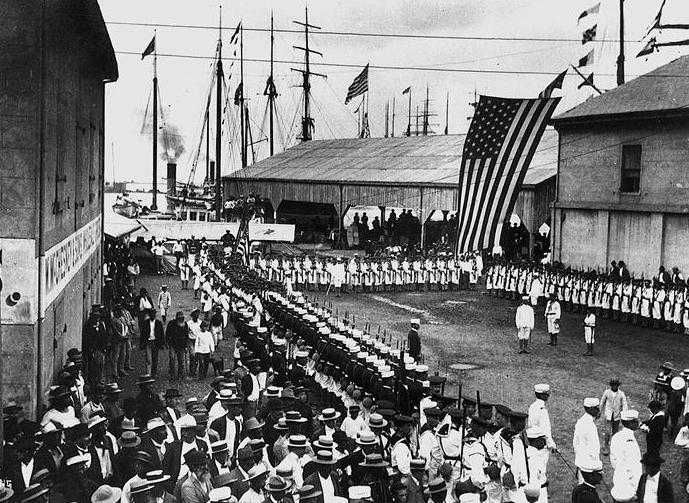
The events of January 1893 were swift and decisive. Backed by the presence of United States Marines who landed to “protect American lives and property,” a Committee of Safety—composed primarily of American and European businessmen—orchestrated a coup d’état. Queen Liliuokalani, hoping to avoid bloodshed, yielded her authority under protest, stating that she surrendered to the superior force of the United States of America until such time as the facts could be presented to the American government.
The Failed Treaty and the Republic of Hawaii
Initially, the administration of President Grover Cleveland refused to annex the islands, believing that the overthrow had been illegal and immoral. Frustrated by the lack of immediate annexation, the coup leaders declared the creation of the Republic of Hawaii in 1894, with Sanford B. Dole serving as its president. For the next several years, the islands existed as an independent republic, though its leadership remained firmly committed to eventual incorporation into the American union.

The Spanish-American War as a Strategic Pivot
The geopolitical climate changed dramatically with the outbreak of the Spanish-American War in 1898. The need for a mid-Pacific coaling station to support American naval operations in the Philippines suddenly made Hawaii strategically indispensable. The rhetoric shifted from moral considerations to national security, and the tide turned in favor of those who had long advocated for the formal takeover of the islands.
The Newlands Resolution and Official Annexation
In July 1898, the United States Congress passed the Newlands Resolution, a joint resolution that bypassed the constitutional requirement for a two-thirds majority treaty in the Senate. This legislative maneuver effectively annexed Hawaii, making it a territory of the United States. While the United States officially accepted the islands, the local population was never given the opportunity to vote on whether they wished to become part of the American republic.
The Transition to an American Territory
With the official change in status in 1900, the Territory of Hawaii was established. Governance became centered on American federal law, and the transition fundamentally altered the legal, educational, and social structures of the islands. English became the primary language of instruction in schools, and the islands were integrated into the broader American economic sphere, which further entrenched the dominance of the sugar and pineapple industries.
The Lasting Impact on Local Identity
The legacy of this period is still deeply felt today. The loss of sovereignty remains a profound part of the Hawaiian cultural consciousness. Visitors traveling to sites like the Bishop Museum or walking the streets of Downtown Honolulu encounter a complex interplay between the modern, American-influenced landscape and the enduring traditions of the native people. Understanding this history is essential for anyone wishing to engage with the islands beyond a superficial level, as it provides the necessary context for the ongoing cultural renaissance and the efforts to preserve Hawaiian culture.
Preservation and Historical Memory in Modern Hawaii
Today, the sites associated with these pivotal years serve as important educational centers and reminders of the fragility of national identity. The preservation of historical landmarks is not merely about maintaining architecture; it is about keeping the memory of the kingdom alive for future generations.
Historical Sites as Living Museums
The Pearl Harbor National Memorial reminds us of the later strategic importance of the islands, while the preservation of royal residences serves as a testament to the sophistication and diplomacy of the Hawaiian monarchy. For travelers, exploring these landmarks provides a unique perspective on the historical trajectory of the Pacific Ocean region.

A Reflective Approach to Travel
As tourism continues to be the bedrock of the Hawaiian economy, the emphasis has shifted toward a more reflective and respectful approach to the islands. Visitors are encouraged to learn about the history of the land before arriving, recognizing that the beauty of Waikiki or the majesty of the Big Island exists alongside a history that is both triumphant and tragic. By acknowledging the circumstances under which the United States took over Hawaii, travelers can better appreciate the resilience of the local community and the vibrant, unique culture that thrives there today despite the political shifts of the past. The history of Hawaii is not a closed book; it is a living, breathing component of the islands’ present, informing everything from local culinary practices to the preservation of sacred natural spaces throughout the Hawaiian Islands.
LifeOutOfTheBox is a participant in the Amazon Services LLC Associates Program, an affiliate advertising program designed to provide a means for sites to earn advertising fees by advertising and linking to Amazon.com. Amazon, the Amazon logo, AmazonSupply, and the AmazonSupply logo are trademarks of Amazon.com, Inc. or its affiliates. As an Amazon Associate we earn affiliate commissions from qualifying purchases.