
The question “When did the Us Annex Hawaii?” delves into a pivotal moment in both American and Hawaiian history, marking a significant shift in geopolitical power and forever altering the destiny of the Pacific island nation. While often simplified to a single date, the annexation was the culmination of decades of increasing foreign influence, political machinations, and strategic interests. The formal act that solidified Hawaii’s place within the United States occurred on July 7, 1898, when President William McKinley signed the Newlands Resolution. However, to truly understand this event, one must trace the intricate historical threads that led to that moment, from the arrival of European explorers to the overthrow of a sovereign monarchy.
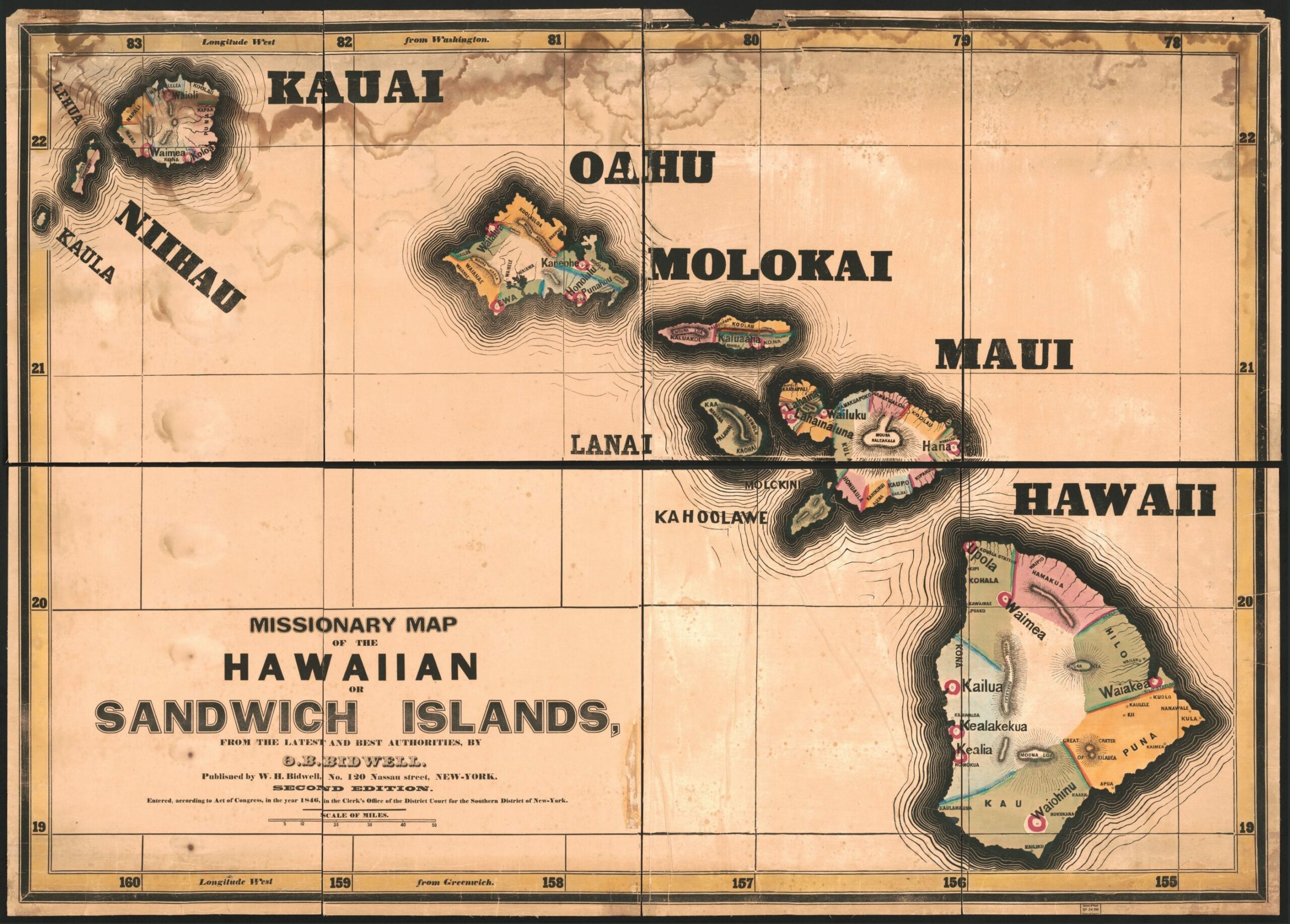
The story of Hawaii’s annexation is not merely a historical footnote; it’s a narrative rich with cultural significance, political intrigue, and economic ambition that continues to shape the islands today. For travelers and history enthusiasts, understanding this past enriches the experience of visiting this breathtaking archipelago, offering deeper insights into its unique identity, vibrant culture, and stunning landmarks. From the bustling streets of Honolulu to the serene beaches of Maui, the echoes of this history resonate, inviting exploration and reflection.
A Brief History of the Hawaiian Kingdom
Long before the United States cast its gaze upon Hawaii, the islands thrived as an independent, self-governing nation with a rich cultural heritage. Its story begins centuries ago, with the intrepid journeys of Polynesian navigators.
Early Polynesian Settlers and European Contact
The first inhabitants of Hawaii were Polynesians, who journeyed from other Pacific islands, likely the Marquesas Islands and Tahiti, between 300 and 800 AD. They brought with them a sophisticated understanding of navigation, agriculture, and social organization, establishing a complex society characterized by a hierarchical class system, a rich spiritual tradition (kapu), and a deep connection to the ‘aina (land). For over a thousand years, these isolated islands flourished, developing unique traditions, language, and governance.
The first documented European contact occurred in 1778, when British explorer Captain James Cook stumbled upon the archipelago, naming them the “Sandwich Islands” after his patron, the Earl of Sandwich. His arrival marked a turning point, opening Hawaii to the outside world and initiating a period of rapid change. While bringing new goods and technologies, European contact also introduced diseases to which the native population had no immunity, leading to a devastating decline in numbers.
The Rise of the Monarchy and Foreign Influence
In the wake of European arrival, one powerful chieftain, Kamehameha I, utilizing European weapons and advisors, began a campaign to unify the islands. By 1810, he had successfully conquered or negotiated the submission of all the main islands, establishing the Kingdom of Hawaii. This centralized monarchy brought a period of stability and relative peace, laying the groundwork for a recognized sovereign state on the world stage.
Throughout the 19th century, Hawaii became a strategic port for whaling ships, traders, and missionaries from the United States and Europe. American Protestant missionaries, who began arriving in 1820, exerted significant influence, converting many Hawaiians to Christianity and transforming the educational and social landscape. Simultaneously, American businessmen, particularly those involved in the lucrative sugar industry, began to acquire vast tracts of land, creating large plantations and developing a powerful economic and political presence on the islands. The Hawaiian monarchs, while striving to maintain independence, found themselves increasingly caught between the competing interests of various foreign powers, including Great Britain, France, and the United States.
The Road to Annexation: Political Unrest and US Interests
The path to annexation was paved with escalating political tensions, driven largely by the growing economic power of American planters and their desire for political control and free access to US markets.
American Missionaries and Sugar Plantations
The descendants of early American missionaries and businessmen formed a powerful oligarchy, often referred to as the “Big Five” companies, which dominated Hawaii’s economy. Sugar, in particular, became the driving force, with plantations requiring large labor forces, often imported from Asia. These planters sought closer ties with the United States, primarily to gain tariff-free access for their sugar to the booming American market. The 1875 Reciprocity Treaty granted this, but in return, the United States gained exclusive rights to use Pearl Harbor as a naval base, signaling a growing military interest in the islands.
As their economic power grew, so did their political ambitions. They sought to limit the power of the Hawaiian monarchy and increase their own influence in the government. This clash between the native Hawaiian desire for self-determination and the foreign residents’ pursuit of economic and political advantage created an increasingly volatile environment.
The Overthrow of the Monarchy
The internal struggle reached a critical point in 1887 with the infamous “Bayonet Constitution.” Forced upon King Kalakaua by a group of armed, non-native businessmen and citizens (the Hawaiian League), this document severely curtailed the monarch’s power and disenfranchised most native Hawaiians by imposing property and income qualifications for voting. This was a clear demonstration of the growing dominance of the foreign-born elite.
Upon Kalakaua’s death in 1891, his sister, the beloved Queen Liliuokalani, ascended to the throne. She immediately recognized the injustices of the Bayonet Constitution and vowed to restore power to the monarchy and the Hawaiian people by promulgating a new constitution. This attempt to reassert native Hawaiian sovereignty was met with fierce opposition from the Annexation Club, composed primarily of American and European businessmen.
On January 17, 1893, fearing the loss of their political and economic control, these conspirators, led by Sanford B. Dole, staged a coup d’état. With the support of heavily armed US Marines from the USS Boston, who landed in Honolulu under the guise of protecting American lives and property, the monarchy was overthrown. Queen Liliuokalani, to avoid bloodshed, yielded her authority under protest, appealing to the United States for justice. This event remains a deeply contentious and painful chapter in Hawaiian history. Today, the elegant Iolani Palace in Honolulu, the former official residence of the Hawaiian monarchs, stands as a poignant reminder of this lost sovereignty and is a must-visit landmark for those seeking to understand the islands’ royal past.
The Republic of Hawaii
Following the overthrow, the conspirators immediately established a provisional government, declaring their intent to seek annexation by the United States. However, President Grover Cleveland, a staunch anti-imperialist, was appalled by the illegal nature of the coup. After an investigation revealed the complicity of US diplomatic and military personnel, Cleveland refused to annex Hawaii and called for the restoration of the monarchy.
Despite Cleveland’s opposition, the provisional government, under the leadership of Sanford B. Dole, refused to relinquish power. Instead, on July 4, 1894, they declared the establishment of the Republic of Hawaii, with Dole as its first and only president. This self-proclaimed republic, largely controlled by the same American and European business interests, continued to lobby vigorously for annexation, waiting for a more receptive administration in Washington D.C.
The Official Act of Annexation

The window of opportunity for annexation finally opened with a shift in US political leadership and the onset of international conflict.
The Spanish-American War and Strategic Importance
The election of William McKinley as President in 1896 marked a turning point. McKinley was a proponent of American expansionism and held a more favorable view of acquiring Hawaii. The decisive catalyst, however, was the Spanish-American War in 1898. As the United States waged war against Spain in the Caribbean and the Pacific (Philippines), the strategic value of Hawaii became acutely apparent. The islands served as a crucial coaling station and naval base, vital for projecting American power across the vast Pacific Ocean and supporting naval operations. The desire for a convenient mid-Pacific outpost greatly intensified calls for annexation.
The Newlands Resolution
Given the controversy surrounding the overthrow of the monarchy and the difficulty of securing a two-thirds majority vote in the Senate for a treaty of annexation (which would require a vote by a sovereign nation), proponents found an alternative route. They pursued a joint resolution of Congress, which only required a simple majority in both the House of Representatives and the Senate.
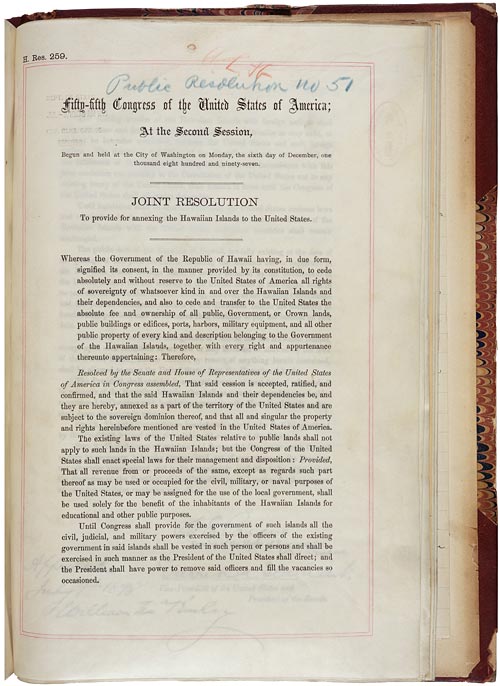
This legislative maneuver culminated in the passage of the Newlands Resolution, named after Nevada Congressman Francis G. Newlands. The resolution officially provided for the annexation of Hawaii to the United States. It was passed by the House on June 15, 1898, and by the Senate on July 6, 1898.
On July 7, 1898, President William McKinley signed the Newlands Resolution into law, officially annexing Hawaii as a territory of the United States. The formal transfer of sovereignty took place on August 12, 1898, during a ceremony at Iolani Palace in Honolulu, where the Hawaiian flag was lowered and the American flag was raised. Although met with protests from native Hawaiians and their supporters, the annexation was complete.
Hawaii’s Transformation: A US Territory and State
Following annexation, Hawaii underwent significant changes, integrating more deeply into the American political and economic system.
Economic Growth and Military Presence
As a US territory, Hawaii saw accelerated economic growth, primarily fueled by the continued expansion of the sugar and pineapple industries, which now benefited from full integration into the American market. Large corporations flourished, consolidating control over vast agricultural lands. The territory also became a crucial military outpost. The strategic importance highlighted during the Spanish-American War led to the significant expansion of military facilities, most notably at Pearl Harbor on Oahu, which became the headquarters of the US Pacific Fleet. This military presence would play a critical role in World War II, particularly with the attack on Pearl Harbor on December 7, 1941, an event that directly propelled the United States into the global conflict. Today, visitors can pay their respects at the USS Arizona Memorial and the Pearl Harbor National Memorial, powerful landmarks that recount this pivotal moment.
Statehood and Modern Hawaii
For decades, native Hawaiians and their allies continued to advocate for the restoration of sovereignty or greater self-determination. However, the momentum for full integration into the United States grew. After years of petitions and debates, and a plebiscite vote in 1959 where a large majority of Hawaiian residents voted for statehood, Hawaii officially became the 50th state of the United States on August 21, 1959. This marked the final political step in the island’s journey from an independent kingdom to an integral part of the American union.
Modern Hawaii is a vibrant blend of its indigenous Polynesian roots, the influences of Asian immigrant cultures, and its American identity. While grappling with the complexities of its history, including ongoing discussions about sovereignty and land rights, Hawaii has also become a global icon of natural beauty, cultural diversity, and unparalleled hospitality.
Experiencing Hawaii Today: A Legacy of Culture and Beauty
Understanding Hawaii’s journey from an independent kingdom to a US state profoundly enhances the travel experience. The islands are not just about stunning beaches and luxurious resorts; they are living museums of history, culture, and resilience.
Iconic Landmarks and Attractions
The rich history of Hawaii is etched into its diverse landscape and historic sites. A visit to Oahu isn’t complete without exploring Iolani Palace, the only official residence of royalty in the United States, where the story of Queen Liliuokalani’s final days as monarch unfolds. Nearby, the Pearl Harbor National Memorial offers a sobering look into World War II history and the strategic importance of Hawaii to the US. Beyond history, natural wonders like Diamond Head Crater, offering panoramic views of Waikiki Beach and Honolulu, or the lush Hanauma Bay for snorkeling, provide endless opportunities for adventure.
On Maui, the scenic drive along the Road to Hana reveals breathtaking waterfalls and black sand beaches, while sunrise at Haleakala National Park is an unforgettable experience. The Big Island (also known as Hawaii Island) is home to Volcanoes National Park, where visitors can witness active geological processes shaping the youngest land on Earth. Each island offers a unique array of attractions that reflect its individual character and historical significance.
Luxurious Accommodations and Authentic Experiences
For those planning a trip, Hawaii offers a spectrum of accommodations, from world-class luxury resorts to charming boutique hotels and cozy vacation rentals, catering to every travel style and budget. On Oahu, iconic properties like The Royal Hawaiian, often called the “Pink Palace of the Pacific,” on Waikiki Beach, or the historic Moana Surfrider, provide a blend of historical charm and modern amenities. On Maui, resorts in Wailea such as the Four Seasons Resort Maui at Wailea offer unparalleled luxury and beachfront access, while Kauai boasts family-friendly options like the Grand Hyatt Kauai Resort & Spa.
Beyond conventional tourism, Hawaii provides rich opportunities for immersive cultural experiences. Engaging with local traditions, learning about the practice of hula, participating in a traditional luau, or visiting the Polynesian Cultural Center on Oahu allows visitors to connect with the living legacy of the islands. Sampling local cuisine, from fresh poke to laulau, offers a taste of the diverse influences that have shaped Hawaiian food culture.
Planning Your Hawaiian Getaway
Whether you’re interested in tracing the footsteps of royalty, delving into World War II history, or simply basking in the natural splendor, Hawaii offers a unique and profound experience. When planning your trip, consider the historical context of each destination, which adds layers of meaning to every landmark and cultural interaction.
From booking your ideal accommodation—be it a lavish suite, a family-friendly villa, or a secluded apartment—to exploring unique local attractions and immersing yourself in the rich Hawaiian lifestyle, understanding the islands’ past, including the story of its annexation, enriches every aspect of your journey. Hawaii is more than just a tropical paradise; it’s a destination with a compelling story waiting to be discovered, inviting visitors to appreciate its beauty, respect its history, and celebrate its enduring spirit.
LifeOutOfTheBox is a participant in the Amazon Services LLC Associates Program, an affiliate advertising program designed to provide a means for sites to earn advertising fees by advertising and linking to Amazon.com. Amazon, the Amazon logo, AmazonSupply, and the AmazonSupply logo are trademarks of Amazon.com, Inc. or its affiliates. As an Amazon Associate we earn affiliate commissions from qualifying purchases.