
The question of when Hawaii was annexed by the United States marks a pivotal moment in the history of both entities, transforming the sovereign Kingdom of Hawaii into an American territory. This historic event formally occurred on August 12, 1898, when the United States Congress passed the Newlands Resolution, effectively absorbing the islands. However, this seemingly straightforward date belies a complex, often tumultuous, narrative of colonial ambitions, economic interests, and a proud Polynesian monarchy’s struggle for survival. Understanding the annexation is crucial not only for grasping the historical trajectory of Hawaii but also for appreciating its unique cultural tapestry and enduring appeal as a world-class travel destination. From its lush landscapes to its vibrant traditions, Hawaii today is a living testament to this rich and intricate past, where ancient customs blend with modern influences, offering visitors an unparalleled experience.

The Road to Annexation: A Kingdom’s Transformation
The path to annexation was neither sudden nor simple; it was a gradual process spanning decades, driven by external influences and internal pressures that ultimately eroded the sovereignty of the Hawaiian Kingdom. This period saw the arrival of foreign powers, the rise of powerful economic interests, and a deliberate campaign to destabilize the native monarchy, setting the stage for the dramatic events of the late 19th century.
Early Encounters and Western Influence
Before the late 18th century, Hawaii was a collection of independent chiefdoms, rich in unique Polynesian culture and traditions. The arrival of Captain James Cook in 1778 marked the islands’ introduction to the Western world, irrevocably altering their future. Initially, these interactions were largely economic, focused on trade. However, by the early 19th century, Protestant missionaries from the United States began arriving, seeking to convert the native population. These missionaries, while introducing literacy and Western education, also brought profound cultural and social changes, often undermining traditional Hawaiian beliefs and practices.
During this time, the shrewd leadership of King Kamehameha I successfully unified the islands under a single monarchy by 1810, establishing the Kingdom of Hawaii. For decades, his successors navigated a complex geopolitical landscape, balancing the interests of various foreign powers, including Britain, France, and the United States. Despite their efforts, Western influence steadily grew, bringing with it new legal systems, land ownership concepts, and an increasingly Westernized economy. The seeds of foreign control were subtly sown, as the monarchy gradually lost ground to external pressures and the ambitions of powerful expatriates.
The Rise of Sugar and Foreign Power
The mid-19th century saw the emergence of the sugar industry as the dominant economic force in Hawaii. American and European businessmen, often descendants of early missionaries, established large sugar plantations across islands like Oahu, Maui, and the Big Island. These “sugar barons” accumulated vast wealth and, with it, immense political power. Their economic interests increasingly aligned with annexation by the United States, which would eliminate tariffs on sugar exports and provide political stability for their enterprises.
A crucial step in this economic entanglement was the Reciprocity Treaty of 1875, which allowed Hawaiian sugar to enter the United States duty-free, in exchange for special economic privileges for the U.S. and, critically, the granting of exclusive rights to the United States to use Pearl Harbor as a naval base. This treaty cemented Hawaii’s economic reliance on the United States and further solidified American strategic interests in the Pacific Ocean. As the power of foreign businessmen grew, they actively sought to curb the authority of the Hawaiian monarchs, viewing the native rule as an impediment to their commercial and political ambitions.
Overthrow of the Monarchy
The culmination of these pressures came in 1887 with the infamous Bayonet Constitution. Forced upon King David Kalakaua by armed militia, largely composed of American and European residents, this constitution drastically limited the monarch’s power and disenfranchised most native Hawaiians, consolidating political control in the hands of wealthy landowners and businessmen. It was a clear precursor to the eventual overthrow.
The final act of the monarchy’s downfall unfolded in 1893. Queen Liliʻuokalani, a strong proponent of Hawaiian sovereignty, sought to promulgate a new constitution that would restore power to the monarchy and the native people. In response, a group of foreign residents, primarily American and European businessmen known as the Committee of Safety, orchestrated a coup. With the support of the United States Marines, who landed in Honolulu under the guise of protecting American lives and property, the monarchy was overthrown on January 17, 1893. Queen Liliʻuokalani surrendered under protest to avoid bloodshed, appealing to the United States government for restoration. A provisional government was established, which soon declared itself the Republic of Hawaii in 1894, with Sanford B. Dole as its president. This republic was explicitly formed with the intention of securing annexation by the United States.
The Annexation Debate and Formal Integration
Despite the desires of the new Republic of Hawaii and powerful pro-annexationist forces within the United States, the path to formal integration was not immediate or without significant opposition. The debate over Hawaii’s future reflected deep divisions within American society regarding expansionism and imperial power.
The Fight for Annexation in Washington
Following the overthrow, the Provisional Government of Hawaii immediately sought annexation by the United States. However, this move faced considerable resistance. President Grover Cleveland, who took office shortly after the coup, was a staunch anti-imperialist. After investigating the overthrow, he concluded that it had been an illegal act, largely orchestrated by American citizens with the unauthorized assistance of the United States Marines. President Cleveland refused to annex Hawaii and even attempted to restore Queen Liliʻuokalani to her throne, though this effort ultimately failed due to the refusal of the Republic of Hawaii to yield power.
The issue of annexation remained a contentious political football in Washington D.C. throughout the mid-1890s. Proponents argued for strategic military advantages in the Pacific Ocean and economic benefits, while opponents raised concerns about the morality of annexing a foreign nation against the will of its native people and the implications for American democracy. The debate raged in newspapers and in the halls of Congress, reflecting a broader national discussion about America’s role on the global stage.
The Newlands Resolution: A Congressional Act
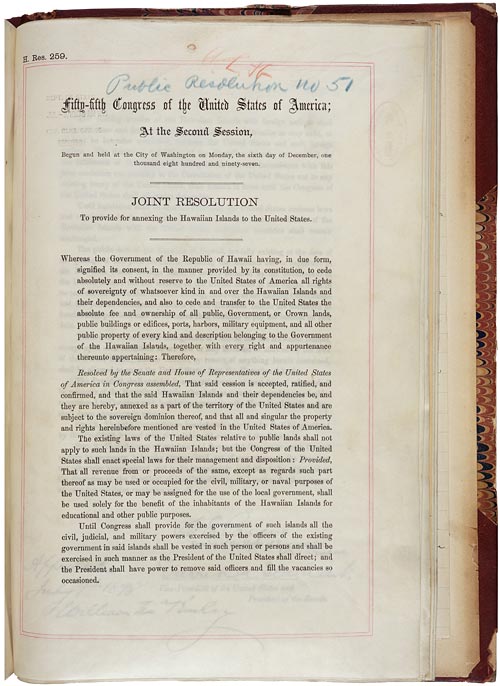
The political tide turned dramatically with the election of President William McKinley in 1896, a fervent expansionist. The advent of the Spanish-American War in April 1898 provided the decisive catalyst for annexation. During the war, Hawaii’s strategic importance as a coaling station and naval base for American operations in the Pacific Ocean (particularly en route to the Philippines) became undeniable. Public and congressional support for annexation surged, framed as a military necessity.
Given the difficulty of securing a two-thirds majority in the Senate for a formal treaty of annexation, proponents opted for a joint resolution of Congress, which required only a simple majority in both houses. On July 6, 1898, the United States Congress passed the Newlands Resolution. President McKinley signed it into law on July 7, 1898. The formal transfer of sovereignty took place on August 12, 1898, at Iolani Palace in Honolulu, where the Hawaiian flag was lowered and the American flag was raised. This date unequivocally answers the question: Hawaii was officially annexed by the United States on August 12, 1898.
From Territory to Statehood
Following annexation, Hawaii became an organized incorporated territory of the United States in 1900, with its citizens granted full U.S. citizenship. For the next six decades, Hawaii developed as a strategic military outpost, especially after the attack on Pearl Harbor during World War II, which underscored its vital role in national defense. Economically, the sugar and pineapple industries continued to thrive, bringing in a diverse immigrant workforce from Asia and other parts of the world, further enriching the islands’ cultural mosaic.
The drive for statehood gained momentum after World War II, fueled by a growing sense of identity among residents and a desire for full political representation. After years of advocacy and debate, Hawaii finally achieved statehood on August 21, 1959, becoming the 50th state of the United States. This final integration marked the completion of a long and complex journey, from an independent Polynesian kingdom to an American territory, and finally, a full-fledged member of the union.
Hawaii Today: A Legacy of History and Tourism
The annexation and subsequent statehood have profoundly shaped modern Hawaii, creating a destination that is simultaneously American and distinctly Hawaiian. Its history is not merely a footnote but an integral part of its identity, influencing its culture, landscape, and the experiences it offers to millions of visitors each year.
Cultural Resilience and Modern Hawaii
Despite the immense pressures of Westernization and integration into the United States, Hawaiian culture has demonstrated remarkable resilience. The native language, hula, music, and spiritual practices (like Aloha Aina, love of the land) continue to be celebrated and revived. Organizations and individuals actively work to preserve and promote Hawaiian traditions, ensuring that the legacy of the Kingdom of Hawaii endures. This cultural depth adds an enriching layer to any visit, allowing travelers to connect with a living heritage that predates European contact.
Modern Hawaii is a vibrant melting pot, a beautiful blend of Polynesian, Asian, American, and European influences, evident in its cuisine, festivals, and everyday life. The people of Hawaii embrace their diverse heritage, creating a welcoming and inclusive atmosphere. This unique blend contributes to Hawaii’s reputation not just as a beautiful escape, but as a place of rich human connection and cultural discovery.
Major Attractions and Experiences
Hawaii’s history is woven into the very fabric of its most famous landmarks and attractions, offering visitors a chance to engage with its past directly. In Honolulu, Oahu, the stunning Iolani Palace stands as the only official residence of royalty in the United States, a poignant reminder of the sovereign Hawaiian Kingdom and the site of the monarchy’s overthrow. Nearby, the USS Arizona Memorial at Pearl Harbor serves as a solemn tribute to the devastating events of World War II, a stark reminder of Hawaii’s strategic importance as a U.S. territory.
Beyond the historical sites, Hawaii’s natural beauty is legendary. Visitors flock to the iconic Waikiki Beach with its backdrop of Diamond Head on Oahu, explore the active volcanoes of Volcanoes National Park on the Big Island, witness breathtaking sunrises from the summit of Haleakala on Maui, or marvel at the dramatic Na Pali Coast on Kauai. The Polynesian Cultural Center on Oahu offers an immersive journey into the heritage of various Pacific island cultures, including Hawaii, providing entertainment and educational experiences that underscore the islands’ deep roots. Each island offers a unique landscape and cultural experience, all connected by a shared history that informs the present.
Planning Your Hawaiian Getaway
For travelers considering a trip to Hawaii, understanding its history enriches the experience immeasurably. When planning your accommodation, consider the type of experience you seek: bustling resorts along Waikiki Beach for vibrant nightlife and easy access to attractions, or secluded villas on Maui for tranquil relaxation. Hawaii caters to all lifestyles, from luxury travel to budget-friendly adventures, family trips, and romantic getaways.
Engaging with local culture, tasting authentic Hawaiian food, and respecting the environment are key aspects of responsible tourism. Many local guides offer tours that delve deeper into the historical and cultural significance of various sites, providing insights that go beyond surface-level beauty. Whether you’re hiking a volcano, learning to surf, or simply enjoying a sunset over the Pacific Ocean, remember that you are treading on land with a profound and compelling story—a story that continues to evolve, shaping the spirit of Aloha for generations to come.
In conclusion, the annexation of Hawaii by the United States on August 12, 1898, was the culmination of decades of foreign entanglement, economic ambition, and a poignant struggle for sovereignty. This critical historical event transformed a proud island kingdom into an American territory, eventually leading to its statehood. Today, Hawaii stands as a vibrant testament to this complex past, offering visitors not just breathtaking natural beauty and luxurious accommodations, but also a rich cultural tapestry woven from its Polynesian roots, monarchical legacy, and American integration. Understanding this history deepens appreciation for Hawaii’s unique place in the world and its enduring allure as a dream destination for travelers seeking both relaxation and profound cultural engagement.
LifeOutOfTheBox is a participant in the Amazon Services LLC Associates Program, an affiliate advertising program designed to provide a means for sites to earn advertising fees by advertising and linking to Amazon.com. Amazon, the Amazon logo, AmazonSupply, and the AmazonSupply logo are trademarks of Amazon.com, Inc. or its affiliates. As an Amazon Associate we earn affiliate commissions from qualifying purchases.