
The landmark Supreme Court[1] decision of Miranda v. Arizona fundamentally reshaped the landscape of criminal justice in the United States. While its implications are deeply felt within the legal system, understanding the timing of this pivotal moment offers a crucial perspective on its historical context and the evolution of constitutional rights. This case, decided on June 13, 1966, addressed the Fifth Amendment’s protection against self-incrimination, ensuring that individuals in police custody are aware of their rights before interrogation. The question of “when” Miranda v. Arizona occurred is not merely a date to be memorized but a gateway to understanding a profound shift in how law enforcement interacts with citizens.
The roots of the decision trace back to a series of legal challenges concerning the admissibility of confessions obtained during custodial interrogations. Prior to Miranda v. Arizona, the standards for admitting confessions were less stringent, often leading to convictions based on statements made without full knowledge of legal protections. The Court’s ruling in 1966 aimed to rectify this by establishing clear procedural safeguards. This was a period of significant social and legal change in the United States, with the Civil Rights Movement[1] gaining momentum and a growing emphasis on individual liberties. The timing of the Miranda v. Arizona decision, therefore, can be seen as both a response to existing legal ambiguities and a product of the era’s broader discourse on justice and fairness.
The Road to the Supreme Court
The journey of the Miranda v. Arizona case to the Supreme Court involved several preceding legal battles that laid the groundwork for the eventual ruling. These cases highlighted the potential for coerced confessions and the need for greater clarity in police procedures. The Court’s increasing attention to the rights of the accused during the mid-20th century was a significant factor in the eventual landmark decision.
The Cases Consolidated
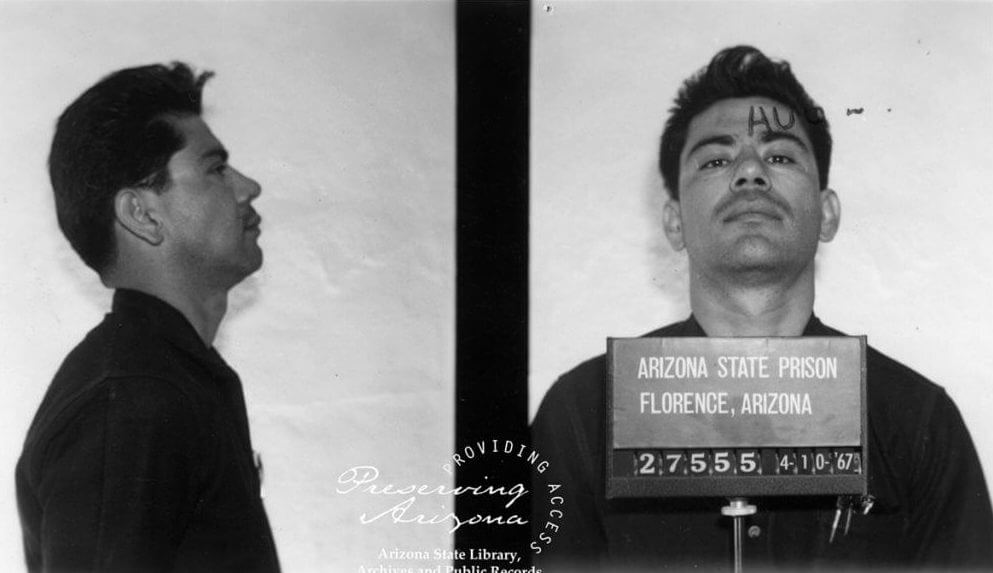
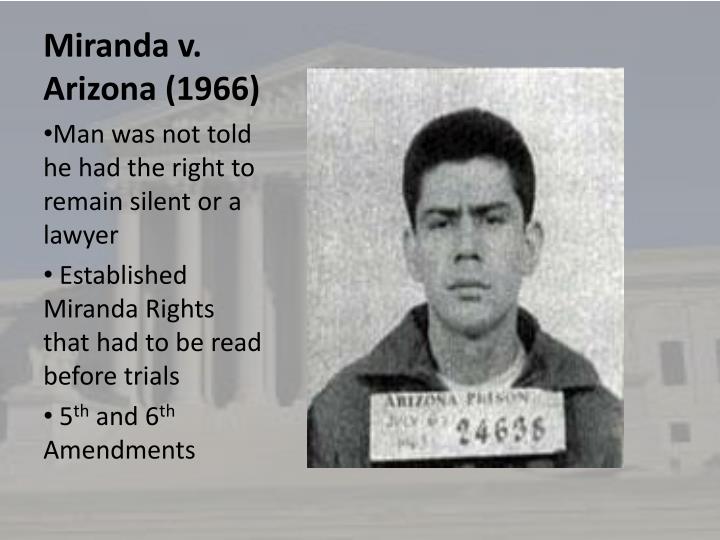
Miranda v. Arizona was not a singular event but rather a consolidation of four separate cases, each raising similar questions about the Fifth Amendment rights during interrogation. The most prominent among these was the case of Ernesto Miranda, whose confession to kidnapping and rape was obtained without him being informed of his right to remain silent or his right to counsel. The other cases involved similar circumstances where defendants’ confessions were challenged on the grounds that they were involuntary or obtained without adequate legal counsel.
The consolidation of these cases allowed the Supreme Court to address the issue of custodial interrogations comprehensively. By examining the specific facts and legal arguments of each case, the justices could formulate a ruling that would have broad applicability across the United States. This strategic approach by the Court ensured that the decision would have a lasting and far-reaching impact on law enforcement practices nationwide.
Precedent and Legal Evolution
Prior to the 1966 decision, legal precedent regarding confessions was somewhat fragmented. While the Fifth Amendment protected against self-incrimination, its application during police interrogations was not always consistently enforced. Cases like Gideon v. Wainwright (1963), which guaranteed the right to counsel for indigent defendants in felony cases, signaled a broader trend towards strengthening the rights of the accused. Miranda v. Arizona built upon this evolving legal landscape, extending these protections into the critical phase of police interrogation.
The Court recognized that the inherently coercive nature of custodial interrogation could easily lead to involuntary confessions. Therefore, the decision established specific warnings that law enforcement officers must provide to individuals in custody before questioning them. These warnings, now famously known as the “Miranda rights,” include the right to remain silent, the right to an attorney, and the warning that anything said can and will be used against them in a court of law.
The Significance of the 1966 Decision
The year 1966 marked a turning point in American jurisprudence. The Supreme Court’s decision in Miranda v. Arizona was not just a legal ruling; it was a societal affirmation of the importance of individual liberties in the face of state power. The immediate and long-term consequences of this decision continue to shape criminal investigations and trials.

The Birth of the “Miranda Rights”
The most tangible outcome of the Miranda v. Arizona decision was the creation of the now-ubiquitous “Miranda warnings.” These warnings are designed to ensure that suspects understand their constitutional protections before they are subjected to potentially coercive interrogation tactics. The core of these warnings is: “You have the right to remain silent. Anything you say can and will be used against you in a court of law. You have the right to an attorney. If you cannot afford an attorney, one will be appointed for you.”
The requirement that these warnings be read to suspects in custody before interrogation became a mandatory practice for law enforcement agencies across the United States. The purpose was to level the playing field, ensuring that individuals, particularly those unfamiliar with the legal system, were not at a disadvantage when confronting police questioning. This shift fundamentally altered the dynamics of police interrogations, making them more transparent and rights-conscious.
Impact on Law Enforcement and the Courts
The impact of Miranda v. Arizona on law enforcement and the court system was profound. Police departments had to adapt their training and interrogation procedures to incorporate the new warnings. The admissibility of confessions in court became contingent on officers properly informing suspects of their rights. If a confession was obtained in violation of the Miranda requirements, it could be suppressed, meaning it could not be used as evidence against the defendant.
This had a significant effect on prosecutorial strategies. Prosecutors could no longer rely on confessions obtained without proper warnings. Instead, they had to ensure that law enforcement followed the established procedures, leading to a greater emphasis on independent evidence gathering. For the courts, the Miranda ruling introduced a new standard for evaluating the legality of confessions, leading to numerous legal challenges and interpretations over the years. The timing of the decision, in 1966, placed it within a broader era of legal reform that sought to protect individual rights more robustly.
The Enduring Legacy of Miranda V. Arizona
Decades after its pronouncement in 1966, the principles established in Miranda v. Arizona remain a cornerstone of criminal justice in the United States. The decision has been revisited and refined by subsequent Supreme Court rulings, but its core tenets continue to guide interactions between law enforcement and citizens. The timing of its enactment is intrinsically linked to the broader movement towards safeguarding civil liberties that characterized the mid-20th century.
The Miranda Warnings in Practice Today
The “Miranda rights” are now a familiar concept, recognized not only by legal professionals but by the general public. They are often portrayed in popular culture, from television shows to movies, highlighting their pervasive influence. Law enforcement officers are trained to administer these warnings as a routine part of any custodial interrogation. The specific wording and procedures have been clarified through subsequent legal interpretations, ensuring consistent application across different jurisdictions.
The requirement to inform individuals of their right to remain silent and their right to counsel serves as a critical safeguard against potential abuses of power. It empowers individuals to assert their constitutional rights and prevents the use of coerced statements in court. The timing of the Miranda v. Arizona decision, in 1966, cemented its place as a vital component of the American legal system, responding to the prevailing concerns about individual freedoms.
Ongoing Debates and Interpretations
Despite its widespread acceptance, Miranda v. Arizona has also been the subject of ongoing debate and legal interpretation. Some argue that the warnings are too complex for some individuals to understand, while others contend that they hinder effective law enforcement investigations. Subsequent court cases have addressed nuances, such as what constitutes “custodial interrogation” and the precise circumstances under which suspects can waive their Miranda rights.
For example, the Supreme Court’s decision in Dickerson v. United States in 2000 affirmed the constitutionality of the Miranda warnings, rejecting an attempt by Congress to supersede the ruling with a statute. This demonstrated the enduring significance of the 1966 decision. The ongoing discussions and legal challenges surrounding Miranda v. Arizona underscore its importance and its continued relevance in the pursuit of justice and the protection of fundamental rights in the United States. The question of “when” it occurred—June 13, 1966—is thus a pivotal marker in the continuous evolution of American civil liberties.
LifeOutOfTheBox is a participant in the Amazon Services LLC Associates Program, an affiliate advertising program designed to provide a means for sites to earn advertising fees by advertising and linking to Amazon.com. Amazon, the Amazon logo, AmazonSupply, and the AmazonSupply logo are trademarks of Amazon.com, Inc. or its affiliates. As an Amazon Associate we earn affiliate commissions from qualifying purchases.