
The New York Subway, an iconic symbol of New York City‘s relentless energy and a vital artery for millions, stands as one of the world’s most extensive and historically significant rapid transit systems. For anyone exploring the city, whether a first-time tourist or a seasoned resident, understanding its origins is key to appreciating its monumental impact on urban development, lifestyle, and global travel. The question of “When was the New York Subway built?” unveils a fascinating narrative of ingenuity, ambition, and the sheer will to transform an ever-growing metropolis.
While the city saw earlier attempts at underground transit and the proliferation of elevated railways, the modern New York Subway system, as we largely know it today, officially opened its doors to the public on October 27, 1904. This date marked a pivotal moment, ushering in a new era of urban mobility that would redefine New York City’s landscape and its future. The inaugural journey commenced from the historic City Hall station, weaving its way through Manhattan up to 145th Street in Harlem. This initial line, operated by the Interborough Rapid Transit Company (IRT), was just the beginning of a vast network that would eventually connect all five boroughs, excluding Staten Island.
The Seeds of Innovation: Pre-Subway Era and Early Visions
Long before the first official subway train rumbled beneath the streets, New York City grappled with a burgeoning population and increasingly congested streets. The mid-19th century saw horse-drawn omnibuses and streetcars struggling to keep pace, leading visionaries to ponder radical solutions.
The Rise of Elevated Railways
Prior to the underground marvel, the city’s answer to its traffic woes came in the form of elevated railways. Beginning in 1868, these “els” provided a quicker, albeit noisy and often unsightly, means of transport above the bustling streets. Lines stretched through Manhattan, Brooklyn, and The Bronx, connecting residential areas with commercial hubs and providing an early template for rapid transit. While efficient for their time, they were not a sustainable long-term solution, casting shadows, dripping steam, and creating an incessant din that residents soon tired of. Their presence, however, demonstrated the city’s desperate need for mass transit and laid the groundwork for public acceptance of large-scale infrastructure projects.
Alfred Ely Beach’s Pneumatic Dream
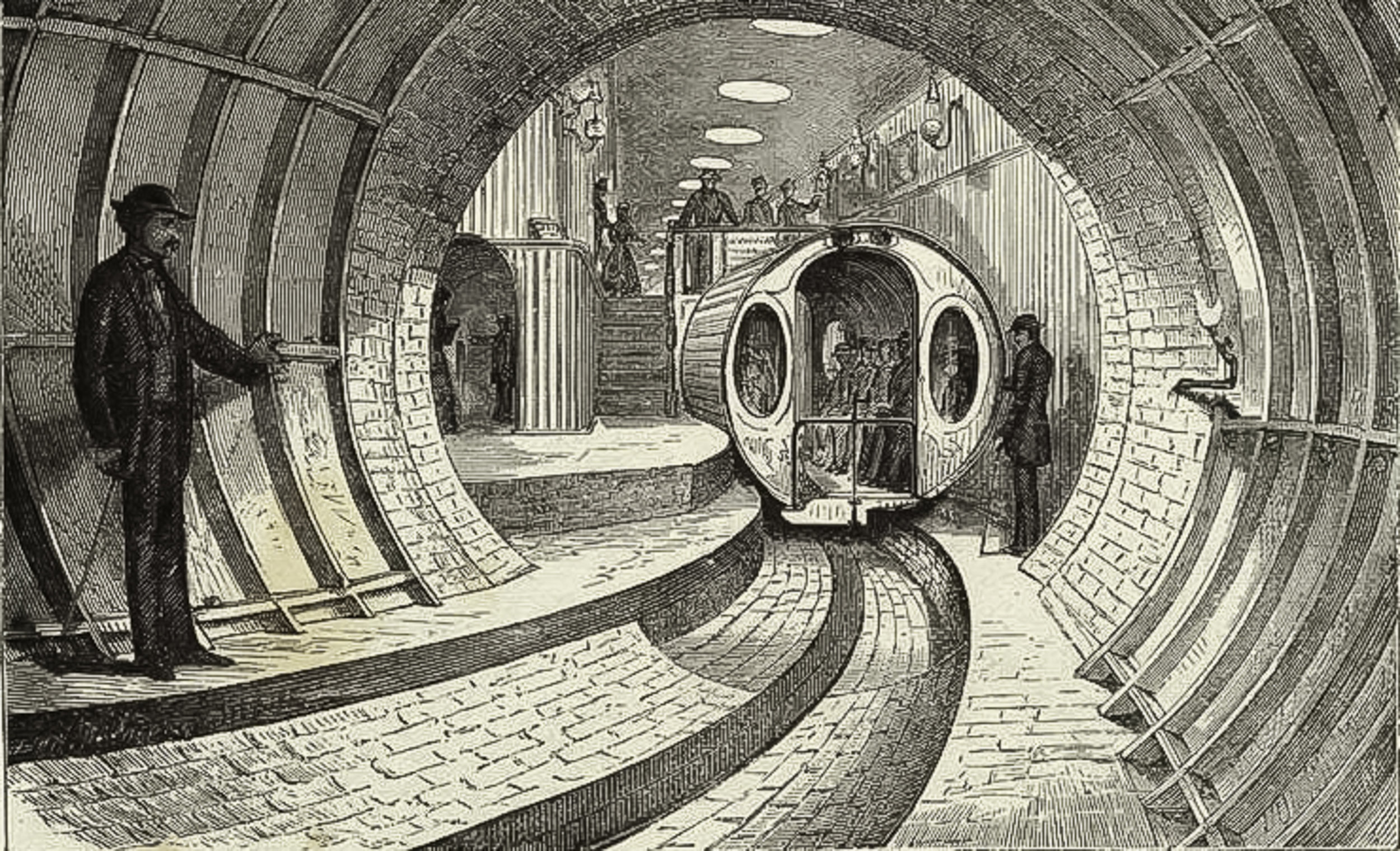
Perhaps the most intriguing precursor to the official subway was the short-lived Beach Pneumatic Transit system. In 1870, inventor Alfred Ely Beach unveiled a revolutionary concept: a single subway tunnel beneath Broadway, utilizing pneumatic pressure to propel a luxurious, circular car. Though only a demonstration line, running for a mere 312 feet between Warren Street and Murray Street, it captivated the public’s imagination. Beach’s elegant station, complete with frescoes, a grand piano, and even a fountain, showcased a vision of clean, quiet, and efficient underground travel. Political opposition and concerns from powerful elevated railway magnates ultimately stifled Beach’s ambitious project, preventing it from expanding. Nevertheless, it proved that underground transit was not only feasible but desirable.
The political and economic climate of the late 19th century was rife with competing interests, from the influential elevated railway companies to various private developers vying for lucrative contracts. It took persistent advocacy and the undeniable pressure of urban growth to finally push the idea of a comprehensive underground system forward.
Breaking Ground: The Birth of the New York Subway System
The official go-ahead for the New York Subway came after years of planning, political wrangling, and public demand. The Rapid Transit Act of 1894 established the Rapid Transit Commission, tasked with designing and overseeing the construction of a publicly owned but privately operated subway system.
Construction Begins: A Feat of Engineering
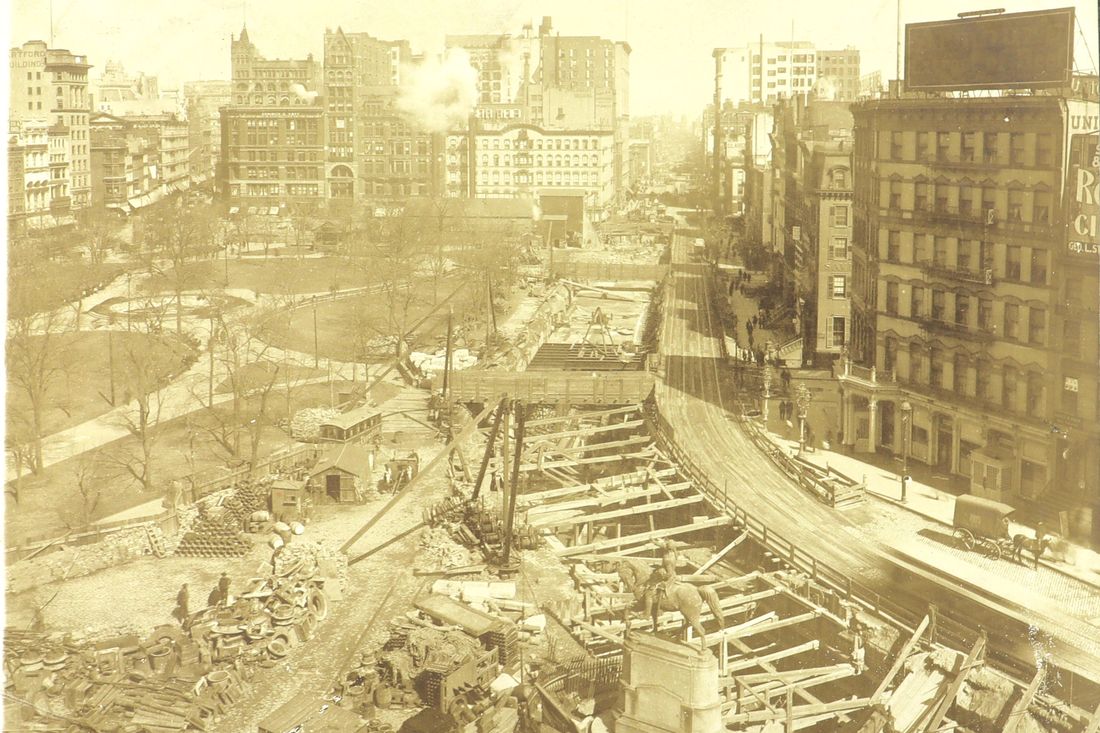
On March 24, 1900, with a ceremonial shovel turned by Mayor Robert A. Van Wyck at the intersection of Park Avenue and Great Jones Street, construction officially began. The primary contract for the ambitious project was awarded to the Interborough Rapid Transit Company (IRT), a consortium led by financier August Belmont Jr. The chief engineer, William Barclay Parsons, played a pivotal role in designing the initial lines and overcoming the immense engineering challenges.
The construction method predominantly used was the “cut-and-cover” technique. This involved digging trenches in the city streets, building a steel framework for the tunnels, and then covering them with concrete and the street surface. While effective, it was a messy and disruptive process, transforming major avenues like Broadway and Lexington Avenue into vast construction sites. Workers encountered everything from utility lines and bedrock to hidden streams and even quicksand. The scale of the undertaking required thousands of laborers, many of them immigrants, working under arduous conditions. Ventilation shafts, subway stations, and complex track layouts were all meticulously planned and executed.

The Grand Opening: October 27, 1904
The day arrived. On October 27, 1904, at 2:35 PM, Mayor George B. McClellan famously took control of the inaugural train from the ornate City Hall station, carrying a crowd of dignitaries and excited citizens. The first passengers paid a nickel to ride the new marvel. The initial line stretched 9.1 miles and included 28 stations, connecting the civic heart of the city with its rapidly expanding northern neighborhoods. The excitement was palpable; people lined the streets, cheering as the trains departed, symbolizing a new era for New York City.
The stations themselves were designed to impress, often featuring intricate tilework, mosaics, and terra cotta decorations, each reflecting the character of its neighborhood. Stations like City Hall and Grand Central Terminal became architectural gems, embodying the “City Beautiful” movement and a sense of civic pride. The opening of the subway dramatically cut travel times, making distant parts of Manhattan accessible and sparking an unprecedented wave of development and population growth in areas that were once considered remote.
Rapid Expansion, Rivalry, and Unification
The success of the initial IRT line quickly spurred further expansion. The city’s appetite for rapid transit seemed insatiable, leading to a period of intense growth and, importantly, competition.
The Duel of the Companies: IRT, BMT, and IND
Within years of the IRT’s debut, another major player emerged: the Brooklyn-Manhattan Transit Corporation (BMT). Formed from the consolidation of various elevated lines and new subway constructions, the BMT focused on expanding routes into Brooklyn and Queens, often developing lines that paralleled or rivaled the IRT. This competition meant different fare structures, incompatible train car sizes, and often confusing transfers for passengers.
By the 1930s, the city recognized the inefficiencies of a fragmented system. To alleviate this, and to address the financial woes of the private companies during the Great Depression, the city created the Independent Subway System (IND). The IND lines were entirely publicly owned and built, characterized by larger, more modern cars and a design philosophy emphasizing broad avenues and direct routes. The famous A, C, E, F, M, and G lines originated as IND routes.
This era of three competing systems (IRT, BMT, and IND) was complex for commuters but resulted in a rapid proliferation of lines across the city. By the mid-20th century, the need for a unified system became paramount.
Public Takeover and the MTA Era
In 1940, the city finally achieved full public ownership and unification of all three systems. This monumental undertaking merged the disparate lines into a single, cohesive network, although legacy issues like different tunnel widths (IRT lines have narrower trains) persist to this day. This unification laid the groundwork for what would become the Metropolitan Transportation Authority (MTA) in 1968, the public benefit corporation that now oversees the entire New York City transit network, including buses and commuter railroads.
The decades following unification saw further expansion, modernization efforts, and continuous maintenance challenges. The New York Subway became synonymous with the city itself – a bustling, often gritty, but undeniably efficient means of traversing the concrete jungle.
The Subway’s Enduring Legacy: Impact on Travel, Tourism, and Lifestyle
The building of the New York Subway was not merely an engineering feat; it was a societal revolution that profoundly shaped New York City and its identity.
Shaping Urban Development and Accessibility
The subway fundamentally altered the geography of New York City. It fostered the growth of suburban neighborhoods in Brooklyn, Queens, and The Bronx, allowing people to live further from their workplaces while maintaining quick commutes. This distributed population growth, alleviating pressure on crowded Manhattan and creating diverse communities across the boroughs. Real estate values skyrocketed near subway stations, and new commercial and residential districts sprang up along its routes. Landmarks like Times Square, Grand Central Terminal, and the Financial District became even more central and accessible thanks to the underground network.
A Catalyst for Tourism and Exploration
For tourists, the New York Subway transformed the experience of visiting the city. It democratized travel, making iconic landmarks and diverse neighborhoods easily reachable for everyone, regardless of their budget. A visitor staying in a hotel near Central Park can swiftly travel downtown to see the Statue of Liberty or explore the vibrant streets of Greenwich Village without the need for expensive taxis or the hassle of driving.
The subway itself has become a cultural landmark and an attraction. Its intricate stations, vibrant street art, and the unique rhythms of its passengers offer an authentic glimpse into the city’s soul. Riding the subway is an essential part of the New York City experience, allowing travelers to navigate the city like a local, discovering hidden gems alongside famous sights. Whether it’s a trip to the Metropolitan Museum of Art on the Upper East Side, a show on Broadway, or a day at Coney Island, the subway connects travelers to every facet of New York City life.
Defining the New York City Lifestyle
The subway is more than just transportation; it is an integral part of the New York City lifestyle. It embodies the city’s fast pace, its diversity, and its constant motion. For millions of residents, it’s the daily commute, the conduit for work, education, and social life. It’s where artists perform, where stories unfold, and where the melting pot of cultures truly mixes.
From luxury travelers seeking access to high-end shopping districts like Fifth Avenue and Michelin-starred restaurants, to budget travelers relying on efficient public transit to maximize their exploration, the subway caters to all. Its 24/7 operation reflects the city that never sleeps, offering freedom of movement at any hour. For accommodation providers, proximity to a subway station is a major selling point, enhancing the appeal of hotels, resorts, apartments, and long-term stays across all boroughs.
Navigating New York City Today: The Subway Experience
Today, the New York Subway continues to evolve, facing challenges of aging infrastructure, modernization, and the ever-growing demands of a global city. Despite its occasional quirks, it remains an indispensable part of urban travel.
Essential Tips for Travelers
For visitors to New York City, mastering the subway is a right of passage and an invaluable skill:
- MetroCard or OMNY: Purchase a MetroCard at any station or use the OMNY “tap-and-go” system with your contactless credit card or smartphone.
- Express vs. Local: Understand the difference. Express trains skip stops to cover longer distances faster, while local trains stop at every station. Maps clearly indicate which trains serve which stops.
- Uptown vs. Downtown: Pay attention to the direction of travel. “Uptown” generally means northbound, and “Downtown” means southbound in Manhattan.
- Maps and Apps: Utilize official MTA maps and real-time transit apps to navigate delays and plan routes efficiently.
- Off-Peak vs. Peak: During rush hour (roughly 7-10 AM and 4-7 PM on weekdays), trains are extremely crowded. If possible, travel during off-peak times for a more comfortable experience.
- Etiquette: Stand clear of the doors, offer seats to those who need them, and avoid blocking walkways.
From connecting you to world-class attractions like the Empire State Building, Rockefeller Center, and the Museum of Modern Art, to whisking you away to a Yankee Stadium game in The Bronx or the beaches of Rockaway in Queens, the subway is your gateway to everything New York City has to offer. It’s a testament to the foresight and determination of those who, over a century ago, envisioned an underground world that would forever change how a city moves.
Conclusion: A Living Historical Landmark
The question of “When was the New York Subway built?” points not to a single date, but to a continuous process of growth, adaptation, and unwavering utility. While its grand opening in October 1904 marked the dawn of its official existence, the subway is a living, breathing historical landmark that continually reinvents itself. It is a testament to New York City’s unyielding spirit, a monument to its past, and a crucial engine for its future. For travelers and locals alike, it remains the most authentic, efficient, and iconic way to experience the vibrant heart of the city that never sleeps.