
California, a name synonymous with golden sunshine, innovative spirit, and breathtaking landscapes, evokes images of Hollywood glamour, Silicon Valley ingenuity, and the majestic Sierra Nevada. From its bustling cities to its pristine coastlines, it stands as a global beacon of culture, economy, and natural beauty. Yet, beneath its modern allure lies a fascinating linguistic history, a tale woven from myth, exploration, and the powerful imagination of a 16th-century novelist. The origin of California’s name is far from straightforward, rooted not in a geographical feature or a revered explorer, but in the pages of a forgotten chivalric romance, conjuring an island of Amazon warriors and mythical beasts. This journey from literary fantasy to factual geography is a testament to the enduring power of storytelling and the vast, unknown possibilities that once fueled European exploration.
The Literary Genesis: An Island of Amazons
The story of California’s name begins not on the sun-drenched shores of the Pacific Ocean but within the imaginative confines of a Spanish novel penned in the early 16th century. This literary connection reveals a remarkable instance where fiction directly influenced the naming of one of the world’s most prominent regions, underscoring the deep interplay between imagination and discovery during the Age of Exploration.
The Romance of Esplandián
At the heart of this captivating origin story is Garci Rodríguez de Montalvo, a Spanish writer who, in 1510, published his sequel to the wildly popular Amadís de Gaula. His creation, titled Las sergas de Esplandián (The Adventures of Esplandián), was a chivalric romance replete with knights, maidens, epic battles, and fantastical lands. These novels were the blockbusters of their era, devoured by a populace eager for tales of heroism and adventure, much like contemporary readers consume fantasy epics today. It was within this novel that the name “California” first appeared in print, not as a place on a map, but as a mythical island. The book captivated readers across Spain and beyond, its narratives shaping the imaginative landscape of a generation. The popularity of such romances even influenced the worldview of explorers, who embarked on their voyages armed with both navigational tools and a rich tapestry of fictional possibilities. They sought not only new trade routes and resources but also the fabled lands described in these very books, blurring the lines between myth and reality.
Queen Calafia and Her Realm
Within Montalvo’s novel, California is depicted as an island situated “on the right hand of the Indies, very close to the earthly Paradise.” It was described as being “inhabited by black women, without a single man among them, for they lived in the manner of Amazons.” These formidable warriors were led by the powerful and magnificent Queen Calafia, a character whose mystique rivaled any heroic knight. The island itself was a land of immense wealth, particularly gold, which was described as the only metal found there. The Amazonian warriors used gold not only for their armor and weaponry but also for the adornments of their wild griffins and other mythical beasts, which they tamed and used in battle. The vivid description of California as a remote, gold-rich island populated by fearsome, independent women would have resonated deeply with the contemporary Spanish imagination, hungry for tales of exotic lands and untapped riches in the wake of Columbus’s discoveries. It offered a compelling blend of danger, wealth, and the unknown, perfectly aligning with the spirit of exploration that was sweeping across Europe. The allure of such a place, especially its abundance of gold, undoubtedly planted a seed in the minds of explorers setting sail for the New World.
From Fiction to Fact: European Exploration
As the 16th century progressed, the fantastical tales of literary romances began to intersect with the very real expeditions of Spanish conquistadors. The quest for wealth, glory, and new territories propelled explorers across vast oceans, leading them to lands that, while not mythical islands of Amazons, still held an air of mystery and promise. It was in this era of ambitious exploration that the name “California” transitioned from the realm of fiction to a tangible, albeit still poorly understood, geographical entity.
Cortés’s Quest for Riches
One of the most prominent figures in this period was Hernán Cortés, the conqueror of the Aztec Empire. After his triumphs in Mexico, Cortés remained driven by an insatiable desire for further discovery and, crucially, for more gold. Rumors of wealthy islands to the west of the newly conquered territories circulated widely, fueling his ambition. These rumors often mingled with the literary narratives of the day, making the prospect of finding a real-life “island of California” seem less like a fantasy and more like a plausible discovery. Cortés launched several expeditions into the Pacific from the western coast of Mexico, driven by the hope of discovering a rich strait or another gold-laden land. His expeditions eventually led him to the rugged and arid peninsula that would later become known as Baja California. Though devoid of the Amazon warriors and griffins of Montalvo’s novel, this land nonetheless held an enigmatic quality, appearing as a vast, isolated expanse seemingly detached from the mainland.
Jiménez and the Discovery of the Peninsula
The first European to officially sight the Baja California peninsula was a rebellious pilot named Fortún Ximénez. In 1533, during an expedition commissioned by Cortés, Ximénez mutinied, killed the captain, and sailed west, ultimately landing on what he believed to be an island. This land was the southern tip of the Baja California peninsula, specifically near what is now the city of La Paz. Upon landing, Ximénez’s crew encountered indigenous inhabitants, some of whom were pearl divers, prompting further rumors of riches. However, the encounter quickly turned violent, leading to Ximénez’s death and the subsequent retreat of his crew. Despite this tragic end, his discovery was significant. The surviving sailors returned to Mexico with tales of a land rich in pearls, believed to be an island. This reinforced the idea of a separate, valuable landmass to the west, adding to the growing mystique of the region. This “discovery” primed the Spanish imagination for the naming that would soon follow, laying the groundwork for how the literary California would come to be applied to a real place.
Cortés’s “Island of California”

It was Hernán Cortés himself who, in 1535, officially landed in the bay now known as La Paz, claiming the land for Spain. He established a small colony, which proved to be short-lived and challenging due to the arid conditions and lack of readily accessible gold. More importantly, it is believed that it was around this time, or shortly after, that the name “California” was formally applied to the peninsula. Historians widely speculate that Cortés, or perhaps his chroniclers, bestowed the name, possibly with a degree of irony. The barren landscape and the absence of the fabled gold and Amazonian warriors must have been a stark contrast to the vivid descriptions in Montalvo’s novel. However, the name stuck. It’s plausible that the choice reflected the contemporary perception of this new land—a distant, mysterious “island” at the edge of the known world, much like the fictional California. The name provided a convenient and memorable tag for this newly encountered territory, connecting it in the public imagination to a narrative of exoticism and potential, even if the reality was initially disappointing. Thus, a name born from a novelist’s fantasy found its unexpected home on a real-world map, marking a unique cross-pollination of culture and cartography.
Solidifying the Name: Maps and Misconceptions
Once the name “California” was tentatively applied to the newly discovered peninsula, its journey from a literary creation to a recognized geographical designation was cemented through the crucial medium of cartography. Maps, the primary tools for understanding and navigating the expanding world, played a pivotal role in popularizing and perpetuating the name, even as they also spread a significant misconception about the region’s true geography for centuries.
The Cartographic Legacy
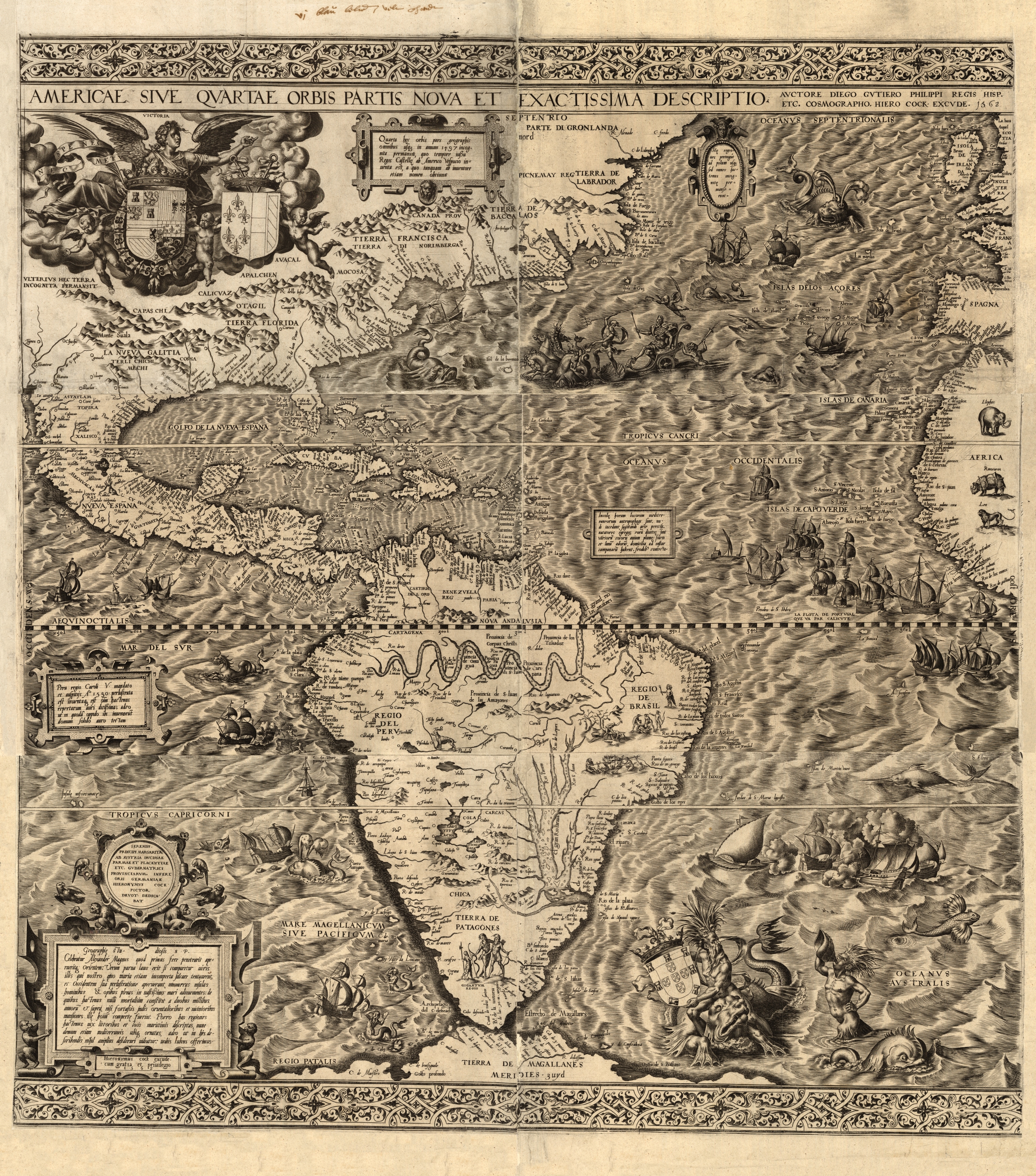
Early Spanish maps quickly adopted the name “California” for the peninsula. One of the earliest known maps to use the name was created around 1541 by Domingo del Castillo, a pilot under the command of Francisco de Ulloa, who had extensively explored the Gulf of California (often referred to then as the Sea of Cortés). These initial maps depicted California as a long, narrow peninsula, clearly connected to the mainland. However, as subsequent expeditions ventured further north, the full extent of the Baja California peninsula remained unclear to many, leading to one of the most persistent and fascinating cartographic errors in history: the “Island of California” myth.
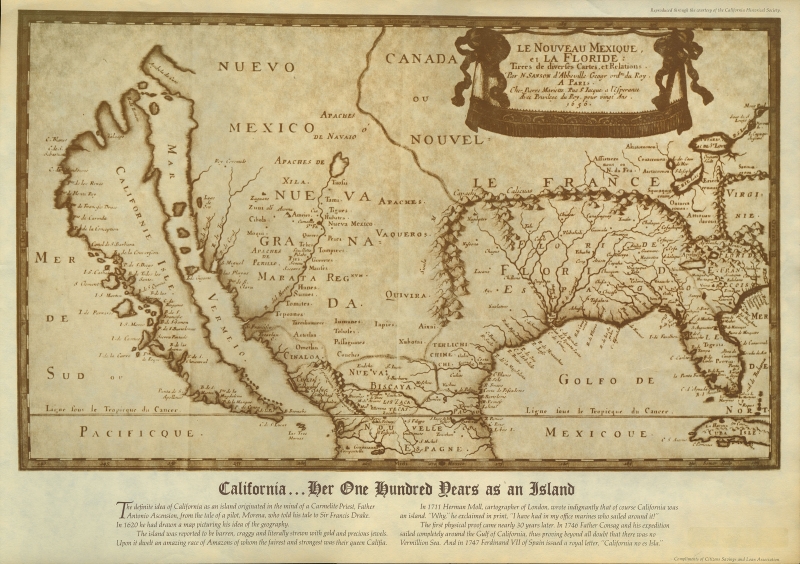
For over 150 years, starting in the early 17th century, numerous European mapmakers—influenced by incomplete reports, misinterpreted observations, and perhaps the lingering literary fantasy of an island—began to draw California as an island entirely separate from the North American continent. This misconception, widely propagated by prominent cartographers like Gerard Mercator and Nicolas Sanson, became ingrained in the European geographical consciousness. Ships sailing to the Philippines would often pass by the coast, further fueling the idea of it being an island. The “Island of California” appeared in atlases, on globes, and in geographical texts, shaping how generations perceived this distant land. It wasn’t until the early 18th century, with the thorough overland explorations of Jesuit missionaries such as Eusebio Francisco Kino and Juan de Ugarte, that the peninsular nature of California was conclusively proven. Their detailed maps and extensive travels finally corrected the long-standing error, yet the name, by then, was irrevocably affixed.
Upper California and Baja California
As Spanish exploration pushed northward, especially in the late 18th century, it became necessary to distinguish between the already known peninsula and the newly explored territories further up the coast. The term “Baja California” (Lower California) was naturally applied to the long, southern peninsula first explored by Cortés. Correspondingly, the vast, unexplored, and eventually settled lands to its north became known as “Alta California” (Upper California). This division reflected a practical administrative and geographical distinction by the Spanish colonial authorities, particularly during the establishment of missions and presidios in Alta California by figures like Junipero Serra and Gaspar de Portolá.
These two regions—Baja California and Alta California—remained part of New Spain (and later Mexico) until the Mexican-American War. Following the war and the Treaty of Guadalupe Hidalgo in 1848, Alta California was ceded to the United States and quickly became the modern state of California. Baja California, meanwhile, remained part of Mexico, eventually becoming two separate Mexican states: Baja California and Baja California Sur. The persistence of the name, despite centuries of evolving geographical understanding and political shifts, illustrates its deep entrenchment in the historical narrative of the American continent.
A Name Endures: From Myth to Modernity
The journey of the name “California” is a compelling narrative that spans literature, exploration, cartography, and nation-building. It represents a unique confluence where a fictional realm of Amazonian warriors, rich in gold and exotic beasts, was transposed onto a real, vast, and complex territory, eventually giving its name to one of the most iconic states in the United States.
American Acquisition and the Gold Rush
The definitive chapter in the story of California’s name truly began with the Mexican-American War (1846-1848), which resulted in the acquisition of Alta California by the United States. This transfer of sovereignty coincided almost immediately with one of the most transformative events in American history: the California Gold Rush. The discovery of gold at Sutter’s Mill in January 1848 unleashed a torrent of migration, transforming a sparsely populated frontier into a bustling, diverse, and rapidly developing territory. This sudden influx of people and wealth propelled California into statehood in 1850, bypassing the traditional territorial phase. The name, which had been applied speculatively by Cortés centuries earlier, now truly began to embody the promise of abundance and opportunity that Montalvo’s fictional island had once represented. The state became a symbol of ambition, dreams, and the frontier spirit, drawing people from all corners of the globe in search of their own golden riches. The name “California,” once tied to mythical gold, became literally synonymous with it.
The Enduring Legacy of Calafia
Today, the state of California continues to be a land of innovation, cultural diversity, and economic power, far exceeding the wildest dreams of its original namers. It stands as a vibrant testament to the human capacity for exploration, adaptation, and reinvention. While few residents or visitors today are familiar with Garci Rodríguez de Montalvo or his Amazonian Queen Calafia, their legacy is indelibly etched into the very identity of the Golden State. The name itself is a living monument to the potent blend of fantasy and reality that shaped the Age of Discovery. It reminds us that places, even the most famous and well-defined, can have origins steeped in wonder and imagination. The story of California’s name is not merely a historical footnote but a fascinating narrative of how a fictional island, envisioned by a Spanish novelist, became the unlikely namesake for a real-world paradise of opportunity, adventure, and enduring allure. It highlights the profound and often surprising ways in which literature, exploration, and historical circumstance converge to shape our understanding of the world and the places within it.
In conclusion, the name “California” is a rare and captivating instance where the vibrant tapestry of human imagination directly influenced the geographical naming of a significant landmark. From the pages of a 16th-century Spanish novel to the maps of European explorers and finally to its modern status as a global powerhouse, the journey of this name is a compelling reminder that the stories we tell, even those of myth and fantasy, can leave an indelible mark on the real world, shaping history and inspiring generations.
LifeOutOfTheBox is a participant in the Amazon Services LLC Associates Program, an affiliate advertising program designed to provide a means for sites to earn advertising fees by advertising and linking to Amazon.com. Amazon, the Amazon logo, AmazonSupply, and the AmazonSupply logo are trademarks of Amazon.com, Inc. or its affiliates. As an Amazon Associate we earn affiliate commissions from qualifying purchases.