
The Source of the Big Apple’s Liquid Life
The ubiquitous rush of water – from the roaring cascades of Niagara Falls to the gentle lapping of the Atlantic Ocean – is a constant presence in the American consciousness. Yet, for the millions who call New York City home, the origin of their daily water supply is often as mysterious as the city’s labyrinthine subway system. This is not a tale of distant, exotic lands, but rather an intricate, often awe-inspiring, testament to engineering and natural preservation. The answer to “Where Does New York Water Come From?” lies in a vast, protected watershed system stretching hundreds of miles north of Manhattan, a vital network that supplies a staggering quantity of pure, high-quality water to the metropolis.

A Glimpse into the Watershed
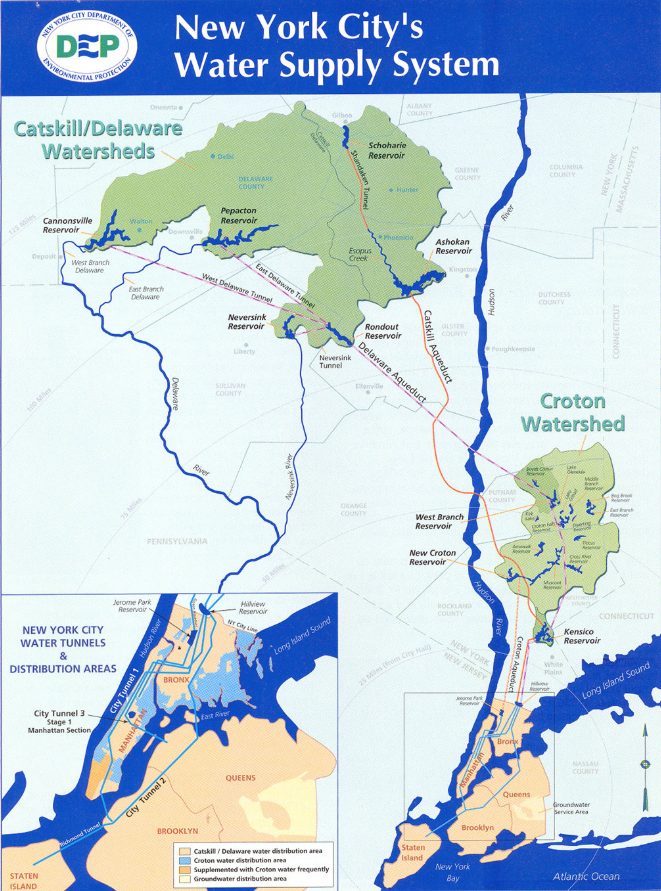
New York City’s water is not pumped from beneath the streets or filtered from a nearby river. Instead, it originates in a series of three large upstate reservoir systems: the Croton Watershed, the Catskill Watershed, and the Delaware Watershed. Together, these systems encompass over 2,000 square miles of forests, mountains, and lakes, primarily in the Catskill and Adirondack Mountains. This vast expanse is meticulously managed and protected by the New York City Department of Environmental Protection (DEP) to ensure the pristine quality of the water before it even begins its journey.
The sheer scale of this operation is difficult to comprehend. These watersheds are responsible for supplying an average of 1.2 billion gallons of water per day to over nine million people in New York City and its surrounding suburban counties. This remarkable feat is achieved through a sophisticated network of dams, reservoirs, aqueducts, tunnels, and pumping stations, a testament to the foresight and ingenuity of city planners and engineers of the past. The journey from these upstate havens to the faucets of a Brooklyn apartment is a long and complex one, a testament to the power of gravity and human engineering.
The Catskill and Delaware Aqueducts: Lifelines of the City
The cornerstone of New York City’s water supply are the Catskill Aqueduct and the Delaware Aqueduct. These monumental feats of engineering were constructed in the early to mid-20th century, designed to tap into the abundant rainfall and snowmelt collected in the Catskill and Delaware watersheds.

The Catskill Aqueduct, completed in 1915, stretches for 92 miles from the Ashokan Reservoir in the Catskills to the Kensico Reservoir in Westchester County. It is a marvel of early 20th-century engineering, primarily a gravity-fed system that utilizes a combination of cut-and-cover tunnels, deep rock tunnels, and even a massive siphon under the Hudson River. Its construction involved the displacement of entire communities and the excavation of millions of tons of rock and soil, a testament to the immense effort required to secure the city’s future water needs.
The Delaware Aqueduct, significantly longer at 85 miles, was completed in 1945. It draws water from the Pepacton, Neversink, and Cannonsville reservoirs in the Delaware River basin. Like the Catskill Aqueduct, it relies on gravity to move water, but it also includes a vast underground tunnel system, including the deepest and longest continuous underground aqueduct in the world. The construction of these aqueducts was not without controversy, as it involved agreements with surrounding states and significant environmental considerations.
The Croton System: An Older, Yet Vital Contributor
While the Catskill and Delaware systems are the primary workhorses of New York City’s water supply, the Croton Watershed and its reservoirs, located north of Manhattan in Westchester, Putnam, and Dutchess counties, represent the city’s earliest large-scale water source. The original Croton Aqueduct, completed in 1842, was a groundbreaking achievement for its time, a testament to the burgeoning needs of a rapidly growing city.
Today, the Croton system comprises a series of reservoirs, including the Croton Reservoir, New Croton Reservoir, and Kensico Reservoir, which also serves as a terminal reservoir for the Catskill system. While its contribution to the overall daily supply has decreased in recent years due to aging infrastructure and water quality concerns, the Croton system remains a crucial component of the city’s water network, providing a significant backup supply and helping to meet peak demand. The DEP has invested substantially in upgrading and maintaining the Croton system to ensure its continued reliability.
From Reservoir to Tap: The Final Journey
Once the water arrives in the terminal reservoirs closer to the city, such as the Kensico Reservoir and the Hillview Reservoir in Yonkers, it begins its final descent into the city’s intricate distribution system. This journey is largely facilitated by gravity, flowing downhill through a network of large pipes and tunnels, known as distribution mains, that spread out beneath the five boroughs.
New York City’s water is remarkably pure and, for the most part, does not require extensive chemical treatment. This is a direct result of the strict watershed protection policies in place. The DEP actively works to preserve the forests and natural landscapes within the watersheds, preventing development and minimizing pollution. This natural filtration and purification process is an invaluable asset, reducing the need for costly and complex treatment plants. However, a minimal amount of disinfection, typically using chlorine and ultraviolet light, is still applied to ensure public health and safety before the water reaches consumers.
The final distribution is managed by a complex network of valves and hydrants, delivering water to individual buildings and businesses. The pressure within the system is maintained through a combination of elevation and strategically placed pumping stations, ensuring that water can reach even the highest floors of the city’s towering skyscrapers. The journey from a pristine mountain stream to a glass of drinking water in a Manhattan apartment is a seamless, and often invisible, process for most New Yorkers, yet it is a continuous cycle of nature and engineering working in concert. The city’s commitment to protecting its watershed is paramount, recognizing that the quality of its water is directly tied to the health and prosperity of its inhabitants.
LifeOutOfTheBox is a participant in the Amazon Services LLC Associates Program, an affiliate advertising program designed to provide a means for sites to earn advertising fees by advertising and linking to Amazon.com. Amazon, the Amazon logo, AmazonSupply, and the AmazonSupply logo are trademarks of Amazon.com, Inc. or its affiliates. As an Amazon Associate we earn affiliate commissions from qualifying purchases.