
The Genesis of a Western Icon
The Colorado River, a vital artery of the American West, carves a dramatic path through some of the continent’s most iconic landscapes. Its journey spans roughly 1,450 miles, sustaining life, shaping geology, and fueling economies across seven U.S. states and two Mexican states. From its humble origins as a pristine trickle, it swells into a monumental force responsible for wonders like the Grand Canyon, a testament to its enduring power and influence. Understanding where such a monumental natural landmark begins offers profound insight into its character, its challenges, and its significance to millions.

This exploration into the river’s genesis reveals not just a geographical point but a rich tapestry of ecological, historical, and cultural narratives. The headwaters of the Colorado River represent the pristine starting line of an epic aquatic odyssey, a critical benchmark in the natural history of North America, and a landmark revered for its raw beauty and environmental importance. It is here, amidst the rugged grandeur of the Rocky Mountains, that the river’s story truly begins, a story of snowmelt, high-altitude meadows, and the subtle forces that give birth to a titan.
Locating the True Headwaters
The precise birthplace of the Colorado River is nestled high in the Rocky Mountains of north-central Colorado. Specifically, the river officially commences its long journey at La Poudre Pass, situated within the boundaries of Rocky Mountain National Park. This remote, subalpine meadow, sitting at an elevation of approximately 10,184 feet (3,104 meters), is where the first discernible flows of the Colorado River emerge.
The source is primarily fed by snowmelt from the surrounding peaks, particularly from the slopes near Mount Cumulus and Mount Richthofen. The immediate genesis point is often identified as a small, marshy area or a series of seeps and springs that coalesce into a tiny stream. This nascent waterway then flows into Poudre Lake, a picturesque glacial tarn that serves as the initial collection point before the river begins its descent. From Poudre Lake, the Colorado River emerges as a defined, albeit small, stream, starting its arduous westbound traverse across the continent. This high-altitude environment is characterized by tundra-like vegetation, hardy subalpine fir and Engelmann spruce, and a short, intense growing season, all contributing to the unique character of its headwaters.
The Continental Divide’s Influence
A crucial geographical feature dictating the Colorado River’s direction from its source is the Continental Divide. This immense hydrological boundary snakes its way through the Rocky Mountains, separating river systems that flow to the Pacific Ocean from those that flow to the Atlantic Ocean or the Gulf of Mexico. The Colorado River begins its journey on the western side of the Continental Divide at La Poudre Pass.
Coincidentally, just a short distance from the Colorado River’s headwaters, on the eastern side of the Continental Divide, lies the source of the Cache la Poudre River. This river flows eastward towards the Mississippi River and eventually the Gulf of Mexico. This proximity highlights the remarkable geological architecture of the Rocky Mountains, where a few yards can determine the ultimate destination of water spanning thousands of miles. The Continental Divide not only shapes the initial trajectory of the Colorado River but also influences the precipitation patterns and snowpack that are vital for its sustenance.
A Journey Through Diverse Landscapes
From its humble beginnings at La Poudre Pass, the Colorado River immediately embarks on a descent through the pristine landscapes of Rocky Mountain National Park. Initially, it is a narrow, meandering stream, scarcely more than a foot wide in places, traversing subalpine meadows and dense conifer forests. The early stages of the river’s course are characterized by a series of small waterfalls and rapids as it drops in elevation, gathering momentum and volume from numerous unnamed rivulets and springs.
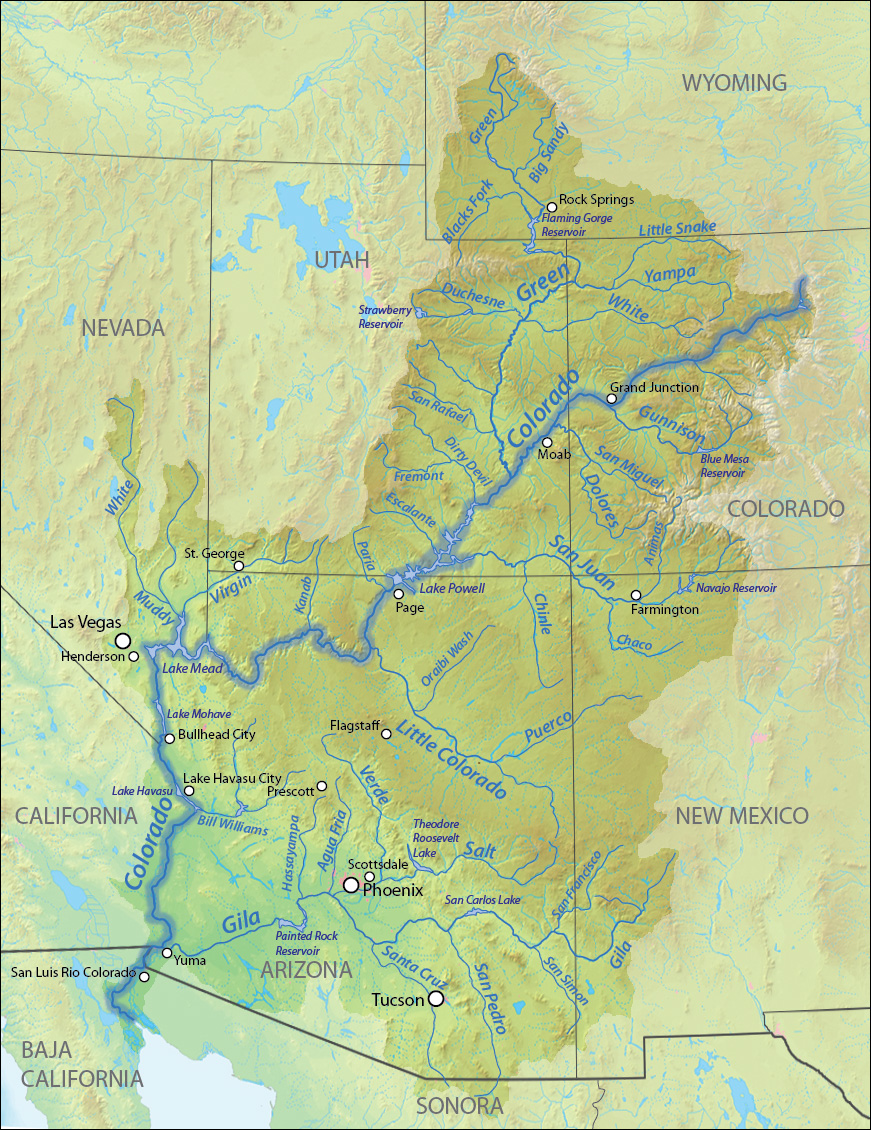
As it exits the national park, the river flows into Grand Lake, Colorado’s largest natural lake, and then through two other large reservoirs, Shadow Mountain Lake and Lake Granby, which are part of the Colorado-Big Thompson Project, an intricate water diversion system. Below these lakes, the river begins to significantly gain size, transitioning from a high-mountain stream to a more substantial river. It is joined by tributaries like the Fraser River and the Blue River, each adding to its flow.
The Colorado River then enters a series of impressive canyons as it carves its way westward through Colorado. One of the most notable is the Glenwood Canyon, a magnificent 12.5-mile-long gorge with sheer walls rising up to 1,300 feet. Here, the river showcases its erosive power, hinting at the grander canyons to come downstream. The transformation from a modest mountain stream to a powerful, canyon-carving river within its first few hundred miles is a remarkable geological spectacle, underscoring the raw force inherent in this natural landmark.
The Significance of the Source
The source of the Colorado River is far more than just a geographical point; it is a critical ecological zone, a historical touchstone, and a place of deep cultural resonance. Ecologically, the headwaters at La Poudre Pass support a fragile alpine and subalpine ecosystem. The pristine waters provide habitat for unique flora and fauna adapted to high-altitude conditions, including various species of trout, birds, and mammals. The snowpack that feeds the river is a crucial element of the regional hydrology, acting as a natural reservoir that releases water gradually throughout the warmer months.
Historically, the headwaters area and the upper Colorado River basin have been significant to indigenous peoples for millennia. Tribes such as the Ute and Shoshone traditionally inhabited these lands, relying on the river’s resources for sustenance and spiritual connection. Later, European explorers and trappers ventured into these mountains, often navigating by the river systems. The discovery and mapping of the Colorado River’s origin contributed to the broader understanding and settlement of the American West.
Today, the source area is a landmark that draws visitors seeking to connect with the natural world. While challenging to access in winter, during the warmer months, hikers can reach areas near Poudre Lake within Rocky Mountain National Park, experiencing the tranquility and pristine beauty of the river’s birthplace. This connection to the source helps foster an appreciation for the entire river system and the immense challenges it faces due to increased water demand and climate change.
Preserving the Headwaters
Given its immense importance, conservation efforts around the Colorado River’s headwaters are paramount. As part of Rocky Mountain National Park, the immediate source area benefits from the highest level of environmental protection. The park actively manages human impact, regulates access, and monitors ecological health to ensure the integrity of this vital natural landmark.
Beyond the park boundaries, a network of federal, state, and local agencies, alongside numerous non-profit organizations, works to protect the upper Colorado River watershed. These efforts focus on maintaining water quality, preserving riparian habitats, managing forest health to support snowpack retention, and balancing water demands with ecological needs. The health of the headwaters directly influences the health of the entire river system downstream, making its preservation a critical endeavor for all the regions that depend on the Colorado River. These initiatives ensure that future generations can also witness and appreciate the genesis of this life-giving river.

Beyond the Origin: The River’s Legacy
From its unassuming beginnings at La Poudre Pass, the Colorado River flows southwest through Colorado, Utah, Arizona, Nevada, California, and into Mexico, nourishing deserts and supporting massive urban centers and agricultural landscapes. It fills colossal reservoirs like Lake Mead and Lake Powell, powers hydroelectric dams, and defines the identity of the regions it traverses.
The journey from a trickling stream in a high mountain meadow to the architect of one of the world’s most spectacular canyons, the Grand Canyon, is a testament to the immense power and enduring spirit of this natural landmark. The Colorado River’s origin serves as a powerful reminder of nature’s delicate balance and the interconnectedness of landscapes. It underscores the profound journey a single drop of water undertakes, influencing geology, ecology, and human civilization over hundreds of miles. To visit or even contemplate the source is to grasp the magnitude of a river system that has shaped, and continues to shape, the very essence of the American West.
LifeOutOfTheBox is a participant in the Amazon Services LLC Associates Program, an affiliate advertising program designed to provide a means for sites to earn advertising fees by advertising and linking to Amazon.com. Amazon, the Amazon logo, AmazonSupply, and the AmazonSupply logo are trademarks of Amazon.com, Inc. or its affiliates. As an Amazon Associate we earn affiliate commissions from qualifying purchases.