
For decades, the sporting identity of Los Angeles was defined by shared spaces and overlapping legacies. However, a seismic shift has occurred in the architectural and cultural landscape of Southern California. The question of where the teams play is no longer answered by a single downtown address. As of the 2024-2025 season, the narrative has changed. The Los Angeles Clippers have officially moved into their own dedicated home, a state-of-the-art landmark known as the Intuit Dome. Located in Inglewood, this facility represents more than just a basketball court; it is a marvel of modern engineering and a symbol of independence for one of the most resilient franchises in the United States.

The Evolution of a Landmark: From Crypto.com Arena to Intuit Dome
To understand the significance of the new venue, one must first look at the history of the team’s residency in California. For twenty-five years, the team shared a roof with their rivals in the heart of Downtown Los Angeles. This shared existence created a unique dynamic within the local sports culture, but it often left the team feeling like a guest in their own building.
The Legacy of Staples Center and Crypto.com Arena
Since 1999, the team called the Staples Center—later renamed the Crypto.com Arena—their home. This venue is undeniably one of the most famous landmarks in the world of sports. Situated in the vibrant L.A. Live district, it has hosted countless historic events, from championship parades to international music awards.
However, sharing the Crypto.com Arena with the Los Angeles Lakers and the Los Angeles Kings meant the team often had the least favorable scheduling. The logistics of converting the floor from ice hockey to basketball and switching between team branding overnight was a feat of stadium management, but it prevented the franchise from establishing a permanent physical identity. The move to Inglewood marks the end of this era, allowing the team to curate an environment designed specifically for their fans.
Establishing a New Identity in Inglewood
The transition to the Intuit Dome signifies a homecoming of sorts to a city that is rapidly becoming the sports capital of California. By moving to Inglewood, the team has stepped out of the shadow of the downtown skyline to create a landmark that is entirely their own. This move wasn’t just about a new building; it was about territorial sovereignty in a city that prizes prestige and real estate. The site was chosen for its accessibility and its proximity to other major landmarks, ensuring that the team remains at the center of the cultural conversation.
Architectural Marvel: Exploring the Intuit Dome
The Intuit Dome is not merely a sports arena; it is a masterclass in contemporary architecture. Designed to be the most technologically advanced venue in the United States, the structure is a visual spectacle that has transformed the skyline of Inglewood. Its exterior, characterized by a complex diamond-patterned metal skin, is meant to evoke the geometry of a basketball net.
The Halo Board and Technological Innovation
Inside the landmark, the most striking feature is the “Halo Board.” This double-sided 4K display spans nearly a full acre, circling the entire bowl of the arena. It provides an immersive experience that is unparalleled in any other stadium in North America. Unlike the standard screens found in New York City or Chicago, the Halo Board is designed to keep fans engaged with advanced statistics, replays, and interactive content without ever obstructing the view of the court.
The building also utilizes cutting-edge biometric technology to streamline the fan experience. From “frictionless” concession stands to facial recognition entry systems, the Intuit Dome is a landmark of the digital age. Every detail, down to the number of toilets—which significantly exceeds the average for an arena of this size—was planned to maximize comfort and minimize wait times, setting a new standard for luxury and efficiency in sports architecture.
“The Wall” and Fan-Centric Design
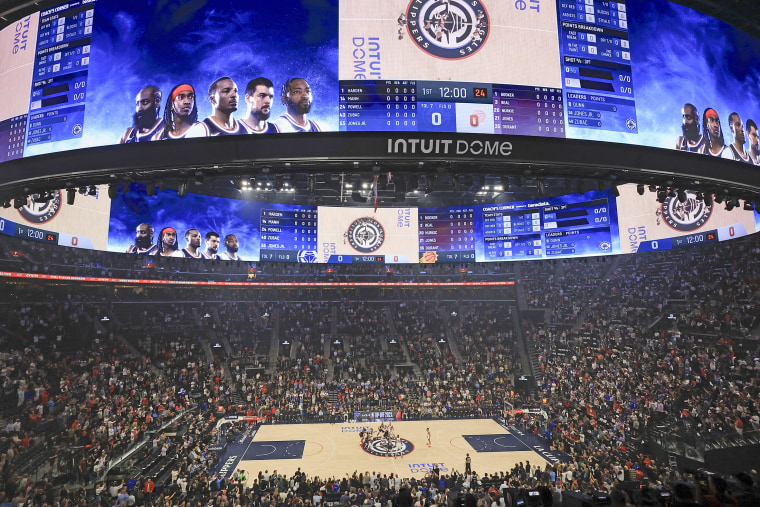
One of the most unique architectural elements of the Intuit Dome is “The Wall.” This section consists of 51 rows of uninterrupted seating behind one of the baskets, specifically designed to house the most vocal supporters. Inspired by the “Yellow Wall” at Westfalenstadion in Germany, this feature is intended to create a home-court advantage that is both visually intimidating and acoustically thunderous. By prioritizing the “energy” of the building, the architects have created a landmark that values the human experience as much as the aesthetic form.
The Cultural Impact on the Los Angeles Landscape
The construction of the Intuit Dome has had a profound impact on the local geography. Inglewood, once a quiet residential and industrial hub, has been revitalized into a premier destination for tourism and entertainment.
Revitalizing the Inglewood Entertainment District
The Intuit Dome sits within a stone’s throw of several other iconic landmarks. It is adjacent to SoFi Stadium, the massive home of the Los Angeles Rams, and the historic Kia Forum, which remains one of the most beloved concert venues in California. Together, these structures form a concentrated hub of activity that rivals the famous Hollywood district or the Santa Monica pier for tourist attention.
This development has brought thousands of jobs and significant infrastructure investment to the area. For visitors traveling from San Diego or flying into Los Angeles International Airport, the sight of these massive, glowing landmarks signifies that they have arrived in a world-class city. The Intuit Dome serves as an anchor for this new “City of Champions” identity.
A Hub for Sports and Entertainment
While basketball is the primary focus, the Intuit Dome was built to be a multi-functional landmark. Its acoustics were fine-tuned by experts to ensure that it could host top-tier musical acts, rivaling the sound quality found in dedicated concert halls in London or Paris. The inclusion of a massive outdoor plaza, complete with a regulation-sized basketball court open to the public, ensures that the landmark remains a community asset even on days when no professional games are scheduled. This blend of private enterprise and public space is a hallmark of modern urban planning in Southern California.
Comparing Global Sporting Landmarks
When evaluating where the team plays, it is helpful to place the Intuit Dome in a global context. The world is full of iconic sporting landmarks, but few have been built with the singular vision and budget of this project.
How the Dome Stands Against Madison Square Garden
For years, Madison Square Garden in New York City has been the gold standard for basketball arenas. It has the history and the prime location atop Pennsylvania Station. However, the Intuit Dome represents the future. While the “Garden” relies on its storied past, the new home of the Los Angeles Clippers relies on futuristic amenities. From the seat-side power outlets to the climate-controlled “breathable” bowl, the Intuit Dome offers a level of comfort that older landmarks simply cannot match.
In Europe, arenas like the O2 Arena in the United Kingdom have set high bars for entertainment complexes, but the Intuit Dome is the first to integrate data-driven fan engagement so deeply into its physical structure. It is a landmark that watches you as much as you watch the game, using heat maps to determine where the most exciting moments are happening in the stands.

Future Landmarks in the United States
The success of the Intuit Dome is likely to trigger a wave of new construction across the United States. Cities like Las Vegas and Seattle are already looking at this model as they plan their own future sports districts. By moving to Inglewood, the franchise has not only found a place to play but has also built a blueprint for what a 21st-century landmark should look like: sustainable, technologically integrated, and fiercely independent.
The journey of the team, from their early days in Buffalo to their time in San Diego and their long residency at the Crypto.com Arena, has finally led them to a permanent home. The Intuit Dome is more than just a destination for sports fans; it is a landmark of architectural ambition and a new cornerstone of the California experience. Whether you are a resident of Los Angeles or a traveler visiting from across the globe, a visit to this arena offers a glimpse into the future of live entertainment.
LifeOutOfTheBox is a participant in the Amazon Services LLC Associates Program, an affiliate advertising program designed to provide a means for sites to earn advertising fees by advertising and linking to Amazon.com. Amazon, the Amazon logo, AmazonSupply, and the AmazonSupply logo are trademarks of Amazon.com, Inc. or its affiliates. As an Amazon Associate we earn affiliate commissions from qualifying purchases.