
The Coral Castle stands as one of the most enigmatic landmarks in the United States. Located in the heart of South Florida, this megalithic structure has puzzled engineers, scientists, and historians for decades. While many visitors flock to the region for the beaches of Miami or the nightlife of South Beach, the Coral Castle offers a profound look into the architectural ingenuity and personal obsession of a single man. To understand the significance of this site, one must first look at its precise location and the unique geography of the Sunshine State that allowed such a feat to be possible.

The Geographic Location of a Modern Wonder
The Coral Castle is situated at 28655 South Dixie Highway in Homestead, Florida. This location places it within Miami-Dade County, roughly 30 miles south of downtown Miami. The site is nestled in an area known as the Redland, a region historically characterized by its agricultural richness and proximity to the Everglades. Unlike the coastal skyscrapers found further north, the architecture here is grounded in the native Oolite limestone that forms the bedrock of much of Florida.
Finding the Site in Homestead
Navigating to the Coral Castle is a straightforward journey for those traveling through the Florida Keys or visiting the Everglades National Park. It sits along the U.S. 1 corridor, making it a prominent stop for travelers heading toward Key Largo. The landmark is easily identifiable by its towering stone walls and the distinctive Coral Castle Museum signage. Despite being surrounded by modern development, the castle remains an island of mystery, preserved as a National Register of Historic Places landmark since 1984.
Proximity to the Everglades and Biscayne Bay
The positioning of the Coral Castle is significant not just for modern tourism but also for its geological context. It lies on the Atlantic Coastal Ridge, a limestone formation that separates the Atlantic Ocean from the Everglades. This proximity to Biscayne Bay meant that the builder had access to vast quantities of coral rock, which is actually fossilized limestone formed from ancient coral reefs. The surrounding environment of Homestead provided the raw materials necessary for the construction of this massive complex.
The History and Mystery of Edward Leedskalnin
The story of the Coral Castle is inseparable from its creator, Edward Leedskalnin. A diminutive man from Latvia, Leedskalnin arrived in the United States following a tragic heartbreak. Legend has it that he was engaged to be married to Agnes Scuffs, whom he called his “Sweet Sixteen.” After she called off the wedding just one day before the ceremony, a devastated Leedskalnin spent the next 28 years building the Coral Castle as a monument to his lost love.
Moving the Castle from Florida City
Interestingly, the Coral Castle was not always located in Homestead. Edward Leedskalnin originally began his work in Florida City around 1923. At the time, the site was known as Rock Gate Park. In the mid-1930s, when a planned subdivision threatened his privacy, Leedskalnin decided to move the entire structure ten miles north to its current location in Homestead. He spent three years moving the massive stones piece by piece, reportedly using a borrowed truck chassis and a friend’s tractor, though no one ever witnessed him loading or unloading the stones.
Engineering Feats Without Modern Machinery
The most enduring mystery of this Florida landmark is how a man who weighed barely 100 pounds and stood only five feet tall managed to move, carve, and stack over 1,100 tons of coral rock. Unlike the construction of the Great Pyramid of Giza or Stonehenge, which involved thousands of laborers, Leedskalnin worked alone. He worked primarily at night by the light of a lantern, away from prying eyes. When asked how he accomplished such a task, he simply claimed that he had discovered the secrets of the pyramid builders and understood the laws of weight and leverage.
The Architectural Marvel of the Stone Structures
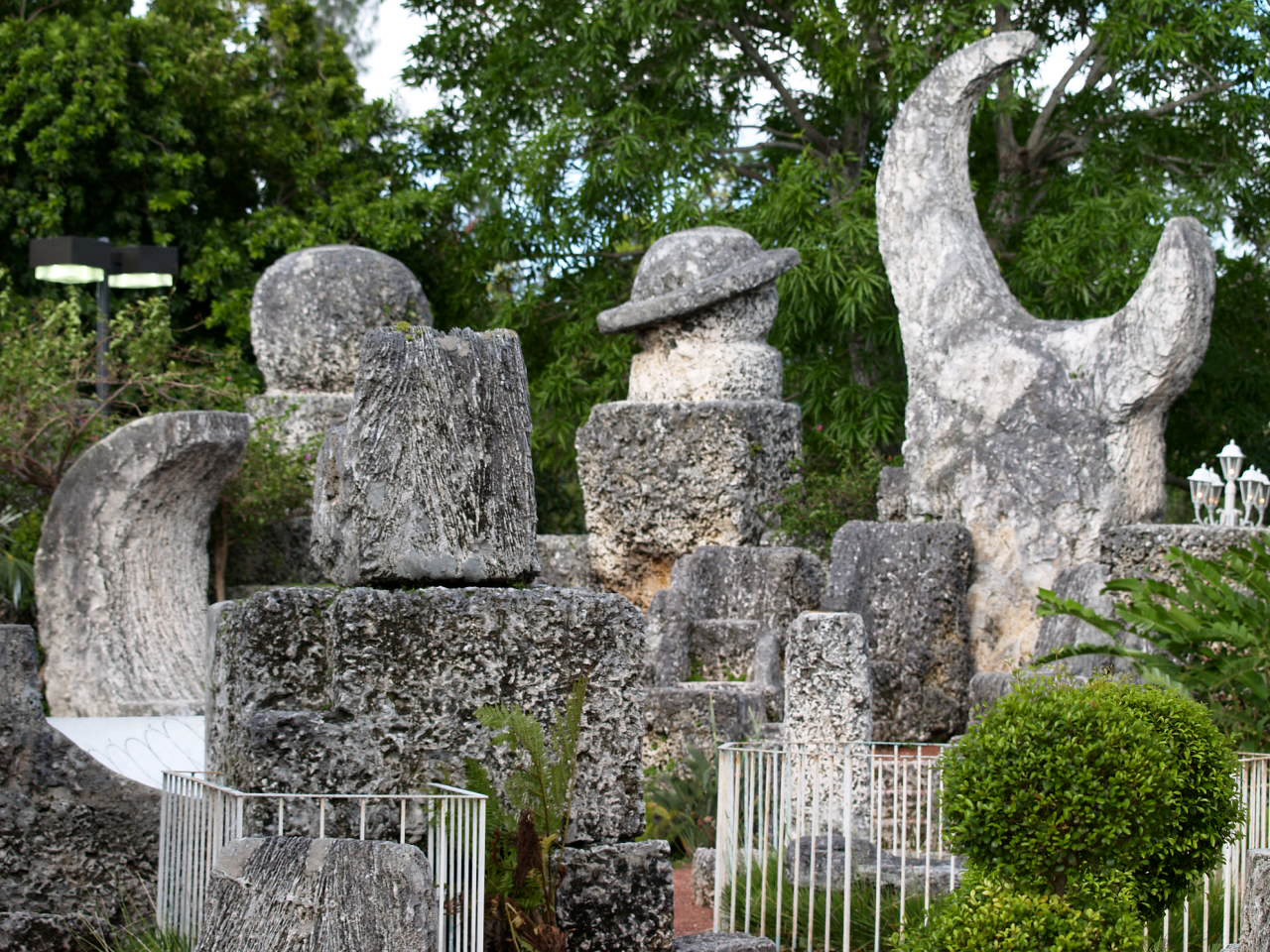
The architecture of the Coral Castle is unlike any other landmark in North America. The walls are made of massive blocks of Oolite limestone, some of which are twice as heavy as the largest blocks in the Great Pyramid of Giza. The precision of the stonework is so exact that no light passes through the joints where the stones meet, yet no mortar was used in the construction.
The Nine-Ton Gate
One of the most famous features of the castle is the Nine-Ton Gate. This massive revolving door is so perfectly balanced that it used to swing open with the light touch of a finger. In 1986, the gate finally stopped moving, and it took a team of engineers and a 50-ton crane to remove it for repair. They discovered that Leedskalnin had used a simple truck bearing and a metal shaft to balance the eight-foot-tall stone. The level of mathematical precision required to find the exact center of gravity for such a massive, irregularly shaped object continues to baffle modern architects.
The Throne Room and Feast of Love Table
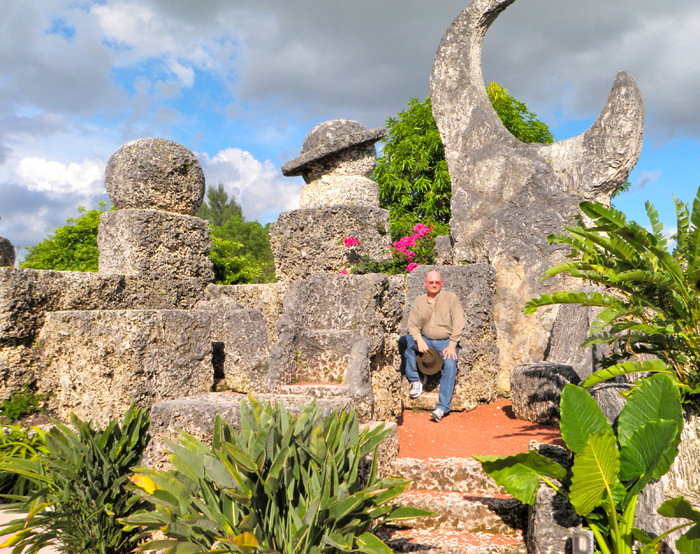
Inside the walls, the landmark features a variety of functional and symbolic furniture carved entirely from stone. The Throne Room contains a massive chair for Leedskalnin, a chair for his Sweet Sixteen, and even a “child’s corner.” Another centerpiece is the Feast of Love Table, a heart-shaped stone table weighing several tons, which is often cited as the most romantic yet tragic element of the park. These structures showcase not only manual labor but a sophisticated understanding of sculpture and design.
Exploring Celestial and Mathematical Precision
Beyond its physical weight, the Coral Castle is a landmark of astronomical significance. Edward Leedskalnin was deeply interested in the cosmos, and many of his structures align with celestial bodies. This has led many to believe that the site was designed to be a giant observatory or a temple to the magnetic forces of the Earth.
The Polaris Telescope and Solar Dial
The Polaris Telescope is a 25-foot tall monolith that weighs nearly 30 tons. It features a hole carved through the stone that aligns perfectly with the North Star, allowing for precise astronomical observations. Nearby, a Sundial remains remarkably accurate, telling the time within two minutes of the local standard. The integration of these elements suggests that Leedskalnin possessed a high level of expertise in surveying and navigation, likely influenced by his time in Latvia and his travels across Europe.
Theories on Magnetism and Levitation
The mystery of “how” has led to numerous fringe theories, many of which Leedskalnin himself encouraged through his writings on Magnetic Current. He believed that all matter was comprised of individual magnets and that by manipulating these magnets, he could neutralize gravity. While mainstream science remains skeptical, the sheer physical impossibility of his work—moving stones like the Great Obelisk, which stands 22 feet tall and weighs 28 tons—keeps these theories alive among enthusiasts of the paranormal and ancient engineering.
Visiting the Landmark Today
Today, the Coral Castle is a major destination for those interested in architecture, history, and the unexplained. It has been featured in countless documentaries on the History Channel and Discovery Channel. Its cultural impact even extends to music; the famous rock singer Billy Idol wrote his hit song “Sweet Sixteen” after being inspired by the story of Edward Leedskalnin.
Preserving the Legacy in Homestead
As a landmark, the Coral Castle serves as a testament to the power of the human spirit and the mysteries that still remain in the modern world. The Coral Castle Museum offers guided tours that explain the history of the site, the tools Leedskalnin used, and the various theories regarding its construction. Visitors can walk through the stone gardens, touch the massive walls, and experience the eerie stillness of a place built by a man who lived and died with his secrets.
Whether you view it as a monument to lost love, a feat of impossible engineering, or a scientific anomaly, the Coral Castle remains a primary landmark of Florida. Its location in Homestead anchors it to the unique landscape of the Everglades region, ensuring that this stone masterpiece will continue to fascinate generations of travelers and researchers for years to come.
LifeOutOfTheBox is a participant in the Amazon Services LLC Associates Program, an affiliate advertising program designed to provide a means for sites to earn advertising fees by advertising and linking to Amazon.com. Amazon, the Amazon logo, AmazonSupply, and the AmazonSupply logo are trademarks of Amazon.com, Inc. or its affiliates. As an Amazon Associate we earn affiliate commissions from qualifying purchases.