
The question “Who Annexed Texas?” is a fundamental one when exploring the rich tapestry of Texan history, a history deeply intertwined with national ambition, westward expansion, and the very identity of the Lone Star State. While the word “annexed” might suggest a simple act, the story of Texas joining the United States is a complex narrative involving independent nationhood, political maneuvering, and significant geopolitical considerations. Understanding this process offers a fascinating glimpse into the forces that shaped not only Texas but also the broader American landscape, particularly as it relates to travel, tourism, and landmark exploration.
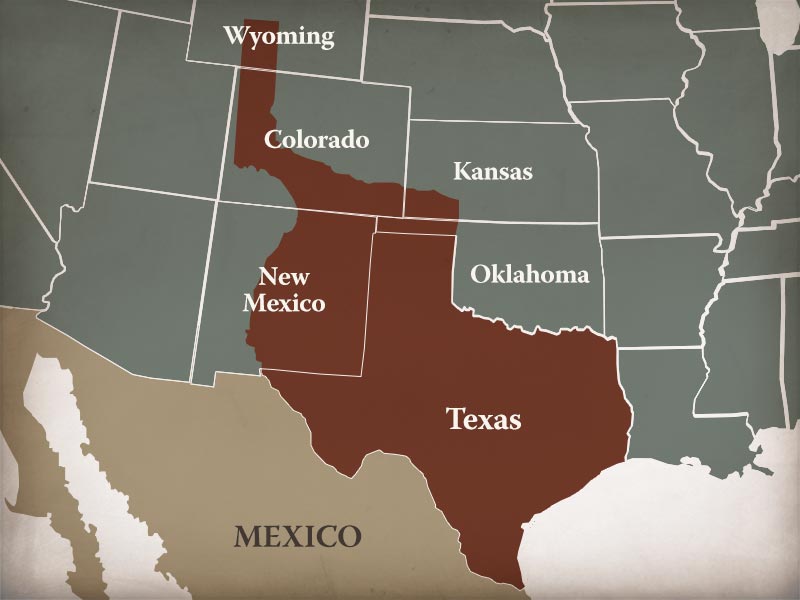
Texas’s journey to statehood is a testament to its unique historical trajectory. Before becoming the 28th state of the United States, Texas existed as an independent republic for nearly a decade. This period, from 1836 to 1845, was a crucial chapter, fostering a distinct Texan identity that still resonates today. The struggle for independence from Mexico had been fierce, culminating in the famous battles of the Alamo and San Jacinto. Once free, the Republic of Texas faced the challenges of establishing its own government, economy, and international relations.
The desire to join the United States was not universal within the Republic of Texas, nor was it immediately embraced by the U.S. However, the allure of American expansionism, often termed “Manifest Destiny,” played a significant role. Proponents envisioned Texas as a vital piece in the westward expansion puzzle, a gateway to further territorial gains and a boost to the nation’s economic and political power. The debate in the United States was fervent, marked by concerns over the balance of power between free and slave states, as Texas was a slave-holding republic.
Ultimately, after years of debate and diplomatic negotiations, Texas was officially annexed by the United States in 1845. This act profoundly shaped the future of Texas, integrating it into the burgeoning nation and setting the stage for its immense growth and development. For anyone planning a trip to Texas, understanding this historical backdrop enriches the experience, transforming visits to historical sites into journeys through pivotal moments in American history.
The Path to Republic and Independence
The story of Texas’s annexation is inextricably linked to its period as an independent republic. Before seeking admission into the United States, Texas carved out its own destiny. This era was defined by a fierce struggle for self-determination and the establishment of a sovereign nation.
The Mexican Struggle and the Birth of the Republic
The early 19th century saw Texas as a province of Mexico. However, growing discontent among American settlers, who had been encouraged to move to the region by the Mexican government, led to increasing tensions. Differences in culture, religion, and governance, particularly Mexico‘s abolition of slavery, fueled the desire for independence.
In 1835, open rebellion erupted. Key events, such as the Battle of Gonzales, marked the beginning of the Texas Revolution. The subsequent year, 1836, was pivotal. The Battle of the Alamo in San Antonio became a symbol of Texan resistance, even though it resulted in a devastating defeat for the rebels. However, the bravery displayed at the Alamo galvanized the Texan spirit. Just weeks later, under the command of Sam Houston, the Texan army achieved a decisive victory at the Battle of San Jacinto, capturing Mexican President Santa Anna and securing Texas’s independence.
On March 2, 1836, the Texas Declaration of Independence was adopted, and on October 22, 1836, Sam Houston was inaugurated as the first elected President of the Republic of Texas. This marked the official birth of a new nation.
Life as an Independent Republic
The Republic of Texas, though independent, faced immense challenges. Economically, it struggled with debt incurred during the revolution and sought to establish stable trade relations. Politically, it was a young nation navigating its place in a turbulent region. The government grappled with internal divisions, border disputes with Mexico (which never fully recognized Texas’s independence), and the constant threat of renewed conflict.
Despite these difficulties, the Republic of Texas developed a unique identity. Its vast landscapes, from the rolling plains to the rugged Big Bend, became synonymous with rugged individualism and frontier spirit. Cities like Houston, named after the hero of San Jacinto, began to grow, serving as important centers of commerce and governance. The dream of westward expansion was a strong undercurrent, with many Texans looking towards the United States as a natural ally and future home.
The period of independence was a formative one, shaping the character of Texas and laying the groundwork for its eventual integration into the American union. For travelers today, visiting historic sites like the San Jacinto Monument offers a tangible connection to this pivotal era, allowing them to walk the grounds where a nation was born.
The Annexation Debate and Process
The question of Texas joining the United States was far from straightforward. It involved complex political considerations, national anxieties, and ultimately, a clash of ideologies that shaped the very future of the United States.
The Lure of Expansion and the Shadow of Slavery
From the outset of the Republic of Texas, there was a strong desire among many Texans to join the United States. The cultural and economic ties were strong, and the prospect of becoming part of a larger, more powerful nation was appealing. For the United States, particularly those who believed in Manifest Destiny, Texas represented a significant territorial prize, expanding the nation’s reach westward and potentially opening up vast new economic opportunities.
However, the path to annexation was fraught with obstacles. The primary concern in the United States was the issue of slavery. Texas was a slave-holding republic, and its admission as a state threatened to upset the delicate balance of power between free and slave states in the U.S. Senate. Southern states were eager to welcome Texas, seeing it as a crucial addition to their bloc, while abolitionists and many in the North viewed annexation with alarm, fearing it would strengthen the institution of slavery and lead to further conflict.
This debate raged for years. Early attempts at annexation in the 1830s were met with resistance in the U.S. Senate, partly due to concerns about provoking Mexico, which still considered Texas a rebellious territory.

The Election of 1844 and the Annexation Treaty
The U.S. Presidential election of 1844 became a pivotal moment in the annexation of Texas. The issue of annexation was a central theme, with the Democratic candidate, James K. Polk, a staunch expansionist, winning the election. His victory was interpreted as a mandate for annexation.
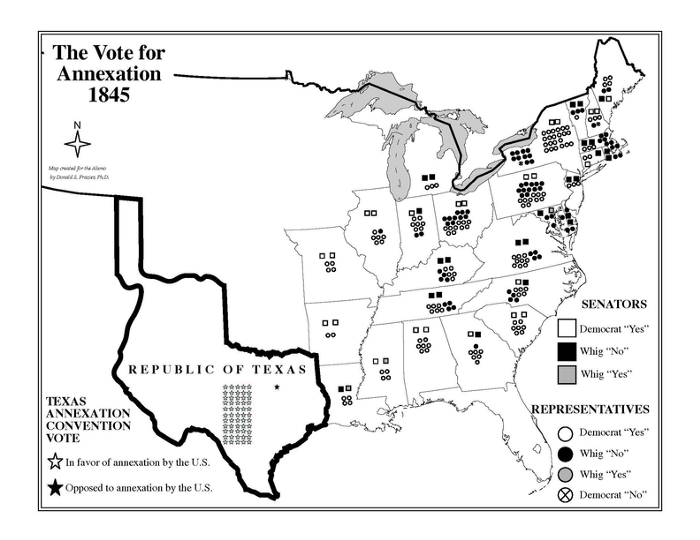
Following Polk’s election, negotiations intensified. The United States and the Republic of Texas agreed on terms for annexation, leading to the signing of a treaty in April 1844. However, this treaty faced significant opposition in the U.S. Senate and was ultimately rejected. The Senate’s rejection was a major setback, but the push for annexation did not wane.
Undeterred, supporters of annexation found a new strategy. Instead of a treaty, which required a two-thirds majority to ratify, they pursued annexation through a joint resolution of Congress, which only required a simple majority in both the House of Representatives and the Senate. This approach proved successful. In March 1845, Congress passed the joint resolution to annex Texas.
Texas’s Decision and Statehood
The Republic of Texas had to formally accept the terms of annexation. This involved a constitutional convention and a vote by the Texan people. On July 4, 1845, the citizens of Texas voted overwhelmingly to accept annexation. In December 1845, Texas officially became the 28th state of the United States.
The annexation of Texas had profound consequences. It significantly increased the size of the United States and fueled further westward expansion, ultimately contributing to the Mexican-American War (1846-1848), which resulted in the United States acquiring vast territories in the Southwest. For travelers exploring Texas, understanding this complex political dance of annexation provides crucial context for the state’s history and its enduring connection to the United States.
Experiencing Texas: Landmarks, Culture, and Travel
The annexation of Texas by the United States in 1845 marked the beginning of a new chapter for the Lone Star State, one that has shaped its unique culture, rich history, and diverse landscapes. Today, Texas offers a wealth of experiences for travelers, from its iconic landmarks to its vibrant local culture, all deeply rooted in its fascinating past.
Historic Landmarks and Sites
The legacy of Texas’s independent republic and its subsequent annexation is evident in numerous historical landmarks across the state. The Alamo in San Antonio stands as a powerful symbol of sacrifice and a must-visit for anyone interested in Texas history. Nearby, the San Antonio Missions National Historical Park, a UNESCO World Heritage Site, preserves four other Spanish colonial missions, offering a glimpse into the region’s early colonial past and its intertwining with Texan identity.
The San Jacinto Monument, located near Houston, commemorates the decisive battle that secured Texas independence. Its towering obelisk is a striking landmark, and the surrounding park allows visitors to step back in time and imagine the events of that fateful day. For those interested in the republic era, visiting the Texas State Capitol in Austin provides insights into the governance of the independent republic and its transition to statehood. The capitol building itself is a magnificent example of Romanesque Revival architecture and a landmark in its own right.
Beyond these key sites, countless smaller historical markers and museums across Texas tell the stories of pioneers, cowboys, and the various cultures that have shaped the state. Exploring these landmarks provides a tangible connection to the events that led to Texas’s annexation and its subsequent development within the United States.
Texan Culture and Lifestyle
The annexation brought Texas into the broader American cultural landscape, but it also allowed its distinct heritage to flourish. Texan culture is a vibrant fusion of Southern hospitality, cowboy individualism, and a strong sense of state pride. This unique blend is evident in everything from its world-renowned cuisine to its lively festivals and traditions.
Food is a central part of the Texan experience. From the smoky flavors of authentic Texas barbecue in places like Austin and Lockhart to the zesty Tex-Mex dishes found in cities along the border, the culinary scene is diverse and delicious. Exploring local eateries and food trucks is an essential part of any Texas travel itinerary.
The lifestyle in Texas is as varied as its geography. Major cities like Houston, Dallas, and Austin offer cosmopolitan experiences with world-class museums, vibrant music scenes, and upscale shopping, catering to those who enjoy luxury travel or business stays. In contrast, the vast ranches of West Texas and the charming small towns offer a more relaxed pace and a deeper connection to the state’s frontier roots, appealing to those seeking budget-friendly adventures or family trips immersed in nature.
Travel and Tourism in the Lone Star State
As the 28th state of the United States, Texas has become a major tourist destination, offering something for every type of traveler. The state’s sheer size means that exploring Texas can be an adventure in itself, requiring careful planning for trips that might involve driving between its major cities or exploring its diverse natural wonders.
For nature enthusiasts, the dramatic landscapes of the Big Bend National Park offer unparalleled opportunities for hiking, stargazing, and exploring a rugged wilderness. The Gulf Coast provides a different kind of appeal, with its sandy beaches and vibrant coastal towns like Galveston. For families, theme parks and educational attractions in cities like San Antonio and Dallas offer entertainment for all ages.
Accommodation options are as diverse as the state itself, ranging from luxurious resorts and boutique hotels to charming bed and breakfasts and affordable apartments for longer stays. Whether you’re seeking a plush suite in a bustling metropolis or a secluded villa with stunning views, Texas has accommodation to suit every need and budget. The continuous influx of visitors, drawn by its history, culture, and natural beauty, underscores the enduring appeal of Texas, a state that has successfully integrated its independent spirit into the fabric of the United States following its annexation.
LifeOutOfTheBox is a participant in the Amazon Services LLC Associates Program, an affiliate advertising program designed to provide a means for sites to earn advertising fees by advertising and linking to Amazon.com. Amazon, the Amazon logo, AmazonSupply, and the AmazonSupply logo are trademarks of Amazon.com, Inc. or its affiliates. As an Amazon Associate we earn affiliate commissions from qualifying purchases.