
In the vibrant landscapes of Florida, where the sun glints off the glass skyscrapers of Miami and the historic limestone of St. Augustine, few sights are as poignant as the United States and state flags flying at half-staff. This visual signal, steeped in centuries of naval and military tradition, serves as a silent but powerful communal expression of mourning, respect, or remembrance. For those traversing the Sunshine State, seeing the colors lowered against the backdrop of the Florida State Capitol or at the entrance of a local landmark often prompts a moment of reflection. Understanding why these flags are lowered requires a dive into state protocol, the architectural significance of the sites where they fly, and the historical milestones that define the identity of the region.
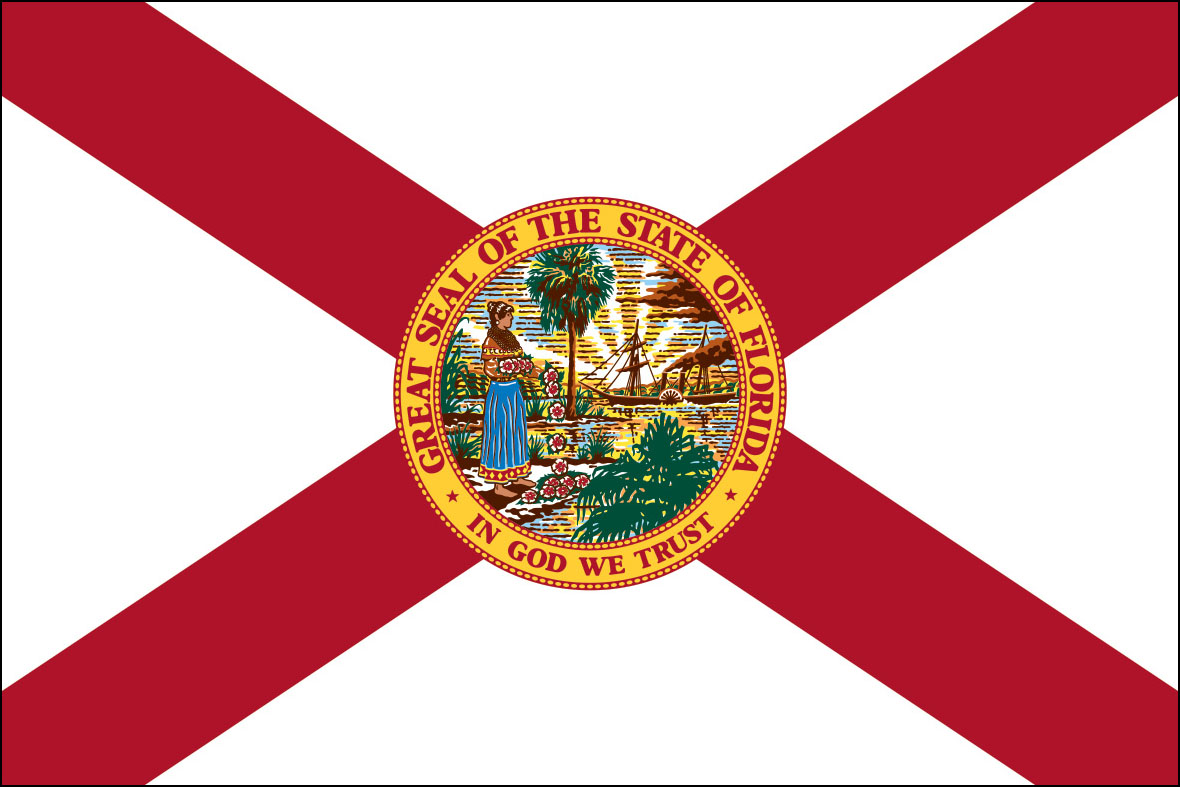
The Protocol and History of Flag Lowering in the Sunshine State
The practice of lowering flags is governed by a strict set of rules known as the Flag Code. While these federal guidelines provide the foundation for how the national banner is treated, Florida also maintains its own specific traditions regarding the state flag. The sight of a flag at half-staff is never an accident; it is a calculated gesture of statecraft and historical recognition.
The Authority of the Governor of Florida
In the Sunshine State, the primary authority to order flags to half-staff at state buildings and grounds rests with the Governor of Florida. This power is typically exercised through official proclamations issued from the capital city of Tallahassee. These orders are not limited to the grounds of the Governor’s Mansion; they extend to all local and state government facilities, including courthouses, city halls, and public schools.
The governor may issue these orders to honor the passing of significant public figures, such as former governors, members of the Florida Cabinet, or distinguished members of the Florida Legislature. Additionally, flags are frequently lowered to honor Florida residents who have died in the line of duty while serving in the armed forces or as first responders. These proclamations often detail the specific period of mourning, ranging from a single day to a full week, depending on the status of the individual or the magnitude of the event being remembered.
Federal vs. State Mandates
While the Governor of Florida controls state-specific observances, the President of the United States can issue national proclamations that apply to all states and territories. When a national mandate is issued—such as for Memorial Day, Patriot Day, or the passing of a national figure like a former President—the flags at landmarks like the Kennedy Space Center and Everglades National Park are lowered in unison.
There is a unique choreography involved in this process. According to protocol, the flag should be first hoisted to the peak for an instant and then lowered to the half-staff position. Before it is lowered for the day, it should again be raised to the peak. This ritual is observed meticulously at historic sites such as Fort San Marcos and other coastal fortifications that have stood as sentinels over Florida for centuries.
Architectural and Historical Landmarks as Sites of Mourning
The physical locations where flags are lowered often add a layer of historical depth to the act of mourning. In Florida, the architecture of the state’s most famous landmarks provides a somber and dignified setting for these observances.
The Florida State Capitol Complex
Nowhere is the tradition of flag protocol more visible than at the Florida State Capitol in Tallahassee. The complex itself is a study in architectural evolution, featuring the modern 22-story executive office building and the historic Old Capitol Building, which has been restored to its 1902 appearance.
When flags are lowered here, they are framed by the neoclassical columns of the old building and the stark, modernist lines of the new tower. The Old Capitol Building serves as a museum of Florida political history, and the sight of the flag at half-staff there serves as a bridge between the state’s past and present. Nearby, the Florida Supreme Court and the Knott Building also participate in these observances, creating a “capitol hill” environment where the collective weight of the state’s respect is felt by all who visit.
Military Monuments and Honor Walls
Beyond the administrative centers, Florida is home to numerous landmarks dedicated specifically to the memory of those who served. The Florida Vietnam Veterans Memorial, located across from the capitol, features two 15-foot high marble pylons inscribed with the names of Floridians who died or are missing in action. When flags fly at half-staff near this monument, the gesture honors the specific sacrifices represented by the names etched in stone.

Similarly, in Pensacola, known as the “Cradle of Naval Aviation,” flags at the National Naval Aviation Museum and the Pensacola Lighthouse frequently fly at half-staff. These sites are landmarks of national importance, and the flag protocol there reflects the deep military heritage of the Florida Panhandle. The Wall of Honor at various veterans’ parks across the state, from Jacksonville to Tampa, further underscores the connection between the physical landmark and the symbolic act of lowering the colors.
Significant Events and Figures Honored in Florida’s History
The reasons for flag-lowering in Florida are as varied as the state’s history itself. While some dates are fixed on the calendar, others are reactive to the unfolding story of the region.
Honoring Public Servants and Fallen Heroes
Florida has a long-standing tradition of honoring those who dedicate their lives to public service. This includes not only political leaders but also the men and women of law enforcement and emergency services. When a law enforcement officer falls in the line of duty in a city like Orlando or Fort Lauderdale, the governor may direct that flags in those counties—or across the entire state—be lowered.
Historic figures who have shaped the Florida Heritage Trail are also commemorated. For example, the passing of civil rights icons or pioneering educators who influenced the cultural fabric of Daytona Beach or Eatonville may trigger a period of mourning. These acts of remembrance ensure that the legacy of those who built the state’s institutions is not forgotten by the millions of people who visit these landmarks annually.
Commemorating National Tragedies and Triumphs
Florida is often at the center of national events, both tragic and triumphant. The state observes Pearl Harbor Remembrance Day with flags at half-staff to honor the lives lost during the 1941 attack. Given Florida’s strategic importance during World War II and its numerous historic bases, this day holds particular significance.
The Kennedy Space Center on Merritt Island is another site where flag protocol is deeply emotional. The flags here are lowered to commemorate the crews of the Challenger and Columbia shuttles. These landmarks are not just tourist attractions; they are hallowed grounds where the quest for human knowledge met with profound sacrifice. When the flags at the Space Mirror Memorial are lowered, it serves as a reminder to the world of the risks inherent in exploration.
The Symbolism of Flags Across Florida’s Diverse Landscape
From the mangroves of the south to the rolling hills of the north, the lowering of the flag transforms the visual narrative of Florida’s most famous natural and man-made landmarks.
From St. Augustine to Miami
In St. Augustine, the oldest continuously inhabited European-established settlement in the United States, the flag flies over the Castillo de San Marcos. Seeing the flag at half-staff against the coquina walls of this 17th-century fortress creates a striking contrast. It reminds visitors that while the stone and mortar of the fortress have survived for centuries, the people who defended and built the nation are mortal.
As one moves south toward the high-energy skyline of Miami, the flag at half-staff takes on a different architectural context. It may fly at half-staff over the Freedom Tower, a landmark that served as the “Ellis Island of the South” for Cuban refugees. Here, the lowered flag symbolizes the state’s role as a haven for those seeking liberty and the shared grief when that liberty or its defenders are threatened.
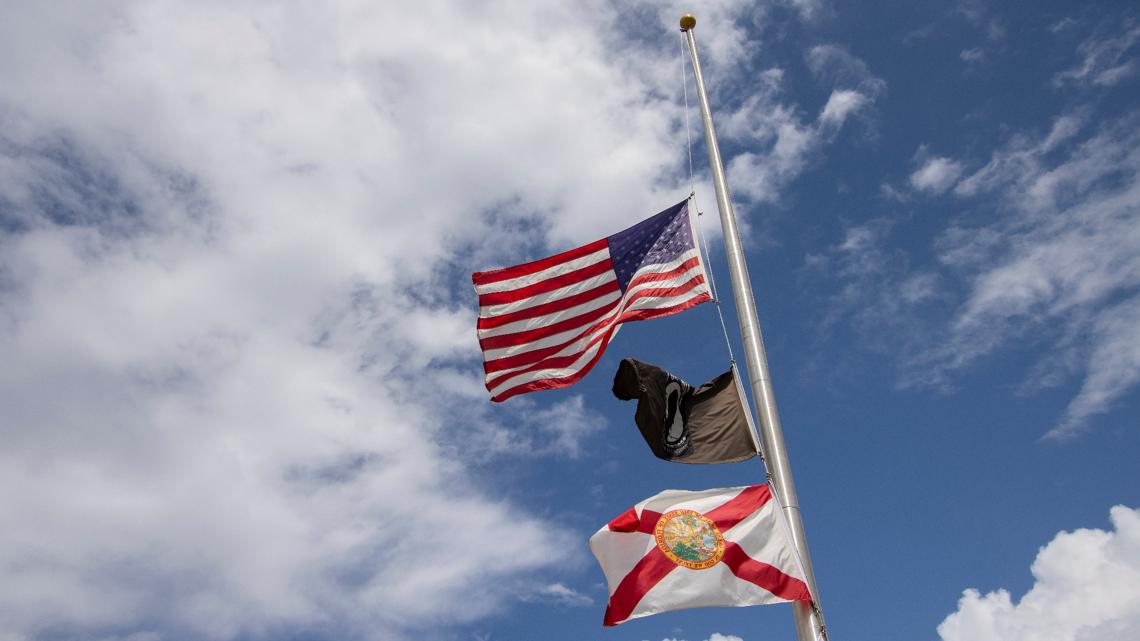
Flag Protocol in Coastal and Marine Landmarks
Florida’s relationship with the water is also reflected in its flag traditions. In the Florida Keys, flags fly over historic sites like Fort Zachary Taylor in Key West. At Dry Tortugas National Park, located nearly 70 miles west of Key West, the flag at Fort Jefferson is one of the most remote places in the country to observe half-staff protocol.
The sight of a lowered flag at a lighthouse, such as the Jupiter Inlet Lighthouse or the St. Augustine Lighthouse, carries a unique weight. These structures were built to guide and save lives; when they display a sign of mourning, it resonates with the maritime community’s long history of facing the perils of the sea. Whether it is a tribute to a fallen Coast Guard member or a remembrance of a hurricane’s impact on the Lake Okeechobee region, the flag remains the state’s most versatile and visible tool for communication.
In conclusion, when you see the flags at half-staff in Florida, you are witnessing a tradition that connects the physical landmarks of the state—from the Florida State Capitol to the Biscayne National Park—to the broader story of the United States. It is a gesture that transcends politics, focusing instead on the shared values of respect, honor, and historical continuity that define the Sunshine State. Each time the colors are lowered, Florida pauses to acknowledge its past and honor the individuals who have left an indelible mark on its landscape and its people.
LifeOutOfTheBox is a participant in the Amazon Services LLC Associates Program, an affiliate advertising program designed to provide a means for sites to earn advertising fees by advertising and linking to Amazon.com. Amazon, the Amazon logo, AmazonSupply, and the AmazonSupply logo are trademarks of Amazon.com, Inc. or its affiliates. As an Amazon Associate we earn affiliate commissions from qualifying purchases.