
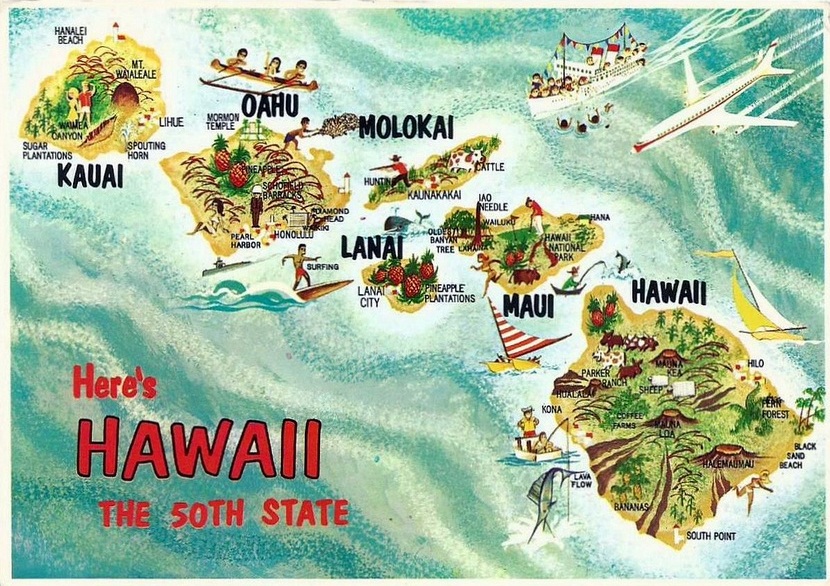
The allure of Hawaii today is undeniable. With its pristine beaches, volcanic landscapes, vibrant culture, and world-class resorts, it stands as a dream destination for travelers worldwide. Yet, beneath the serene surface of this Pacific Ocean paradise lies a rich, complex, and often tumultuous history that shaped its destiny, culminating in its status as the 50th state of the United States. The journey from an independent kingdom to an American state was not a simple one; it was a saga marked by exploration, foreign influence, economic ambition, political upheaval, and a fervent fight for self-determination. Understanding “Why Did Hawaii Become A State?” requires delving into centuries of historical events, tracing the pivotal moments that transformed this isolated archipelago into a cornerstone of American identity.
From Ancient Kingdoms to Western Influence
The story of Hawaii begins long before Western contact, with courageous Polynesian navigators who journeyed thousands of miles across the ocean, settling the islands over a millennium ago. These early inhabitants developed a sophisticated society, rich in oral traditions, intricate social structures, and a deep reverence for the land and sea. They established distinct chiefdoms across the islands, each with its own customs and leadership.
The Unification of the Islands
By the late 18th century, these various chiefdoms were brought under a single rule through the formidable efforts of King Kamehameha I. Through a combination of strategic alliances, military prowess, and the acquisition of Western weaponry, Kamehameha successfully unified the islands by 1810, establishing the sovereign Kingdom of Hawaii. This period marked a significant turning point, bringing an end to centuries of inter-island conflict and laying the foundation for a unified Hawaiian nation that would interact with the burgeoning global powers. The stability offered by the unified kingdom allowed for cultural flourishing and a more structured approach to foreign relations.
The arrival of Captain James Cook in 1778 profoundly altered the trajectory of Hawaii’s history. While initially friendly, this contact opened the door to increased interaction with Europe and America. Whalers, traders, and missionaries soon followed, bringing with them new technologies, diseases, and ideologies that would irrevocably change Hawaiian society. The initial encounters were often characterized by curiosity and trade, but they also introduced new pressures on the indigenous population and their way of life.
The Rise of Foreign Influence and Economic Interests
The 19th century saw a dramatic increase in Western influence. American Protestant missionaries arrived in 1820, bringing not only Christianity but also Western education, writing systems, and political ideas. While their contributions were significant in terms of literacy and the codification of the Hawaiian language, their presence also subtly eroded traditional beliefs and social structures. Simultaneously, the islands’ strategic location in the Pacific Ocean made them a crucial hub for whaling and maritime trade, attracting merchants and entrepreneurs from various nations.
However, it was the burgeoning sugar industry that truly cemented foreign economic interests in Hawaii. American businessmen, many of them descendants of early missionaries, began acquiring vast tracts of land for sugar cane cultivation. This industry required significant labor, leading to waves of immigration from China, Japan, the Philippines, and Portugal, creating a diverse, multi-ethnic population but also a complex social hierarchy where foreign plantation owners held considerable power.
The economic ties to the United States deepened with the Reciprocity Treaty of 1875. This agreement allowed Hawaiian sugar to enter the U.S. market duty-free, providing a massive boon to the plantation owners and further integrating Hawaii into the American economic sphere. In return, the United States gained preferential access to Hawaiian ports, including the exclusive right to establish a naval base at Pearl Harbor on Oahu. This treaty, while economically beneficial to some, underscored Hawaii’s growing dependence on the U.S. and its strategic importance for American geopolitical interests.
The Overthrow of the Monarchy and the Path to Annexation
As foreign economic power grew, so did political influence, leading to increasing tensions between the native Hawaiian monarchy and a powerful bloc of American and European businessmen and planters.
Growing Tensions and Political Machinations
The late 19th century was a period of intense political struggle. The foreign business community, often referred to as “sugar lords,” sought to limit the power of the monarchy and expand their own influence, believing that a closer relationship with the United States would secure their economic interests. This culminated in the infamous Bayonet Constitution of 1887. Forced upon King Kalākaua by an armed militia, this document drastically stripped the monarchy of its executive authority, disenfranchised many native Hawaiians and Asian immigrants, and granted voting rights primarily to wealthy property owners, many of whom were American or European.
Upon her accession in 1891, Queen Liliʻuokalani recognized the precarious position of her kingdom. She was a strong proponent of native Hawaiian sovereignty and sought to restore the monarchy’s power and amend the Bayonet Constitution to give more rights back to her people. Her efforts, however, were perceived as a threat by the powerful foreign-backed elite, who were determined to push for annexation by the United States.
The Overthrow and the Republic
On January 17, 1893, a group of American and European businessmen, supported by armed U.S. Marines from the USS Boston, orchestrated a coup d’état against Queen Liliʻuokalani. Though the landing of the Marines was ostensibly to protect American lives and property, their presence intimidated the royalist forces and effectively ensured the success of the overthrow. The Queen, to avoid bloodshed, yielded her authority under protest, appealing to the United States for justice.
Following the overthrow, the conspirators established a provisional government, which soon became the Republic of Hawaii in 1894, with Sanford B. Dole, a prominent American lawyer and businessman, serving as its first and only president. Their primary goal was immediate annexation by the United States. However, the move was controversial. U.S. President Grover Cleveland initially opposed annexation, deeming the overthrow an illegal act, and even attempted to restore the Queen to her throne, though his efforts ultimately failed due to the provisional government’s refusal to step down.
Annexation by the United States
The tide turned with the election of President William McKinley, who was a staunch advocate for American expansionism. The outbreak of the Spanish-American War in 1898 provided the critical impetus for annexation. Hawaii’s strategic military importance, particularly its deep-water harbor at Pearl Harbor, became acutely evident as a crucial coaling station and naval base for U.S. operations in the Pacific.
With growing public support and a clear strategic advantage, the United States Congress passed the Newlands Resolution, effectively annexing Hawaii as a U.S. territory on July 7, 1898. The formal transfer of sovereignty occurred on August 12, 1898, marking the end of the independent Hawaiian nation and the beginning of its territorial period under the American flag. This event, while celebrated by many in the United States and by the planter class in Hawaii, was a profound loss for native Hawaiians, who had seen their sovereignty usurped.

The Long Road to Statehood
For over six decades, Hawaii operated as an organized territory of the United States, governed under the Hawaiian Organic Act of 1900. While its residents were U.S. citizens, they lacked full representation in Congress and could not vote in presidential elections, fueling a persistent drive for statehood.
A Territory Under the American Flag
During the territorial period, Hawaii underwent significant development. The sugar and pineapple industries flourished, making Hawaii a vital agricultural contributor to the U.S. economy. Infrastructure improved, and the military presence at Pearl Harbor expanded dramatically, making it the central hub for the U.S. Pacific Fleet. This military buildup further cemented Hawaii’s strategic importance but also led to a complex interplay of civilian and military authority.
The diverse population continued to grow, with a rich mix of Native Hawaiians, Caucasians, Japanese, Chinese, Filipinos, and Portuguese. While this cultural melting pot contributed to the unique identity of the islands, it also presented challenges, including racial prejudice and socio-economic disparities, which were often cited as arguments against statehood by those who feared a “non-white” state.
World War II and its Impact
The defining moment for Hawaii during its territorial status, and a major catalyst for statehood, was the attack on Pearl Harbor on December 7, 1941. This devastating surprise attack by the Empire of Japan plunged the United States into World War II and placed Hawaii squarely on the global stage. The immediate aftermath saw the imposition of martial law across the islands, a stark reminder of their vulnerable position as a territory.
However, the war also showcased the loyalty and patriotism of Hawaii’s diverse population. Thousands of residents, including many of Japanese ancestry who faced intense scrutiny and discrimination on the mainland, bravely served in the U.S. armed forces, often distinguishing themselves with valor, such as the famed 442nd Regimental Combat Team. Their sacrifices and unwavering commitment to the United States helped dispel lingering doubts about the “Americanism” of Hawaii’s diverse populace, greatly strengthening the moral and political arguments for statehood.
The Post-War Push for Statehood
After World War II, the push for statehood gained undeniable momentum. Supporters argued that it was fundamentally undemocratic for American citizens in Hawaii to be denied full voting rights and representation simply because of their geographic location. They emphasized that Hawaii was economically self-sufficient, strategically vital, and culturally mature enough to govern itself as a state. Prominent figures like Delegate Joseph Farrington tirelessly lobbied the United States Congress for decades, presenting compelling cases for admission.
Opponents of statehood, however, raised concerns about Hawaii’s distance from the mainland, its unique multi-ethnic population (which some viewed as too “Oriental” to be truly American), and fears that its economy would not be robust enough. There were also underlying anxieties about potential communist influence, particularly given labor disputes in the post-war period. These arguments, often thinly veiled prejudices, gradually lost their sway in the face of compelling evidence of Hawaii’s contributions and its population’s deep integration into the American fabric.
The Birth of the 50th State
The culmination of decades of advocacy, changing political tides, and the unwavering resolve of the Hawaiian people finally led to the realization of statehood.
The Alaska Precedent and Congressional Approval
The admission of Alaska as the 49th state in January 1959 played a crucial role in paving the way for Hawaii. Congress had often linked the two territories, seeing them as geographically distant but strategically important outliers. Once Alaska’s statehood was approved, it became increasingly difficult to deny Hawaii’s similar aspirations.
On March 12, 1959, the United States Congress passed the Hawaii Admission Act, and President Dwight D. Eisenhower signed it into law on March 18, 1959. This Act required the people of Hawaii to vote on a referendum to accept the terms of statehood. The referendum, held on June 27, 1959, resulted in an overwhelming approval, with over 94% of voters choosing statehood. This landslide victory demonstrated the clear desire of the islands’ residents to become full and equal participants in the American union.
A New Era
On August 21, 1959, President Dwight D. Eisenhower issued Proclamation 3309, officially declaring Hawaii the 50th state of the United States. The news was met with widespread jubilation across the islands. Celebrations erupted in Honolulu and throughout the archipelago, marking the end of a long and often challenging journey.
Statehood brought immediate and profound changes. Hawaii gained full representation in Congress with two senators and one representative, along with the right to participate in presidential elections. The economy, previously dominated by agriculture, began a significant pivot towards tourism, which would quickly become its largest industry. The newfound national attention and improved infrastructure made Hawaii more accessible than ever, transforming it into the iconic travel destination we know today, celebrated for its unique blend of American modernity and ancient Polynesian heritage.

Conclusion
The question “Why Did Hawaii Become A State?” unravels a captivating narrative of power, diplomacy, economics, and identity. From its origins as a unified kingdom under King Kamehameha I, through the impactful arrival of Captain James Cook and subsequent foreign influence, the islands navigated a complex path. The overthrow of Queen Liliʻuokalani’s monarchy by American businessmen, followed by the strategic annexation by the United States amidst the Spanish-American War, fundamentally reshaped Hawaii’s political landscape.
The decades as a U.S. territory, punctuated by the pivotal events of World War II and the attack on Pearl Harbor, solidified the arguments for full integration. The unwavering loyalty of its diverse population, combined with persistent lobbying efforts, ultimately overcame congressional hesitations and prejudices, culminating in the Hawaii Admission Act of 1959.
Today, Hawaii stands as a vibrant testament to this layered history. Its landmarks, from the solemn memorials of Pearl Harbor to the historic ʻIolani Palace (the only royal palace in the United States), tell tales of a profound past. Its unique local culture, a blend of indigenous traditions and influences from successive waves of immigration, offers an enriching experience for visitors. While the statehood journey was fraught with challenges and continues to be viewed with varying perspectives, particularly among native Hawaiians who advocate for sovereignty, it is an undeniable chapter in the American story, shaping Hawaii into the extraordinary state and sought-after destination it is today. Its history reminds us that every place, no matter how idyllic, holds a narrative woven with diverse threads of human ambition, resilience, and transformation.
LifeOutOfTheBox is a participant in the Amazon Services LLC Associates Program, an affiliate advertising program designed to provide a means for sites to earn advertising fees by advertising and linking to Amazon.com. Amazon, the Amazon logo, AmazonSupply, and the AmazonSupply logo are trademarks of Amazon.com, Inc. or its affiliates. As an Amazon Associate we earn affiliate commissions from qualifying purchases.