
The narrative of Hawaii is often told through the lens of sun-drenched beaches and volcanic landscapes, yet the history of these Pacific Ocean islands is inextricably linked to the complex, often contentious, political machinery of the United States. One of the most pivotal moments in this transition—a moment that briefly stalled the inevitability of American expansionism—was the staunch refusal of President Grover Cleveland to annex the islands in 1893. To understand this decision, one must look at the intersection of international law, moral integrity, and the volatile climate of the late 19th-century Kingdom of Hawaii.
The Overthrow of the Monarchy
In early 1893, the political stability of Honolulu was shattered. A group of American sugar planters and business leaders, supported by the presence of United States Marines, orchestrated the overthrow of Queen Liliuokalani. The coup was swift and effectively sidelined the sovereign authority of the Hawaiian Islands.
The Role of Business Interests
The catalyst for this upheaval was largely economic. The sugar industry, which dominated the Hawaiian economy, was facing uncertainty under the McKinley Tariff. By annexing the islands, these business magnates stood to gain duty-free access to the American market, effectively turning the kingdom into a domestic territory.
The Diplomatic Misstep
The American Minister to Hawaii, John L. Stevens, acted with uncharacteristic boldness. He authorized the landing of U.S. troops from the USS Boston, purportedly to protect American life and property, but in reality, his actions provided the necessary military intimidation to force the Queen’s abdication. The provisional government, led by Sanford B. Dole, immediately sought recognition and annexation from Washington D.C..
Grover Cleveland’s Moral Reappraisal
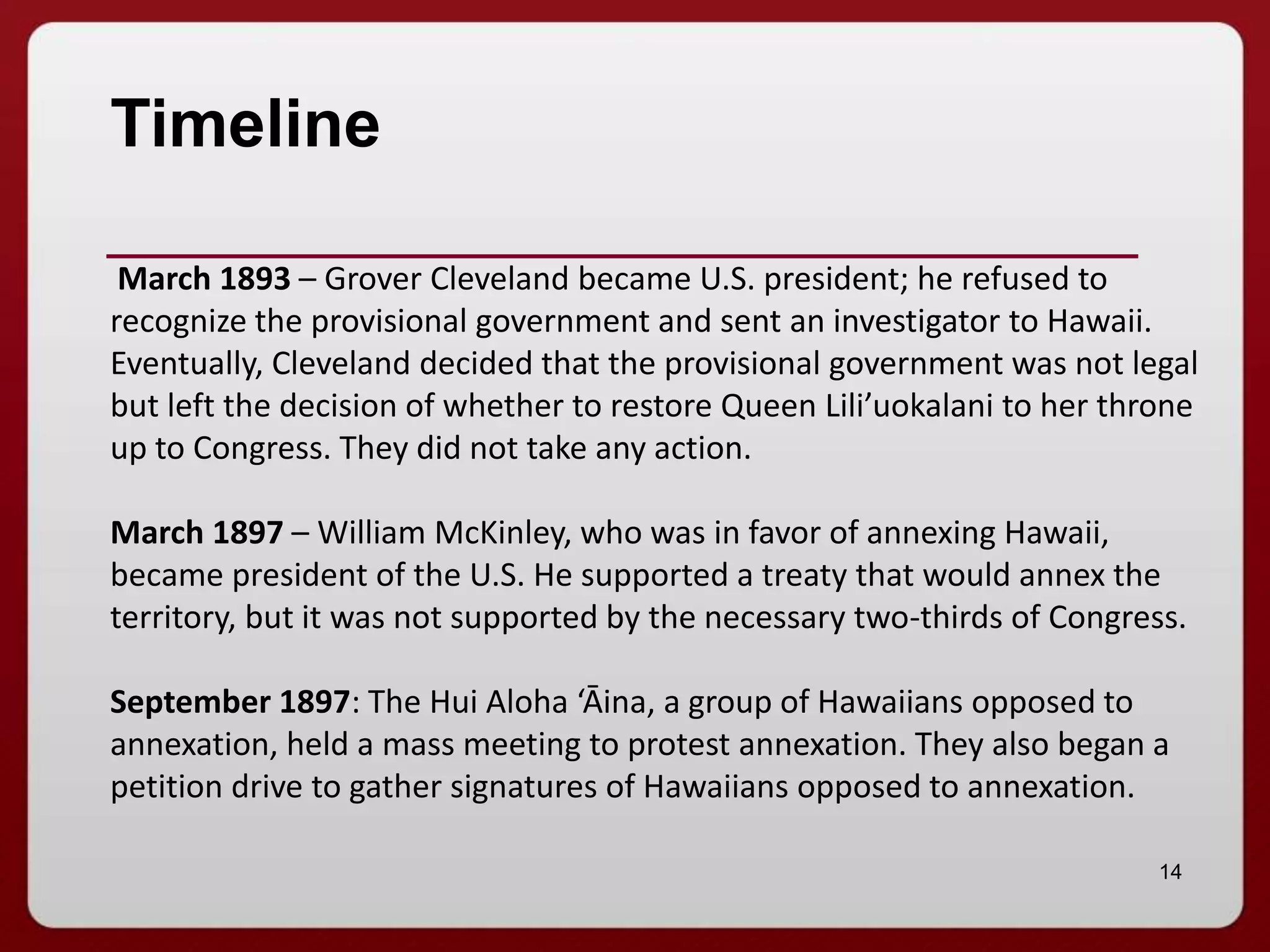
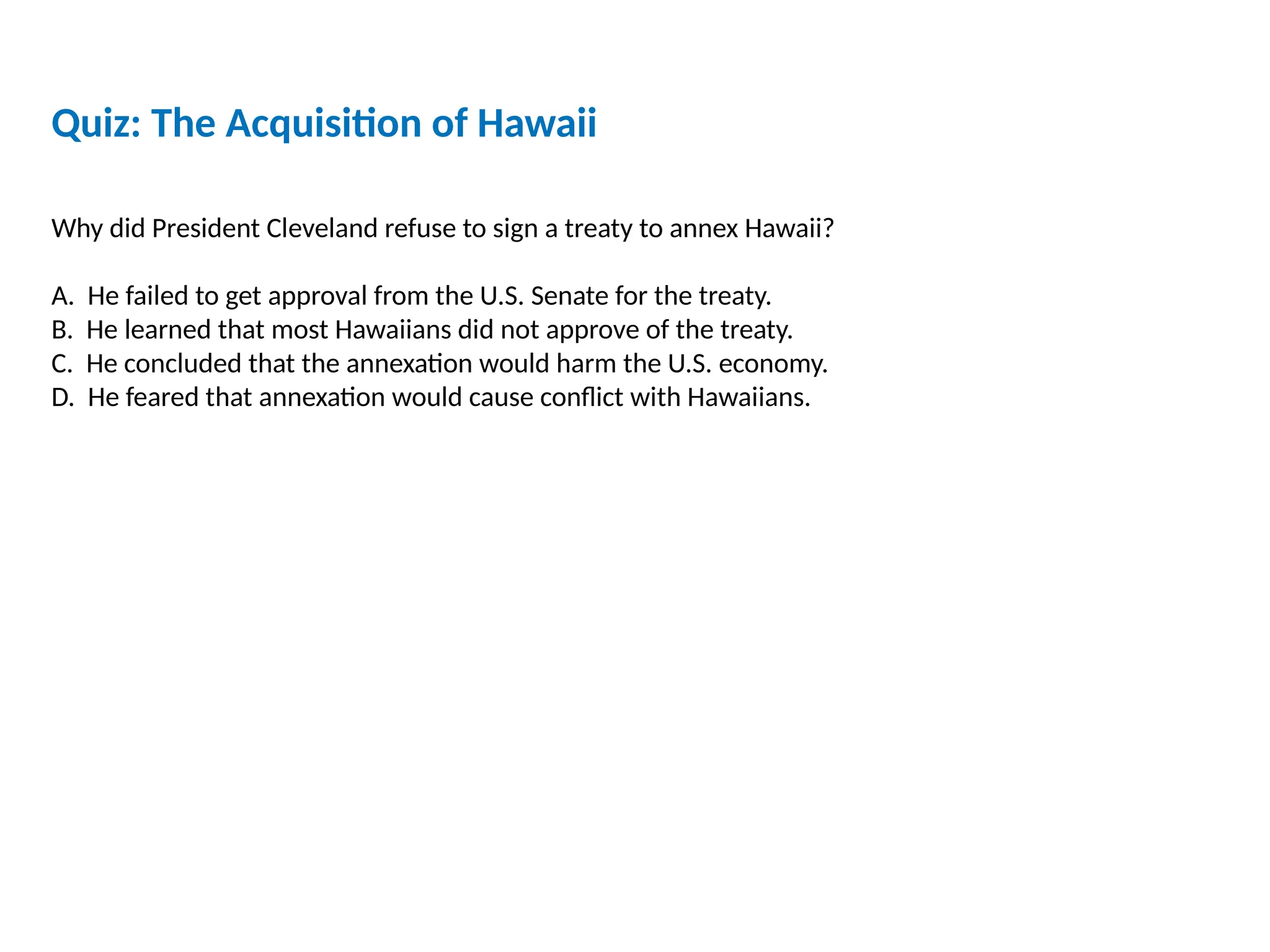
When Grover Cleveland assumed the presidency for his second term, he inherited a treaty of annexation pending before the United States Senate. Unlike his predecessor, Benjamin Harrison, who had moved quickly to support the coup, Cleveland harbored deep reservations about the legitimacy of the proceedings.
The Blount Report
Seeking to uncover the truth, Cleveland dispatched James Henderson Blount to conduct an exhaustive investigation. The resulting report was a stinging indictment of American interference. Blount concluded that the overthrow was not a popular uprising of the people, but rather a conspiracy involving American diplomatic and military personnel who had acted without proper authorization from their government.

A Violation of International Principles
Cleveland viewed the actions in Hawaii as a profound betrayal of the principles of national sovereignty. In his address to Congress, he famously stated that the United States had committed an act of war against a friendly nation. For Cleveland, the morality of the annexation was the central issue; he believed that the United States could not rightfully acquire territory through the illegitimate displacement of a sitting monarch who enjoyed the loyalty of her people.
The Consequences of Temporary Stasis
By refusing to submit the treaty to the Senate, Cleveland effectively blocked the immediate annexation of Hawaii. This created a period of limbo for the Hawaiian Islands, where the provisional government—and later the Republic of Hawaii—remained in power, though they lacked the full endorsement of the United States government.
Straining Relations with the Local Government
The refusal deeply angered the American interests in Honolulu. The local planters felt that their strategic and economic investments were being undermined by the whims of a president thousands of miles away. Sanford B. Dole and his contemporaries were forced to consolidate their power without formal American protection, a state of affairs they found intolerable.
The Impact on Indigenous Sovereignty
For Queen Liliuokalani, Cleveland’s stance offered a flicker of hope, though it proved insufficient to restore her throne. The refusal slowed the momentum of the annexationists and highlighted the plight of the native population to the international community. It remains a rare instance in American history where a leader actively chose to reject territorial expansion on ethical grounds rather than strategic ones.
The Eventual Shift toward Annexation
Despite Cleveland’s principled stand, the forces of Manifest Destiny and the changing geopolitical landscape proved impossible to hold back indefinitely.
The Influence of Global Conflict
The Spanish-American War in 1898 fundamentally altered the American view of the Pacific Ocean. The need for a mid-Pacific coaling station and naval base became a strategic imperative. The USS Philadelphia, along with other naval assets, demonstrated how crucial a stable, American-controlled port would be for Pacific operations.
The New Administration
When William McKinley succeeded Grover Cleveland, the political winds shifted. McKinley, unlike his predecessor, was an ardent expansionist who viewed the acquisition of Hawaii as a crucial step for the country’s emergence as a global power. The annexation was finally pushed through via the Newlands Resolution, a joint resolution of Congress that required only a simple majority rather than the two-thirds vote required for a treaty.
A Lasting Historical Debate
The refusal of Cleveland to annex Hawaii remains a subject of intense study. It serves as a reminder of the tension between moral governance and national interest. Today, visitors to Iolani Palace can witness the remnants of this era, reflecting on the complex narrative of a kingdom that was once a sovereign state and the complicated path that led it to become the 50th state of the United States. Cleveland’s choice was a rare moment of restraint, one that forced the American public to confront the uncomfortable reality of how its borders were being expanded, and at what cost to the autonomy of others. Even as Hawaii stands today as a central pillar of American tourism and culture, the ghost of this historical debate lingers in the preservation of the Polynesian heritage and the ongoing discussions regarding sovereignty and history.
LifeOutOfTheBox is a participant in the Amazon Services LLC Associates Program, an affiliate advertising program designed to provide a means for sites to earn advertising fees by advertising and linking to Amazon.com. Amazon, the Amazon logo, AmazonSupply, and the AmazonSupply logo are trademarks of Amazon.com, Inc. or its affiliates. As an Amazon Associate we earn affiliate commissions from qualifying purchases.