
The story of how Hawaii became a part of the United_States is not merely a tale of geographic expansion; it is a complex narrative of economic ambition, strategic military necessity, and a clash of cultural ideologies. For the modern traveler walking the historic streets of Honolulu or visiting the solemn memorials of Pearl Harbor, understanding this history transforms these landmarks from simple tourist stops into profound testaments of a turning point in global history. The annexation of the islands in 1898 marked the first major foray of the American republic into overseas imperialism, forever altering the destiny of the Pacific Ocean region.
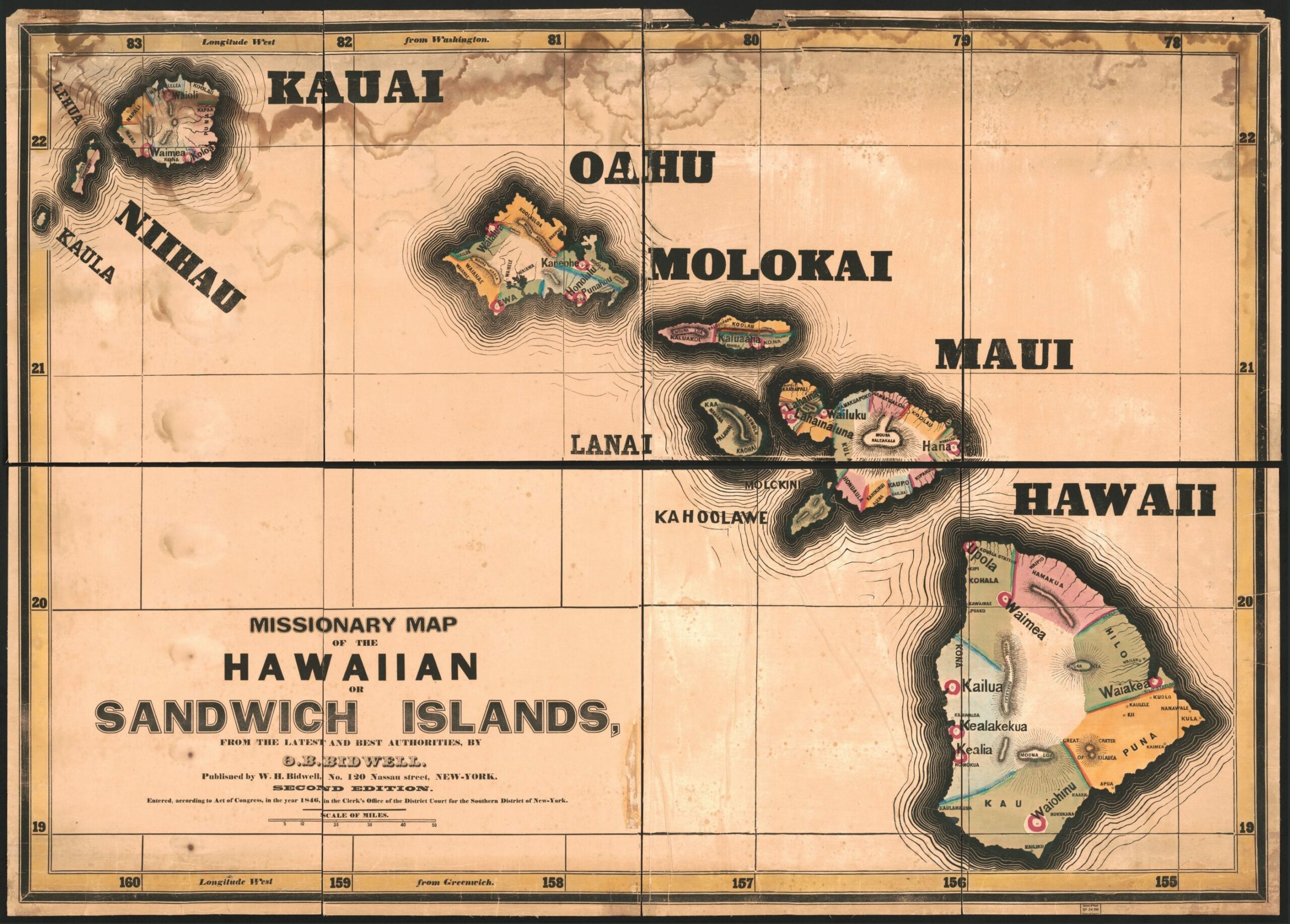
The Economic and Strategic Impetus
Long before the official annexation, the relationship between the United States and the Hawaiian Kingdom was defined by the lucrative sugar trade. By the mid-19th century, American businessmen had established vast plantations across Oahu, Maui, and Kauai. These entrepreneurs, many of whom were the descendants of early Christian missionaries, became a powerful political and economic force within the islands.
The Golden Age of Sugar and the Reciprocity Treaty
The turning point for the economic integration of the two nations came with the Reciprocity Treaty of 1875. This agreement allowed Hawaiian sugar to enter the United States duty-free, providing an immense boost to the island’s economy but also creating a dangerous dependency. As the sugar industry boomed, the American planters’ influence grew, leading them to seek more control over the local government to protect their investments.
However, the economic landscape shifted dramatically with the McKinley Tariff of 1890, passed in Washington DC. This act removed the duty-free status of Hawaiian sugar and provided a subsidy to domestic American producers. Suddenly, Hawaiian-grown sugar was more expensive than its competitors in California and Louisiana. The sugar barons realized that if Hawaii were to be annexed and become a territory, their sugar would once again be considered “domestic,” saving them from financial ruin. This economic desperation became a primary driver for the eventual overthrow of the monarchy.
Pearl Harbor: The Key to the Pacific
Beyond the sugar fields, the United States Navy had long recognized the strategic value of the islands. Situated halfway between North America and Asia, Hawaii was the “Crossroads of the Pacific.” In 1887, an amendment to the Reciprocity Treaty granted the United States exclusive rights to use Pearl Harbor as a coaling and repair station for its ships.
Military leaders argued that controlling the islands was essential for the protection of the West Coast, particularly for cities like San Francisco and Seattle. Without a permanent base in the central Pacific, the American fleet would be unable to project power toward Japan or China. This geopolitical reality meant that annexation was not just a matter of trade, but a cornerstone of emerging American naval doctrine.
The Fall of the Monarchy and the 1893 Coup
The push for annexation reached a fever pitch during the reign of King Kalakaua and his successor, Queen Liliuokalani. The conflict between the traditional sovereignty of the Hawaiian people and the interests of the American-descended “Missionary Party” culminated in one of the most controversial events in Pacific history.
The Bayonet Constitution and the Committee of Safety
In 1887, an armed militia forced King Kalakaua to sign what became known as the Bayonet Constitution. This document severely limited the power of the monarch and disenfranchised much of the native Hawaiian population by imposing property and income requirements for voting. When Queen Liliuokalani ascended to the throne in 1891, she sought to restore power to the monarchy and the people through a new constitution.
In response, a group of thirteen men—largely of American and European descent—formed the Committee of Safety. Their goal was the total overthrow of the kingdom and immediate annexation by the United States. On January 17, 1893, with the unauthorized support of John L Stevens, the American Minister to Hawaii, and the landing of troops from the USS Boston, the committee staged a coup.
Queen Liliuokalani’s Resistance
To avoid bloodshed, Queen Liliuokalani surrendered under protest. She famously stated that she was yielding her authority not to the provisional government, but to the “superior force of the United States.” She believed that once the facts were known in Washington DC, the American government would restore her to the throne.
President Grover Cleveland, an anti-imperialist, was indeed appalled by the actions of the Committee of Safety and Minister John L Stevens. He commissioned the Blount Report, which concluded that the overthrow was illegal and that the native population did not support it. However, the provisional government, led by Sanford B Dole, refused to step down, declaring Hawaii a Republic in 1894 and waiting for a more sympathetic administration to take power in the United States.
Global Conflict and the Newlands Resolution
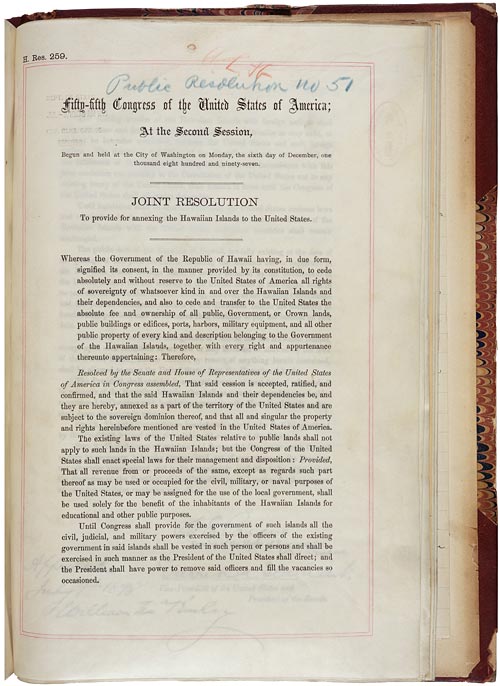
The tide turned in favor of the annexationists with the election of President William McKinley and the outbreak of the Spanish-American War in 1898. Suddenly, the strategic arguments that had been circulating for decades became urgent national security priorities.
The Spanish-American War as a Catalyst
When the United States went to war with Spain, the theater of operations expanded rapidly to the Philippines and Guam. The need for a mid-Pacific refueling station for troops and supplies heading to Manila became undeniable. Military planners argued that the United States could not afford to leave Hawaii as a neutral or potentially hostile independent republic.
President William McKinley argued that annexation was a “manifest destiny” for the nation. He famously told his secretaries, “We need Hawaii just as much and a good deal more than we did California. It is manifest destiny.” The war provided the necessary political cover to bypass the standard treaty process, which required a two-thirds majority in the Senate—a threshold the annexationists could not reach due to strong opposition from those who viewed imperialism as a violation of American democratic principles.
The Newlands Resolution of 1898
Instead of a treaty, the annexation was accomplished via the Newlands Resolution, a joint resolution of Congress that required only a simple majority. Despite a massive petition signed by over 21,000 native Hawaiians (the Kui Heluhelu petitions) protesting the loss of their sovereignty, the resolution passed. On August 12, 1898, in a somber ceremony at Iolani Palace, the Hawaiian flag was lowered, and the Stars and Stripes were raised. Hawaii was officially a territory of the United States.
This moment solidified the American presence in the Pacific and set the stage for the islands’ eventual statehood in 1959. For many, it was a moment of triumph for American expansionism; for others, it was a day of mourning for a stolen nation.
Exploring the Historical Landmarks of Annexation Today
For those visiting the islands today, the physical remnants of this era offer a tangible connection to the past. These landmarks are more than just architectural marvels; they are repositories of the stories, struggles, and spirits of the people who shaped modern Hawaii.
Iolani Palace: The Silent Witness
Located in downtown Honolulu, Iolani Palace is perhaps the most significant landmark related to the annexation. Completed in 1882 by King Kalakaua, it is the only royal palace on American soil. Its “American Florentine” architecture was intended to showcase the kingdom’s modernity and sophistication to the world.
Visitors can tour the throne room where the monarchy was dissolved and see the upstairs bedroom where Queen Liliuokalani was imprisoned for several months following a failed 1895 counter-revolution. Standing on the palace grounds, one can almost hear the echoes of the 1898 ceremony that ended Hawaiian independence. Across the street stands Aliiolani Hale, which served as the seat of government and is now home to the Hawaii State Supreme Court. In front of this building is the iconic statue of King Kamehameha I, a symbol of the unified kingdom that the annexationists eventually dismantled.
Washington Place and the Bishop Museum
A short walk from the palace is Washington Place, the former private residence of Queen Liliuokalani. It was here that she spent her final years as a private citizen, and it remains a place of deep cultural reverence. The home serves as a reminder of the personal toll the political upheaval took on the Hawaiian royal family.
To understand the broader cultural context, a visit to the Bishop Museum is essential. Founded in 1889 by Charles Reed Bishop in memory of his wife, Princess Bernice Pauahi Bishop, the museum houses the world’s premier collection of Hawaiian artifacts. Its exhibits detail the rich history of the Polynesian voyagers, the rise of the Kamehameha dynasty, and the legislative battles of the late 19th century.
Pearl Harbor and the Nuuanu Pali Lookout
While Pearl Harbor is most famous for the events of 1941, its role as a landmark of annexation is equally vital. The USS Arizona Memorial and the Pacific Fleet presence today are the direct results of the strategic decisions made in the 1890s. The harbor stands as the physical manifestation of the military necessity that drove the United States to secure the islands.
Finally, the Nuuanu Pali Lookout offers a panoramic view of the Windward Coast and serves as the site of the 1795 Battle of Nuuanu, where King Kamehameha I won the struggle to unite the islands. Looking out from the cliffs, travelers can reflect on the long arc of Hawaiian history—from a collection of warring chiefdoms to a unified kingdom, and finally to a pivotal state within the United States.
Understanding why the United_States annexed Hawaii requires looking past the palm trees and beaches to the historical landmarks that tell a story of power, profit, and the enduring legacy of a fallen kingdom. Each site, from the halls of Iolani Palace to the decks of the ships in Pearl Harbor, provides a window into a pivotal era that continues to shape the identity of the Aloha State today.
LifeOutOfTheBox is a participant in the Amazon Services LLC Associates Program, an affiliate advertising program designed to provide a means for sites to earn advertising fees by advertising and linking to Amazon.com. Amazon, the Amazon logo, AmazonSupply, and the AmazonSupply logo are trademarks of Amazon.com, Inc. or its affiliates. As an Amazon Associate we earn affiliate commissions from qualifying purchases.