
It is one of the most persistent curiosities for travelers planning a trip to Nevada: how can world-class, luxury resorts located on the world’s most famous strip offer rooms for a fraction of what one would pay in New York City, London, or even San Francisco? At first glance, the pricing model seems counterintuitive. A five-star experience at a property like the Bellagio or Caesars Palace often costs less than a mid-range business hotel in a secondary city. However, the secret lies in a highly calculated business model known as “loss-leader pricing.” In Las Vegas, the room is rarely the product—it is the bait.
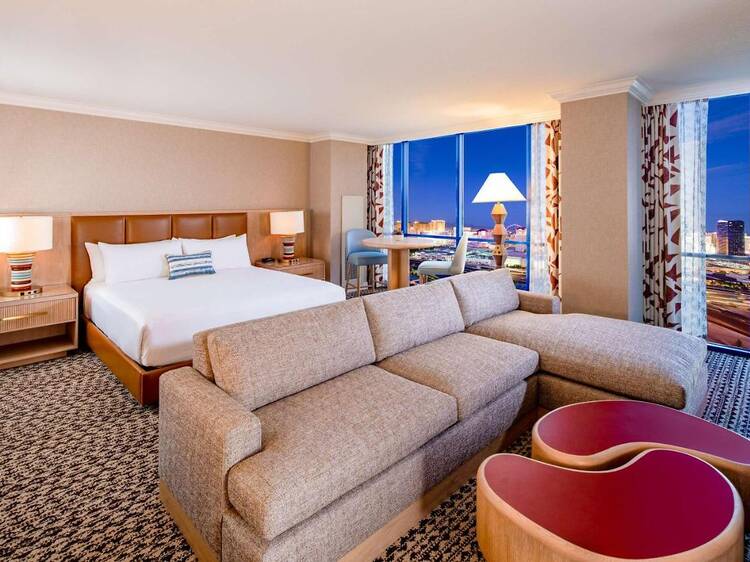
The Loss-Leader Economic Model
In most global tourism markets, hotels make the vast majority of their revenue from room rates. If a hotel cannot cover its operational costs, staff wages, and property maintenance through nightly rates, it will inevitably fail. In the desert oasis of the United States, the math functions differently. For the major gaming corporations, the room is merely a vessel to get a guest onto the property.
The Mathematics of Gaming Revenue
The primary goal of a resort like the MGM Grand or the Wynn Las Vegas is to maximize “share of wallet.” Once a guest has checked into their room, the casino floor becomes the engine of profitability. A guest who saves $200 on their nightly room rate is statistically much more likely to spend that same $200—or significantly more—at the slot machines, blackjack tables, or poker rooms. Casinos rely on high-volume foot traffic, and cheap rooms are the most effective way to guarantee a full house, even during the slower midweek periods.
Ancillary Spending Patterns
Beyond gambling, the integrated resort model captures revenue at every touchpoint. Between the high-end dining, extravagant nightclub entrance fees, Cirque du Soleil performances, and curated poolside experiences, the average visitor spends far more on entertainment and food than they do on their bed. By keeping the barrier to entry (the room rate) low, these properties ensure that guests have more disposable income to spend on the high-margin experiences that define a trip to the Mojave Desert.
Economies of Scale and Property Density
The sheer size of the hotel infrastructure in Las Vegas provides an economy of scale that is difficult for other cities to replicate. Many of the properties here are among the largest hotels in the world. When you operate a building with 3,000 to 5,000 rooms, the overhead cost per room decreases significantly compared to a boutique hotel.

Efficiency of Operational Management
Large resorts utilize centralized purchasing, massive laundry facilities, and shared staffing models that drive down the cost per occupied room. Because these hotels are often grouped under massive corporate umbrellas, such as Caesars Entertainment or MGM Resorts International, they benefit from immense bargaining power with vendors and food suppliers.
The Midweek Vacancy Strategy
One of the most distinct features of this market is the dramatic price fluctuation between weekdays and weekends. During the work week, when Las Vegas is not filled with leisure tourists, hotels aggressively drop prices to fill rooms. A room that costs $500 on a Saturday night might drop to $40 on a Tuesday. The reasoning is simple: a vacant room is a total loss. By pricing rooms low during off-peak times, hotels still generate revenue through gaming, food, and beverage sales that would have been zero if the room had remained empty.
Data-Driven Marketing and Loyalty Programs
The Las Vegas hospitality industry has pioneered the use of predictive analytics to determine guest value. Loyalty programs like Caesars Rewards or MGM Rewards are sophisticated tracking tools. These systems know exactly how much a guest spends, how long they stay, and, most importantly, their “theoretical win”—the mathematical probability of how much they will lose in the casino.
The Role of “Comps”
For high-value players, the “cheap” room often becomes free. Through the system of “comps” (complimentary services), the hotel provides lodging, meals, and show tickets at no cost to the guest. This is not charity; it is a calculated investment. If the internal data suggests a guest will spend thousands of dollars on the casino floor, the resort is happy to provide a luxury suite at the Cosmopolitan of Las Vegas to ensure that guest chooses their property over a competitor. Even for the casual tourist, the data collected from their stay helps the resort tailor offers to bring them back during slower periods, further subsidizing the cost of the room.
The Hidden Costs: Resort Fees and Taxes
While the base rate for a room might look enticingly low, it is important for travelers to recognize that the advertised price is rarely the final price. The proliferation of mandatory “resort fees” has become a standardized practice across the Las Vegas Strip. These fees, which can range from $30 to $50 per night, are often added at checkout to cover amenities like Wi-Fi, fitness center access, and pool usage.
Understanding True Value
These fees serve as a psychological pricing tool. By keeping the nightly room rate low, hotels appear more competitive on search engines like Expedia or Booking.com. The resort fee is then tacked on as a “non-negotiable” cost. While it may feel like a hidden surcharge, it is essentially a way to keep the base rate visible to the consumer low while ensuring the hotel captures enough revenue to cover the cost of the amenities provided.
When planning a stay, it is essential to look at the total “out-the-door” price, including taxes and these mandatory fees. Even with these additions, Las Vegas remains one of the best values for luxury accommodation globally. Whether you are staying at the Venetian Resort or a more budget-friendly option like Flamingo Las Vegas, you are benefiting from a business model that prioritizes volume and ancillary revenue over room-rate maximization. By understanding how these hotels monetize the entire guest experience, you can better navigate the options, find the best deals, and appreciate why this neon-lit city remains a global anomaly in the world of hospitality.
LifeOutOfTheBox is a participant in the Amazon Services LLC Associates Program, an affiliate advertising program designed to provide a means for sites to earn advertising fees by advertising and linking to Amazon.com. Amazon, the Amazon logo, AmazonSupply, and the AmazonSupply logo are trademarks of Amazon.com, Inc. or its affiliates. As an Amazon Associate we earn affiliate commissions from qualifying purchases.