
Navigating the legal landscape of divorce can feel overwhelming, especially when dealing with the intricacies of state-specific procedures. This guide is designed to demystify the process of applying for a divorce in California, providing a clear, step-by-step approach to help you understand your rights and obligations. While this article offers comprehensive information, it is essential to remember that every divorce case is unique, and consulting with a qualified legal professional is always recommended.
Understanding the Grounds for Divorce in California
California is a “no-fault” divorce state. This means that you do not need to prove that your spouse did something wrong to be granted a divorce. Instead, the law recognizes two grounds for dissolution of marriage:

Irreconcilable Differences
This is the most common ground for divorce in California. It simply means that the marriage has broken down to the point where there is no reasonable chance of reconciliation. You do not need to provide specific details or evidence of these differences. A simple assertion that irreconcilable differences exist is sufficient to initiate divorce proceedings.
Legal Insanity
This ground is rarely used and requires a doctor’s certification that one spouse has been legally insane for at least three years immediately preceding the filing of the petition. This is a much more complex and medically-dependent basis for divorce.
Initiating the Divorce Process: Filing the Petition
The first formal step in applying for a divorce in California is to file a Petition for Dissolution of Marriage. This document officially begins the legal process.
Key Documents to File
- Petition — Marriage/Domestic Partnership (Form FL-100): This is the primary document that tells the court you want a divorce. It requires basic information about you, your spouse, your marriage, and any children from the marriage.
- Summons (Family Law — Uniform Parentage) (Form FL-110): This is a legal notice to your spouse that a lawsuit has been filed against them. It informs them of their rights and responsibilities, including the need to respond within a specific timeframe.
- Proof of Service of Summons (Form FL-115): This form is completed after your spouse has been formally served with the petition and summons.
Where to File
These documents must be filed with the Superior Court in the county where you or your spouse has resided for the past three months, and where one of you has lived for the past six months. For example, if you live in Los Angeles County and your spouse lives in Orange County, you can file in either county, provided you meet the residency requirements for that county.
Serving Your Spouse
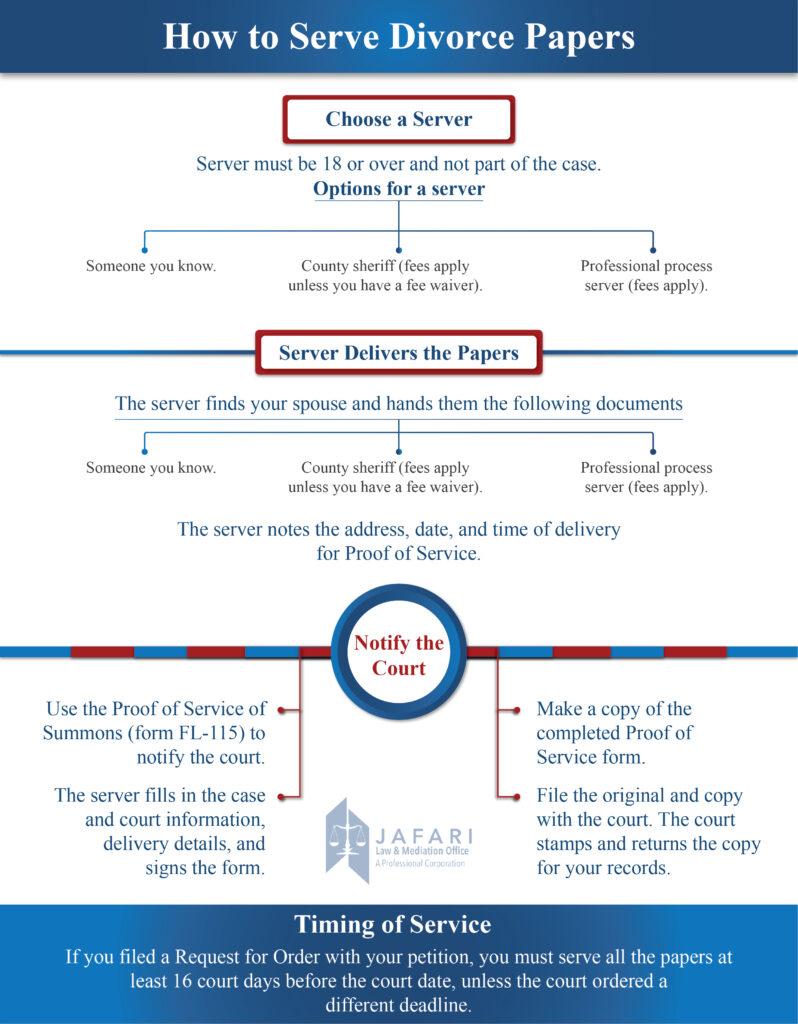
Once you have filed the initial paperwork, your spouse must be formally notified. This is known as “service of process.”
Who Can Serve?
- The documents cannot be served by you.
- Service must be performed by someone who is at least 18 years old and not a party to the case. This can be a friend, family member, professional process server, or the sheriff’s department.
Methods of Service
The most common method is personal service, where the server hand-delivers copies of the filed documents to your spouse. Other methods, such as substituted service or service by mail with a Notice and Acknowledgment of Receipt, may be permissible under certain circumstances.
Proof of Service
After your spouse has been served, the person who served them must complete and file a Proof of Service of Summons (Form FL-115) with the court. This is crucial proof that your spouse was properly notified.
Responding to the Petition: The Respondent’s Role
Once your spouse has been served with the petition, they become the “Respondent.” They have a limited time to respond to the allegations and requests made in the petition.
The Response
The Respondent must file a Response — Marriage/Domestic Partnership (Form FL-120) with the court within 30 days of being served. This document allows the Respondent to agree or disagree with the statements made in the petition and to make their own requests regarding property division, child custody, support, and other matters.
What Happens if No Response is Filed?
If the Respondent fails to file a Response within the 30-day timeframe, you may be able to proceed with a “default” judgment. This means the court can grant the divorce and make orders based on your petition without the Respondent’s participation. However, the court will still review the fairness of the proposed orders, especially concerning children.
Financial Disclosures and Property Division
A critical aspect of any divorce proceeding is the full and accurate disclosure of all financial assets and debts. Both parties are required to exchange detailed financial information.
Preliminary Declaration of Disclosure
Within 60 days of filing the Petition, each party must serve the other with a Preliminary Declaration of Disclosure (Form FL-140). This document includes:
- Schedule of Assets and Debts (Form FL-142): A detailed list of all community and separate property assets and debts.
- Income and Expense Declaration (Form FL-150): A summary of your current income, expenses, and earning capacity.
- Stipulation and Waiver of Final Declaration of Disclosure (Form FL-144): In some cases, parties may agree to waive the final declaration.
Final Declaration of Disclosure
Before a final divorce judgment can be entered, both parties must serve a Final Declaration of Disclosure (Form FL-140). This ensures that all financial information has been updated and that neither party is withholding information about assets or debts. In certain situations, the Final Declaration can be waived if both parties agree and understand the implications.
Community Property and Separate Property

California is a community property state. This means that most assets and debts acquired during the marriage are considered jointly owned by both spouses and will be divided equally upon divorce. Separate property, such as assets owned before the marriage or received as a gift or inheritance during the marriage, is generally not subject to division. Accurately identifying and valuing community and separate property is a crucial step.
Child Custody and Support
If you have minor children, the court will make orders regarding child custody and child support. These decisions are based on the best interests of the child.
Child Custody
The court will consider various factors when determining custody arrangements, including:
- Legal Custody: The right and responsibility to make important decisions about the child’s health, education, and welfare. This can be awarded jointly to both parents or solely to one parent.
- Physical Custody: Where the child will live primarily. This can be sole physical custody (one parent has the child most of the time) or joint physical custody (both parents share significant time with the child).
The court will also establish a visitation schedule outlining when each parent will have the child.
Child Support
Child support is calculated based on state guidelines, which take into account:
- The income of both parents.
- The amount of time each parent spends with the child.
- The number of children.
- The standard of living of the children.
The court can order one parent to pay child support to the other to ensure the child’s financial needs are met.
Spousal Support (Alimony)
Spousal support, often referred to as alimony, is financial support paid by one spouse to the other after divorce. The court considers numerous factors when determining whether to award spousal support and the amount and duration:
- The length of the marriage.
- The standard of living established during the marriage.
- The ability of each spouse to contribute to their own support.
- The age and health of each spouse.
- The present and future earning capacity of each spouse.
- The contribution of each spouse to the marriage, including contributions to education or career opportunities.
Spousal support can be temporary (during the divorce proceedings) or long-term, and its purpose is to help the supported spouse become self-sufficient.
Reaching an Agreement or Going to Trial
Most divorce cases in California are resolved through a settlement agreement rather than a trial.
Settlement Agreement
A settlement agreement is a legally binding contract between spouses that outlines how issues such as property division, child custody, child support, and spousal support will be resolved. Reaching an agreement outside of court can save time, money, and emotional distress. You can negotiate this agreement directly with your spouse, through your attorneys, or with the help of a mediator.
Mediation
Mediation involves a neutral third party (a mediator) who helps facilitate discussions between spouses to reach a mutually acceptable agreement. Mediators do not make decisions but guide the conversation and help identify solutions.
Collaborative Divorce
Collaborative divorce is another out-of-court settlement process where both spouses and their attorneys commit to resolving issues peacefully and cooperatively.
Trial
If spouses cannot reach an agreement on all issues, the case will proceed to a trial. During a trial, both sides present evidence and arguments to a judge, who will then make a final decision on all disputed matters. Trials can be lengthy, expensive, and emotionally draining.
Finalizing the Divorce: Judgment
Once all issues are resolved, either by agreement or by court order after a trial, the final step is to obtain a Judgment of Dissolution of Marriage.
Submission of Judgment Package
The attorney or parties will prepare a judgment package, which typically includes:
- Judgment (Form FL-180): The official court order that finalizes the divorce.
- Stipulated Judgment (if agreement reached): A document signed by both parties outlining their agreed-upon terms.
- Orders Attached to Judgment: Documents detailing custody, support, property division, and other relevant orders.
- Notice of Entry of Judgment (Form FL-190): A document the court clerk will mail to both parties once the judgment is officially entered.
Waiting Period
California has a mandatory waiting period of six months and one day from the date the Respondent was served with the summons and petition before the divorce can be finalized. This means that even if an agreement is reached and signed quickly, the divorce cannot be legally effective until this waiting period has passed.
Seeking Legal Counsel
While this guide provides a general overview, the complexities of divorce law necessitate professional guidance. An experienced family law attorney can:
- Explain your rights and obligations.
- Help you prepare and file all necessary legal documents.
- Negotiate on your behalf with your spouse or their attorney.
- Represent you in court if necessary.
- Ensure your interests are protected throughout the process.
Remember, this is a significant life event, and seeking expert legal advice is a prudent step towards a fair and equitable resolution.
LifeOutOfTheBox is a participant in the Amazon Services LLC Associates Program, an affiliate advertising program designed to provide a means for sites to earn advertising fees by advertising and linking to Amazon.com. Amazon, the Amazon logo, AmazonSupply, and the AmazonSupply logo are trademarks of Amazon.com, Inc. or its affiliates. As an Amazon Associate we earn affiliate commissions from qualifying purchases.