
Understanding and calculating property tax in California is a crucial aspect of homeownership and real estate investment within the Golden State. While the process might seem complex, it’s rooted in clear principles that, once understood, empower property owners to accurately estimate their tax obligations. This guide will demystify the calculation, break down the key components, and provide insights into how your property tax bill is determined.
The Foundation: Proposition 13
At the heart of California’s property tax system lies Proposition 13, a landmark initiative passed by voters in 1978. This initiative fundamentally altered how property taxes are assessed and levied. Its core tenets are:

- Acquisition Value Assessment: Property taxes are based on the property’s assessed value at the time of its acquisition or at its base year value as of March 1, 1975. This means that taxes on properties purchased decades ago are significantly lower than on comparable properties purchased recently, even if their market values are similar.
- Annual Inflationary Adjustment: The assessed value of a property can only increase by a maximum of 2% per year, or by the percentage change in the Consumer Price Index (CPI), whichever is less. This provides predictability and limits rapid tax increases.
- Reassessment Upon Change of Ownership or New Construction: Property taxes are reassessed to current market value when there is a “change of ownership” or when “new construction” is completed. Certain transfers, such as those between family members, may be excluded from reassessment.
Understanding Assessed Value
The assessed value is the cornerstone of your property tax calculation. It is not necessarily the current market value, but rather the value established under the rules of Proposition 13.
Base Year Value
For properties owned before March 1, 1975, their base year value is their assessed value on that date. For properties acquired or newly constructed after that date, the base year value is the assessed value at the time of acquisition or completion of construction.
Annual Adjustments
Each year, your property’s assessed value can increase by no more than 2% to account for inflation. This annual adjustment is applied to the prior year’s assessed value.
Reassessment Triggers
- Change of Ownership: This typically occurs when a property is sold, gifted, or inherited. However, California law provides numerous exclusions for certain types of transfers, such as interspousal transfers or transfers to children, which do not trigger a reassessment.
- New Construction: Any additions, alterations, or new buildings on a property that increase its value will trigger a reassessment. Routine repairs and maintenance generally do not.
The Role of the County Assessor
Each of California’s 58 counties has a County Assessor’s office. Their primary responsibility is to identify taxable property, determine its assessed value, and notify property owners of these values. They maintain records of property ownership, sales, and new construction.
The Tax Rate
Once the assessed value is determined, the next critical component is the tax rate. In California, the standard property tax rate is 1% of the assessed value. This 1% rate is distributed to various local government entities, including:
- Schools
- Counties
- Cities
- Special districts (e.g., fire protection, water, sanitation)
Beyond the General Fund: Special Taxes and Bond Measures
While the 1% is the general property tax rate, property owners may also see additional charges on their tax bill. These are often the result of voter-approved special taxes or bond measures designed to fund specific local services or improvements.
Special Taxes
These are taxes levied for a specific purpose, such as funding local schools, parks, or libraries. They are often tied to specific geographic areas or property types.
Bond Measures
When local governments seek to finance major capital projects like new schools, infrastructure upgrades, or public facilities, they may issue bonds. The repayment of these bonds is often funded through property taxes levied on properties within the affected jurisdiction. These levies are in addition to the basic 1% rate and are subject to voter approval.
How to Find Your Property’s Assessed Value and Tax Rate
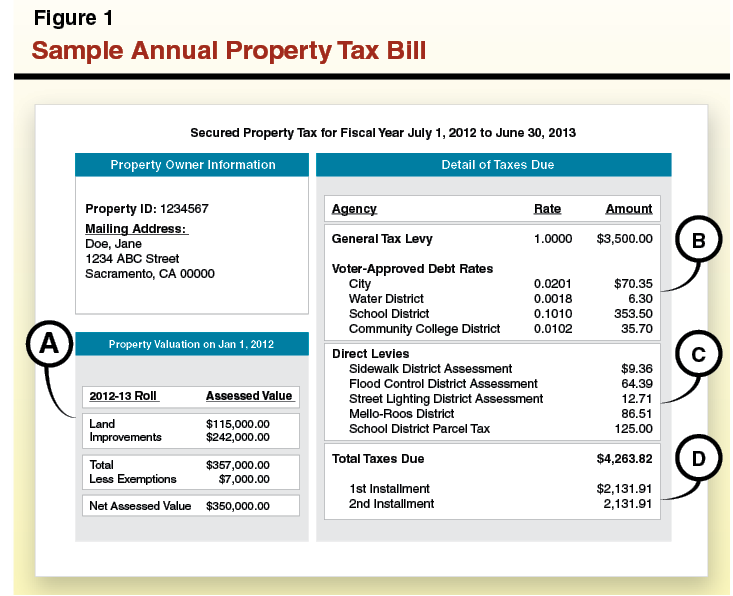
Your property tax bill, which is typically mailed annually by your county tax collector, will clearly state your property’s assessed value and the applicable tax rate. You can also often find this information on your county assessor’s website. Many counties provide online property search tools where you can look up property details, including assessed values and tax history, by parcel number or address.
Calculating Your Property Tax Bill
The fundamental formula for calculating your property tax bill is straightforward:
Assessed Value x Tax Rate = Property Tax Bill
Let’s break this down with an example:
Suppose your property has an assessed value of $500,000. The standard property tax rate in California is 1%.
- Assessed Value: $500,000
- Tax Rate: 1% (or 0.01)
Calculation:
$500,000 x 0.01 = $5,000
In this simplified scenario, your annual property tax bill would be $5,000.
Incorporating Special Assessments and Levies
Now, let’s consider a scenario where there are additional levies. Suppose your property is in an area that has approved a special school bond measure and a local park improvement assessment.
Let’s assume:
- Assessed Value: $500,000
- General Tax Rate: 1%
- School Bond Levy: 0.5%
- Park Improvement Levy: 0.25%
In this case, the total tax rate applicable to your property would be the sum of these rates:
1% + 0.5% + 0.25% = 1.75% (or 0.0175)
Calculation with additional levies:
$500,000 x 0.0175 = $8,750
Your property tax bill would then be $8,750. It’s crucial to review your tax bill carefully to understand all the components that contribute to the total amount due.
Factors Affecting Your Property Tax
Several factors can influence the amount of property tax you pay in California. Understanding these can help you anticipate changes and manage your tax liability.
Changes in Ownership
As mentioned, a change of ownership is a significant event that can lead to a reassessment of your property at its current market value. If you purchase a new home in Los Angeles for $1,000,000, your assessed value will likely be $1,000,000 (subject to a 1% base rate), which will result in a much higher tax bill than a similar property purchased years ago.
New Construction
Completing a significant addition, such as adding a second story or a swimming pool, will trigger a reassessment of the increased value. The assessor will determine the value of the new construction and add it to your existing assessed value.
Inflationary Adjustments
While Proposition 13 limits annual increases to 2%, this steady, albeit small, increment will gradually increase your assessed value and, consequently, your property tax bill over time.
Property Tax Exemptions
Certain property owners may qualify for property tax exemptions, which can reduce their taxable property value.
Homeowner’s Exemption
This is the most common exemption, reducing the taxable value of a principal residence by a set amount annually (this amount is adjusted each year). If you own and occupy your home, you are likely eligible.
Other Exemptions
California also offers exemptions for veterans, disabled veterans, homeowners with disabilities, and certain charitable or religious organizations. Eligibility requirements vary, and it’s advisable to contact your county assessor for more information.
Navigating Property Tax Appeals
If you believe your property has been over-assessed, you have the right to appeal the assessed value. This process typically involves:
- Informal Review: You can begin by discussing your concerns with your county assessor’s office. They may be able to resolve discrepancies without a formal appeal.
- Formal Appeal: If an informal review is unsuccessful, you can file a formal application with the county assessment appeals board. This usually involves submitting documentation to support your claim, such as recent appraisals or comparable sales data.
- Hearing: You will have the opportunity to present your case before the assessment appeals board.
The deadline for filing an appeal is generally November 15th for the current tax year, but it’s essential to confirm the specific deadlines with your county assessor’s office.

Conclusion: Informed Ownership
Calculating property tax in California involves understanding the interplay of assessed value, tax rates, and potential additional levies. While Proposition 13 provides a framework for stable and predictable taxation, factors like changes in ownership and new construction can significantly alter your tax burden. By familiarizing yourself with these components, staying informed about your county’s specific rules, and reviewing your tax bills diligently, you can effectively manage your property tax obligations as a homeowner or investor in the Golden State.
LifeOutOfTheBox is a participant in the Amazon Services LLC Associates Program, an affiliate advertising program designed to provide a means for sites to earn advertising fees by advertising and linking to Amazon.com. Amazon, the Amazon logo, AmazonSupply, and the AmazonSupply logo are trademarks of Amazon.com, Inc. or its affiliates. As an Amazon Associate we earn affiliate commissions from qualifying purchases.