
The California Form DE-4, Employee’s Withholding Allowance Certificate, is a crucial document for ensuring accurate state income tax withholding from your paycheck. While seemingly straightforward, correctly completing this form can significantly impact your tax refund or, conversely, lead to an unexpected tax bill at the end of the year. Understanding each section and its implications is paramount for every employee working in California. This guide aims to demystify the DE-4 form, providing a comprehensive walkthrough to ensure you fill it out accurately and efficiently.
Understanding the Purpose of the DE-4 Form
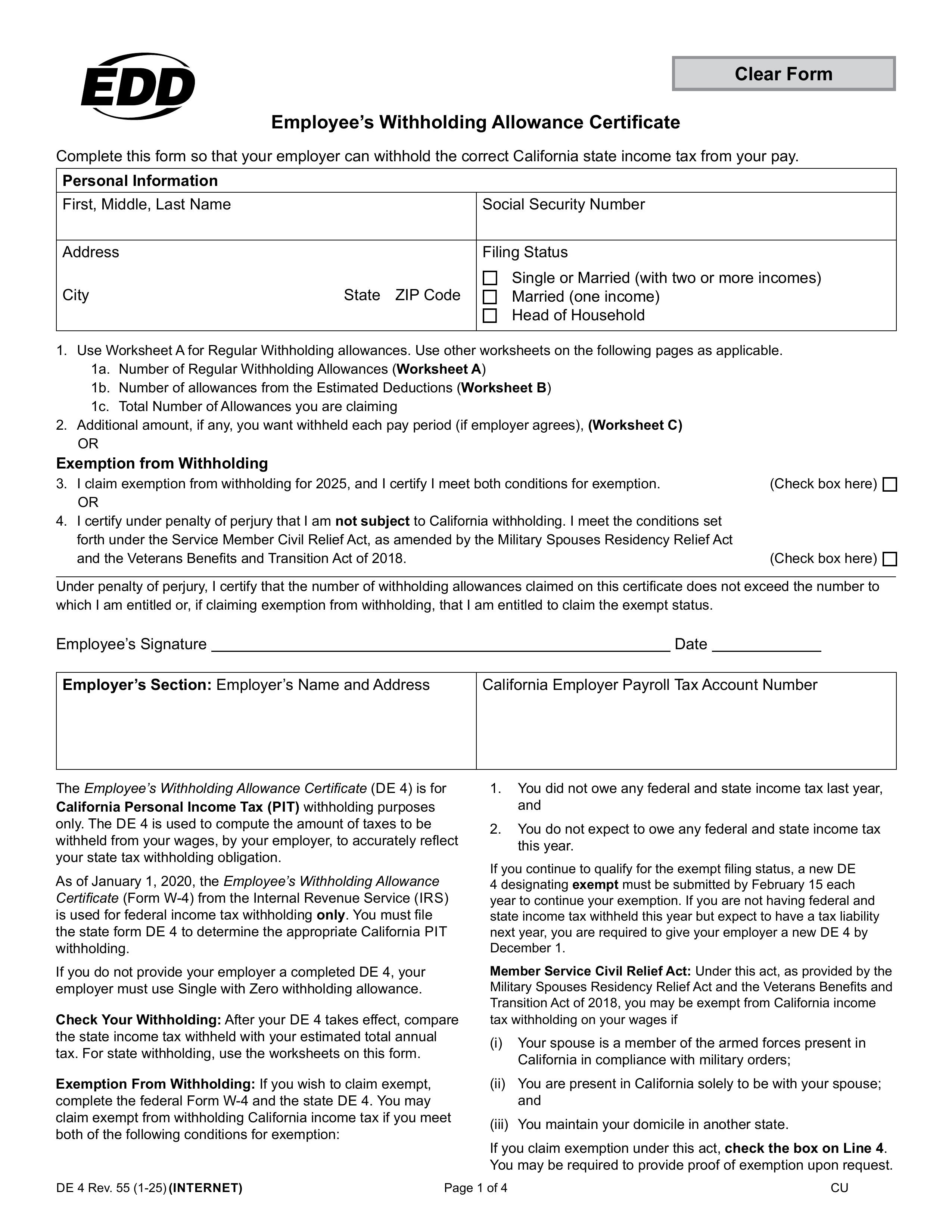
The DE-4 form serves as a directive from you, the employee, to your employer regarding the amount of state income tax to be withheld from your wages. This withholding is an advance payment of your estimated income tax liability for the year. The California Franchise Tax Board (FTB) uses this information to adjust the amount of tax your employer sends to the state on your behalf.
Why Accurate Withholding Matters
Over-withholding can result in a larger tax refund, essentially providing the state with an interest-free loan. While a refund might feel like a bonus, it means you had less disposable income throughout the year. Conversely, under-withholding can lead to owing taxes at the end of the year, potentially with penalties and interest. The DE-4 form is your tool to align your withholding as closely as possible with your actual tax liability.
Key Differences from Federal W-4
It’s important to note that the DE-4 form is specific to California state income tax. While it shares similarities with the federal Form W-4, which deals with federal income tax withholding, they are distinct documents and must be completed separately. Changes made to your federal W-4 do not automatically update your state DE-4.
Filling Out the DE-4 Form: A Step-by-Step Guide
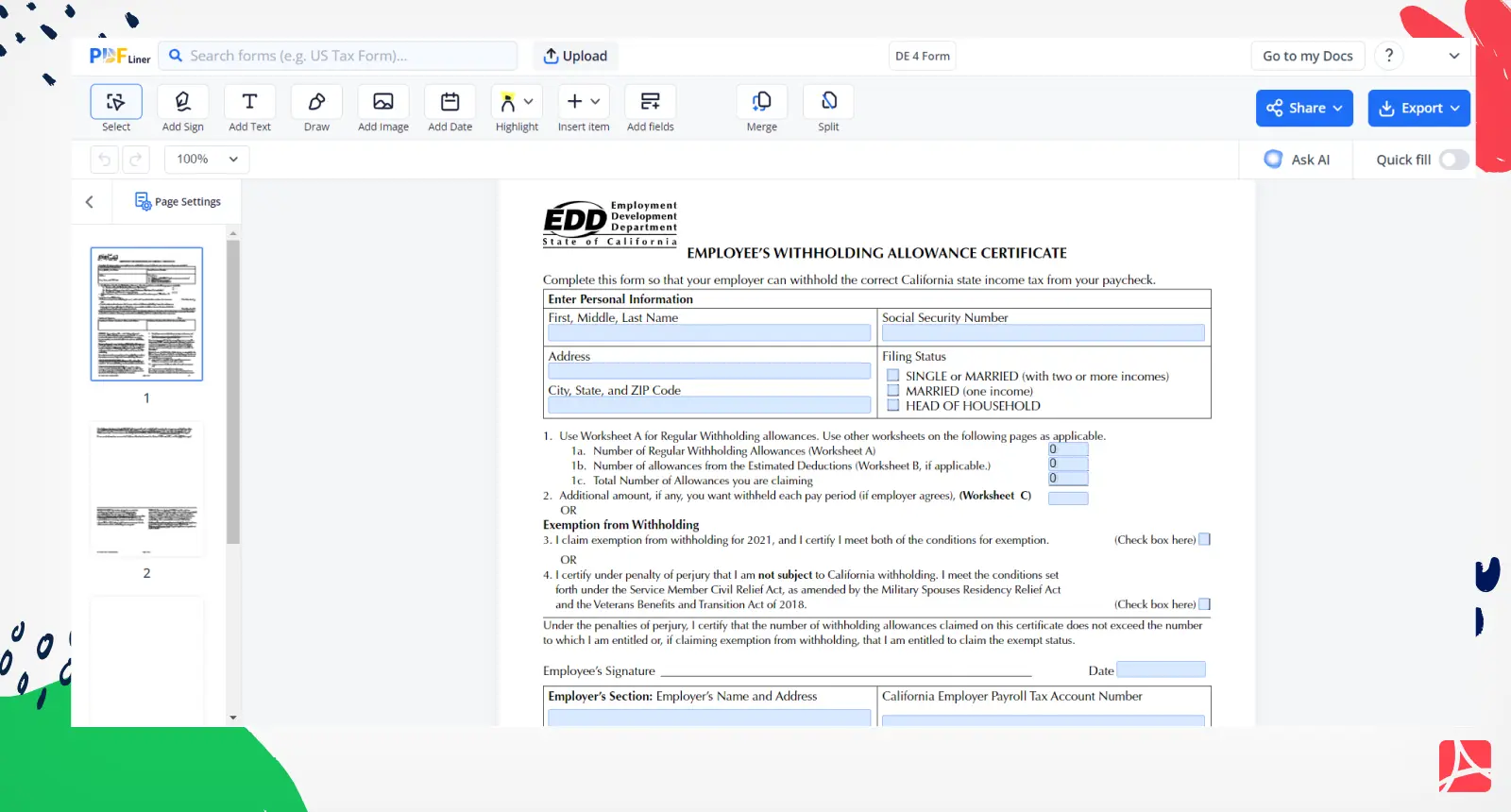
The DE-4 form is divided into several sections, each requiring specific information. We will walk through each part systematically.
Section 1: Personal Information
This section is generally straightforward and requires your basic personal details.
1a. Employee’s Social Security Number (SSN)
Enter your nine-digit SSN as issued by the Social Security Administration. Ensure accuracy, as this number is crucial for tax identification.
1b. Employee’s First Name and Initial, Last Name
Provide your full legal name, including your first name, middle initial (if applicable), and last name, exactly as it appears on your Social Security card.
1c. Employee’s Home Address
Enter your current residential address, including street address, city, state, and ZIP code. This is where California tax notices and documents will be sent.
Section 2: Marital Status and Number of Exemptions
This section is critical for determining your withholding allowances. Allowances reduce the amount of tax withheld from your pay. The more allowances you claim, the less tax will be withheld.
2a. Marital Status
Select your marital status as of the beginning of the tax year. Your options are:
- Single: If you are unmarried.
- Married: If you are married and your spouse does not work or you are filing jointly with your spouse.
- Married, but spouse does not work: This option is for married individuals whose spouse has no income or very little income, allowing for a higher withholding allowance.
- Head of Household: If you are unmarried and pay more than half the costs of keeping up a home for yourself and a qualifying child or other qualifying dependent.
2b. Number of Exemptions
This is where you claim allowances. Generally, you can claim one allowance for yourself and one for each dependent. However, the DE-4 form has specific instructions for claiming additional allowances.
- Basic Allowance: You can claim one allowance for yourself.
- Spouse Allowance: If married, you can claim an allowance for your spouse if they do not claim themselves as exempt on another DE-4.
- Dependent Allowances: Claim one allowance for each dependent you expect to claim on your California income tax return. A dependent is typically a child or other relative who meets certain dependency tests.
- Additional Allowances: You may be able to claim additional allowances if you have significant itemized deductions, tax credits, or other income not subject to withholding. This is where the worksheet comes into play.
Section 3: Other Income (Not Subject to Withholding)
If you have income from sources other than your primary job that is not subject to withholding (e.g., interest, dividends, self-employment income, pensions), you can use this section to adjust your withholding.
3a. Other Income
Enter the total amount of other income you expect to receive during the year.
3b. Withholding Adjustments
This section allows you to specify how you want this additional income to be handled. You can choose to have additional tax withheld to cover this income, or you can adjust your allowances to account for it.
Section 4: Deductions and Additional Withholding
This section is for further customizing your withholding based on specific tax situations.
4a. Standard Deduction or Itemized Deductions
If you plan to itemize deductions on your California tax return, and these deductions are expected to be greater than your standard deduction, you can increase your withholding allowances here. The form provides tables to help estimate the additional allowances you can claim.
4b. Tax Credits
California offers various tax credits, such as credits for low-income individuals, dependents, or certain expenses. If you anticipate qualifying for tax credits, you can claim additional allowances to reduce your withholding.
4c. Additional Withholding Amount
If you wish to have an additional amount of tax withheld from each paycheck beyond what is calculated by the allowances, you can specify a dollar amount here. This is often used to ensure you don’t owe taxes at the end of the year, especially if you have complex financial situations.
Section 5: Employee’s Signature and Date
This is the final step. You must sign and date the form to certify that the information provided is true and correct to the best of your knowledge.
The DE-4 Worksheet: Your Key to Accurate Calculations
The DE-4 form is accompanied by a worksheet that helps you calculate your total withholding allowances. This worksheet is essential for accurately determining the correct number of allowances to claim, especially if you have multiple income sources, plan to itemize deductions, or expect to receive tax credits.
Completing the DE-4 Worksheet
The worksheet guides you through a series of calculations:
- Line 1: Enter the number of exemptions you can claim for yourself, spouse, and dependents.
- Line 2: Calculate additional allowances for dependents not claimed on your spouse’s DE-4.
- Line 3: Enter your estimated total income from all sources.
- Line 4: Calculate allowances for anticipated itemized deductions.
- Line 5: Calculate allowances for anticipated tax credits.
- Line 6: Total the allowances from lines 1 through 5. This is the total number of allowances you will claim on line 2b of the DE-4 form.
Important Note: The worksheet is designed to be used with the official California DE-4 form. Always refer to the latest version of the form and worksheet published by the California Franchise Tax Board.
When to Update Your DE-4 Form
Life circumstances change, and so can your tax situation. It’s crucial to update your DE-4 form whenever significant events occur that might affect your tax liability.
Common Situations Requiring an Update
- Marriage or Divorce: These events directly impact your marital status and potential tax deductions and credits.
- Birth or Adoption of a Child: Adding a dependent increases your allowance count.
- Change in Employment Status: Starting a new job, changing from full-time to part-time, or becoming self-employed will necessitate a new DE-4.
- Significant Changes in Income: A substantial raise, a significant bonus, or the loss of a second income in the household will alter your withholding needs.
- Changes in Deductions or Credits: If you anticipate major changes in your deductible expenses or eligibility for tax credits, update your DE-4.
How to Submit an Updated DE-4
To update your DE-4 form, simply obtain a new form from your employer or the California FTB website, complete it with your updated information, and submit it to your employer’s payroll department. Your employer will then begin withholding taxes based on the new information provided.
Common Pitfalls and Best Practices
Navigating the DE-4 form can present challenges. Being aware of common mistakes can help you avoid them.
Avoid Over-Claiming Allowances
While it might be tempting to claim the maximum number of allowances to reduce your current tax burden, over-claiming can lead to owing a significant amount at tax time, possibly with penalties. It’s always better to err on the side of slightly more withholding than less.
Consider the Impact of Other Income
Don’t forget to account for income from sources other than your primary W-2 job. If this income is not subject to withholding, you might need to adjust your DE-4 to cover the additional tax liability.
Consult a Tax Professional
For individuals with complex financial situations, multiple income streams, or significant deductions and credits, consulting a tax professional is highly recommended. They can help you accurately complete the DE-4 form and ensure your withholding is optimized for your specific circumstances.
By carefully following these guidelines and understanding the purpose of each section, you can confidently complete your California DE-4 form, ensuring accurate tax withholding and a smoother tax season.
LifeOutOfTheBox is a participant in the Amazon Services LLC Associates Program, an affiliate advertising program designed to provide a means for sites to earn advertising fees by advertising and linking to Amazon.com. Amazon, the Amazon logo, AmazonSupply, and the AmazonSupply logo are trademarks of Amazon.com, Inc. or its affiliates. As an Amazon Associate we earn affiliate commissions from qualifying purchases.