
Navigating the legal landscape of firearm ownership and carriage is a crucial aspect of responsible gun ownership, particularly when traveling to different jurisdictions. For many, the question of whether a particular state permits concealed carry is paramount to planning a trip and ensuring personal safety. This inquiry often arises when considering travel to the Golden State, a destination renowned for its diverse attractions, from the bustling metropolises of Los Angeles and San Francisco to the natural wonders of Yosemite National Park and the iconic Pacific Coast Highway. Understanding the nuances of California‘s firearm laws, specifically regarding concealed carry, requires a detailed examination of its legislative framework and enforcement practices.

Understanding California’s Concealed Carry Laws
California has historically maintained some of the most restrictive firearm laws in the United States. When it comes to concealed carry, the state operates under a “shall-issue” system, but with significant discretionary powers vested in law enforcement agencies. This means that if an applicant meets specific criteria, a permit to carry a concealed firearm shall be issued. However, the interpretation of “good cause” and the applicant’s suitability has been subject to considerable variation among different counties and issuing authorities.
Permit Requirements and Eligibility
To obtain a concealed carry permit in California, an individual must meet several stringent requirements. These typically include:
- Age: Applicants must be at least 21 years of age.
- Residency: Proof of residency within the county where the application is filed is generally required.
- Good Moral Character: This is a broad category that law enforcement agencies assess through background checks, interviews, and sometimes references. Criminal history, history of substance abuse, and demonstrated patterns of irresponsibility can all negatively impact an applicant’s standing.
- “Good Cause”: This has been the most contentious aspect of California’s concealed carry laws. Historically, applicants had to demonstrate a compelling reason, such as a specific and ongoing threat to their life or property, to be granted a permit. The definition of “good cause” has been subject to numerous legal challenges and interpretations. Following the Supreme Court’s decision in New York State Rifle & Pistol Association, Inc. v. Bruen in 2022, the requirement for demonstrating “good cause” in the traditional sense has been significantly altered, aiming to make the process more rights-based rather than need-based. However, the practical implementation and ongoing legal challenges mean that the landscape is still evolving.
- Firearm Safety Training: Approved firearm safety courses are mandatory, covering safe handling, storage, and the legal aspects of carrying a firearm.
- Psychological Evaluation: In some jurisdictions, applicants may be required to undergo a psychological evaluation to assess their mental fitness to carry a firearm.
- No Prohibited Person Status: Applicants cannot be prohibited from possessing firearms under federal or state law, which includes individuals with felony convictions, those subject to domestic violence restraining orders, or those deemed mentally unfit by a court.
The “Shall-Issue” vs. “May-Issue” Distinction
While California is classified as a “shall-issue” state, its historical application of “good cause” made it function much like a “may-issue” state for many years. In a true “may-issue” system, the issuing authority has broad discretion to deny a permit even if an applicant meets basic eligibility criteria, based on subjective assessments of need or suitability. The Bruen decision has aimed to shift this balance, emphasizing that the right to carry arms in public for self-defense is a fundamental constitutional right, and restrictions must be based on objective criteria rather than subjective discretion. Nonetheless, the process for obtaining a permit can still be lengthy and requires thorough preparation.
Traveling to California with a Firearm: Reciprocity and Restrictions
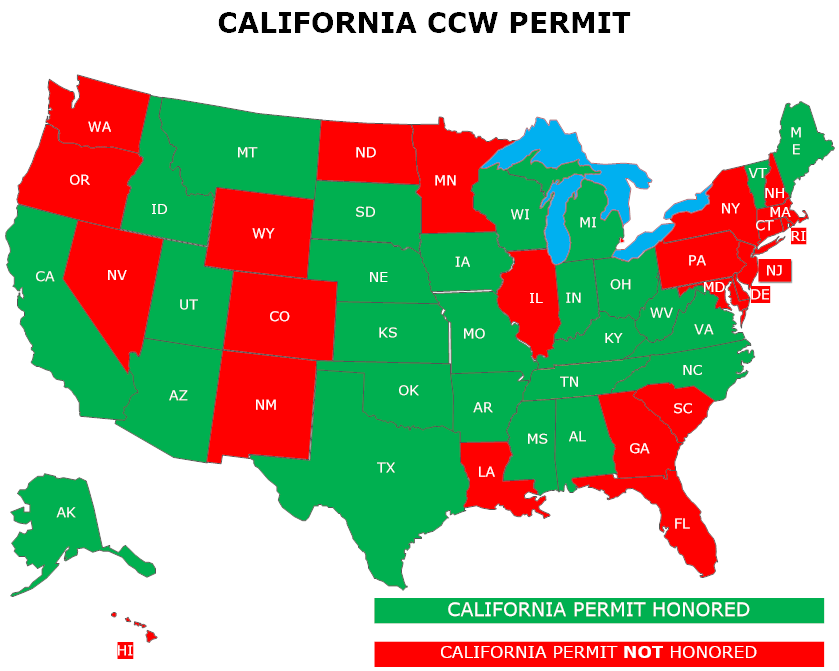
For individuals who legally possess a concealed carry permit from another state, the question of reciprocity with California is of utmost importance. California generally does not recognize concealed carry permits issued by other states. This means that even if you are licensed to carry a concealed weapon in your home state, you are typically not permitted to carry a concealed firearm within California unless you obtain a California CCW permit.
Federal Law and Interstate Transportation
Federal law, specifically the Firearms Owners’ Protection Act (FOPA) of 1986, provides some protections for the interstate transportation of firearms. Under FOPA, an individual who is legally in possession of a firearm in their home state may transport it through another state, provided that they comply with specific conditions. This generally means that the firearm must be unloaded, locked in the trunk of the vehicle, and inaccessible to the driver and passengers. Ammunition must also be stored separately, typically in a locked container. It is crucial to understand that FOPA does not authorize concealed carry in states that do not recognize your permit. It only protects the right to transport unloaded firearms.
Key Restrictions and Prohibited Areas
Even for those who successfully obtain a California CCW permit, there are numerous locations where carrying a firearm is strictly prohibited. These “gun-free zones” are established by state law and are critical to be aware of to avoid legal entanglements. Common prohibited areas include:
- Schools and Universities: Including K-12 schools and public colleges/universities, and their grounds.
- Courthouses: All areas within a courthouse.
- Polling Places: During the hours that an election is being held.
- Government Buildings: Certain federal, state, and local government buildings.
- Airports: Sterile areas of airports.
- Public Transportation: In some instances, depending on the specific mode of transport and local ordinances.
- Private Property with Posted Signs: Businesses and private property owners can prohibit firearms on their premises.
- Areas where alcohol is served for on-site consumption: Such as bars and restaurants that derive a significant portion of their revenue from alcohol sales.
It is imperative for permit holders to be aware of these restrictions and to exercise extreme caution. Ignorance of the law is not a valid defense, and violations can result in severe penalties, including hefty fines and imprisonment.
Staying Informed and Responsible
The legal landscape surrounding firearm laws, including concealed carry, is dynamic and subject to change. Factors such as legislative updates, court rulings, and evolving interpretations by law enforcement agencies can all impact the legality of carrying a firearm. For anyone planning to travel to California and considering carrying a firearm, or for residents seeking to obtain a permit, staying informed is paramount.

Resources for Accurate Information
Reliable sources of information are essential for understanding California’s firearm laws. These include:
- The California Department of Justice (DOJ): The official state agency responsible for firearm regulation provides information on laws, regulations, and licensing.
- Local Law Enforcement Agencies: Sheriff’s departments and police departments in the specific county or city where you intend to travel or reside are the primary issuing authorities for CCW permits and can provide county-specific information.
- Legal Counsel: Consulting with an attorney specializing in firearm law in California is highly recommended for personalized advice and to ensure full compliance.
- Reputable Firearm Rights Organizations: Organizations dedicated to the advocacy and education of gun owners often provide summaries and updates on state firearm laws.
Ultimately, while California does have a concealed carry permit system, it is characterized by stringent requirements and numerous restrictions. For travelers, the general rule is that permits from other states are not recognized, necessitating the procurement of a California permit if one intends to carry concealed within the state. Responsible gun ownership demands a thorough understanding of and strict adherence to all applicable laws and regulations to ensure safety and avoid legal complications.
LifeOutOfTheBox is a participant in the Amazon Services LLC Associates Program, an affiliate advertising program designed to provide a means for sites to earn advertising fees by advertising and linking to Amazon.com. Amazon, the Amazon logo, AmazonSupply, and the AmazonSupply logo are trademarks of Amazon.com, Inc. or its affiliates. As an Amazon Associate we earn affiliate commissions from qualifying purchases.