
The Overlook Hotel remains one of the most chilling and iconic locations in cinematic history. To many, the sprawling, isolated mountain resort is as much a character as the Torrance family themselves. However, the answer to where the film was shot is far more complex than a single location. The visual identity of The Shining is actually a composite of multiple real-world Landmarks, elaborate soundstages, and architectural inspirations scattered across North America and Europe. Understanding the origins of this legendary site requires a journey through the literary mind of Stephen King, the meticulous perfectionism of Stanley Kubrick, and the historic structures that provided the backdrop for this psychological horror masterpiece.
The Dual Identity of the Overlook Hotel
While the story takes place in the Rocky Mountains of Colorado, the production of the 1980 film was a global endeavor. To create the vast, unsettling atmosphere of the Overlook Hotel, the production team utilized distinct locations for the exterior shots and the interior sets.
The Inspiration: The Stanley Hotel
Before the cameras ever rolled, the seeds of the story were planted at The Stanley Hotel in Estes Park. In 1974, Stephen King and his wife, Tabitha King, stayed at this Colonial Revival landmark just as it was closing for the winter season. They were the only guests in the massive hotel, a situation that sparked the premise for King’s third published novel.
The Stanley Hotel is a stunning architectural achievement, built by Freelan Oscar Stanley and opened in 1909. With its grand white facade and red roof, it stands as a testament to the luxury of the early 20th century. Although it was the birthplace of the idea, Stanley Kubrick chose not to film there. He felt the aesthetic did not match the more imposing, oppressive vision he had for the film. However, the hotel remains a major site for horror enthusiasts and is listed on the National Register of Historic Places.
The Cinematic Face: Timberline Lodge
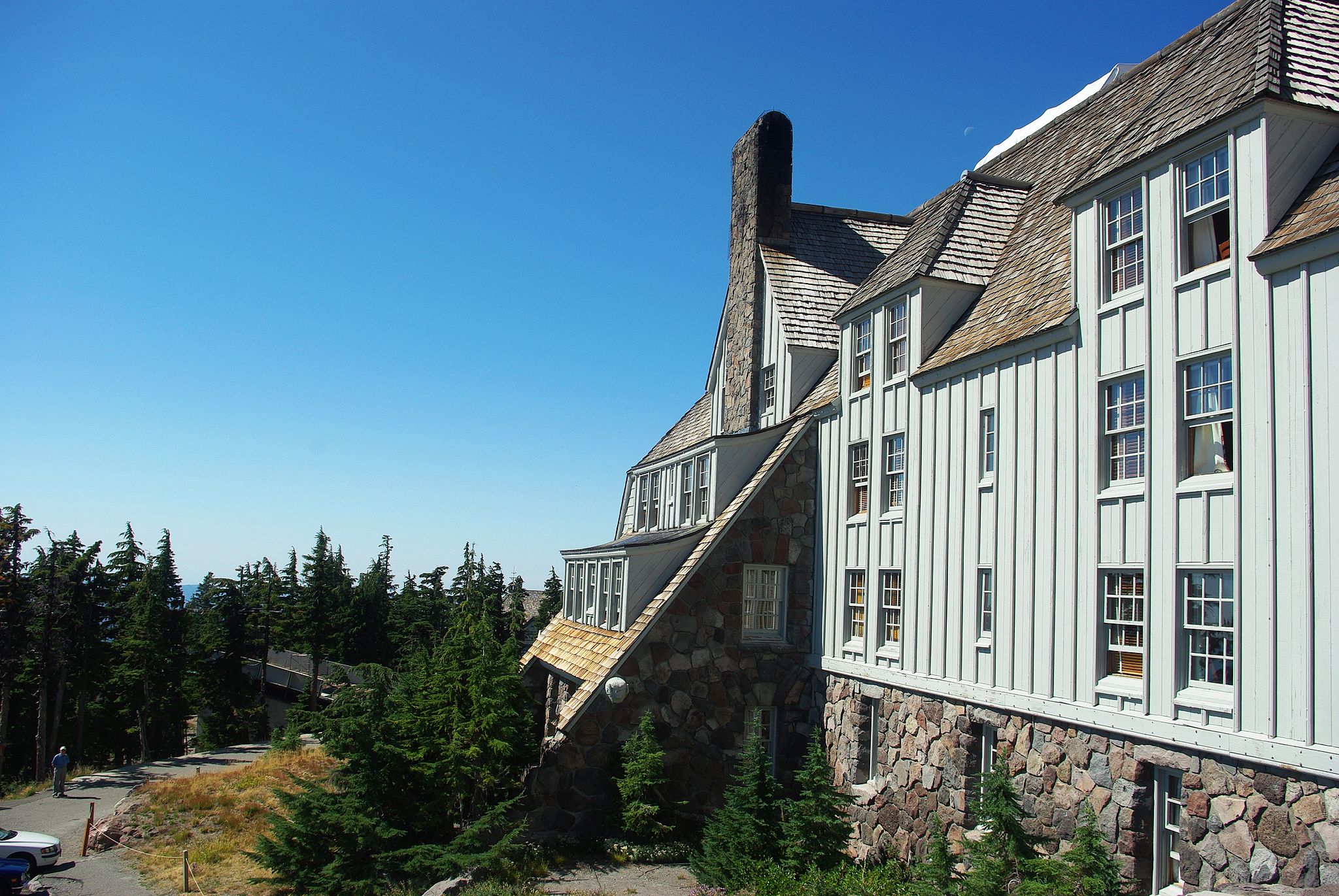
When moviegoers see the wide shots of the hotel’s exterior, they are looking at Timberline Lodge, situated on the south slope of Mount Hood in Oregon. Built during the Great Depression by the Works Progress Administration, the lodge was dedicated in 1937 by President Franklin D Roosevelt.
Architecturally, Timberline Lodge is a masterpiece of the Cascadian style, utilizing massive local timbers and native stone. It serves as a National Historic Landmark today, functioning as a ski resort and mountain retreat. Stanley Kubrick chose this location because its rugged, heavy-set stone architecture felt more menacing than the elegant Stanley Hotel. Interestingly, the lodge management requested that the film change the room number from the book’s Room 217 to the non-existent Room 237, fearing that future guests would be afraid to stay in Room 217.
Architectural Grandeur and the Interior Illusions
While the exterior of Timberline Lodge provided the face, the interior of the Overlook Hotel was almost entirely a construction. Stanley Kubrick was known for his total control over his environment, and to achieve the impossible geometry of the hotel, he moved the production to England.
Designing Terror at Elstree Studios
The vast majority of the interior scenes, including the Colorado Lounge, the Gold Room, and the winding hallways, were built at Elstree Studios in Borehamwood, Hertfordshire. At the time, these sets were among the largest ever constructed. Kubrick and his production designer, Roy Walker, spent months researching American hotels to create a set that felt authentically massive yet subtly “wrong.”
The set of the Colorado Lounge, where Jack Nicholson as Jack Torrance famously types his repetitive manuscript, was designed with a deliberate focus on spatial confusion. The layout of the hallways and the placement of doors often contradict one another, a technique used to make the audience feel as disoriented as the characters. This psychological use of architecture is one reason why the film remains so deeply unsettling decades later.
Borrowing Elegance: The Ahwahnee Hotel Influence

To ensure the sets felt like a real American landmark, the production team drew heavy inspiration from The Ahwahnee Hotel located in Yosemite National Park, California. Specifically, the Great Lounge of The Ahwahnee Hotel served as the primary model for the Colorado Lounge in the film.
Visitors to the Yosemite National Park landmark will immediately recognize the floor-to-ceiling windows, the massive stone hearths, and the Native American motifs in the rugs and decor. The Ahwahnee Hotel, built in 1927, is renowned for its “National Park Service Rustic” architecture, often referred to as Parkitecture. While no actual filming for the movie took place inside The Ahwahnee Hotel, the meticulous recreation of its aesthetic on the Elstree Studios stage is so accurate that many tourists believe the movie was shot on-site.
The Cultural and Historical Legacy of the Sites
The landmarks associated with The Shining have gained a level of fame that transcends the film itself. These locations are now pilgrimage sites for movie buffs, historians, and lovers of grand architecture.
Preservation of Timberline Lodge
Today, Timberline Lodge stands as a vibrant part of the Oregon landscape. It is one of the few Landmarks from that era that still serves its original purpose as a public lodge. Despite its association with a horror film, the atmosphere at the lodge is warm and welcoming, far removed from the snowy isolation depicted by Kubrick. The craftsmanship of the lodge—its hand-carved wood and locally sourced stonework—continues to be a draw for those interested in the WPA era of American history.
The Horror Tourism Phenomenon at The Stanley Hotel
While The Stanley Hotel missed out on the Kubrick film, it fully embraced its connection to the story. In fact, when Stephen King produced a 1997 television miniseries of The Shining that stayed closer to his original novel, he chose to film it at The Stanley Hotel.
The hotel now offers ghost tours and has even added a hedge maze to its grounds, a direct nod to the Kubrick film, despite the maze not being in the original book. The Estes Park landmark has leveraged its history to become a hub for the paranormal and literary tourism, proving that a location’s legacy is often shaped as much by fiction as by reality.
Exploring the Scenic Landscapes of the Opening Credits
The sense of isolation and the sheer scale of the wilderness in The Shining are established in the first few minutes of the film. The opening sequence, featuring the Torrance family’s yellow Volkswagen Beetle driving through the mountains, is widely considered one of the greatest opening shots in cinema.
Going-to-the-Sun Road and Glacier National Park
The sweeping aerial shots were filmed in Glacier National Park in Montana. The winding road seen in the film is the famous Going-to-the-Sun Road, a 50-mile stretch of highway that crosses the Continental Divide. This engineering marvel is a National Historic Landmark in its own right, offering some of the most breathtaking views in the United States.
The use of this location was vital in conveying the idea that the characters were leaving civilization behind. The sheer cliffs and expansive vistas of Montana create a feeling of vulnerability. Wild Goose Island, a tiny island in the middle of Saint Mary Lake, is also visible in these opening frames, becoming a permanent fixture in the mental map of horror fans.

The Significance of Place in Cinema
The “hotel” from The Shining is a masterclass in how multiple Landmarks can be woven together to create a singular, terrifying identity. By combining the exterior of Timberline Lodge, the interior inspiration of The Ahwahnee Hotel, the literary soul of The Stanley Hotel, and the vastness of Glacier National Park, Stanley Kubrick created a space that feels more real than any single building could.
For those who visit these sites today, there is a strange sense of familiarity. Whether you are standing in the shadow of Mount Hood or walking the halls in Estes Park, the architectural and historical significance of these locations continues to be enhanced by their ties to the screen. They stand as monuments not just to the film, but to the power of American architecture and the enduring allure of the great wilderness. These Landmarks allow us to step into the world of the Overlook Hotel, safely separated from the supernatural, but forever touched by the legacy of the film.
LifeOutOfTheBox is a participant in the Amazon Services LLC Associates Program, an affiliate advertising program designed to provide a means for sites to earn advertising fees by advertising and linking to Amazon.com. Amazon, the Amazon logo, AmazonSupply, and the AmazonSupply logo are trademarks of Amazon.com, Inc. or its affiliates. As an Amazon Associate we earn affiliate commissions from qualifying purchases.