
Embarking on the journey to drive in the Golden State is an exciting prospect, opening up a world of independent travel and exploration. Whether you’re a young adventurer eager to explore California’s iconic landscapes or an adult seeking the freedom to navigate its vibrant cities and scenic routes, obtaining a driving permit is the crucial first step. California, a state renowned for its diverse attractions, from sun-drenched beaches to majestic mountains and bustling urban centers, offers unparalleled opportunities for those with the ability to drive themselves. This comprehensive guide will walk you through the process of securing your driving permit, ensuring you’re well-prepared for the road ahead.
The ability to drive transforms your travel experience, allowing you to discover hidden gems beyond typical tourist trails and immerse yourself more deeply in local culture and experiences. Imagine driving along the stunning Pacific Coast Highway or exploring the charming towns nestled in wine country – it all begins with understanding the requirements and procedures set forth by the California Department of Motor Vehicles (DMV). This article is designed to demystify the process, making your path to a California driving permit as smooth as possible.
Understanding California’s Driving Permit System
The California driving permit, often referred to as a learner’s permit, is your initial authorization to begin learning to drive. It signifies that you’ve demonstrated a basic understanding of traffic laws and road signs but are not yet ready to drive unsupervised. This probationary period is essential for developing practical driving skills under the guidance of an experienced, licensed driver.
Why a California Driving Permit Matters
Beyond the sheer convenience of personal transportation, a California driving permit is your gateway to experiencing the state’s unique lifestyle and unparalleled travel opportunities. For tourists and residents alike, having a permit means you can begin the process of obtaining a full driver’s license, which unlocks access to incredible destinations, from the sprawling urban landscapes of Los Angeles and San Francisco to the natural wonders of Yosemite National Park and the pristine beaches of San Diego. It’s an investment in your independence, offering the flexibility to explore at your own pace, whether you’re seeking luxury resorts or budget-friendly accommodations off the beaten path.
For many, particularly younger individuals, obtaining a permit symbolizes a significant step towards adulthood and greater freedom. It allows for participation in family trips, business-related travel, and simply navigating daily life with ease. The permit itself, however, comes with strict rules designed to ensure safe learning.
Who Needs a Driving Permit?
Generally, any new driver in California who does not hold a valid driver’s license from another state or country must obtain a permit before they can begin to learn to drive. This applies to:
- Minors (under 18 years old): These applicants have specific requirements, including mandatory driver education and behind-the-wheel training before they can even apply for a permit, and then must hold the permit for a minimum period before being eligible for a full license.
- Adults (18 years old and over): While adults do not have the same educational prerequisites as minors, they still must obtain a permit to practice driving with a licensed adult present.
Even if you’re an experienced driver from another country, if you intend to reside in California and drive long-term, you will eventually need a California driver’s license. The permit phase is often a necessary bridge to familiarize yourself with California’s specific traffic laws and driving conditions before taking the final driving test.
Essential Steps Before Visiting the DMV
Preparation is key to a smooth and successful permit application process. Before you even step foot into a DMV office, there are several vital steps you need to complete. These steps are designed to verify your identity, residency, and foundational knowledge of traffic laws, ensuring that only qualified individuals proceed to the next stages of obtaining a driving permit.
Gathering Required Documents
The California DMV requires specific documents to prove your identity, residency, and legal presence in the United States. This is a critical step, as incomplete documentation will lead to delays or rejection of your application. It’s highly recommended to gather and organize these documents well in advance of your appointment.
Here’s a general checklist of what you’ll need:
- Proof of Identity: You’ll need at least one primary document, such as a United States birth certificate, a valid United States passport, a foreign passport with a valid United States visa and I-94 form, or a permanent resident card. The DMV has a comprehensive list of acceptable documents, so check their official website for the most current requirements.
- Proof of Residency: You typically need two different documents that show your California residency. Examples include utility bills, rental agreements, mortgage statements, bank statements, or school documents. These documents must display your current name and address.
- Proof of Social Security Number (SSN): Your Social Security Administration card is the primary proof. If you don’t have an SSN, you may still be eligible to apply if you meet certain criteria, particularly if you are an international visitor with a valid visa.
- Completed Form DL 44: This is the driver’s license or ID card application form. While you can usually obtain this form at the DMV office, it’s often more convenient to fill it out online and print it before your visit. Note that minors will require parental or guardian signatures on this form.
- Proof of Date of Birth: While often covered by identity documents, some situations may require additional proof.
For those interested in obtaining a REAL ID compliant driver’s license or ID card (which will be required for air travel within the United States and access to certain federal facilities starting May 7, 2025), the documentation requirements are more stringent. The REAL ID typically requires one proof of identity, two proofs of residency, and your Social Security Number documentation. Planning for a REAL ID from the outset can save you a future trip to the DMV.
Preparing for the Knowledge Test
The knowledge test is a fundamental part of the permit application, designed to assess your understanding of California traffic laws, road signs, and safe driving practices. This isn’t just a formality; it’s a critical component that ensures new drivers have a theoretical foundation for safe driving, which is vital for both personal safety and the safety of others on the road.
The official California Driver Handbook is your primary study resource. It’s available online on the DMV website in multiple languages. Dedicate ample time to studying this handbook thoroughly, paying close attention to sections on:
- Traffic laws and rules of the road: Understand right-of-way, speed limits, lane usage, and turning regulations.
- Road signs and signals: Be able to identify and interpret all standard road signs, pavement markings, and traffic signals.
- Safe driving practices: Learn about defensive driving, impaired driving laws, seatbelt laws, and rules regarding pedestrians and cyclists.
- Vehicle registration and insurance requirements: Basic understanding of what is legally required for a vehicle on California roads.
Many online resources offer practice tests, which can be an excellent way to gauge your readiness and identify areas where you need further study. However, always ensure these practice tests are based on the current California Driver Handbook to avoid misinformation. The knowledge test consists of multiple-choice questions, and a passing score is usually required within a limited number of attempts. Failing the test means you’ll have to wait before retaking it, so thorough preparation is essential to avoid unnecessary delays in your permit journey.
The Application Process at the DMV
With your documents in hand and your mind prepared, the next stage involves an actual visit to the California DMV. This is where your application officially begins, culminating in the crucial vision and knowledge tests. The DMV experience can vary, but being well-informed about each step will streamline your visit.
Navigating the DMV Visit
Before heading to the DMV, it’s highly recommended to make an appointment online. This can significantly reduce wait times, allowing you to spend more time enjoying California’s attractions rather than waiting in line. On the day of your appointment:
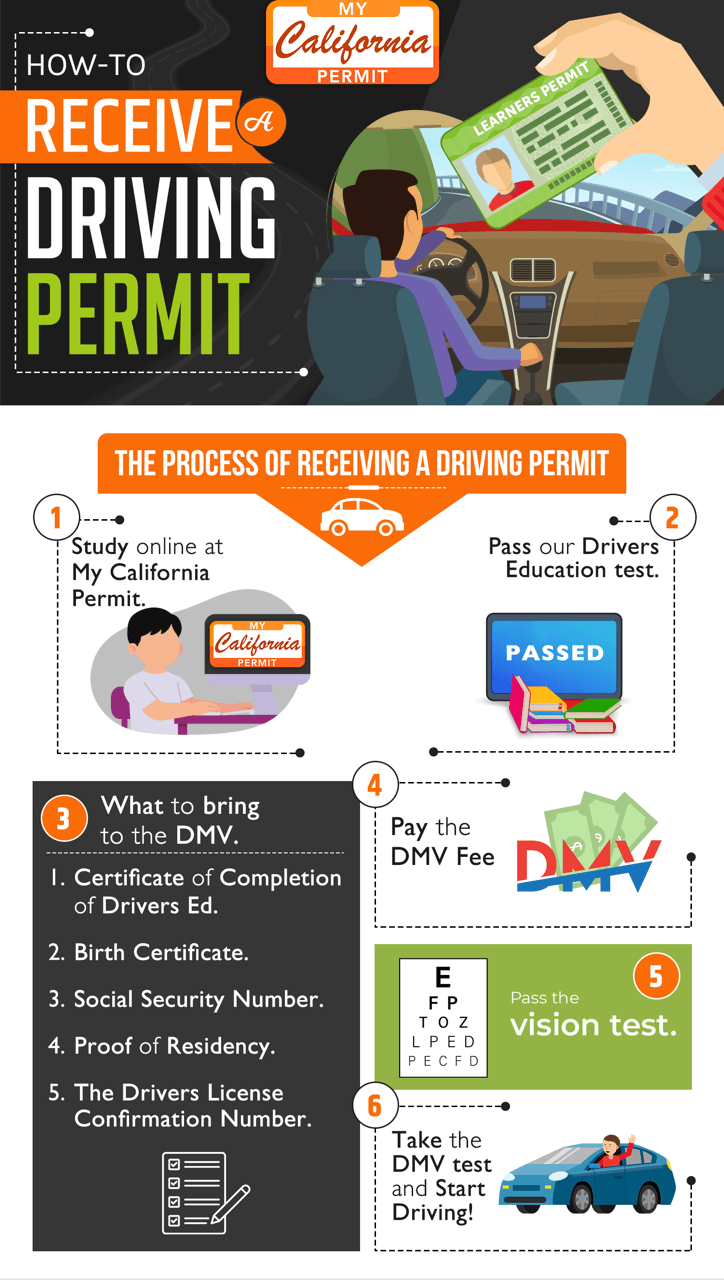
- Check-in: Arrive a few minutes early for your appointment. You’ll check in and receive a number for service.
- Submit Application and Fee: When called, you’ll present your completed DL 44 application form and your required identity and residency documents to a DMV representative. You will also pay the non-refundable application fee. Keep in mind that this fee covers multiple attempts at the knowledge test within a 12-month period, but it is not refunded if you do not pass or complete the process.
- Thumbprint and Photo: Your thumbprint will be scanned, and a photo will be taken for your permit. This photo will likely be the one used for your driver’s license, so present yourself well!
- Vision Test: You will undergo a vision screening to ensure your eyesight meets the minimum standards for driving safely. If you wear glasses or contact lenses, bring them with you, as you’ll be tested with them on. If you don’t pass, you might be referred to an optometrist for further evaluation.
The overall atmosphere at the DMV can be busy, but patience and politeness go a long way. Having all your documents neatly organized will help expedite the process for both you and the DMV staff.
Acing the Vision and Knowledge Tests
After completing the administrative steps, you’ll proceed to the tests.
- Vision Test: This is usually a quick test where you’ll read letters or numbers on an eye chart. Your ability to distinguish colors may also be checked. Passing the vision test is non-negotiable for safe driving.
- Knowledge Test: This is the core written test that assesses your understanding of traffic laws and road signs.
- For minors (under 18): The test typically has 46 questions. You are allowed a maximum of 8 errors to pass, meaning you must correctly answer at least 38 questions (approximately 83%).
- For adults (18 and over): The test usually has 36 questions. You are allowed a maximum of 6 errors to pass, meaning you must correctly answer at least 30 questions (approximately 83%).
The tests are often administered on a computer touchscreen, allowing for immediate scoring. If you fail the knowledge test, you must wait a minimum of 7 days before you can attempt it again. You get three attempts to pass the knowledge test within the 12-month validity period of your application fee. If you fail all three attempts, you’ll have to restart the entire application process, including paying the fee again. This underscores the importance of thorough preparation using the California Driver Handbook.
What Happens Next?
If you pass both the vision and knowledge tests, congratulations! You will be issued a temporary instruction permit. The official permit will then be mailed to you, usually within a few weeks. This temporary permit is valid immediately, allowing you to begin your supervised driving practice. For minors, the issuance of the permit also depends on having completed their driver education and, in some cases, having already started their behind-the-wheel training.
Once you have your permit, remember that it’s an instruction permit, not a license. This means you have strict rules to follow regarding supervised driving, which we’ll delve into in the next section.
Specific Requirements for Minors and Adults
The state of California has distinct regulations for obtaining a driving permit, depending on whether the applicant is a minor (under 18) or an adult (18 or older). These differences primarily revolve around driver education requirements, supervised practice hours, and the duration the permit must be held. Understanding these specific guidelines is crucial for a smooth application process.
Guidelines for Applicants Under 18
For aspiring young drivers in California, the path to a permit is part of a Graduated Driver Licensing (GDL) program, designed to progressively introduce driving privileges as experience is gained. This structured approach aims to reduce risks for new, inexperienced drivers, contributing to safer roads for everyone, including those enjoying California’s scenic drives and tourist destinations.
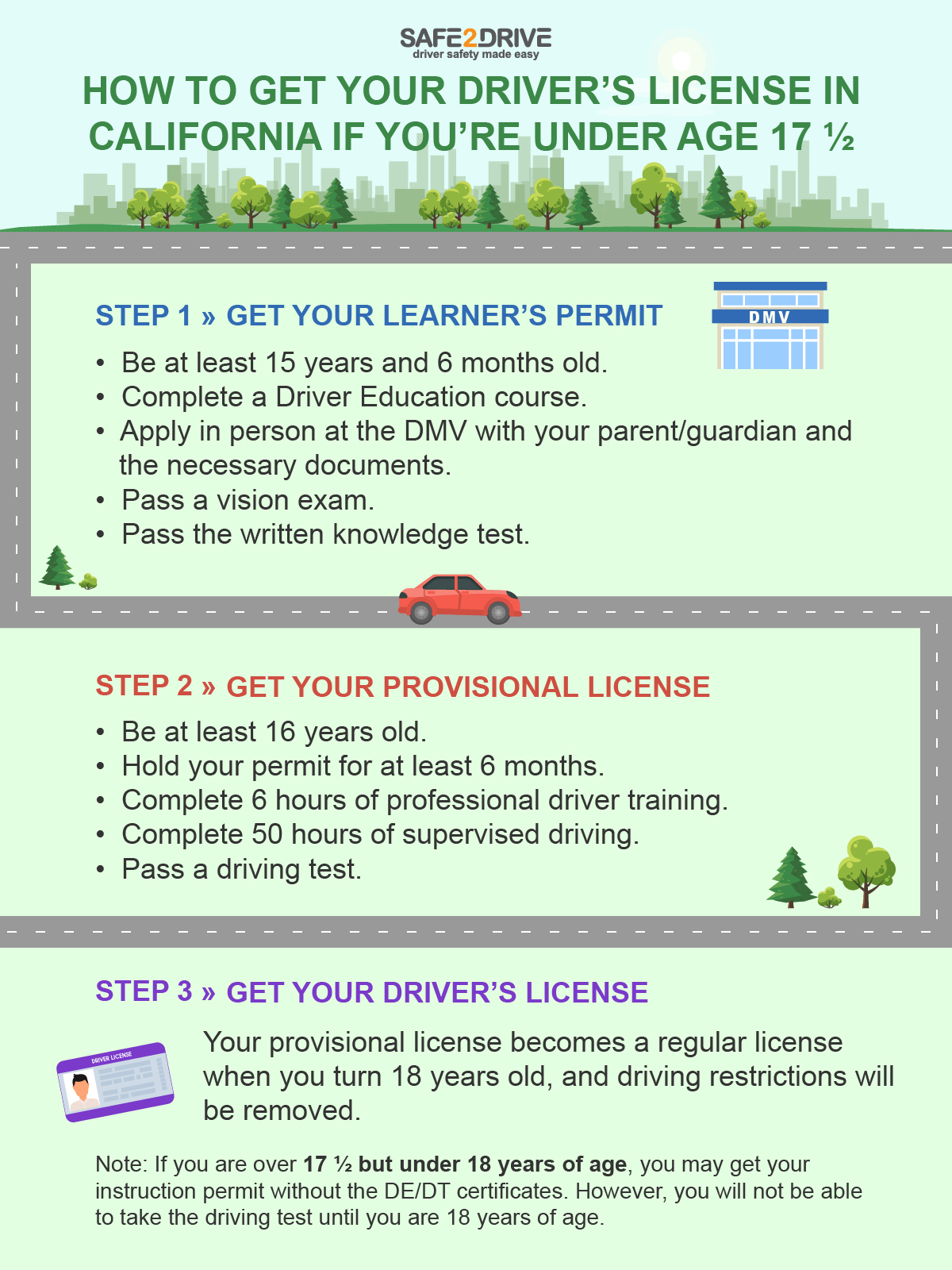
To obtain a provisional instruction permit, minors must:
- Be at least 15 ½ years old: This is the minimum age to apply for the permit.
- Complete Driver Education: This involves completing an approved driver education course, typically 30 hours of classroom instruction or an equivalent online course. You must receive a Certificate of Completion of Driver Education (Form DL 400C or OL 237).
- Begin Driver Training (Behind-the-Wheel): You must also be concurrently enrolled in or have completed an approved professional driver training program, which includes at least 6 hours of behind-the-wheel instruction. You’ll need a Certificate of Enrollment in Driver Training (Form DL 392) or a Certificate of Completion of Driver Training (Form DL 400D or OL 238). Many schools issue the DL 400C/D as a combined certificate.
- Parental/Guardian Signatures: The DL 44 application form must be signed by both parents/guardians (or one if applicable) to confirm financial responsibility.
- Pass Tests: Pass the vision exam and the knowledge test at the DMV.
Once the provisional permit is issued, minors can only drive with a licensed California driver who is at least 25 years old. This supervisor must be seated in the passenger seat and capable of taking control of the vehicle. This provisional permit must be held for a minimum of six months before the minor is eligible to take the driving test for a provisional driver’s license. During this period, the minor must also complete at least 50 hours of supervised driving practice, including 10 hours at night, with a licensed adult. These hours must be logged and certified by a parent or guardian.
Procedures for Adults Aged 18 and Over
For adults, the process is generally more streamlined, acknowledging that older applicants may possess greater maturity and judgment. While adults do not fall under the GDL program, they still must adhere to specific requirements before obtaining a full driver’s license.
To obtain an instruction permit, adults must:
- Be at least 18 years old: There is no upper age limit, but all new drivers aged 18 and above follow this process.
- No Driver Education Requirement: Unlike minors, adults are not required to complete formal driver education or behind-the-wheel training courses. However, taking such courses is highly recommended to build confidence and prepare for the driving test.
- Pass Tests: Pass the vision exam and the knowledge test at the DMV.
- No Parental Signatures: Adult applicants are responsible for their own application and financial responsibility.
Similar to minors, an adult instruction permit holder can only drive with a licensed California driver who is at least 18 years old. This supervisor must be seated in the passenger seat and capable of taking control of the vehicle. The adult permit is valid for 12 months. While there’s no mandatory waiting period or logged practice hours required by the DMV for adults to take the driving test, sufficient practice is highly advised to ensure readiness and pass the driving test confidently. Many adults choose to take professional driving lessons to hone their skills and learn specific maneuvers that are part of the driving test.
Maximizing Your Chances of Success and Beyond
Obtaining a driving permit in California is a significant milestone, but it’s just the beginning of your journey towards independent driving. To ensure a smooth transition from permit to full license, and to become a confident and safe driver, there are several practical tips to consider. These strategies not only help you navigate the immediate process but also set the stage for a fulfilling driving experience as you explore all the travel, tourism, and lifestyle opportunities California has to offer.
Practical Tips for Aspiring Drivers
- Study the Handbook Religiously: This cannot be stressed enough. The California Driver Handbook is your bible for the knowledge test and a valuable reference for safe driving practices. Read it multiple times, take notes, and utilize practice tests.
- Make DMV Appointments: Always schedule your DMV visit online. Walk-in services can lead to exceptionally long wait times, particularly in popular areas.
- Organize Documents Thoroughly: Create a checklist and double-check all required documents before your DMV appointment. Ensure they are original or certified copies, as photocopies are usually not accepted. This meticulous preparation saves time and prevents multiple trips.
- Practice Safely and Consistently: Once you have your permit, consistent practice is vital. Drive in various conditions (different times of day, different types of roads) and practice fundamental maneuvers like parking, lane changes, and turns. Always ensure your supervising driver is attentive and provides constructive feedback.
- Consider Professional Driving Lessons: Even for adults, professional lessons can be incredibly beneficial. Instructors are skilled at teaching safe driving techniques and preparing you for the specifics of the DMV driving test. For minors, these lessons are often a mandatory part of the process.
- Maintain a Positive Attitude: The process can sometimes be challenging, but approaching it with patience and a positive mindset will make it much more manageable.
From Permit to License: The Next Steps
After successfully obtaining your instruction permit, your focus shifts to gaining practical experience and ultimately securing your driver’s license.
- Supervised Driving: For both minors and adults, the permit phase is about accumulating supervised driving experience. Minors must log their 50 hours (10 at night) over a minimum of six months. Adults should practice until they feel confident and proficient.
- Scheduling Your Driving Test: Once you meet the permit holding period requirements (for minors) and feel ready (for adults), you can schedule your driving test with the DMV. It’s crucial to schedule this test in advance, as slots can fill up quickly.
- The Driving Test: This practical exam assesses your ability to safely operate a vehicle and follow traffic laws. You’ll drive with a DMV examiner who will evaluate your driving skills, including turns, lane changes, safe following distance, parallel parking, and overall situational awareness.
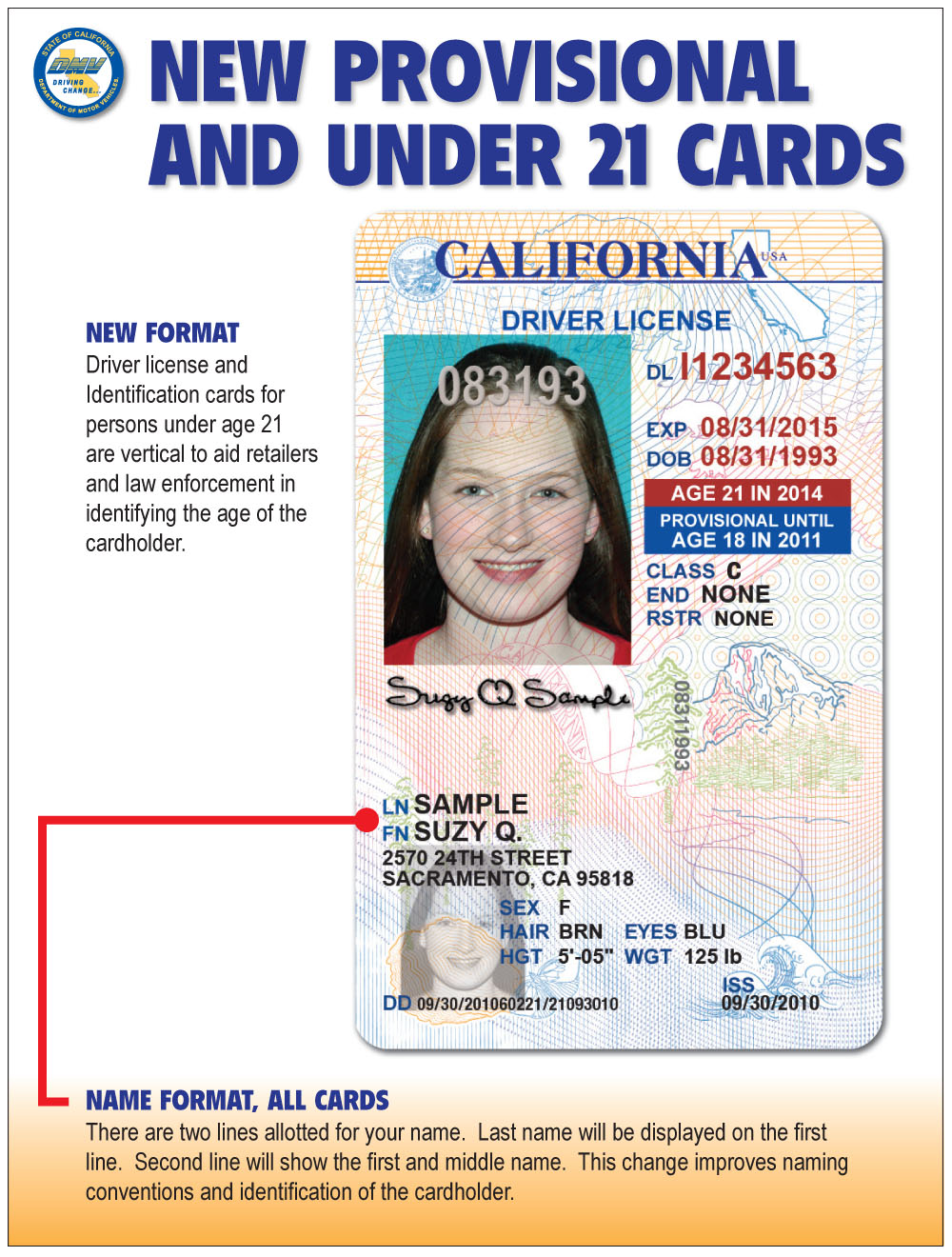
- Getting Your License: Pass the driving test, and you’ll be issued a temporary driver’s license immediately. Your official, permanent California driver’s license will be mailed to you within a few weeks.
With your full California driver’s license in hand, the open roads of the state await. You’ll have the freedom to plan your own travel itineraries, discover charming hotels, explore renowned landmarks, and fully immerse yourself in the rich culture and diverse experiences that make California a premier destination. Whether it’s a weekend getaway to the desert, a scenic drive along the coast, or a business trip across the state, your license is the key to unlocking independent travel and a more enriching lifestyle. Drive safely and enjoy the journey!
LifeOutOfTheBox is a participant in the Amazon Services LLC Associates Program, an affiliate advertising program designed to provide a means for sites to earn advertising fees by advertising and linking to Amazon.com. Amazon, the Amazon logo, AmazonSupply, and the AmazonSupply logo are trademarks of Amazon.com, Inc. or its affiliates. As an Amazon Associate we earn affiliate commissions from qualifying purchases.