
The name California evokes images of sun-drenched beaches, towering redwoods, vibrant cities, and innovative spirit. It’s a land of dreams, from the silver screen glamour of Hollywood to the tech marvels of Silicon Valley, and a premier destination for travelers worldwide seeking diverse experiences. But before it became the Golden State as we know it today, California was a mythical island, a realm of Amazonian queens and untold riches, existing only in the pages of a popular Spanish romance novel. The journey of how this legendary name transitioned from fiction to grace one of the most dynamic regions in North America is a fascinating tale deeply intertwined with the age of exploration, discovery, and enduring human imagination.
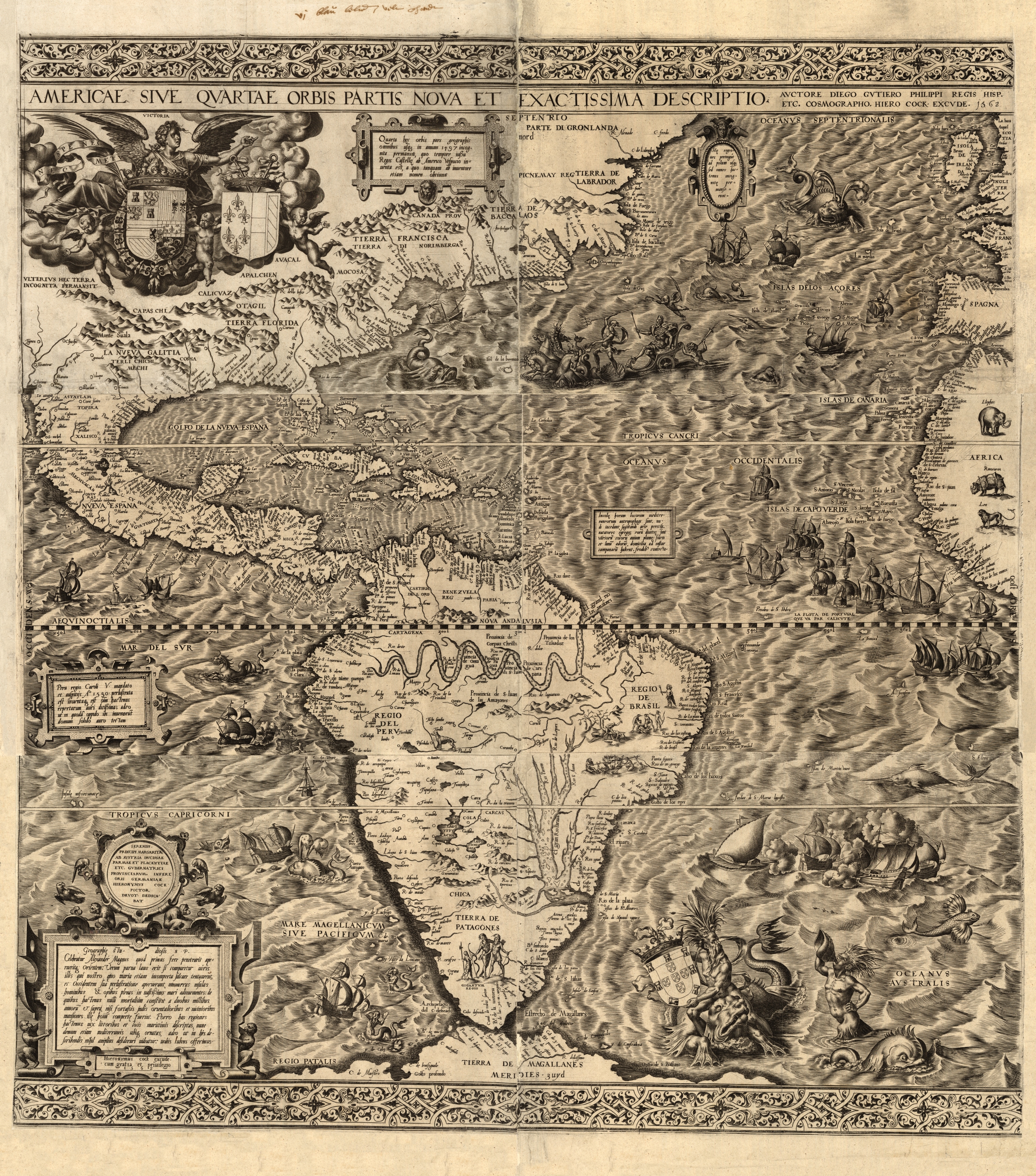
For those planning a journey to this incredible part of the United States, understanding the origin of its name adds another layer of appreciation to its rich tapestry. It’s a story that blends literary fantasy with the rugged reality of early exploration, offering a unique perspective on the state’s historical and cultural identity. From luxurious resorts catering to the most discerning travelers to charming boutique hotels perfect for budget-conscious adventurers, California offers accommodation and experiences that echo its mythical beginnings.
The Mythical Origins: A Spanish Romance
To uncover the true source of the name California, we must journey back to the early 16th century, not to a map or an explorer’s log, but to a bestselling Spanish novel. This piece of fiction captivated readers across Europe and undoubtedly influenced the minds of the adventurous men who would soon set sail into uncharted waters.
Montalvo’s Enchanting Tale
The year was 1510 when a Spanish knight, Garci Rodríguez de Montalvo, published his epic romance novel, Las sergas de Esplandián (The Adventures of Esplandián). This book was a sequel to the even more famous Amadís de Gaula, a foundational work of chivalric romance that was immensely popular in its time. Montalvo’s Esplandián featured a fantastical island nation named California, located “on the right hand of the Indies, very close to the earthly paradise.” This description immediately placed the island in a mythical, yet geographically plausible, context for readers of the era – somewhere in the then-largely-unknown western seas.
The popularity of chivalric romances during this period cannot be overstated. These tales of brave knights, daring quests, and exotic lands fueled the imaginations of a generation, including many of the explorers, conquistadors, and navigators who would soon embark on ambitious voyages across the globe. For minds steeped in such narratives, the line between fiction and potential discovery was often blurred. The notion that an actual island matching Montalvo’s description might exist was not far-fetched for those driven by the lure of new lands, riches, and glory. This literary backdrop is crucial to understanding why a name born of fantasy found its way onto real-world maps.
Queen Calafia and Her Realm
Montalvo’s mythical California was no ordinary island. It was described as a land rich in gold and precious stones, inhabited by fierce, dark-skinned Amazonian women. These warrior women lived without men, ruling their realm with iron fists and wielding weapons crafted from gold, the only metal found there. Their formidable queen was named Calafia, a powerful and charismatic figure who led her armies into battle. The novel vividly depicted a society that was exotic, formidable, and utterly captivating to the imagination.
The allure of Queen Calafia and her golden island resonated deeply. The idea of a wealthy, unconquered land, guarded by formidable female warriors, provided a tantalizing vision for the explorers who were just beginning to probe the vast expanse of the Pacific Ocean. The story offered a blueprint for a potential discovery, a powerful name ripe for application to a new, mysterious territory. The richness in gold, in particular, would prove to be a powerful, albeit often misleading, motivator for the Spanish explorers who soon ventured forth from Mexico.
From Fiction to Fact: The Age of Exploration
The literary invention of California might have remained purely fictional were it not for the relentless drive of the Spanish Empire to explore and conquer new territories in the Americas. As conquistadors pushed westward from Mexico, they encountered lands that sparked immediate recognition of Montalvo’s tale.
Cortés and the Baja Peninsula
The pivotal moment in the naming of California came with the expeditions led by the famed conquistador, Hernán Cortés. After his conquest of the Aztec Empire, Cortés turned his attention to the west, driven by rumors of wealthy lands and a belief in the existence of a strait connecting the Atlantic and Pacific Ocean (the mythical Strait of Anian).
In 1533, one of Cortés’ ships, under the command of Fortún Ximénez, landed on what is now the southern tip of the Baja California peninsula. Ximénez and his crew were met with hostility and Ximénez was killed, but the survivors returned to report the discovery of land that they believed was an island, sparsely populated and seemingly rich in pearls.
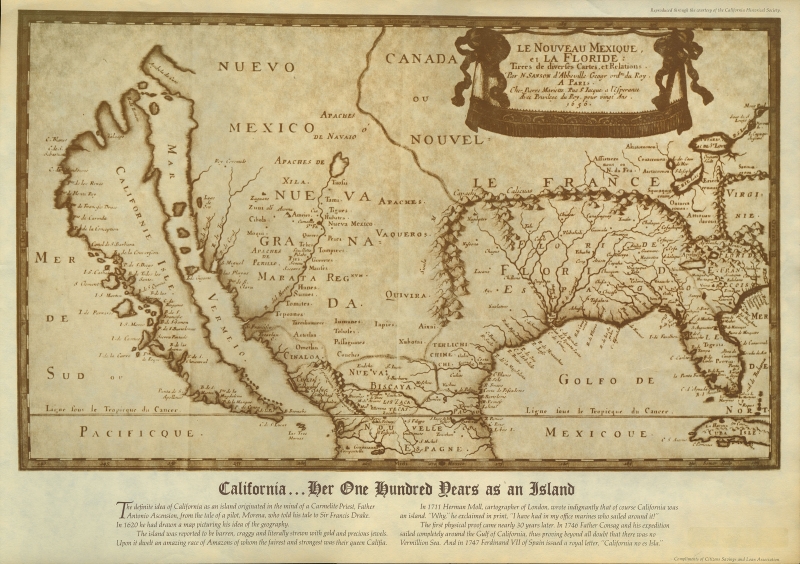
It was in 1535 that Cortés himself sailed to this new land, establishing a short-lived colony at what is now La Paz, Mexico. Upon seeing this rugged, arid peninsula, isolated by the vast waters of the Sea of Cortés (also known as the Gulf of California), the explorers were struck by a resemblance to Montalvo’s mythical island. The remoteness, the pearl oyster beds (which could be interpreted as “riches”), and the initial belief that it was an island – all these factors aligned with the romanticized descriptions from Las sergas de Esplandián. The name “California” was soon applied to this newly “discovered” territory, initially referring specifically to the Baja California peninsula.
The Spanish explorers, many of whom were educated and familiar with the popular literature of their time, made the connection between the desolate, pearl-rich “island” and the fabled land of Queen Calafia. They projected their literary fantasies onto the landscape, giving a tangible name to an abstract ideal of adventure and wealth. This act of naming was more than just geographical designation; it was an act of cultural appropriation, bringing fiction into reality.
The Persistence of the Name
For many years, the belief that California was an island persisted on maps and in official documents. It wasn’t until the late 17th century that sustained exploration and cartography definitively established that Baja California was, in fact, a peninsula, connected to the North American mainland. However, by this point, the name had firmly taken root. As Spanish expeditions continued northward, exploring what is now the modern state of California, the name expanded its reach. Figures like Juan Rodríguez Cabrillo in 1542, and later Sebastián Vizcaíno in 1602, explored the coast, further cementing the name “California” across a broader and broader territory.
The land they encountered, stretching from sun-baked deserts to lush valleys and magnificent forests, was vastly different from Montalvo’s volcanic island of gold. Yet, the name stuck. It transcended its fictional origins and the initial geographical misunderstanding, becoming synonymous with the entire region. The early Spanish missions, presidios, and pueblos established throughout the 18th century—like those in San Diego, Los Angeles, and San Francisco—all flourished under the banner of California, a testament to the enduring power of a well-told story and the human desire for discovery.
California Today: A Legacy of Legend and Lure
Today, the mythical origins of California add an intriguing layer to its identity as one of the world’s most sought-after travel destinations. The blend of history, natural beauty, and modern innovation makes it a unique place where legend meets contemporary allure. Travelers from across the globe flock here, drawn by its diverse landscapes, vibrant culture, and endless possibilities for adventure.
Exploring the Golden State’s Diverse Landscapes
From the rugged coastline of Big Sur to the majestic peaks of the Sierra Nevada, California’s geography is as varied as its historical narrative.
- Coastal Wonders: The famous Pacific Coast Highway (often referred to as Route 1) offers breathtaking drives along the edge of the Pacific Ocean, connecting charming beach towns like Santa Barbara and iconic cities such as San Francisco with its majestic Golden Gate Bridge and historic Alcatraz Island. Further south, the sun-soaked beaches of Malibu and the vibrant energy of Santa Monica Pier are perennial favorites for family trips and romantic getaways. The dramatic cliffs and redwood groves of Northern California provide a stark contrast to the lively shores of Southern California.
- National Parks and Natural Beauty: California is home to an impressive array of national parks, each offering unique natural attractions. Yosemite National Park stuns with its colossal granite cliffs, towering waterfalls, and ancient sequoia groves, making it a paradise for hikers and nature enthusiasts. Redwood National Park shelters the world’s tallest trees, providing an awe-inspiring experience of ancient forests. Meanwhile, the stark beauty and extreme temperatures of Death Valley National Park offer a humbling perspective on desert survival and adaptation. Other natural gems include the pristine waters of Lake Tahoe and the rugged wilderness of Joshua Tree National Park.
- Urban Explorations: Los Angeles invites visitors to explore its celebrity culture in Beverly Hills, catch a glimpse of the iconic Hollywood Sign, or immerse themselves in the arts at the Getty Center and the Griffith Observatory. San Francisco boasts a unique blend of Victorian architecture, diverse neighborhoods, and culinary innovation. San Diego offers a relaxed vibe with its historic Gaslamp Quarter, world-famous zoo, and beautiful beaches. For wine aficionados, Napa Valley and Sonoma Valley provide unparalleled experiences, combining exquisite wines with stunning vineyard landscapes and gourmet dining.
Where Myth Meets Modernity: Accommodation and Experiences
The myth of a rich, golden land has transformed into a reality of diverse and enriching experiences for every type of traveler. California excels in providing accommodation options that range from ultra-luxurious resorts to quaint, budget-friendly stays, all designed to enhance a memorable trip.
- Luxury and Comfort: For those seeking an indulgent lifestyle experience, California offers world-class hotels and resorts. Imagine waking up in a suite overlooking the Pacific Ocean in Monterey or enjoying the amenities of a five-star resort in Palm Springs. Many establishments offer spa services, gourmet dining, and personalized concierge services. Iconic hotels like The Beverly Wilshire, A Four Seasons Hotel in Beverly Hills or The Langham Huntington, Pasadena offer a taste of old-world glamour combined with modern luxury. For longer stays, private villas and apartment rentals provide a home-away-from-home feel, perfect for family trips or group travel.
- Unique and Authentic Stays: Beyond the conventional, California is rich with unique accommodation options. Historic hotels, charming bed-and-breakfasts in wine country, or eco-lodges nestled in the redwoods offer distinct experiences. Consider a stay at a glamping site under the stars near a national park, or a quirky boutique hotel in a vibrant urban neighborhood. These diverse options cater to different budgets and travel styles, allowing every visitor to tailor their accommodation to their desired experience.
- Tourism and Local Culture: California’s tourism sector thrives on its ability to offer a wide array of activities. Visitors can spend days exploring the theme parks of Anaheim, including the magical Disneyland Park, or delving into the rich history of Spanish missions. Food tourism is also a major draw, from the fresh seafood of San Francisco’s Fisherman’s Wharf to the innovative farm-to-table cuisine found throughout the state. Festivals, art exhibits, and live music venues offer insights into the local culture, ensuring that there’s always something new to discover. For business stays, many cities offer state-of-the-art conference facilities integrated with comfortable hotel options, blending work with the opportunity to explore.

The Enduring Allure of California
The name California, once a fantastical invention in a 16th-century novel, has become synonymous with a real-world paradise of unparalleled diversity and opportunity. From the mythical island of gold and Amazonian queens to a global hub of innovation, culture, and natural splendor, the journey of its name is a testament to the power of human imagination and the relentless spirit of exploration.
Whether you’re drawn by the promise of adventure in its national parks, the glamour of its cities, the tranquility of its wine regions, or the allure of its historical legends, California offers an experience like no other. Its hotels and resorts, attractions and landmarks, and vibrant lifestyle cater to every traveler, echoing the enduring appeal that led explorers centuries ago to christen this magnificent land with a name born of dreams. So, as you plan your next escape, remember the intriguing tale behind the name and let the legacy of Queen Calafia inspire your own adventures in this truly legendary state.
LifeOutOfTheBox is a participant in the Amazon Services LLC Associates Program, an affiliate advertising program designed to provide a means for sites to earn advertising fees by advertising and linking to Amazon.com. Amazon, the Amazon logo, AmazonSupply, and the AmazonSupply logo are trademarks of Amazon.com, Inc. or its affiliates. As an Amazon Associate we earn affiliate commissions from qualifying purchases.