
Changing your last name is a significant personal decision, often marking a new chapter, solidifying an identity, or rectifying a long-standing preference. While the process might seem daunting, navigating a name change in Florida is a structured legal procedure accessible to most residents. This comprehensive guide aims to demystify the steps involved, offering a professional, insightful, and engaging roadmap for anyone considering this important lifestyle adjustment within the Sunshine State.
Understanding the Reasons and Legal Context for Name Change in Florida
Before embarking on the administrative journey, it’s crucial to understand why individuals typically seek a name change and the specific legal framework governing these requests in Florida. This foundational knowledge ensures you approach the process with clarity and confidence.

Common Reasons for Seeking a Name Change
People pursue a legal name change for a myriad of personal and professional reasons. One of the most common scenarios is related to marriage or divorce, where individuals opt to take a spouse’s surname or revert to a maiden name, respectively. For others, the motivation might stem from a desire to correct a misspelling on official documents, align their legal name with a long-used informal name, or adopt a name that better reflects their gender identity.
Sometimes, individuals seek a name change to honor a family legacy by adopting a grandparent’s or ancestor’s surname. In more sensitive cases, a name change can be a critical step for personal safety and security, particularly for victims of domestic violence or those seeking to escape a dangerous past. Furthermore, some professionals might desire a name change to better align with a personal brand or to avoid a name with negative connotations. Whatever the motivation, Florida law generally accommodates these requests, provided they meet specific legal criteria and are not intended for fraudulent purposes.
Florida’s Legal Framework for Name Changes
In Florida, the primary legal avenue for a name change, outside of marriage or divorce decrees, is through a Petition for Change of Name filed in the Circuit Court in the county where you reside. Chapter 68 of the Florida Statutes outlines the general requirements for such petitions. The court’s role is to ensure that the requested name change is legitimate and does not pose a risk to public safety or facilitate fraud.
Unlike some other legal processes, a name change petition is generally straightforward for adults, assuming there are no criminal records, outstanding judgments, or questionable intentions. The legal process is designed to be accessible, though meticulous attention to detail is required for successful navigation. It’s important to note that a judge must approve the change, and they will consider various factors, including the petitioner’s criminal history, any outstanding financial obligations, and the absence of any intent to defraud. For minors, the process involves additional considerations, including parental consent and a determination of what is in the child’s best interest.
The Step-by-Step Process for a General Name Change Petition
For most adult residents seeking a name change not tied to marriage or divorce, the journey involves a series of distinct legal and administrative steps. Understanding each phase is vital for a smooth and efficient process.
Preparing Your Petition and Required Documents
The first substantive step is to prepare the necessary legal documents. This primarily involves drafting the Petition for Change of Name. This petition typically requires personal information, including your current legal name, the name you wish to adopt, your date and place of birth, your current address, and a brief explanation for the name change. It also requires a sworn statement that you are not seeking the change for fraudulent purposes or to avoid creditors.
Crucially, you will also need to submit a set of fingerprints, which the court will use to conduct a criminal background check through the Florida Department of Law Enforcement and the Federal Bureau of Investigation. This step is mandatory for adult name changes, excluding those associated with marriage or divorce. The fingerprinting process usually takes place at a local law enforcement agency or a designated private vendor. Additionally, you may need to gather supporting documents like your birth certificate or proof of residency to present to the court.
Filing Your Petition and Court Proceedings
Once your petition and supporting documents, including the results of your background check, are ready, you will file them with the Clerk of the Circuit Court in the Florida county where you reside. This will involve paying a filing fee, which can vary by county (e.g., Miami-Dade County or Orange County may have slightly different fees). If you cannot afford the fee, you may apply for a fee waiver (indigent status).
After filing, the court will review your petition. In many cases, particularly when the request is straightforward and there are no complications from the background check, the court may issue a Final Judgment of Name Change without requiring a formal hearing. However, depending on the judge and the specifics of your case, a brief court hearing may be scheduled. During this hearing, you would typically answer questions from the judge about your reasons for the name change and confirm the details of your petition. It is a formal, yet generally amicable, proceeding where the judge ensures all legal requirements have been met.
Public Notice Requirements and Final Order
For adult name changes, Florida law typically requires publication of a notice in a local newspaper. This notice informs the public of your intent to change your name, providing an opportunity for anyone with a legitimate objection to come forward. The specifics of publication requirements can vary by county, but generally, the notice must run for a set period, such as once a week for four consecutive weeks. This step is designed to prevent fraud and ensure transparency in the legal system.
Once the publication requirement has been met, and assuming no valid objections have been raised and all other legal criteria are satisfied, the judge will sign the Final Judgment of Name Change. This document is your official proof of your new legal name. It is imperative to obtain several certified copies of this order, as you will need them to update all your personal identification and official records. Consider obtaining at least 5-10 certified copies, as many institutions require an original or certified copy rather than a photocopy.
Name Changes in Specific Circumstances
While the general petition process covers most adult name changes, specific life events and demographic considerations have their own streamlined or modified procedures.
Name Change After Marriage or Divorce
The most common instances of name changes occur as a result of marriage or divorce. When you get married in Florida, your marriage certificate itself serves as legal documentation for a name change (taking your spouse’s surname or a hyphenated name). You typically do not need to file a separate petition with the Circuit Court. The marriage certificate can be used directly to update your Social Security card, driver’s license, and passport.
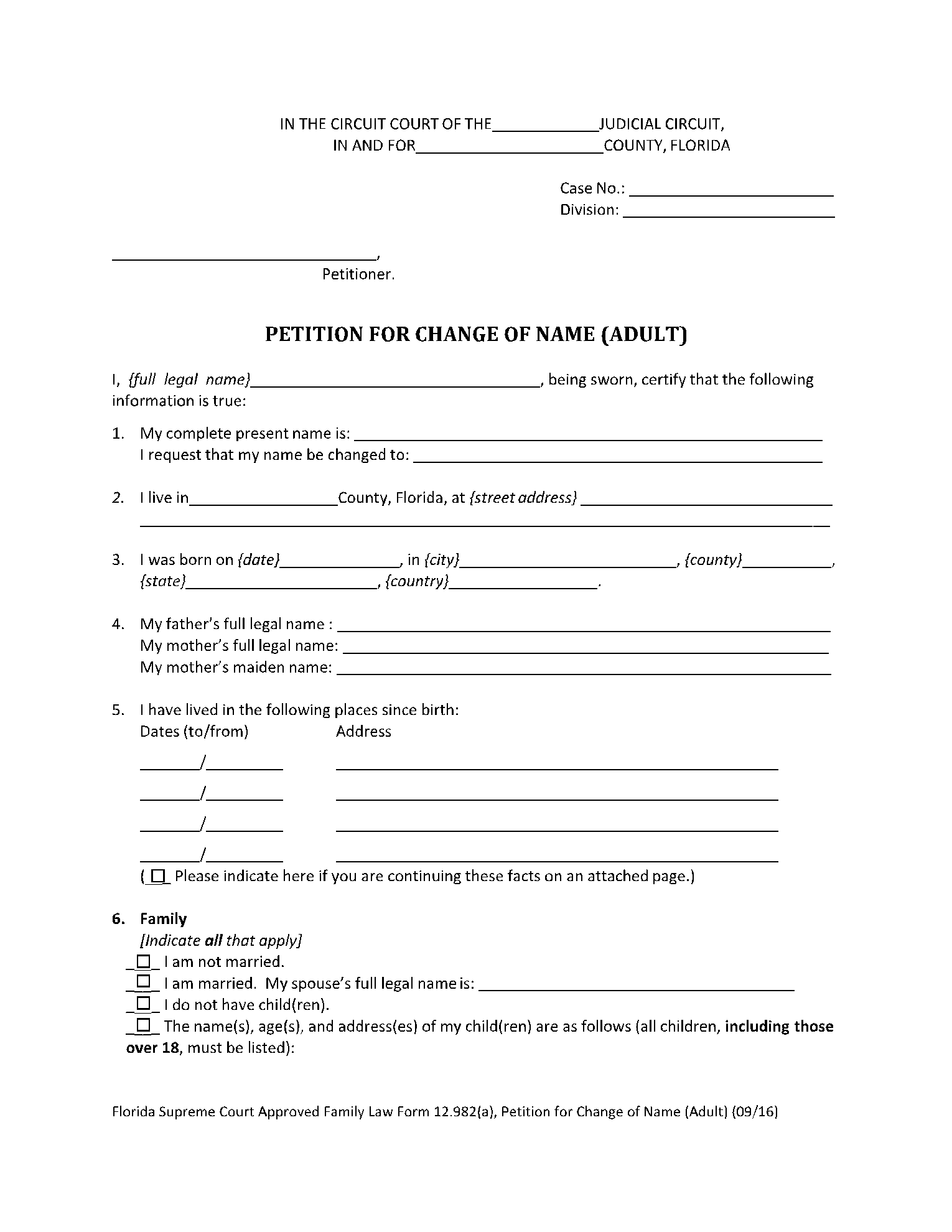
Similarly, during a divorce, if you wish to revert to your maiden name or a former legal name, you can request that the divorce decree include a provision for this name restoration. If the judge grants this request, the divorce decree then acts as the official legal document for updating your name, bypassing the need for a separate name change petition and its associated fingerprinting and publication requirements. It’s always advisable to ensure this provision is explicitly stated in the final judgment of dissolution of marriage.
Name Change for Minors
Changing a minor’s name in Florida involves a more stringent process, primarily focused on safeguarding the child’s best interests. Both parents, if living and having parental rights, must generally consent to the name change. If one parent objects, the court will hold a hearing to determine if the name change is in the minor’s best interest, considering factors such as the child’s preference (if old enough to express one), the child’s relationship with each parent, and the potential impact on the child’s identity and well-being.
The process for a minor still involves filing a petition with the Circuit Court, but it will be filed by the parents or legal guardians on behalf of the child. Fingerprinting is also required for children aged 14 and older. The court will pay close attention to the reasons presented for the name change, often prioritizing stability and preventing confusion or harm to the child.
Name Change for Professionals or Special Cases
While the general process applies to most, certain professional licensure boards or specific industries may have additional requirements or notifications once your name change is complete. For example, medical professionals, lawyers, or certified public accountants might need to update their professional licenses with the respective state boards (e.g., Florida Bar for attorneys).
Individuals seeking a name change due to witness protection programs or to escape domestic violence often have access to expedited or confidential processes that waive public notice requirements for safety reasons. These cases are handled with extreme sensitivity and often require the involvement of specific legal aid organizations or government agencies. Always consult with an attorney specializing in such cases to ensure your safety and privacy are protected.
Post-Court Order: Updating Your Identity Documents
Receiving your Final Judgment of Name Change is a significant milestone, but the process isn’t truly complete until you’ve updated all your official identification and records. This critical phase ensures your new legal name is recognized across all aspects of your life.
Essential Documents to Update
The first and most crucial document to update is your Social Security card. The Social Security Administration requires you to submit an application (Form SS-5), your certified court order, and proof of identity and citizenship. Updating your Social Security record is foundational, as many other agencies verify your identity against this federal database.
Next, you’ll need to update your Florida Driver’s License or State ID with the Florida Department of Highway Safety and Motor Vehicles. This typically involves visiting a local office with your certified court order, updated Social Security card (or proof of application), and other identification documents.
Updating your passport is also essential, especially if you plan to travel internationally. The U.S. Department of State has specific forms and requirements depending on how recently your passport was issued. Generally, you’ll need to submit your current passport, certified court order, a new photo, and the appropriate application form.
Beyond these primary forms of identification, you’ll need to update:
- Bank accounts and financial institutions
- Credit cards and loans
- Utility bills and leases/mortgages
- Employer records and payroll
- Insurance policies (health, auto, life)
- Voter registration
- Professional licenses or certifications
- Educational institutions (transcripts, diplomas)
- Medical records
- Vehicle titles and registrations
The Importance of Timely Updates Across All Records
Timely updating of all your identity documents and records is paramount. Failing to do so can lead to a host of complications, ranging from minor inconveniences to significant legal and financial hurdles. Discrepancies between your legal name on different documents can cause issues with travel, banking transactions, employment verification, and access to services.
For example, having different names on your driver’s license and bank account can make cashing checks or applying for loans difficult. Furthermore, inconsistent names on medical records could lead to administrative errors or confusion in emergency situations. Proactively updating all records ensures a seamless transition to your new legal identity and prevents potential fraud risks. It’s often helpful to create a checklist of all the places where your name appears and systematically work through updating each one, always keeping certified copies of your court order readily available.
Legal Assistance and Resources for Your Florida Name Change
While the Florida name change process is designed to be manageable, certain complexities can arise. Knowing when to seek professional help and where to find reliable resources can make a significant difference.
When to Consult an Attorney
While not always mandatory, consulting a Florida attorney specializing in family law or civil litigation is highly recommended in several situations. If you have a criminal record, significant outstanding debts or judgments, or are seeking a name change for a minor against the objection of a parent, legal counsel becomes invaluable. An attorney can help navigate potential roadblocks, represent your interests in court, and ensure all legal requirements are met, particularly regarding publication waivers in cases of domestic violence or safety concerns.
Even for straightforward cases, an attorney can offer peace of mind by reviewing your petition and guiding you through the filing process, ensuring accuracy and completeness. They can also advise on the specific requirements of your county’s Circuit Court and help you prepare for any potential court hearings.
Navigating Florida Court Resources
The Florida Courts website provides a wealth of information and self-help resources for individuals navigating the legal system, including forms and instructions for name changes. Each county’s Clerk of the Circuit Court also typically has a self-help center or staff available to answer procedural questions, though they cannot provide legal advice.
These resources can be an excellent starting point for understanding the required forms and steps. However, always remember that procedural assistance differs from legal advice. For personalized guidance on complex issues or ensuring your specific situation aligns with legal requirements, a qualified attorney remains the best resource. Successfully changing your last name in Florida is an empowering step towards a new chapter, and with careful planning and adherence to the legal process, it’s an achievable goal for many.
LifeOutOfTheBox is a participant in the Amazon Services LLC Associates Program, an affiliate advertising program designed to provide a means for sites to earn advertising fees by advertising and linking to Amazon.com. Amazon, the Amazon logo, AmazonSupply, and the AmazonSupply logo are trademarks of Amazon.com, Inc. or its affiliates. As an Amazon Associate we earn affiliate commissions from qualifying purchases.