
Embarking on a journey to the idyllic shores of Hawaii is a dream for many, conjuring images of pristine beaches, lush volcanic landscapes, and vibrant Polynesian culture. However, before the first mai tai can be savored or the first surfboard caught, there’s the inevitable question that every aspiring island-hopper considers: “How long is the plane ride to Hawaii?” The answer, while seemingly straightforward, is a nuanced one, influenced by a variety of factors ranging from your departure city to the specific Hawaiian island you choose as your paradise. Understanding these elements is key to planning a seamless and enjoyable travel experience, setting the stage for an unforgettable escape to the heart of the Pacific.
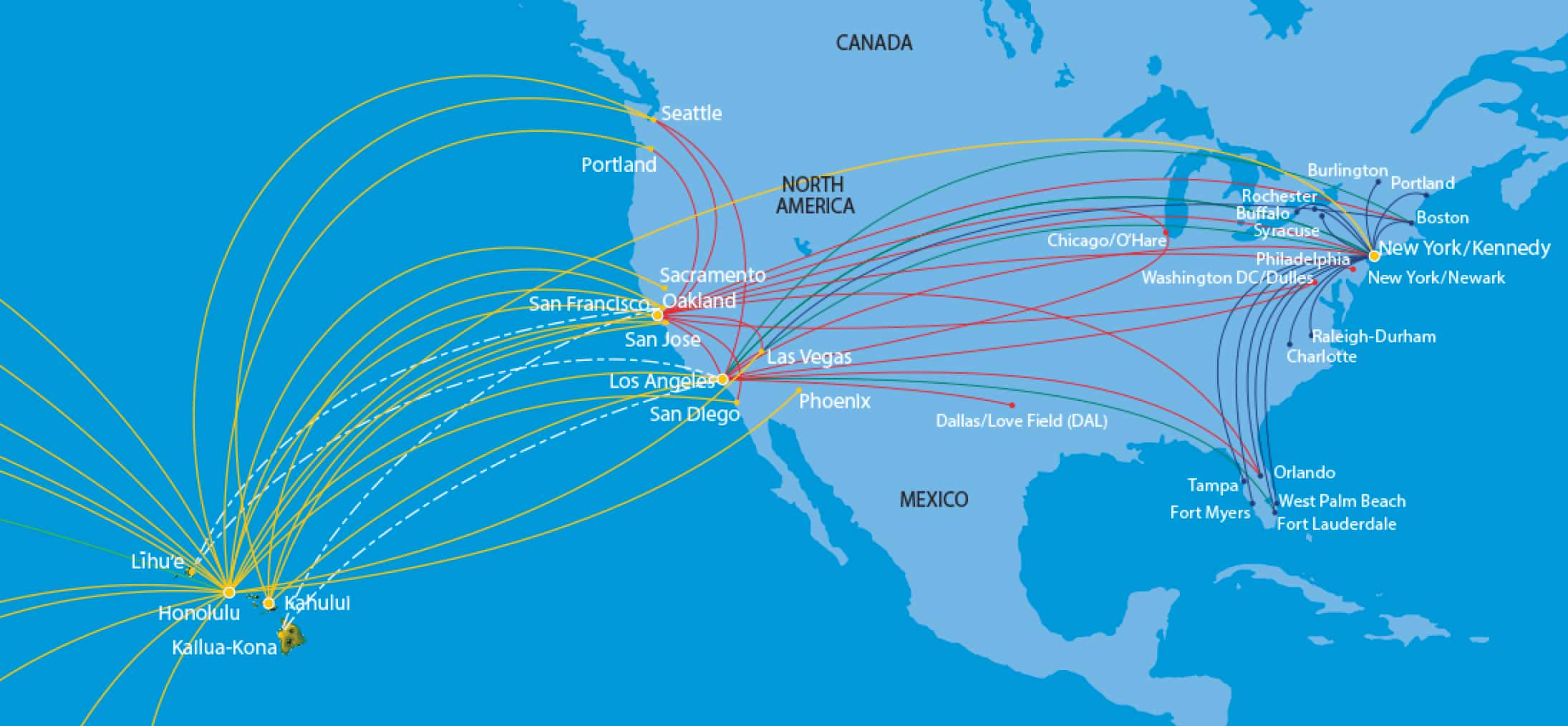
The allure of Hawaii is undeniable, but its remote location means a significant commitment in terms of air travel. Positioned nearly 2,400 miles from the United States mainland, it requires a sustained flight across the vast expanse of the Pacific Ocean. While the duration might seem daunting to some, the anticipation of arriving in a place where natural beauty reigns supreme and the spirit of aloha thrives makes every hour in the air a worthwhile investment. This comprehensive guide will break down the typical flight durations, explain the variables at play, and offer practical tips to make your journey to the 50th state as comfortable and pleasant as possible.
Understanding the Variables: Factors Influencing Flight Duration
The actual time you spend in the air on your way to Hawaii is not a fixed number. Several critical factors come into play, each contributing to the overall length of your journey. Being aware of these variables can help you make informed decisions when booking your flights and managing your expectations.
Departure City and Origin Coast
Perhaps the most significant determinant of your flight time is your point of origin within the United States or abroad. Due to Hawaii’s position in the Pacific, flights originating from the West Coast of the mainland United States are considerably shorter than those departing from the East Coast or even the Midwest. The further east you are, the longer the flight will be, often necessitating layovers.
For instance, a direct flight from a major West Coast hub like Los Angeles or San Francisco will be much shorter than a direct flight from Chicago or New York. This difference is primarily due to geographical distance, but also relates to the availability of direct routes and the operational capabilities of various aircraft types over such vast distances. Travelers from the East Coast often find that a single stop in a West Coast city is unavoidable, extending total travel time significantly.
Specific Hawaiian Island Destination
Hawaii is an archipelago composed of numerous islands, but most tourists fly into one of four primary destinations: Oahu (Honolulu), Maui, Kauai, or the Big Island (Kona or Hilo). While the flight path to the general region of Hawaii is similar, there can be slight variations in flight time depending on which island you’re landing on.
Honolulu (Daniel K. Inouye International Airport on Oahu) is the main gateway to the islands and is often the first stop for many international and mainland flights. Flights to Maui’s Kahului Airport, Kauai’s Lihue Airport, or the Big Island’s Kona or Hilo airports might add an additional 20-45 minutes to your journey compared to landing directly in Honolulu, depending on their relative position in the island chain. For those not landing in Honolulu first, these are often direct flights, meaning no inter-island transfer is needed immediately upon arrival.
Headwinds and Tailwinds
Believe it or not, the weather conditions high in the atmosphere can have a measurable impact on your flight duration. Jet streams, powerful currents of air, can act as either headwinds or tailwinds. When flying westward to Hawaii, strong headwinds can increase flight times by 30 minutes to an hour, as the aircraft has to work harder against the opposing air current. Conversely, returning eastward, tailwinds can significantly shorten the journey, sometimes by an hour or more. Airlines account for these possibilities in their scheduling, but actual flight times can fluctuate.
Layover Considerations
While not part of the “plane ride” itself, layovers are a crucial component of total travel time, especially for travelers departing from areas without direct flights to Hawaii. A single layover can add anywhere from 2-5 hours to your trip, depending on the connection time. Multiple layovers, while sometimes cheaper, can stretch your travel day into 15-20 hours or even longer. When considering flights, it’s essential to weigh the cost savings of connecting flights against the added fatigue and time.
Typical Flight Durations from Major North American Hubs
To give a clearer picture, let’s explore the average non-stop flight times from various regions across North America to Honolulu (Oahu), which serves as the most common entry point for travelers. Remember that flights to other islands like Maui or the Big Island will be similar, perhaps adding a small amount of time.
West Coast Departures
The West Coast offers the shortest direct flights to Hawaii, making it a popular connecting point for travelers from further inland.
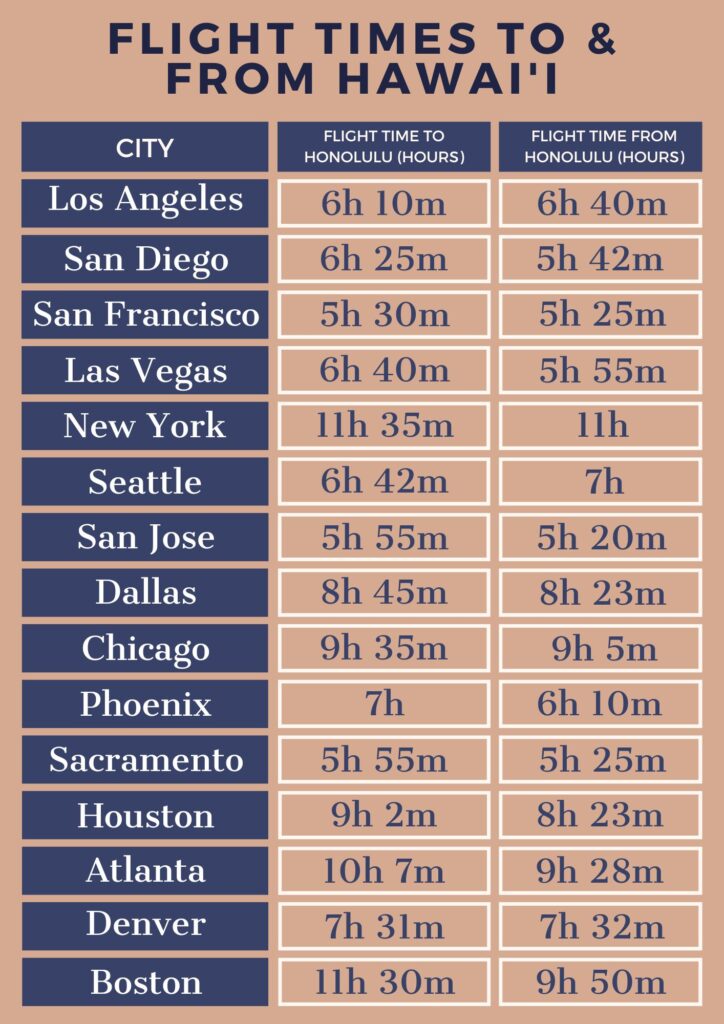
- Los Angeles (LAX) / San Francisco (SFO) to Honolulu: Approximately 5 hours 30 minutes to 6 hours. These are some of the most frequent and shortest routes.
- Seattle (SEA) / Portland (PDX) to Honolulu: Roughly 5 hours 45 minutes to 6 hours 30 minutes. Slightly longer than California departures due to the more northern origin.
- Vancouver (YVR), Canada to Honolulu: Typically 6 hours to 6 hours 30 minutes, mirroring flights from the northern United States West Coast.
Mid-America Departures
Travelers from the central United States will experience longer direct flights, though these are less common than West Coast direct routes. Many will involve a stopover.
- Chicago (ORD) to Honolulu: A direct flight can take around 8 hours 30 minutes to 9 hours 30 minutes. These flights are long-haul and less frequent.
- Dallas (DFW) / Houston (IAH) to Honolulu: Expect direct flights to be in the range of 8 hours to 9 hours.
- Denver (DEN) to Honolulu: Direct services usually last between 7 hours 30 minutes and 8 hours 30 minutes.
East Coast Departures
Direct flights from the East Coast are the longest and are often considered ultra-long-haul domestic flights. They are fewer in number compared to West Coast options.
- New York (JFK/ Newark EWR) to Honolulu: A direct flight is a significant journey, typically spanning 10 hours to 11 hours.
- Boston (BOS) to Honolulu: Similar to New York, direct flights are rare and would take around 10-11 hours.
- Miami (MIA) to Honolulu: One of the longest potential domestic routes, a direct flight would be in the range of 10 hours 30 minutes to 11 hours 30 minutes.
- Atlanta (ATL) to Honolulu: Direct flights from Atlanta are also very long, typically 9 hours 30 minutes to 10 hours 30 minutes.
- Toronto (YYZ), Canada to Honolulu: Direct flights, if available, would be in the 9 hour to 10 hour range.
For most East Coast and many Midwest travelers, the most practical and often most affordable option is a connecting flight through a major West Coast hub. This could mean a total travel time of 12-16 hours or more, including layovers.
International Flights to Hawaii
Hawaii’s appeal extends far beyond North America, drawing visitors from around the globe. For these international travelers, the flight durations can be considerably longer, often involving multiple legs.
Asia-Pacific Routes
Given its geographic location, Hawaii is a popular destination for travelers from the Asia-Pacific region.
- Tokyo (NRT/HND) to Honolulu: Around 7 hours to 7 hours 30 minutes. This is a very well-serviced and popular route.
- Seoul (ICN) to Honolulu: Typically 8 hours to 8 hours 30 minutes.
- Sydney (SYD), Australia to Honolulu: A substantial journey, usually 9 hours 30 minutes to 10 hours 30 minutes.
- Auckland (AKL), New Zealand to Honolulu: Similar to Sydney, expect around 8 hours 30 minutes to 9 hours 30 minutes.
European Connections
For travelers from Europe, a direct flight to Hawaii is generally not an option due to the immense distance. A journey from major European cities would typically involve at least one, if not two, layovers, usually in a major United States hub (like Los Angeles, San Francisco, Seattle, or even Dallas/Fort Worth).
- London (LHR) to Honolulu: Total travel time, including layovers, could easily range from 17 to 24 hours or more. The flight from London to the West Coast is typically 10-11 hours alone, followed by the 5-6 hour flight to Hawaii, plus layover time.
- Frankfurt (FRA) to Honolulu: Similar to London, expect total travel times upwards of 18-25 hours.
These extended travel times highlight the remote beauty of Hawaii and underscore the need for thorough planning to make the journey as comfortable as possible.
Making the Journey Enjoyable: Tips for a Long Flight
While the duration of the flight to Hawaii can be substantial, there are numerous strategies to ensure your travel day is as pleasant as possible, allowing you to arrive refreshed and ready to embrace the islands.
Choosing the Right Flight
Opt for direct flights whenever possible, especially if traveling from the West Coast or other regions with available non-stop services. This minimizes time spent in airports and reduces the chances of delays or missed connections. If a layover is unavoidable, try to choose one with a reasonable connection time – enough to comfortably get to your next gate, but not so long that you’re stuck for hours. Consider flying overnight for longer routes; you can sleep for a good portion of the journey, arriving in Hawaii in the morning or early afternoon, which helps with jet lag.
Comfort Essentials
Prioritize comfort in your packing. A good quality neck pillow, eye mask, and earplugs or noise-canceling headphones are invaluable for rest. Dress in loose, comfortable layers, as cabin temperatures can fluctuate. Pack entertainment: download movies, TV shows, podcasts, and e-books. While most airlines offer in-flight entertainment, having your own options ensures you won’t be bored. Don’t forget a portable charger for your devices!
Staying Hydrated and Moving
Cabin air is notoriously dry, making hydration crucial. Drink plenty of water before, during, and after your flight, and try to limit caffeine and alcohol, which can contribute to dehydration. Get up and move around the cabin every hour or two if possible, even if it’s just a short walk to the restroom. Perform simple stretches in your seat to promote circulation and prevent stiffness. Compression socks can also be beneficial for preventing swelling and reducing the risk of deep vein thrombosis (DVT) on long flights.
Beating Jet Lag
Traveling to Hawaii typically means crossing multiple time zones, especially from the East Coast. Jet lag can significantly impact your first few days. Start adjusting your sleep schedule a few days before departure by gradually shifting your bedtime closer to [Hawaii](https://lifeoutofthebox.com/hawaii]’s time zone. Once on the plane, immediately set your watch to Hawaii time and try to sleep and eat according to that schedule. Upon arrival, expose yourself to natural light as much as possible, and try to stay awake until evening, even if you’re tired. Avoid heavy meals and excessive naps on your first day.
Conclusion
The plane ride to Hawaii is indeed a significant commitment, a journey that can range from a relatively quick 5-6 hours from the West Coast to a full travel day, or even longer, when originating from the East Coast or international destinations. Understanding the factors that influence flight duration—your departure city, specific island destination, and even atmospheric conditions—is key to setting realistic expectations and planning effectively.
However, the moments spent in transit are merely a prelude to the unparalleled beauty and unique experiences that await. With careful planning, attention to comfort, and a positive mindset, the journey itself can be managed effectively, ensuring you arrive in Hawaii feeling ready to immerse yourself in its stunning landscapes, warm hospitality, and the vibrant spirit of aloha. The reward of swaying palm trees, crystal-clear waters, and breathtaking sunsets truly makes every hour in the air a small price to pay for a Hawaiian paradise.
LifeOutOfTheBox is a participant in the Amazon Services LLC Associates Program, an affiliate advertising program designed to provide a means for sites to earn advertising fees by advertising and linking to Amazon.com. Amazon, the Amazon logo, AmazonSupply, and the AmazonSupply logo are trademarks of Amazon.com, Inc. or its affiliates. As an Amazon Associate we earn affiliate commissions from qualifying purchases.