
Navigating the complexities of divorce represents a significant life transition, marking the end of one chapter and the beginning of another. In California, the process is governed by specific legal frameworks designed to ensure fairness and equity for all parties involved. Understanding these procedures is crucial for anyone contemplating or undergoing a marital dissolution. This comprehensive guide outlines the essential steps and considerations for filing for divorce in the Golden State, providing a roadmap for managing this profound lifestyle change with clarity and informed decision-making.
Understanding the Basics: Residency and Grounds for Divorce in California
Before initiating divorce proceedings, it is vital to ascertain whether you meet California’s residency requirements. The state mandates that at least one spouse must have lived in California for a minimum of six months immediately prior to filing the petition. Additionally, one spouse must have resided in the specific county where the divorce is filed for at least three months. These requirements are non-negotiable and are a foundational prerequisite for the Superior Court of California to assert jurisdiction over your case.
California is a “no-fault” divorce state. This means that a spouse does not need to prove marital misconduct (such as adultery or abandonment) to obtain a divorce. The only grounds required are “irreconcilable differences,” which essentially signifies that the marriage has broken down to the point where it cannot be saved, or “incurable insanity.” The vast majority of divorces in California are filed under the grounds of irreconcilable differences, simplifying the emotional burden often associated with assigning blame.
Types of Divorce Proceedings
California offers several pathways for divorce, depending on the specific circumstances of the couple:
- Standard Divorce (Dissolution of Marriage): This is the most common type and applies to most cases, particularly those involving children, significant assets, or disagreements over support. It involves a formal court process.
- Summary Dissolution: This expedited process is available only to couples who meet very specific criteria. To qualify, you must have been married for less than five years, have no children, possess limited community property and debts, and both agree to the dissolution. Both parties must also waive their right to appeal and to receive spousal support. This option offers a simpler and quicker path to dissolving a marriage for qualifying couples.
- Legal Separation: While not a divorce, legal separation allows couples to formalize property division, custody arrangements, and support orders while remaining legally married. This option is sometimes chosen for religious, health insurance, or other personal reasons.
Choosing the appropriate path hinges on your unique situation and should be carefully considered, potentially with legal counsel.
Navigating the Paperwork: Initial Filings and Service of Process
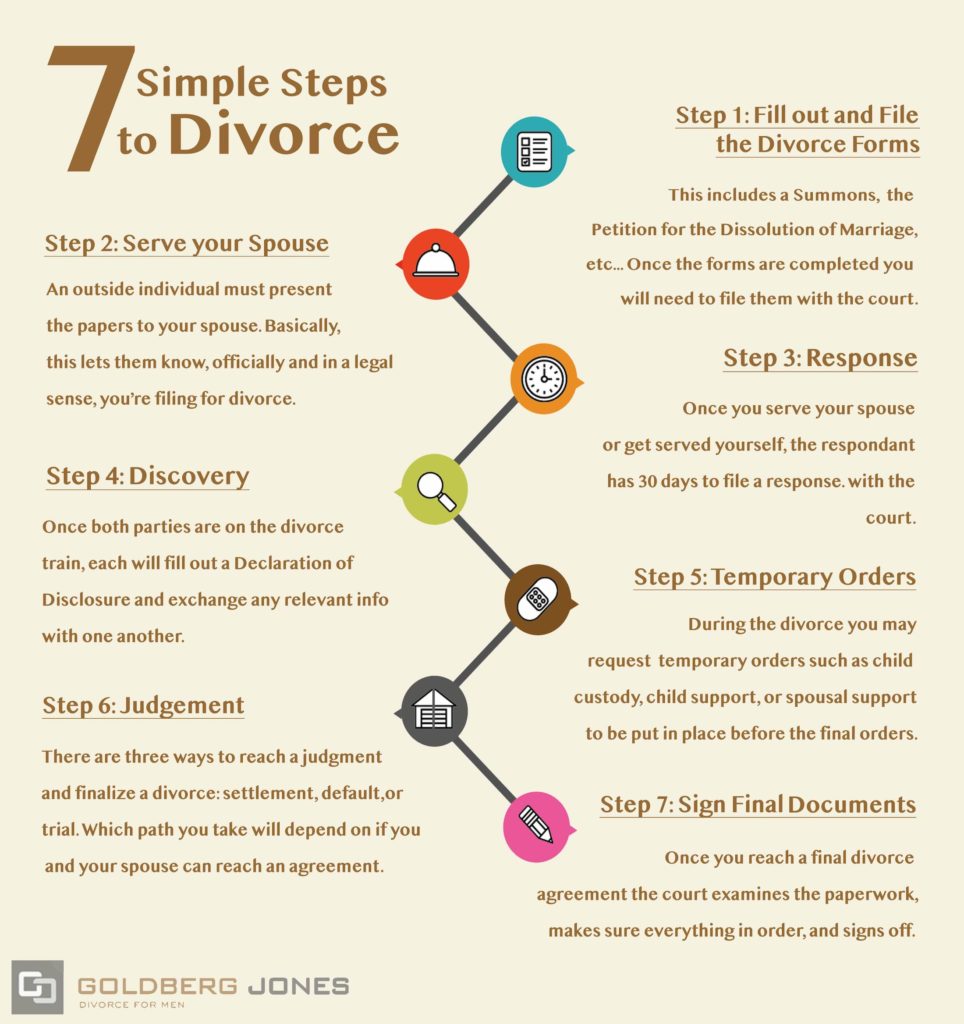
The initial steps of filing for divorce involve a series of crucial legal documents and strict adherence to procedural rules. This phase sets the stage for the entire divorce process.
Initiating the Petition
The divorce process officially begins when one spouse, known as the “petitioner,” files a “Petition — Marriage/Domestic Partnership” (Form FL-100) with the Superior Court of California in the appropriate county. This form identifies the parties, states the grounds for divorce, and outlines requests regarding property division, spousal support, child custody, and child support.
Along with the petition, the petitioner typically files:
- Summons (Form FL-110): This form notifies the other spouse (the “respondent”) that a divorce action has been filed and that they have a limited time (typically 30 days) to respond.
- Declaration Under Uniform Child Custody Jurisdiction and Enforcement Act (UCCJEA) (Form FL-105/GC-120): If minor children are involved, this form provides the court with necessary information regarding the children’s residence and any prior custody orders.
- Community Property Declaration (Form FL-160) and Separate Property Declaration (Form FL-160): These forms, or similar declarations, are used to list assets and debts, categorizing them as community property (acquired during marriage) or separate property (acquired before marriage or by gift/inheritance).
All these forms must be filled out accurately and completely, as omissions or errors can cause significant delays.
Serving the Respondent
Once the petition and summons are filed with the court, the respondent must be legally “served” with copies of these documents. Proper service is a fundamental due process requirement, ensuring the respondent is formally notified of the legal action. Service cannot be performed by the petitioner themselves. It must be done by someone who is at least 18 years old and not a party to the case, such as a professional process server, a sheriff, or a friend/family member.
Methods of service include:
- Personal Service: The most common method, where the documents are personally delivered to the respondent.
- Service by Mail with Notice and Acknowledgment of Receipt: The documents are mailed, and the respondent signs and returns a form acknowledging receipt.
- Substituted Service: If personal service is unsuccessful after several attempts, the court may allow service by leaving documents with an adult at the respondent’s home or workplace, followed by mailing.
- Service by Publication: A rare method used when the respondent cannot be located after diligent search, requiring court permission to publish notice in a newspaper.
After service is completed, the person who served the documents must fill out a “Proof of Service of Summons” (Form FL-115) and file it with the court. This crucial step verifies that the respondent has been properly notified and is a prerequisite for the case to move forward.
Addressing Key Issues: Asset Division, Spousal Support, and Child Custody
The core of any divorce proceeding in California involves resolving critical issues pertaining to the division of assets and debts, financial support for a spouse, and arrangements for minor children. These decisions profoundly impact the post-divorce lifestyle of all involved.
Property and Debt Division
California is a community property state. This means that all assets and debts acquired by either spouse during the marriage, from the date of marriage to the date of separation, are considered “community property” and must be divided equally, 50/50. “Separate property,” which includes assets owned before marriage, gifts, and inheritances received by one spouse, typically remains the sole property of that spouse.
Identifying, valuing, and categorizing assets and debts can be complex, often requiring the assistance of financial experts, appraisers, and attorneys. Common assets include real estate, bank accounts, retirement funds, investments, and businesses. Debts can range from mortgages and credit card balances to car loans and personal loans. Full disclosure of all assets and debts by both parties is legally mandated and critical for a fair division.
Spousal Support (Alimony)
Spousal support, often referred to as alimony, is financial assistance paid by one spouse to the other after divorce. In California, there are two types:
- Temporary Spousal Support: Provided during the divorce proceedings to help the lower-earning spouse maintain their lifestyle while the case is ongoing.
- Permanent Spousal Support: Awarded as part of the final judgment, intended to help the supported spouse become self-supporting. The court considers numerous factors when determining permanent spousal support, as outlined in Family Code section 4320. These factors include the marital standard of living, the duration of the marriage, each spouse’s earning capacity, age and health, and contributions to the other spouse’s education or career. For marriages of less than 10 years, support generally lasts for half the length of the marriage. For “long-term marriages” (10 years or more), there is no presumptive end date, and the court retains jurisdiction indefinitely unless otherwise agreed.
Child Custody and Support
When minor children are involved, their best interests are the paramount concern for the court. California courts issue orders for both legal custody and physical custody.
- Legal Custody: Determines who has the right to make decisions about the children’s health, education, and welfare. It can be “sole” (one parent makes all decisions) or “joint” (parents share decision-making).
- Physical Custody: Determines where the children live. It can be “sole” (children live primarily with one parent) or “joint” (children spend significant time with both parents). Courts generally favor arrangements that allow for frequent and continuing contact with both parents, provided it is in the child’s best interest.
Child support is calculated using a statewide guideline formula that considers both parents’ incomes, the percentage of time each parent spends with the children, health insurance costs, and other factors. Child support is a legal obligation and cannot be waived by the parents. Modifications to custody and support orders are possible if there is a significant change in circumstances.
Reaching Resolution: Settlement or Trial
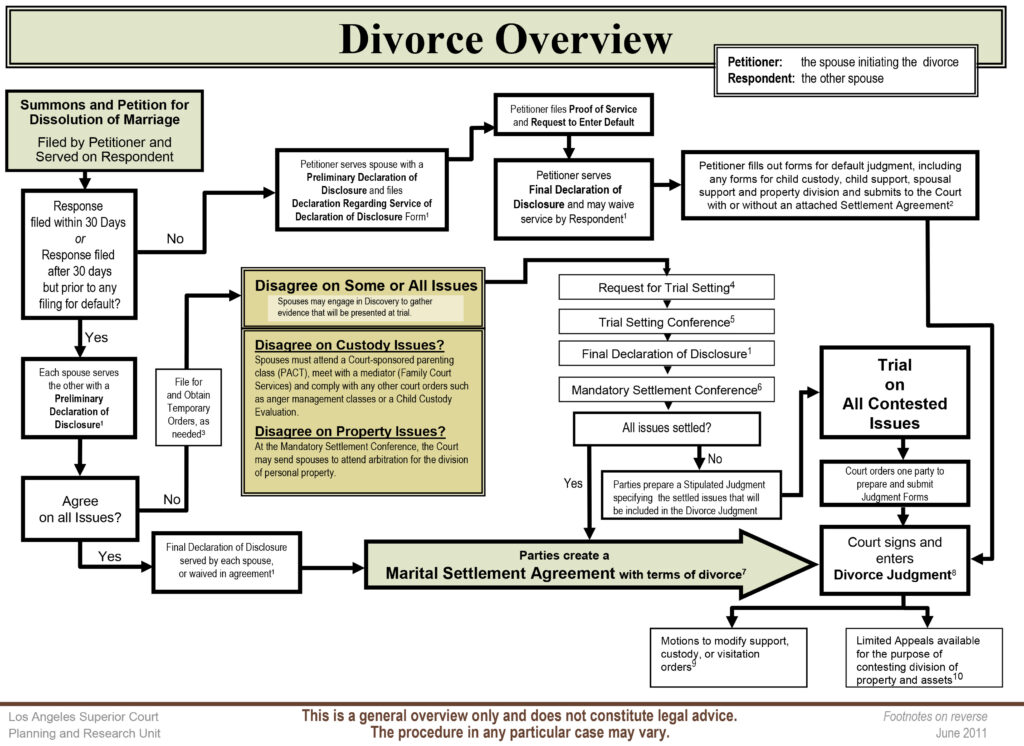
The path to a final divorce judgment typically involves either a mutual agreement between the parties or a court trial.
Marital Settlement Agreement (MSA)
The most common and often preferred method for resolving a divorce is through a Marital Settlement Agreement (MSA). An MSA is a legally binding contract that outlines all agreements reached by the divorcing couple regarding property division, spousal support, child custody, and child support. This agreement can be negotiated directly by the parties, through mediation, or with the assistance of attorneys.
Advantages of an MSA include:
- Cost-Effectiveness: Avoiding a trial significantly reduces legal fees.
- Control: Spouses have more control over the outcome, tailoring solutions to their specific needs rather than having a judge impose decisions.
- Reduced Conflict: The process is generally less adversarial, fostering better co-parenting relationships if children are involved.
Once an MSA is finalized and signed by both parties, it is submitted to the court for approval. The court will review the agreement to ensure it is fair and, particularly regarding child-related issues, is in the children’s best interests. If approved, the MSA becomes part of the final divorce judgment.
Divorce Trial
If spouses cannot reach a full agreement on all issues, the case will proceed to trial. During a divorce trial, a judge will hear evidence, testimony from witnesses, and legal arguments from each spouse’s attorney. The judge will then make decisions on all outstanding issues, which will become part of the final judgment. Trials are typically more expensive, time-consuming, and emotionally draining than reaching a settlement, and the outcome is ultimately determined by a third party.
Finalizing Your Divorce: The Judgment and Post-Judgment Considerations
The final step in the divorce process is the entry of the “Judgment of Dissolution” by the court. This document formally ends the marriage and incorporates all the agreements made in an MSA or the decisions rendered by a judge after a trial.
The Divorce Judgment
The judgment is a comprehensive legal document that details all the terms of your divorce, including:
- Date of marriage termination.
- Division of community and separate property and debts.
- Spousal support orders (amount, duration, and conditions).
- Child custody and visitation schedule.
- Child support orders.
- Any other specific orders related to the parties or their assets.
It is crucial to ensure that the judgment accurately reflects all agreements or court orders. Once entered, the parties are legally divorced, and the terms of the judgment are enforceable.
The Six-Month Waiting Period
California imposes a mandatory six-month waiting period from the date the respondent was served with the divorce papers (or the date the respondent appeared in court, whichever is first) until the marriage can be legally terminated. Even if all issues are settled quickly, the marital status cannot officially end before this period expires. This waiting period allows time for reflection, potential reconciliation, or the finalization of all necessary paperwork.

Post-Judgment Considerations
After the judgment is entered, certain actions may still be necessary, such as:
- Executing QDROs: If retirement accounts are divided, a Qualified Domestic Relations Order (QDRO) is a separate court order required to instruct the plan administrator on how to divide the funds.
- Transferring Property Titles: Deeds for real estate or titles for vehicles may need to be formally transferred to reflect the new ownership.
- Updating Beneficiaries: Life insurance policies, wills, and other estate planning documents should be updated to reflect the change in marital status.
While the legal proceedings provide closure to the marriage, managing the practical and emotional aspects of a new lifestyle continues. Seeking financial advice, emotional support, and engaging in personal planning are essential steps for building a stable and fulfilling future after divorce. Understanding the procedural landscape in California empowers individuals to navigate this challenging period with greater confidence and foresight.
LifeOutOfTheBox is a participant in the Amazon Services LLC Associates Program, an affiliate advertising program designed to provide a means for sites to earn advertising fees by advertising and linking to Amazon.com. Amazon, the Amazon logo, AmazonSupply, and the AmazonSupply logo are trademarks of Amazon.com, Inc. or its affiliates. As an Amazon Associate we earn affiliate commissions from qualifying purchases.