
Navigating the process of obtaining a handicap placard in Texas can seem daunting, but understanding the requirements and steps involved makes it a manageable task. This guide is designed to provide a clear, comprehensive overview for Texas residents seeking accessible parking options, ensuring they can enjoy their travels and daily activities with greater ease. Whether you are a resident planning a trip across the state or simply looking to improve local mobility, a handicap placard, officially known as a Disability Parking Placard, is an invaluable tool.
Understanding Texas Disability Parking Placard Requirements
To qualify for a disability parking placard in Texas, an individual must demonstrate a qualifying disability that significantly impairs their mobility. The eligibility criteria are set by the Texas Department of Motor Vehicles (TxDMV) and are designed to ensure that these parking privileges are granted to those who truly need them.

Qualifying Disabilities
The definition of a qualifying disability is broad and encompasses several conditions. Generally, it refers to a person who:
- Cannot walk 200 feet without stopping to rest.
- Cannot walk without the use of a brace, cane, crutch, prosthetic device, wheelchair, or other assistive device, or without assistance from another person.
- Is restricted by lung disease to such an extent that their corrected vision is 20/200 or less in the better eye with all refractive error corrected, or whose visual acuity is detracted to a degree that the applicant can be expected to move about with the aid of an assistant.
- Has a cardiac condition to the extent that the person’s physical functional limitations are as follows:
- Has Class III or Class IV cardiac condition according to the standards set by the American Heart Association.
- The applicant’s physician has determined that the physical functional limitations imposed by the cardiac condition are similar to, or in excess of, those imposed by the Class III or IV cardiac condition.
- Is severely limited in their ability to engage in or to work in a livelihood because of a vision impairment, including blindness, as defined by state law.
- Suffers from a neurological, orthopedic, or other medical impairment that severely limits mobility. This can include conditions like severe arthritis, multiple sclerosis, Parkinson’s disease, or significant spinal cord injuries.
It is crucial to consult with a healthcare professional to determine if your condition meets these criteria. The physician plays a pivotal role in the application process by certifying your disability.
Types of Placards
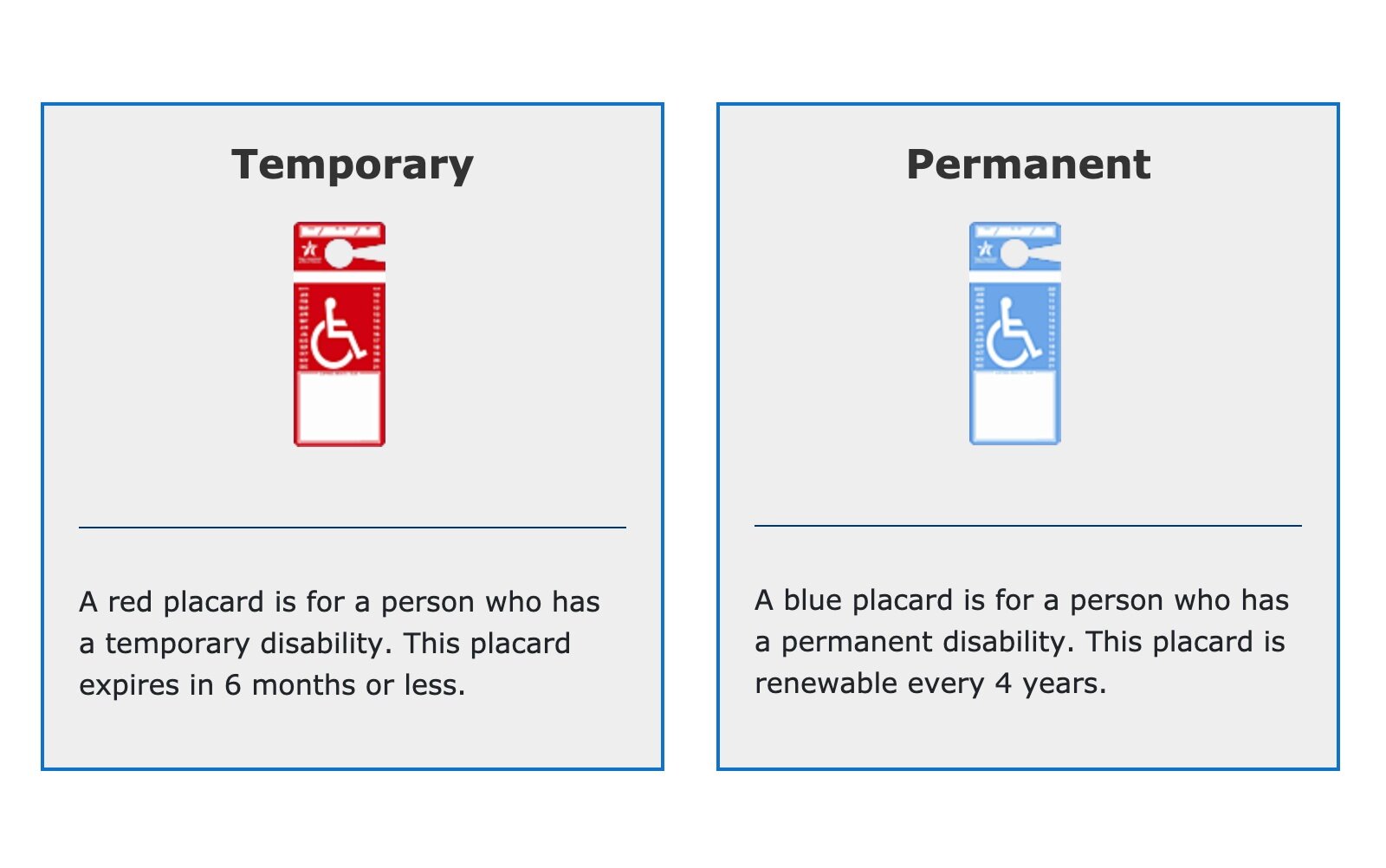
Texas offers two primary types of disability parking placards:
- Long-Term Placard: This placard is issued to individuals with a disability expected to last for more than six months. These are typically valid for a period of five years and can be renewed.
- Short-Term Placard: This placard is for individuals with a temporary disability, such as those recovering from surgery or a severe injury, expected to last for less than six months. The expiration date will be specified on the placard.
A disabled person can also obtain a disabled license plate if they own a vehicle, which serves the same purpose as a placard but is affixed to the vehicle’s license plate.
The Application Process: Step-by-Step
Obtaining a handicap placard in Texas involves completing a specific application form and having it certified by a medical professional. The process is managed by the Texas Department of Motor Vehicles.
Step 1: Obtain the Application Form
The official application form is called the “Application for Texas Disability Parking Placard” (Form VTR-215). This form is available for download from the TxDMV website. You can also obtain a copy from your local county tax assessor-collector office. It is essential to use the most current version of the form.
Step 2: Complete Your Section of the Application
As the applicant, you will need to fill out the personal information section of the form. This includes:
- Your full name and mailing address.
- Your driver’s license number or ID card number.
- Information about the type of placard you are requesting (long-term or short-term).
- A declaration that you meet the eligibility requirements.
Ensure all information is accurate and legible.
Step 3: Medical Certification by a Healthcare Professional
This is a critical step. A licensed healthcare professional must certify that you meet the eligibility requirements for a disability parking placard. This healthcare professional can be:
- A physician (M.D. or D.O.)
- A podiatrist (D.P.M.)
- An optometrist (O.D.) – for visual impairments only.
- A chiropractor (D.C.) – for certain mobility impairments, but their certification is limited to specific conditions.
The healthcare professional will complete the “Medical Condition Certification” section of the application form. They will need to describe your condition and explain how it limits your mobility, specifying the type of placard (long-term or short-term) they recommend. They must also provide their license number and signature.
Step 4: Submit the Application
Once the application is completed and medically certified, you can submit it. The primary submission point is your local county tax assessor-collector office. You can typically find the office closest to you through the Texas Department of Motor Vehicles website.
- In Person: Visiting your local tax assessor-collector office is often the most efficient method. Bring your completed application form, a valid form of identification (like a driver’s license or state ID), and any required fees.
- By Mail: Some counties may allow submission by mail. It is advisable to contact your local office to confirm this option and get specific mailing instructions.
There is typically no fee to obtain a disability parking placard in Texas. However, if you are applying for disabled license plates, there will be vehicle registration fees involved.
Using Your Disability Parking Placard Responsibly
Receiving your disability parking placard is the first step towards more accessible parking. Understanding how to use it correctly and the privileges it affords is essential.
Placard Placement
- Vehicle Placard: When using the placard, it must be hung from the rearview mirror assembly of the vehicle when parked in a designated accessible parking space. It should not be hung when the vehicle is being driven.
- Personal Placard: If you are a passenger in a vehicle and have your own placard, the driver must display your placard when parking in an accessible space.
Designated Parking Spaces
Disability parking placards grant the holder the right to park in spaces marked with the International Symbol of Access (wheelchair symbol). These spaces are typically located closer to building entrances, providing convenient access to businesses, medical facilities, and public venues.
Reciprocity with Other States and Countries
Texas disability parking placards are recognized in all other states in the United States and in many foreign countries. This means you can use your placard when traveling to destinations like California, Florida, or even international locations that adhere to similar accessibility standards. Always be aware of local regulations in your destination, as there might be minor differences in enforcement or specific parking rules.
Renewal and Replacement
- Renewal: Long-term placards are valid for five years. The TxDMV or your local county tax assessor-collector office will typically send a renewal notice. It is the placard holder’s responsibility to renew it before expiration. The renewal process usually involves completing a new application form and obtaining medical recertification.
- Replacement: If your placard is lost, stolen, or damaged, you can apply for a replacement. You will need to submit a new application and pay any applicable replacement fees. You can typically do this at your local county tax assessor-collector office.
Special Considerations for Travelers
For individuals who rely on their disability parking placard to enhance their travel experiences, planning ahead can make a significant difference.
Accessible Accommodations
When booking hotels or other accommodations, inquire about accessible rooms. Many hotels, from budget-friendly chains like Motel 6 to luxury resorts like the Ritz-Carlton, offer rooms with wider doorways, grab bars in bathrooms, and other features to accommodate mobility needs. Some may even have designated accessible parking directly outside the hotel entrance or within their parking garages. Popular travel booking sites often have filters to search for accessible accommodations.
Planning Accessible Attractions
When visiting cities or popular tourist destinations, research accessibility options beforehand. Many major attractions, such as the Alamo in San Antonio, Space Center Houston, or museums like the Perot Museum of Nature and Science in Dallas, have dedicated accessible parking and offer services for visitors with disabilities. Websites for these attractions often have an “Accessibility” section detailing available features.
Transportation Services
For longer distances or within cities, consider accessible transportation options. Many rental car companies offer accessible vehicles. In larger cities, public transportation systems often have accessible buses and rail lines. Ride-sharing services like Uber and Lyft also have options for accessible vehicles in many areas. Planning your transportation can reduce stress and ensure you can reach your desired destinations comfortably.
Documenting Your Placard
While Texas placards have reciprocity, it’s always wise to carry a copy of your original application or your physician’s contact information, especially when traveling internationally or to less familiar regions. This can be helpful if any questions arise about the validity of your placard.
Obtaining and using a disability parking placard in Texas is about more than just parking; it’s about enabling independence and ensuring that everyone can participate fully in society and enjoy the many experiences Texas and beyond has to offer. By understanding the process and adhering to the guidelines, individuals with mobility impairments can confidently access the resources and opportunities they need.
LifeOutOfTheBox is a participant in the Amazon Services LLC Associates Program, an affiliate advertising program designed to provide a means for sites to earn advertising fees by advertising and linking to Amazon.com. Amazon, the Amazon logo, AmazonSupply, and the AmazonSupply logo are trademarks of Amazon.com, Inc. or its affiliates. As an Amazon Associate we earn affiliate commissions from qualifying purchases.