
The vast, arid landscapes of Arizona hold a breathtaking testament to cosmic power: the Barringer Meteorite Crater. Often simply called Meteor Crater, this colossal landmark near Winslow stands as the best-preserved impact site on Earth, offering an unparalleled window into the cataclysmic events that shape planetary surfaces. The sheer scale of the crater invites immediate wonder and an inevitable question: just how immense was the meteor responsible for such a monumental scar on our planet? Understanding the size of this ancient cosmic projectile involves delving into geology, physics, and the dedicated work of scientists who pieced together this incredible story.

The Immense Impact: Unveiling the Barringer Meteorite Crater
Approximately 50,000 years ago, an extraterrestrial object hurtled through Earth’s atmosphere and slammed into what is now the high desert of Arizona. The resulting explosion, estimated to be equivalent to about 10 megatons of TNT, instantly vaporized much of the meteoroid itself and excavated a crater nearly a mile wide. The Barringer Meteorite Crater is a relatively young feature in geological terms, meaning erosion and subsequent geological processes have had limited time to obscure its pristine form. This preservation is what makes it such a vital landmark for scientific study and public awe.
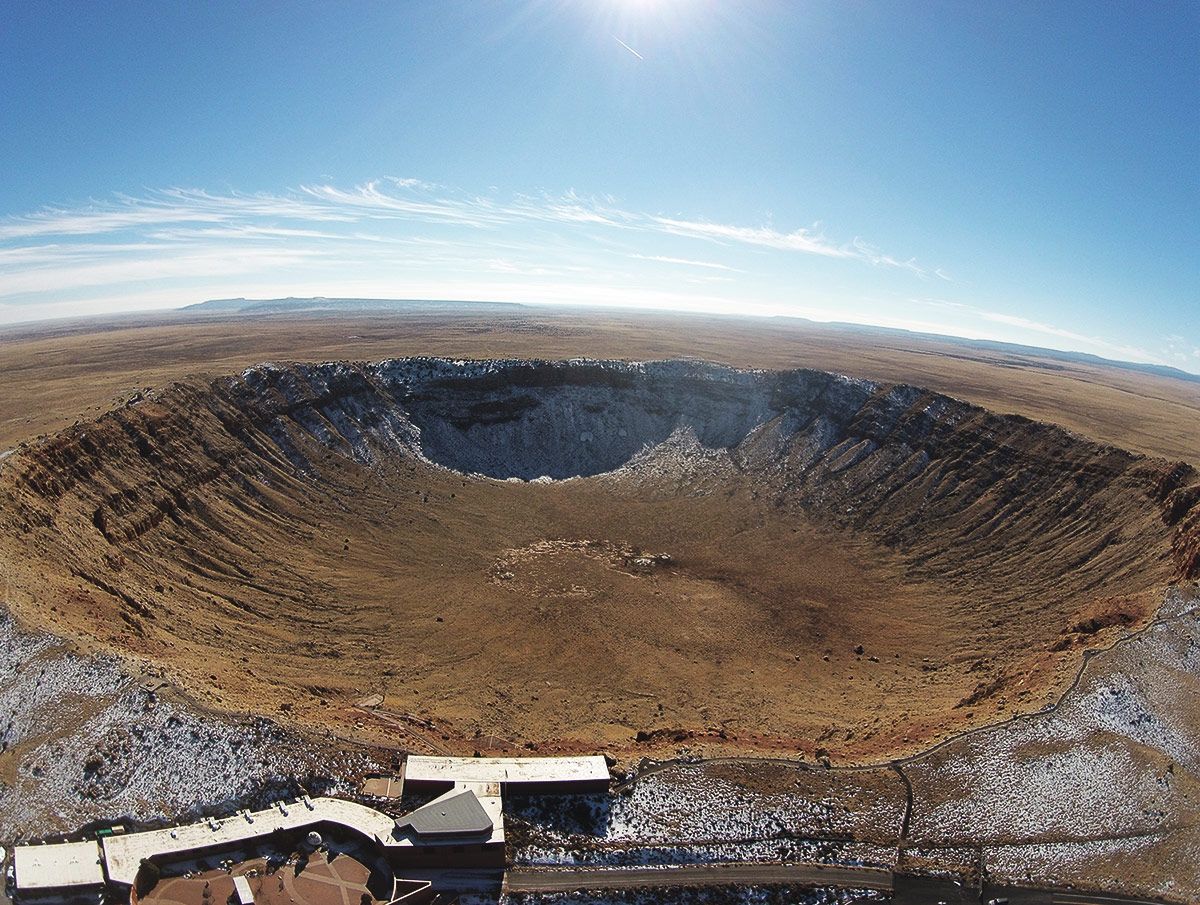
Unlike volcanic craters, which feature raised rims formed by molten rock, the Barringer Meteorite Crater exhibits characteristics typical of hypervelocity impacts: an uplifted rim of overturned rock strata, a flat floor, and a distinct bowl shape. The rim rises approximately 150 feet (45 meters) above the surrounding plain, and the crater floor lies about 560 feet (170 meters) below the rim. For perspective, this vast depression could comfortably hold twenty professional football fields, and its depth would conceal a 60-story building. The immediate area around the crater is also littered with impactites – rocks modified by the extreme pressure and heat of the event – and fragments of the meteoroid itself. This tangible evidence has been crucial in unraveling the true nature of this terrestrial scar.
The scientific understanding of the crater was a hard-won battle. For centuries, its origin was debated, with many assuming it to be volcanic. It was largely through the tireless efforts of mining engineer Daniel Barringer in the early 20th century that the impact hypothesis gained traction. Barringer correctly identified the massive quantities of meteoric iron found around the site as definitive proof of its extraterrestrial origin, though his attempts to locate the main body of the meteoroid beneath the crater floor proved futile due to its fragmentation and vaporization upon impact. Today, the Barringer Meteorite Crater is managed by the Barringer Crater Company, preserving it as a unique natural landmark and a living laboratory for planetary science.
Estimating the Cosmic Visitor: Size and Composition
The question of “how big was the meteor” is perhaps the most intriguing aspect for visitors to this iconic Arizona landmark. It’s important to differentiate between the size of the crater and the size of the object that created it. The meteoroid itself was significantly smaller than the mile-wide cavity it blasted into the Earth. Based on extensive research, including geological surveys, geophysical modeling, and the analysis of meteoritic fragments, scientists have arrived at a consensus regarding the estimated size and composition of the impactor.
The Canyon Diablo Meteorite
The meteoroid responsible for the Barringer Meteorite Crater is classified as an iron meteorite. Its fragments, known as the Canyon Diablo meteorites, are primarily composed of iron with a significant percentage of nickel, along with trace amounts of other elements. This composition is key to estimating its original mass and dimensions. Iron meteorites are dense, meaning even a relatively smaller object can possess enormous kinetic energy.
Calculated Dimensions

The most widely accepted estimate for the meteoroid’s diameter is approximately 150 feet (about 45 meters). To put this into perspective, that’s roughly the length of a Boeing 737 airplane, or half the height of the Statue of Liberty. While 150 feet might not sound colossal when compared to the vastness of the crater, it’s crucial to remember the incredible speed at which it traveled – estimated at around 26,000 miles per hour (42,000 kilometers per hour) upon atmospheric entry. This immense velocity transformed a relatively modest-sized object into an earth-shattering projectile. Its mass is estimated to have been several hundred thousand tons. The atmospheric entry and impact dynamics meant that much of this mass was vaporized or scattered as fine dust, rather than remaining as a single, buried body. This understanding was a critical breakthrough in planetary science, explaining why Daniel Barringer’s extensive drilling efforts to find the main meteoroid were unsuccessful.
A Geological Marvel: The Crater’s Dimensions and Significance
The Barringer Meteorite Crater is more than just a large hole in the ground; it’s a living laboratory and a profoundly significant landmark. Its dimensions are truly impressive, even when viewed from its rim. The crater measures approximately 0.75 miles (1.2 kilometers) in diameter from rim to rim, forming an almost perfectly circular depression. The rim rises about 150 feet (45 meters) above the surrounding plains, composed of rock strata that were violently uplifted and overturned by the impact. The floor of the crater is about 560 feet (170 meters) below the rim, roughly 200 feet (60 meters) below the pre-impact ground level.
A Rosetta Stone for Planetary Science
The pristine state and accessible geology of the Barringer Meteorite Crater have made it an invaluable site for understanding impact mechanics on Earth and other celestial bodies. Prior to the 20th century, the concept of large meteorite impacts shaping planetary surfaces was not widely accepted. The unequivocal evidence presented by Barringer and subsequent researchers at this site fundamentally shifted our understanding of Earth’s geological history and the processes that formed the Moon and Mars. Scientists have studied the shock effects on rocks, the distribution of ejecta, and the overall morphology of the crater to refine models of impact events. These studies have directly informed missions to other planets and helped interpret images of craters across the solar system.
Training Ground for Astronauts
The significance of this Arizona landmark extends beyond pure geology. During the 1960s, the unique terrain of the Barringer Meteorite Crater served as a vital training ground for NASA‘s Apollo astronauts. The crater’s rugged, impact-scarred landscape provided an ideal analogue for the lunar surface, allowing astronauts to practice geological observation, sample collection, and traverse techniques in an environment that closely mimicked what they would encounter on the Moon. This historical connection adds another layer of profound importance to the site, linking a prehistoric cosmic event to humanity’s greatest voyages of exploration.
Visiting a Celestial Scar: Experiencing the Landmark
Today, the Barringer Meteorite Crater is a privately owned and operated landmark, offering a remarkable visitor experience. Located just off Interstate 40, approximately 35 miles (56 kilometers) east of Flagstaff and 20 miles (32 kilometers) west of Winslow, it is easily accessible to travelers exploring northern Arizona. The Barringer Crater Company maintains an excellent visitor center perched on the crater’s rim, providing comprehensive exhibits and educational programs that bring the science and history of the impact to life.
The Visitor Experience
The Barringer Meteorite Crater Visitor Center features interactive displays, a 10-minute video presentation, and the “Apollo Imax Theater” which further details the site’s role in space exploration. Perhaps the most captivating aspect is the collection of meteoritic fragments, including a massive 1,406-pound (638 kg) piece of the Canyon Diablo meteorite, allowing visitors to touch a piece of the very object that created the landmark before them. Observation decks provide stunning panoramic views of the crater, allowing visitors to truly grasp its monumental scale. Guided rim tours, led by knowledgeable staff, offer deeper insights into the geology and history, pointing out specific features and explaining the impact process in detail.
For those captivated by natural history, geology, or space exploration, a visit to the Barringer Meteorite Crater is an essential Arizona landmark experience. It is a powerful reminder of Earth’s dynamic past, the forces that shape our solar system, and the scientific curiosity that allows us to unravel such cosmic mysteries. Standing on the rim and gazing into the vast bowl carved by an extraterrestrial visitor, one gains a profound appreciation for both the destructive power of nature and the resilience of our planet.
LifeOutOfTheBox is a participant in the Amazon Services LLC Associates Program, an affiliate advertising program designed to provide a means for sites to earn advertising fees by advertising and linking to Amazon.com. Amazon, the Amazon logo, AmazonSupply, and the AmazonSupply logo are trademarks of Amazon.com, Inc. or its affiliates. As an Amazon Associate we earn affiliate commissions from qualifying purchases.