
Making a Lifestyle Change: Understanding Unemployment Eligibility in California
Deciding to quit a job is a monumental step, often driven by a desire for a significant lifestyle change, career pivot, or personal well-being. For many, the golden state of California represents a dream locale for such transitions, offering diverse opportunities and a vibrant culture. However, a primary concern when voluntarily leaving employment is the question of financial stability, specifically, whether one can collect unemployment benefits to support their transitional lifestyle.
Unlike being laid off or terminated without cause, voluntarily quitting a job generally makes you ineligible for unemployment benefits from the Employment Development Department (EDD) in California. The premise of unemployment insurance is to provide a safety net for individuals who lose their jobs through no fault of their own. This foundational principle often leads to the misconception that quitting automatically disqualifies you. However, California law does provide exceptions to this rule, primarily centered around the concept of “good cause.”

Understanding these exceptions is crucial for anyone contemplating a voluntary departure and hoping to maintain a semblance of their desired lifestyle during a period of non-employment. Without a clear grasp of what constitutes “good cause,” individuals risk facing a significant financial void that could severely impact their ability to pursue new life goals, explore new career paths, or simply cover essential living expenses in a state known for its high cost of living. Navigating the EDD’s requirements demands careful preparation and documentation to demonstrate that your reasons for quitting were compelling and reasonable, falling outside a simple preference or dissatisfaction.
Defining “Good Cause” in California Law
The term “good cause” is the cornerstone of eligibility for unemployment benefits after quitting in California. It essentially means that you had a compelling reason to leave your job, a reason that would prompt a reasonable person, genuinely desirous of retaining employment, to quit under similar circumstances. Importantly, the burden of proof rests entirely on the claimant to demonstrate that good cause existed. This isn’t a casual assertion; it requires concrete evidence and a clear narrative presented to the Employment Development Department.
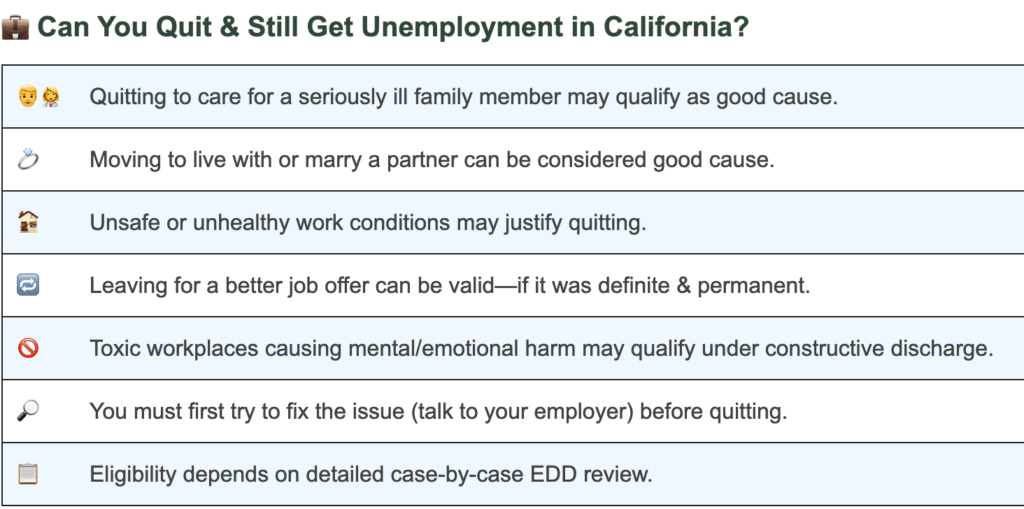
What exactly constitutes “good cause” can be multifaceted and is often determined on a case-by-case basis during an EDD interview. However, several common scenarios are typically recognized:
- Unsafe Working Conditions: If your workplace posed a legitimate threat to your health or safety, and you attempted to resolve the issue with your employer without success, quitting might be deemed for good cause. This could include exposure to hazardous materials, lack of proper safety equipment, or a hostile work environment not addressed by management.
- Sexual Harassment or Discrimination: Experiencing or being subjected to sexual harassment, discrimination based on protected characteristics (race, gender, religion, age, disability, etc.), or retaliation in the workplace can be strong grounds for good cause, especially if the employer failed to take appropriate remedial action after being notified.
- Medical Reasons: If you must quit your job due to your own verifiable medical condition, or to care for an immediate family member with a severe medical condition, and you have exhausted all reasonable accommodations or leave options with your employer, this can qualify. Medical documentation and proof of attempts to preserve employment are vital.
- Relocation for Spouse/Domestic Partner: If your spouse or registered domestic partner is required to relocate for their employment, and your current job is no longer feasible due to the distance, quitting to accompany them to a new permanent residence might be considered good cause. The relocation must be a necessity, not just a preference.
- Significant Change in Working Conditions or Duties: If your employer made substantial, detrimental changes to your job duties, hours, or working conditions that were not agreed upon and made the job unsuitable, this could also be a basis for good cause. This often requires showing that the changes made the job fundamentally different from what you were hired for.
- Wage Reduction or Unpaid Wages: A substantial cut in pay without prior agreement, or an employer’s consistent failure to pay earned wages, can be considered good cause for quitting.
Crucially, in almost all “good cause” scenarios, the claimant must demonstrate that they made reasonable efforts to resolve the issue with their employer before resigning. This could involve communicating concerns to management, seeking accommodations, or exploring internal complaint procedures. Quitting impulsively without attempting to rectify the situation with the employer typically undermines a claim of good cause.
The “Good Cause” Criterion: Safeguarding Your Financial California Lifestyle
The concept of “good cause” isn’t merely a legal formality; it’s a critical gateway to maintaining financial stability during a period of transition, directly impacting your ability to sustain your preferred lifestyle in California. Without unemployment benefits, navigating the financial landscape post-quitting can be daunting, forcing significant adjustments to spending, housing, and even the ability to pursue personal growth or leisure activities. Securing benefits, therefore, becomes paramount for preserving your quality of life.
The Application and Interview Process
Once you’ve voluntarily quit your job, the first step is to file a claim for unemployment benefits with the Employment Development Department (EDD) as soon as possible. During this initial application, you will indicate that you quit your job. This action will trigger a mandatory eligibility interview with an EDD representative. This interview is not a mere formality; it is where you present your case for “good cause.”
- Be Prepared: Before your interview, gather all relevant documentation. This might include medical records, employer communications (emails, letters, memos about your concerns or attempts to resolve issues), police reports (in cases of harassment or threat), or proof of a spouse’s job relocation.
- Be Clear and Concise: During the interview, clearly explain why you quit, focusing on the specific “good cause” reasons. Detail the steps you took to try and resolve the issues with your employer before resigning. Emphasize that you truly desired to keep your job but felt you had no reasonable alternative but to quit.
- Consistency is Key: Your statements must be consistent with any documentation you provide and with your initial application. Any discrepancies can raise red flags and potentially lead to a denial. The EDD representative will also contact your former employer to obtain their side of the story, so anticipating their perspective can be helpful.
A successful outcome in this interview is directly tied to your ability to articulate and prove your good cause. A denial can leave you without the financial support necessary to pursue your desired lifestyle changes, potentially forcing you into a more immediate and less desirable job search.
Managing Your Transitional Lifestyle: Financial Planning While on California Unemployment
Even if you successfully navigate the “good cause” criteria and begin receiving unemployment benefits, it’s vital to recognize that these benefits are designed as a temporary safety net, not a replacement for your previous income. For many, unemployment benefits will be significantly less than their former wages, necessitating careful financial planning to maintain a sustainable lifestyle in California during this transition.
Budgeting for a New Reality
A crucial aspect of managing your transitional lifestyle is to immediately create a detailed budget. Categorize all your expenses: housing (rent/mortgage in California can be substantial), utilities, food, transportation, healthcare, and any discretionary spending. Compare this against your expected unemployment benefits. This stark comparison will highlight areas where adjustments are necessary.
- Prioritize Needs Over Wants: This period often calls for a re-evaluation of spending habits. Luxuries or non-essential services might need to be temporarily suspended. This doesn’t mean sacrificing all enjoyment; rather, it’s about smart choices that align with your temporary income.
- Explore Cost-Saving Measures: Look into ways to reduce recurring expenses. This could mean adjusting your phone plan, cutting down on subscription services, exploring public transportation, or opting for home-cooked meals over dining out. California offers numerous free or low-cost activities that can still provide a rich lifestyle experience without breaking the bank.
- Emergency Fund Utilization: If you have an emergency fund, now might be the time to judiciously draw from it to bridge any gaps between your benefits and essential expenses. However, use it wisely, as its purpose is to provide stability during unexpected periods.
Maintaining Your Job Search and Skill Development
Receiving unemployment benefits comes with ongoing requirements, primarily the active search for new employment. This isn’t just a compliance issue; it’s an integral part of your lifestyle transition. Leveraging this period for skill development or career exploration can enhance your long-term lifestyle prospects.
- Active Job Search: You must actively seek work each week and report your efforts to the EDD. This often involves applying for jobs, attending interviews, or participating in job fairs. Utilize online platforms, networking, and career services to maximize your search.
- Skill Enhancement: Consider using this time to acquire new skills or refresh existing ones. Many community colleges, online platforms, and vocational schools in California offer affordable or free courses that can make you more marketable in your desired field or open doors to new career paths. This investment in yourself can lead to a more fulfilling and financially secure lifestyle in the future.
- Networking: Engage with professionals in your target industry. California’s diverse economy offers abundant networking opportunities that can lead to unexpected career opportunities.
Beyond the Benefits: Rebuilding and Redefining Your Lifestyle in California
The period of receiving unemployment benefits, whether brief or extended, should be viewed as an opportunity for rebuilding and redefining your lifestyle. It’s a chance to reassess priorities, explore new passions, and strategically plan for a future that aligns more closely with your personal and professional aspirations in California.
Strategizing for Long-Term Financial Well-being
Beyond the immediate concerns of budgeting, consider the long-term implications of your career break. How will this period impact your retirement savings, investment plans, or ability to afford future lifestyle choices like homeownership or travel?
- Financial Advisement: This might be an opportune time to consult with a financial advisor. They can help you assess your current situation, make adjustments to long-term plans, and explore strategies to minimize the financial impact of your career transition.
- Debt Management: If you have high-interest debt, developing a plan to manage or reduce it during this period is critical. Minimizing debt can free up future income, providing more flexibility for your desired lifestyle.
- Saving and Investing (When Possible): Even small contributions to savings or investments can make a difference over time. If unemployment benefits cover your essentials and you have a modest buffer, consider setting aside a portion for future goals.

Embracing a New Chapter: Lifestyle Enrichment
A career transition, even one involving a period of unemployment, doesn’t mean putting your life on hold. California offers an unparalleled backdrop for personal enrichment, even on a budget.
- Explore Local California Experiences: Take advantage of California’s natural beauty and cultural offerings. Hiking trails, state parks, free museums, and local community events provide rich experiences that contribute to a fulfilling lifestyle without significant expense. This could be your opportunity to explore Yosemite National Park or the Golden Gate Bridge if you’re close enough.
- Health and Wellness: Prioritize your physical and mental health. This period can be stressful, so incorporating exercise, mindfulness practices, and healthy eating habits can significantly improve your well-being and resilience.
- Volunteerism and Community Engagement: Giving back to your community can be a rewarding way to use your time, build new skills, expand your network, and provide a sense of purpose during your transition. Many organizations throughout California rely on volunteers and offer diverse opportunities.
Ultimately, quitting a job in California and potentially collecting unemployment benefits is a complex decision with significant lifestyle implications. By understanding the “good cause” criteria, meticulously planning your finances, and actively engaging in personal and professional development, you can navigate this transition effectively and emerge with a redefined, purposeful lifestyle that aligns with your aspirations in the Golden State.
LifeOutOfTheBox is a participant in the Amazon Services LLC Associates Program, an affiliate advertising program designed to provide a means for sites to earn advertising fees by advertising and linking to Amazon.com. Amazon, the Amazon logo, AmazonSupply, and the AmazonSupply logo are trademarks of Amazon.com, Inc. or its affiliates. As an Amazon Associate we earn affiliate commissions from qualifying purchases.