
Arizona, often celebrated for its breathtaking desert landscapes, vibrant cities like Phoenix and Tucson, and rich cultural heritage, attracts millions of travelers each year. From exploring the majestic Grand Canyon to hiking through red rock formations in Sedona, visitors come for diverse experiences. For those who prioritize personal safety or are simply curious about local firearm regulations, a crucial question often arises: can you conceal carry in Arizona without a permit? The answer, for eligible individuals, is generally yes. Arizona is one of several states that has adopted “constitutional carry,” a legal framework allowing law-abiding citizens to carry a concealed firearm without needing a specific government-issued permit. However, this freedom comes with a significant responsibility and a specific set of rules and restrictions that all residents and visitors must understand. Navigating these laws is essential for anyone traveling through or residing in the Grand Canyon State who intends to carry a firearm. This guide will delve into the specifics of Arizona’s permitless carry laws, outline eligibility, discuss critical restrictions, and offer insights into responsible firearm ownership for travelers and locals alike.
Understanding Arizona’s Permitless Carry Laws
Arizona’s approach to firearm ownership is often considered one of the most permissive in the United States. In 2010, the state enacted legislation that removed the requirement for a permit to carry a concealed weapon for individuals who are legally allowed to possess a firearm. This move solidified Arizona’s status as a “constitutional carry” state, a term derived from the belief that the Second Amendment to the U.S. Constitution protects an individual’s right to carry firearms, openly or concealed, without needing government permission.
The Concept of Constitutional Carry in Arizona
Constitutional carry, also known as permitless carry, means that an eligible individual can carry a concealed firearm without first obtaining a permit from the state. This contrasts sharply with states that require a Concealed Handgun Permit (CHP) or Concealed Weapons Permit (CCW) to carry a firearm hidden from public view. In Arizona, if you meet the basic legal requirements to own a firearm, you generally meet the requirements to carry it concealed. This simplifies the process for many but places a greater onus on the individual to understand and comply with all applicable laws. It’s crucial to remember that while a permit is not required, the underlying laws regarding firearm possession and use still apply. Constitutional carry does not grant immunity from misuse or carrying in prohibited areas, nor does it override federal firearm laws.
Who is Eligible for Permitless Concealed Carry?
While Arizona has permitless carry, it’s not a carte blanche for everyone. Specific eligibility criteria must be met:
- Age Requirement: To carry a concealed firearm without a permit in Arizona, an individual must be 21 years of age or older. Those between 18 and 20 years old may openly carry a firearm, but cannot carry concealed without a permit.
- Legal Status: You must be legally allowed to possess a firearm under both federal and Arizona state law. This means you cannot be a prohibited possessor, which includes individuals convicted of a felony, those subject to certain restraining orders, individuals adjudicated mentally defective or committed to a mental institution, illegal aliens, and those dishonorably discharged from the military, among others.
- No Prior Convictions: You must not have been convicted of a domestic violence misdemeanor or be under indictment for a felony.
Meeting these criteria allows an individual to exercise their right to permitless concealed carry within the state. Failing to meet any of these disqualifiers can lead to severe legal consequences, regardless of whether a permit is involved.
Distinguishing Concealed vs. Open Carry
Arizona is also an open-carry state, meaning that individuals who are legally allowed to possess a firearm may generally carry it openly in public. Open carry involves carrying a firearm in a manner that is visible to others, such as in a holster on the hip. While open carry has long been a practice in Arizona, permitless concealed carry offers a different dynamic. Concealed carry means the firearm is hidden from ordinary observation, whether in a holster under clothing, in a purse, or in a vehicle’s glove compartment. The choice between open and concealed carry is often a personal one, influenced by comfort, situation, and local social norms. Both methods are generally legal for eligible individuals in Arizona, with the same restrictions applying to both regarding prohibited locations.
Navigating Restrictions and Prohibited Locations
While Arizona broadly permits concealed carry without a permit, this freedom is not absolute. There are crucial restrictions on where firearms can be carried, even for eligible individuals. Understanding these prohibited locations is paramount to avoid legal trouble, as ignorance of the law is not a defense.
Places Where Concealed Carry is Restricted or Prohibited
Even with constitutional carry, certain locations remain off-limits for carrying firearms. These restrictions are often in place due to federal laws, specific state statutes, or private property owner rights. Common prohibited areas include:
- Schools and Universities: Carrying a firearm on the property of any public or private school, from K-12 to universities, is generally prohibited. This includes within 1,000 feet of a school’s boundary. Exceptions usually exist for law enforcement and authorized security personnel.
- Federal Buildings: Federal law prohibits firearms in federal buildings, such as post offices, federal courthouses, IRS offices, and national parks (though possession in vehicles within national parks may be permitted under specific conditions).
- Polling Places: While voting, firearms are prohibited at any location being used as a polling place on election day.
- Correctional Facilities: Jails, prisons, and other correctional facilities are strict no-go zones for firearms.
- Nuclear Generating Stations: Due to safety and security concerns, firearms are prohibited at nuclear power plants.
- Airports (Beyond Security Checkpoints): While you can carry a firearm in the unsecured areas of an airport, once you pass through TSA security checkpoints, firearms are strictly prohibited, except for law enforcement. Specific rules apply for checking firearms in luggage.
- Private Property with Signage: Property owners in Arizona have the right to prohibit firearms on their premises. If a business or private property displays clear signage indicating “No Firearms Allowed” (e.g., with a gun with a line through it, or explicit text), carrying a firearm there, concealed or open, is illegal and can result in trespass charges.
- Bars and Establishments Primarily Serving Alcohol for Consumption: Carrying a firearm in an establishment licensed to dispense liquor for consumption on the premises is prohibited if you are consuming alcohol. Even if not consuming, some establishments may prohibit firearms on their property.
It is the responsibility of the individual carrying the firearm to be aware of and comply with these restrictions. Failure to do so can result in serious legal penalties, including fines, imprisonment, and forfeiture of the firearm.
Interaction with Law Enforcement
Knowing how to conduct yourself during an interaction with law enforcement is crucial when carrying a firearm. In Arizona, there is no specific duty to inform a police officer that you are carrying a concealed firearm if you do not have a permit. However, if you do possess an Arizona Concealed Weapons Permit (CCW), you are generally required to inform an officer that you are carrying a firearm when contacted. Despite the lack of a legal requirement for permitless carriers, many firearm owners choose to inform officers as a courtesy and to prevent misunderstandings, especially if the firearm becomes visible. Always keep your hands visible, follow all instructions from the officer, and avoid making any sudden movements. Your cooperation and respectful demeanor can significantly influence the outcome of the interaction.
Special Considerations for Visitors and Non-Residents

The permitless carry laws in Arizona generally apply to all individuals who meet the eligibility criteria, regardless of whether they are residents of Arizona or visiting from another state. This means a non-resident, if they are 21 years or older and not a prohibited possessor under federal and Arizona law, can concealed carry a firearm without an Arizona permit. However, non-residents must be particularly vigilant about understanding Arizona’s specific laws, as they may differ significantly from their home state’s regulations. Furthermore, traveling to Arizona with a firearm involves understanding federal transportation laws, especially when crossing state lines or flying. It’s always advisable for travelers to consult both Arizona state laws and federal regulations to ensure compliance throughout their journey.
The Benefits and Drawbacks of an Arizona CCW Permit
Given that Arizona allows permitless concealed carry, many wonder why anyone would bother obtaining an Arizona Concealed Weapons Permit (CCW). While not legally required for concealed carry within the state, an Arizona CCW permit offers several distinct advantages, especially for those who travel frequently or seek additional legal protection and knowledge.
Why Obtain a Permit if Not Required?
Despite permitless carry, thousands of Arizona residents and even non-residents choose to obtain an Arizona CCW permit. The reasons often revolve around:
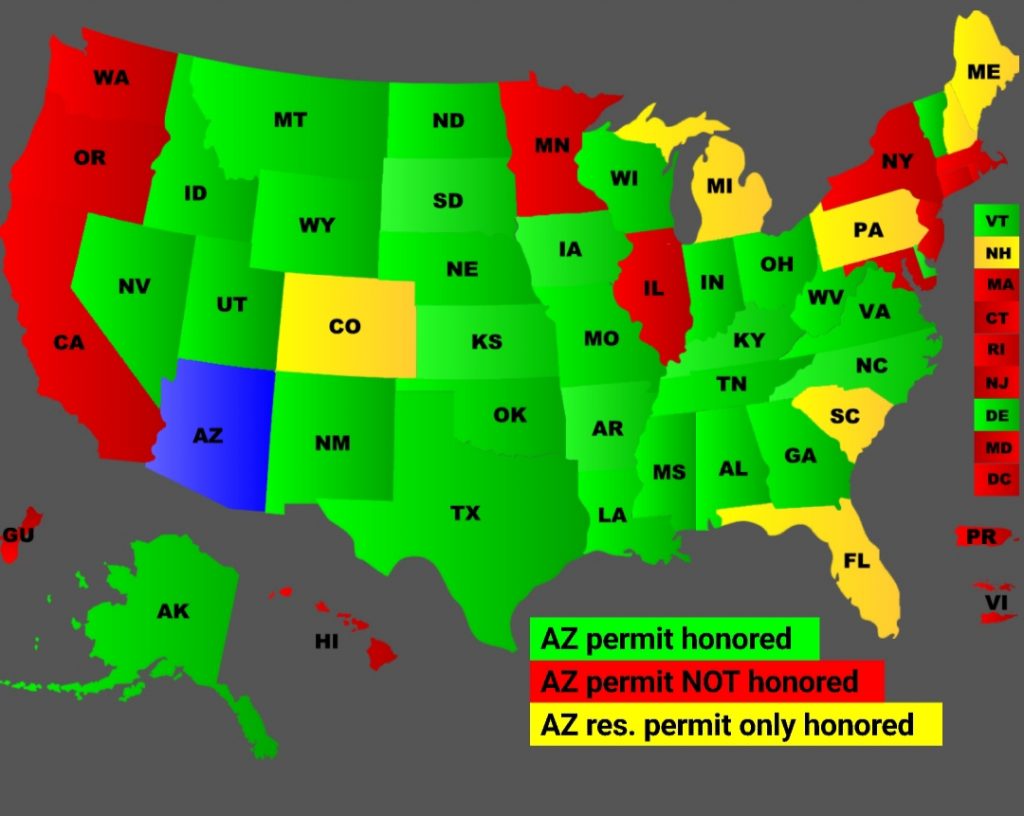
- Reciprocity with Other States: This is arguably the most significant benefit. An Arizona CCW permit is recognized in many other states, allowing the permit holder to legally carry a concealed firearm while traveling outside Arizona in those reciprocating states. Without an Arizona CCW, permitless carry rights generally do not extend beyond Arizona’s borders, making interstate travel with a firearm more complex and restrictive.
- Enhanced Legal Knowledge and Training: Obtaining an Arizona CCW requires completion of a firearms safety course from a certified instructor. This training typically covers safe handling, storage, marksmanship fundamentals, and, crucially, a review of state and federal laws regarding self-defense, use of force, and firearm restrictions. This structured education can be invaluable, far exceeding the minimal knowledge many permitless carriers might possess.
- Purchasing Exemptions: An Arizona CCW permit can exempt the holder from the federal Brady background check requirement when purchasing a firearm from a licensed dealer. This can streamline the purchase process.
- Duty to Inform: As mentioned, Arizona CCW holders have a duty to inform law enforcement officers that they are carrying a firearm upon contact. While some see this as a drawback, it can also lead to more transparent and less confrontational interactions with officers who are aware of the firearm from the outset.
- Carrying in Bars (Non-Consumption): Arizona CCW holders may carry a firearm in an establishment licensed to sell alcohol for consumption on the premises, provided they do not consume alcohol themselves. Permitless carriers generally do not have this allowance.
Reciprocity and Interstate Travel
For individuals who frequently travel between states, an Arizona CCW permit is incredibly useful. Arizona has reciprocity agreements or unilateral recognition with a substantial number of other states across the country. This means that an Arizona CCW holder can legally carry a concealed firearm in any state that recognizes the [Arizona](https://lifeoutofthebox.com/arizona] permit, provided they comply with that state’s specific laws regarding carrying. This eliminates the headache of trying to understand the myriad of varying firearm laws in each state you might pass through. Travelers should always check the most current reciprocity agreements before traveling, as laws can change. Websites like the Arizona Department of Public Safety often provide updated lists of recognized states.
Training and Legal Education
The training requirement for an Arizona CCW permit is not just a formality; it’s an opportunity for essential education. These courses typically cover:
- Firearm Safety: Basic rules of gun safety, safe storage, and handling.
- Marksmanship: Practical shooting skills to ensure proficiency.
- Arizona Firearm Laws: In-depth review of statutes governing possession, carry, self-defense, and prohibited locations.
- Use of Force Laws: Understanding when the use of deadly force is legally justified.
This comprehensive training goes beyond simply knowing you can carry; it teaches you how to carry safely, legally, and responsibly, enhancing both personal safety and legal compliance.
Responsible Firearm Ownership and Travel Tips
Carrying a firearm, whether with or without a permit, is a serious responsibility. For both residents and visitors in Arizona, understanding and adhering to principles of responsible firearm ownership is paramount, especially when traveling.
Safe Storage and Transportation
When traveling with a firearm, safe storage and transportation are non-negotiable.
- In a Vehicle: While permitless concealed carry allows a firearm to be in your vehicle’s glove compartment or console, it is still advisable to secure it, especially if the vehicle will be left unattended. A locked container can prevent theft and accidental access.
- In Accommodation: If staying in a hotel, resort, or rental property, consider the safety of others, particularly children. A portable safe or secured case is highly recommended for storing your firearm when not on your person.
- Air Travel: Federal regulations govern the transportation of firearms on commercial airlines. Firearms must be declared to the airline, unloaded, and transported in a locked, hard-sided container as checked luggage. Ammunition also has specific packing requirements. Never attempt to carry a firearm or ammunition in your carry-on luggage.
Staying Informed on Arizona Gun Laws
Firearm laws, both state and federal, can and do change. What is legal today might be subject to new legislation tomorrow. It is the responsibility of every firearm owner to stay informed about the most current laws. Regularly checking official sources, such as the Arizona Department of Public Safety website or consulting with a qualified legal professional specializing in firearm law, is essential. Relying solely on outdated information or anecdotal advice can lead to severe legal consequences.

Mindset and Situational Awareness
Beyond the legalities, responsible firearm ownership involves cultivating a safety-conscious mindset and maintaining situational awareness. Carrying a firearm is a last resort tool for self-defense, not an invitation for confrontation. Training, practice, and a commitment to de-escalation are all critical components of responsible carry. Always be aware of your surroundings, avoid potentially dangerous situations, and be prepared to act lawfully and judiciously if faced with an immediate threat to life.
In conclusion, Arizona stands out as a state where eligible individuals can indeed concealed carry a firearm without a permit, embracing the principle of constitutional carry. This provides both residents and visitors with a significant degree of freedom regarding personal protection. However, this freedom is intertwined with considerable responsibility. Understanding the specific eligibility requirements, knowing the numerous prohibited locations, and being aware of the nuances of interacting with law enforcement are non-negotiable for anyone choosing to carry. While not legally mandated for in-state concealed carry, obtaining an Arizona CCW permit offers valuable benefits, particularly for interstate travel and comprehensive legal education. Ultimately, responsible firearm ownership, adherence to safety protocols, and a commitment to staying informed on current laws are paramount for anyone exercising their right to carry in the beautiful and diverse state of Arizona. This information serves as a general guide, and individuals should always seek professional legal advice for specific situations.
LifeOutOfTheBox is a participant in the Amazon Services LLC Associates Program, an affiliate advertising program designed to provide a means for sites to earn advertising fees by advertising and linking to Amazon.com. Amazon, the Amazon logo, AmazonSupply, and the AmazonSupply logo are trademarks of Amazon.com, Inc. or its affiliates. As an Amazon Associate we earn affiliate commissions from qualifying purchases.