
Navigating career changes and significant life transitions often involves a complex interplay of personal aspirations, financial realities, and strategic planning. For many individuals, the dream of a new venture, a period of travel, or a more fulfilling professional path might necessitate leaving a current job. However, a common misconception, and a critical concern for those planning such a lifestyle shift, is whether one can receive unemployment benefits after voluntarily quitting in California. The short answer, as with many legal and financial matters, is nuanced: generally no, but with significant exceptions that are vital for informed lifestyle choices.

Understanding the specific conditions under which the California Employment Development Department (EDD) might approve benefits for a voluntary quit is paramount for anyone considering such a move. This insight allows for more robust financial planning, helps mitigate risks associated with career pivots, and ensures that personal lifestyle goals, whether they involve budget travel during a career break or maintaining a certain standard of living during a transition, remain attainable.
Understanding the EDD and the “Good Cause” Principle
The core principle of unemployment insurance in California is to provide temporary financial assistance to individuals who lose their jobs through no fault of their own. This foundational rule typically disqualifies those who voluntarily quit. However, the EDD recognizes that not all quits are equal, and there are circumstances where leaving a job is deemed justified. This is where the concept of “good cause” comes into play – a critical aspect for anyone strategically managing their career and lifestyle decisions.
For individuals who are proactively shaping their future, whether that involves pursuing a passion project, relocating for personal growth, or simply seeking a healthier work environment, understanding “good cause” is not just about legal compliance; it’s about empowering informed choices. It allows you to assess the potential financial safety nets available if your lifestyle plans involve a voluntary separation from employment.
What Constitutes “Good Cause” in California?
Establishing “good cause” is challenging, as the burden of proof lies entirely with the claimant. The EDD defines “good cause” as a compelling reason that would cause a reasonable person, genuinely desiring to stay employed, to leave their job. This reason must be substantial, personal, and work-related, making continued employment impossible or highly impractical. Some common scenarios that may qualify include:
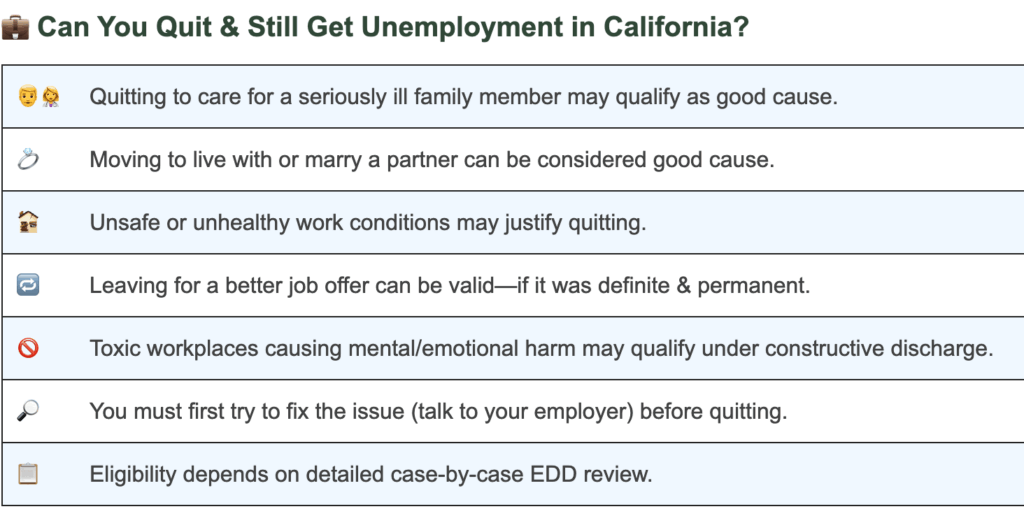
- Unsafe or Unhealthy Working Conditions: If the workplace poses a significant risk to your health or safety, and you have exhausted all reasonable avenues to resolve the issue with your employer, quitting could be for good cause. This might be relevant for individuals prioritizing health and well-being as part of their lifestyle.
- Harassment or Discrimination: Enduring harassment, discrimination, or a hostile work environment can be a valid reason to quit, provided you’ve formally reported it and the employer failed to take appropriate action. A healthy and respectful work environment is fundamental to a balanced lifestyle.
- Medical Necessity: If you, or an immediate family member, have a medical condition that requires you to leave your job or relocate, and you can provide medical documentation, this could constitute good cause. This often ties into family lifestyle and health priorities.
- Spousal Relocation: If your spouse secures employment in a distant geographic location, making it unreasonable for you to commute or maintain your household separately, quitting to move with your spouse can be considered good cause. This directly impacts family lifestyle choices and geographical flexibility.
- Significant Change in Terms and Conditions of Employment: If your employer substantially alters your job duties, hours, pay, or working conditions without your consent, and these changes are detrimental, you might have good cause to quit. This impacts your work-life balance and overall lifestyle quality.
- Lack of Work/Constructive Discharge: While not strictly quitting, if an employer significantly reduces your hours to the point where it’s no longer viable, or creates conditions so intolerable that you are forced to resign, it can be treated as an involuntary separation.
Crucially, in all “good cause” scenarios, the EDD will assess whether you attempted to resolve the issue with your employer before quitting. Documenting every attempt at resolution, including dates, names, and specific actions taken, is essential for strengthening your claim and demonstrating that you were truly forced to leave for compelling reasons, rather than making a casual lifestyle decision.
Navigating Career Transitions and Lifestyle Changes
For many individuals, the decision to quit a job is not impulsive but part of a larger strategy for personal growth, career advancement, or a shift in lifestyle. Whether it’s to pursue further education, embark on a long-term travel adventure, or transition to a different industry, understanding the implications for unemployment benefits is a critical component of risk management and financial planning.
Quitting for a New Opportunity (and it Falls Through)
A common scenario in proactive career management is resigning from an existing position to accept a new job offer. What happens, however, if that new opportunity unexpectedly falls through after you’ve already quit your previous role? This situation presents a unique challenge for unemployment claims. Generally, if you quit your job to accept a definite offer of new work, and that work does not materialize through no fault of your own, the EDD may consider this “good cause.”
However, the key is the “definite offer.” This means you must have had a firm, confirmed job offer, not just a prospective one or a verbal agreement without formalization. Strong documentation, such as an offer letter, is indispensable. This specific exception is vital for those taking calculated career risks to enhance their lifestyle, providing a potential safety net should unforeseen circumstances arise in their planned transition. It underscores the importance of securing formal commitments before making irreversible lifestyle decisions.
Relocation for Personal Reasons vs. Spouse’s Employment
The desire to relocate is a powerful driver of lifestyle change, whether it’s for a change of scenery, proximity to family, or simply to explore a new city or region. However, the EDD distinguishes sharply between different reasons for relocation when it comes to “good cause.”
- Relocation for Personal Reasons: Quitting your job simply because you desire to move to a new city or state for general lifestyle improvement (e.g., warmer climate, lower cost of living, new experiences) is generally not considered good cause for quitting. The EDD expects you to have made arrangements for new employment before such a move, or to have demonstrated compelling personal circumstances (like a medical necessity) that required the move. This is a critical point for budget travelers or those aspiring to a nomadic lifestyle who might think they can collect benefits while seeking new opportunities in a new location.
- Relocation for Spouse’s Employment: As mentioned earlier, if you quit to accompany your spouse to a new locality due to their new job, it can constitute “good cause,” provided the new location is genuinely too far for a reasonable commute and you meet other criteria (e.g., your spouse’s employment is bona fide). This recognizes the importance of family unity and supporting a partner’s career, which are integral aspects of a shared lifestyle.
Understanding this distinction is crucial for couples planning their future together, ensuring that a joint lifestyle decision doesn’t inadvertently lead to unnecessary financial hardship.
The Impact on Your Financial Lifestyle
The decision to quit a job, especially without a new one lined up, profoundly impacts one’s financial lifestyle. Unemployment benefits, if secured, offer a temporary reprieve, but they are rarely enough to maintain a pre-quit standard of living, especially for those accustomed to a luxury travel or higher-budget lifestyle. They are designed as a safety net, not a substitute for regular income.
For individuals planning a career break, early retirement, or pursuing a passion project that may not immediately generate income, the potential availability of unemployment benefits shapes their overall financial strategy. It influences:
- Budgeting for the Transition: How much savings are needed to bridge the gap? Can you afford that family trip or business stay you’ve been planning?
- Risk Assessment: How much financial risk are you willing to take with a voluntary quit?
- Lifestyle Adjustments: What temporary adjustments to your spending habits (e.g., shifting from luxury to budget travel, reducing discretionary expenses) might be necessary?
Proactive financial planning that considers the likelihood of receiving unemployment benefits (or the lack thereof) is fundamental to ensuring that a desired lifestyle, rather than being compromised, can be strategically sustained during periods of transition.
The Application Process and What to Expect
If you believe you have “good cause” for quitting your job in California and decide to apply for unemployment benefits, understanding the process is essential. It’s not merely about filling out a form; it’s about effectively communicating your situation and providing the necessary evidence to the EDD.
Key Steps for Filing a Claim
- File Promptly: The first step is to file your claim for unemployment benefits as soon as you become unemployed. Delays can impact the start date of your benefits. The application can be submitted online through the EDD website.
- Be Detailed and Honest: When asked why you separated from your employer, provide a clear, concise, and truthful explanation. This is where you will initially present your “good cause” argument.
- Gather Documentation: Assemble all relevant documents that support your claim. This includes medical records, written communication with your employer, police reports (in cases of harassment), spouse’s offer letter (for relocation), and any other evidence that substantiates your reason for quitting. Strong documentation is the cornerstone of a successful “good cause” claim.
The EDD Interview and Appeal Process
After filing, the EDD will typically contact both you and your former employer. A phone interview is common, where an EDD representative will ask questions to clarify the circumstances of your separation. This interview is critical for individuals who have voluntarily quit, as it’s their primary opportunity to present their “good cause” argument directly.
- Prepare for the Interview: Rehearse your explanation, citing specific dates, events, and individuals. Refer to your documentation. Maintain a professional and respectful tone.
- Understand Your Employer’s Stance: Your former employer will also provide their account of your separation. Be prepared to address any discrepancies or counter-arguments they might present.
- The Decision: The EDD will make a determination based on the information gathered. If benefits are denied, you have the right to appeal the decision. The appeal process involves a hearing before an Administrative Law Judge, where you can present your case and evidence again. This could be a lengthy process, which further emphasizes the need for robust financial reserves to support your lifestyle during this period.
Successfully navigating this process requires patience, meticulous organization, and a clear understanding of the “good cause” criteria, all of which are essential attributes for someone strategically managing their career and life path.
Proactive Lifestyle Planning and Financial Prudence
Ultimately, the question of whether you can get unemployment if you quit in California highlights a broader truth about lifestyle management: foresight and preparation are invaluable. While unemployment benefits can offer a temporary safety net, they should never be the sole basis for a decision to voluntarily leave employment.
Before You Quit: A Lifestyle Checklist
Before making the momentous decision to quit your job, particularly without a new one secured, engage in thorough lifestyle planning:
- Build a Financial Cushion: Aim for at least 3-6 months (or more, depending on your lifestyle and goals like extended travel) of living expenses in savings. This significantly reduces financial stress during a career transition.
- Understand Your “Good Cause”: Honestly assess if your reason for quitting aligns with the EDD’s “good cause” criteria. Gather all potential documentation beforehand.
- Explore Alternatives: Have you explored all options with your current employer? Could a leave of absence or a different role within the company be a viable short-term solution?
- Network Proactively: If your goal is a new job, start networking and job searching well before you plan to quit.
- Budget for Potential Gaps: Assume you might not receive unemployment benefits immediately, or at all. How will you sustain your desired lifestyle, whether it’s a budget-conscious travel phase or maintaining family expenses?

The Bigger Picture: Your Long-Term Lifestyle Goals
The decision to quit a job is often intertwined with larger aspirations for your life: greater work-life balance, pursuing a passion, spending more time with family, or embarking on significant personal development. Understanding the intricacies of unemployment benefits in California allows you to integrate this knowledge into a holistic strategy for achieving these goals. It’s about more than just a paycheck; it’s about strategically managing your career trajectory and financial health to support the lifestyle you envision for yourself, whether that involves global adventures, focused personal projects, or simply a more fulfilling daily existence. With careful planning and a clear understanding of the rules, you can make informed decisions that pave the way for a richer, more intentional life.
LifeOutOfTheBox is a participant in the Amazon Services LLC Associates Program, an affiliate advertising program designed to provide a means for sites to earn advertising fees by advertising and linking to Amazon.com. Amazon, the Amazon logo, AmazonSupply, and the AmazonSupply logo are trademarks of Amazon.com, Inc. or its affiliates. As an Amazon Associate we earn affiliate commissions from qualifying purchases.