
The question of whether Donald Trump deployed United States Marines to Los Angeles is one that has sparked considerable debate and confusion, particularly in the context of civil unrest and political rhetoric. While the imagery of military forces on American streets can be potent and evoke strong reactions, understanding the actual deployment of federal assets requires a careful examination of legal frameworks, official statements, and the specific events that may have led to such inquiries. This article delves into the nuances of federal troop deployment within the U.S., focusing on the specific circumstances that might have given rise to the perception or reality of Marines operating in a domestic capacity in Los Angeles.

Understanding Federal Troop Deployment
The deployment of any U.S. military personnel, including Marines, within the United States for law enforcement purposes is a complex legal and constitutional matter. The Posse Comitatus Act, enacted in 1878, generally prohibits the use of the Army and Air Force (and by extension, often interpreted to include the Navy and Marine Corps) for domestic law enforcement. This act is a cornerstone of the principle that the military should remain separate from civilian law enforcement to prevent authoritarianism and protect civil liberties.
However, there are exceptions to the Posse Comitatus Act. These exceptions are crucial for understanding how federal assets might be engaged in situations that appear to involve domestic security. The Insurrection Act of 1807 is perhaps the most significant exception, granting the President the authority to deploy U.S. military personnel to quell civil disorder, insurrection, or rebellion when requested by a state legislature or governor, or when the state is unable to control the situation itself. The President can also invoke the Insurrection Act under specific circumstances without a state’s request, particularly if federal law is being obstructed or if the government is unable to enforce federal laws.
Beyond the Insurrection Act, other federal statutes allow for the use of federal forces in specific circumstances. For instance, the Stafford Act can authorize the deployment of federal resources, including military personnel, for disaster relief and emergency response. Additionally, federal law enforcement agencies, such as the Department of Homeland Security, can deploy their own personnel and assets, which might include individuals with military backgrounds or equipment typically associated with the military, to assist in maintaining order or securing federal property.
The U.S. Constitution also plays a vital role. The President, as Commander-in-Chief, has inherent authority to protect the United States and its interests. This authority can be invoked in extreme circumstances to maintain order and uphold the rule of law, though it is generally understood to be exercised within the bounds of existing legislation like the Insurrection Act.
The Role of the National Guard
It is important to distinguish between federal troops and the National Guard. The National Guard is a unique entity, serving as both a state militia and a component of the federal military reserve. When deployed by a state governor, National Guard units operate under state control and are not subject to the Posse Comitatus Act. However, when federalized by the President, the National Guard can be used in ways similar to active-duty federal forces, although typically still with a focus on support roles rather than direct law enforcement. During periods of civil unrest, it is common for state governors to activate their National Guard forces to assist local law enforcement.
Events Leading to Inquiries About Federal Deployment in Los Angeles
The question of federal troop deployment to Los Angeles often arises in the context of specific periods of civil unrest. The summer of 2020, following the murder of George Floyd in Minneapolis, saw widespread protests and demonstrations across the United States, including in Los Angeles. These protests, while largely peaceful, were sometimes accompanied by instances of looting, vandalism, and violence, prompting local and state authorities to seek additional support.
During this period, then-President Donald Trump took a strong stance on restoring order, often advocating for a more assertive federal response. He publicly discussed the possibility of deploying federal personnel, including law enforcement agents and potentially military forces, to cities experiencing significant unrest. The rhetoric from the White House at the time fueled public speculation and concern about the nature and extent of any federal involvement.
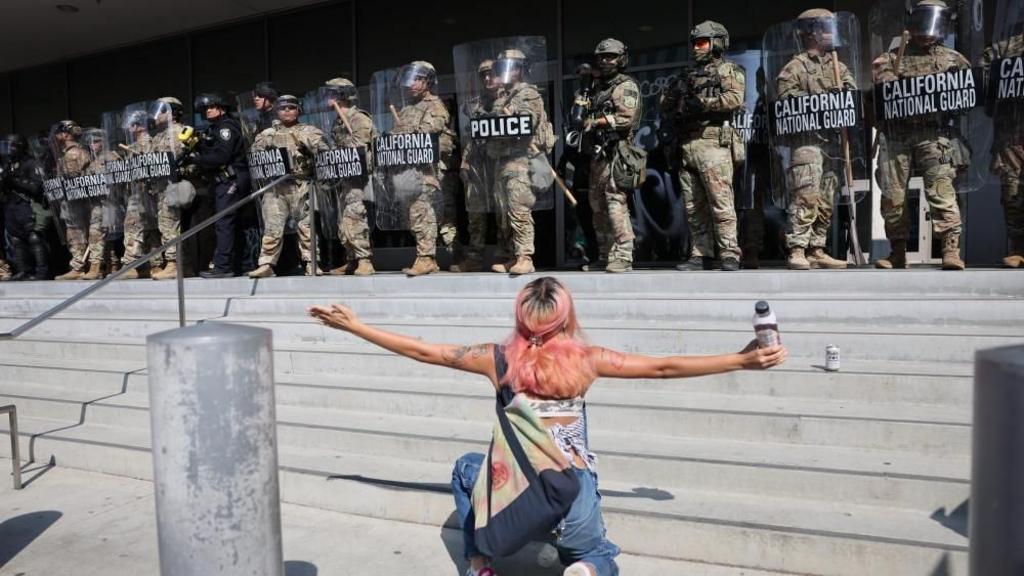
In Los Angeles, the protests led to significant damage in some areas, and the Los Angeles Police Department and the California National Guard were heavily deployed. There were also reports of federal law enforcement agencies, such as the Department of Homeland Security’s Customs and Border Protection and Federal Protective Service, assisting in securing federal buildings and property within the city. The presence of these federal agents, who often wear tactical gear and operate in formations that can resemble military units, may have contributed to the perception of a broader federal military deployment.
Official Statements and Clarifications
In response to concerns about federal troop presence, officials often sought to clarify the role of any deployed federal assets. While President Trump expressed a willingness to use federal resources to quell unrest, official statements from the Department of Defense and other agencies generally emphasized that any deployment would adhere to legal restrictions. The focus, when federal law enforcement was involved, was typically on protecting federal property, assisting in investigations, and supporting local authorities through non-law enforcement means, unless explicitly authorized by law, such as under the Insurrection Act.
It is crucial to note that the direct deployment of U.S. Marines, as active-duty combat troops, for domestic law enforcement purposes in Los Angeles during these events is not supported by official records or credible reports. The Department of Defense has consistently stated that active-duty military personnel are not typically used for domestic law enforcement and that such deployments would be an extraordinary measure, requiring specific legal authorization. The National Guard, being under state control for most of these deployments, is a distinct category from active-duty Marines.
Distinguishing Between Federal Law Enforcement and Military Deployment
The distinction between federal law enforcement and military deployment is often blurred in public perception, especially during times of heightened tension. Agencies like the Federal Bureau of Investigation (FBI), the Drug Enforcement Administration (DEA), and components of the Department of Homeland Security (DHS) have federal jurisdiction and can deploy agents to assist in civil disturbances or secure federal interests. These agents, while often highly trained and equipped, are civilian law enforcement officers, not active-duty military personnel subject to the Posse Comitatus Act in the same way.
During the 2020 unrest, federal agents were indeed present in Los Angeles and other cities, often tasked with protecting federal courthouses, post offices, and other government facilities. Their presence was authorized under various federal statutes related to the protection of federal property and the enforcement of federal laws. The visible presence of these heavily armed individuals in tactical gear, sometimes operating in coordinated groups, could easily be mistaken for or conflated with a military deployment.
Furthermore, there were discussions and considerations at the federal level about potentially deploying elements of the Coast Guard, which is part of the Department of Homeland Security and has law enforcement capabilities, or other DHS components. However, the deployment of U.S. Marines or Army units for direct law enforcement roles in Los Angeles on a widespread basis would have represented a significant escalation and a departure from established norms, requiring explicit legal justification and Presidential orders under extraordinary circumstances. The available evidence does not indicate that such a deployment of Marines occurred.
The Impact of Rhetoric and Media Coverage
The narrative surrounding potential federal troop deployments is often amplified by political rhetoric and media coverage. Statements made by political leaders, particularly on social media platforms or during press conferences, can shape public perception. In the context of the 2020 protests, President Trump frequently used strong language regarding the need to restore order and indicated a willingness to deploy federal assets. This rhetoric, coupled with images of federal agents and National Guard troops on the streets, contributed to widespread public discussion and concern about military intervention in domestic affairs.
Media outlets, in their efforts to report on rapidly unfolding events, sometimes use imprecise language or focus on visual cues that can lead to misinterpretations. The sight of armed individuals in uniform, regardless of their specific agency or legal authority, can evoke powerful associations with military action. Therefore, distinguishing between federal law enforcement support, National Guard activations, and hypothetical or actual deployments of active-duty military personnel requires careful attention to detail and reliance on verified information.
Conclusion: No Confirmed Deployment of Marines
Based on available official information and credible reports, there is no confirmed evidence to suggest that Donald Trump deployed U.S. Marines to Los Angeles for domestic law enforcement or widespread public order duties. While federal law enforcement agencies were present and provided support in Los Angeles during periods of unrest, and the National Guard was activated by the state, the deployment of active-duty Marines in such a capacity would have been a significant and highly publicized event, subject to strict legal oversight and requiring explicit authorization that does not appear to have been granted or executed. The confusion likely stems from the heightened presence of federal personnel, the strong rhetoric surrounding federal intervention, and the general public’s difficulty in distinguishing between various types of uniformed federal and state security forces operating during times of crisis. The legal and constitutional barriers to deploying active-duty military for domestic law enforcement remain significant, and historical precedent suggests that such actions are reserved for the most extreme circumstances, typically under the authority of the Insurrection Act and with clear state or federal justification.
LifeOutOfTheBox is a participant in the Amazon Services LLC Associates Program, an affiliate advertising program designed to provide a means for sites to earn advertising fees by advertising and linking to Amazon.com. Amazon, the Amazon logo, AmazonSupply, and the AmazonSupply logo are trademarks of Amazon.com, Inc. or its affiliates. As an Amazon Associate we earn affiliate commissions from qualifying purchases.