
Understanding Marital Status in the Heart of the South
Navigating the legal landscape of marriage can be a complex undertaking, especially when considering less conventional forms of union. For many, the term “common law marriage” evokes images of established partnerships recognized without the formality of a wedding ceremony. However, the reality of common law marriage is far more nuanced, varying significantly from state to state. In the context of Alabama, a state steeped in Southern tradition and legal precedent, understanding its stance on common law marriage is crucial for residents and visitors alike who may be in or contemplating such arrangements. This exploration delves into the legal framework governing marital status in Alabama, clarifying the state’s position and offering insights for those seeking legal recognition of their relationship.
The Historical Context and Alabama’s Current Position
Historically, common law marriage was a more prevalent concept, arising from situations where couples lived together, presented themselves to the community as husband and wife, and intended to be married, even without a formal ceremony or license. This informal union was recognized in many jurisdictions as a valid means of establishing a marital relationship. However, over time, states have moved towards requiring formal marriage licenses and ceremonies to ensure legal clarity and protect the rights and responsibilities associated with matrimony.
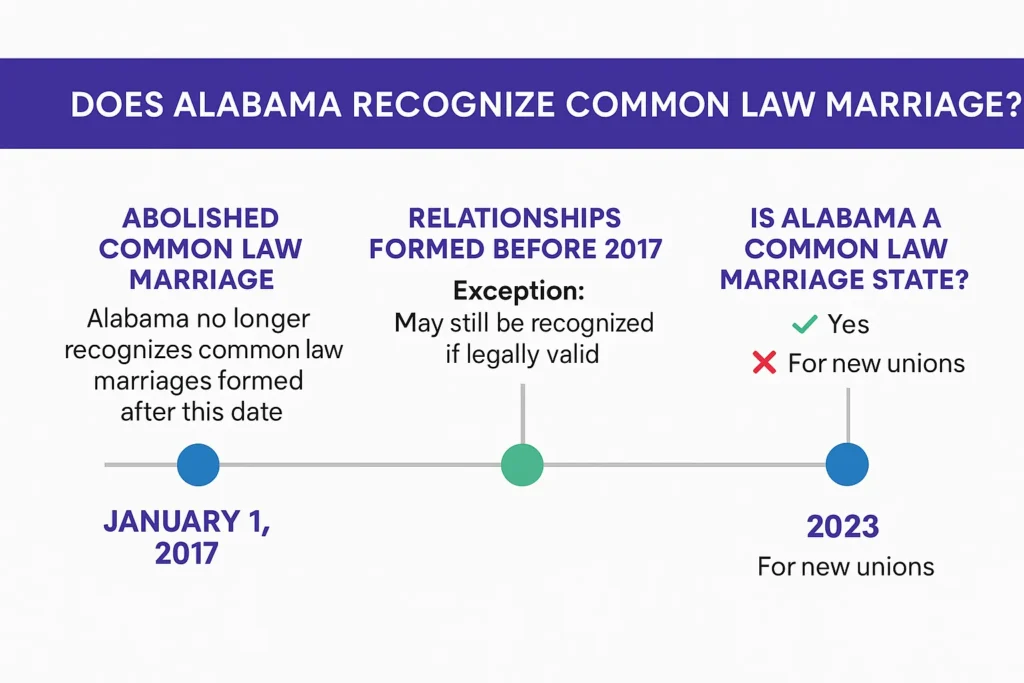
Alabama, like many other states, has taken a definitive stance on this matter. The state’s legal code and judicial interpretations have largely moved away from recognizing new common law marriages established within its borders. The Alabama Supreme Court has repeatedly held that the state does not permit the creation of new common law marriages. This means that if a couple wishes to be legally married in Alabama, they must obtain a marriage license and undergo a formal ceremony performed by an authorized officiant.
However, there’s a critical caveat to this general rule. Alabama does recognize common law marriages that were validly established in another state that does permit them. This principle is rooted in the Full Faith and Credit Clause of the U.S. Constitution, which requires states to respect the public acts, records, and judicial proceedings of every other state. Therefore, if a couple entered into a common law marriage in a state where such unions are legally recognized, and they can provide sufficient proof of that valid marriage, Alabama will generally uphold its validity.
Establishing a Valid Common Law Marriage (in states that allow it)
While Alabama does not permit the creation of new common law marriages, understanding the elements required in states that do recognize them is essential for comprehending how an existing common law marriage might be presented for recognition in Alabama. The specific requirements can vary slightly, but generally, three core elements must be present:
- Capacity to Marry: Both individuals must be legally able to marry. This includes being of legal age, not currently married to someone else, and not within a prohibited degree of kinship.
- Present Agreement to be Married: This is the most crucial element. The couple must have a mutual, present agreement that they are married to each other. This is not about an agreement to get married in the future, but rather an understanding that they are currently husband and wife, even if they haven’t had a formal ceremony. This agreement can be expressed verbally or through actions.
- Cohabitation and Holding Out: The couple must live together as husband and wife and present themselves to the public as a married couple. This “holding out” can manifest in various ways, such as:
- Using the same last name.
- Referring to each other as “my husband” or “my wife” in public and private.
- Filing joint tax returns.
- Listing each other as spouses on insurance policies or other legal documents.
- Introducing each other as spouses to friends, family, and the community.
The burden of proof lies with the individuals asserting the existence of a common law marriage. They must present clear and convincing evidence to demonstrate that all the required elements were met at the time and place where the alleged common law marriage was established.

Proving a Common Law Marriage in Alabama
For a couple who established a common law marriage in another state and subsequently moves to Alabama, or whose marital status becomes relevant in an Alabama legal proceeding, proving the validity of that marriage is paramount. Since Alabama does not allow for the creation of new common law marriages, the focus is solely on whether the marriage was legally formed in a jurisdiction that permits it.
The evidence required to prove an out-of-state common law marriage can include:
- Testimony: Sworn statements from the couple themselves, as well as friends, family members, neighbors, or colleagues who can attest to the couple’s belief and representation of being married.
- Documents: Any documents that indicate marital status, such as:
- Affidavits from third parties stating the couple’s marital status.
- Joint bank account statements, leases, or mortgage documents where they are listed as husband and wife.
- Insurance policies naming the other as a spouse.
- Letters or correspondence referring to each other as spouses.
- Evidence of joint property ownership or inheritance.
- Any official records from the state where the common law marriage was allegedly established, if available.
The court will carefully examine all presented evidence to determine if the couple met the requirements for a valid common law marriage in the originating state. The absence of a marriage license or certificate from that state does not automatically invalidate the marriage, provided sufficient evidence of the common law elements can be presented.
Implications for Alabama Residents and Visitors
The legal distinction regarding common law marriage in Alabama has significant implications for individuals’ rights and responsibilities. For instance, in matters of divorce, property division, spousal support, inheritance, and benefits, the legal status of marriage is a fundamental determinant.
If a couple lives together in Alabama without a formal marriage license, they are generally considered to be in a non-marital cohabitation relationship, regardless of how long they have been together or how they present themselves to others. This means that in the event of a separation, the legal framework for dissolving a marriage—including equitable distribution of assets and potential alimony—does not apply. Property acquired during the relationship would typically be treated as individually owned unless jointly titled or subject to other contractual agreements.
For couples who believe they have an established common law marriage from another state and are now residing in Alabama, it is highly advisable to consult with an attorney experienced in family law and interstate marriage recognition. Establishing the validity of their common law marriage through a declaratory judgment or by presenting robust evidence in any relevant legal proceedings is crucial to ensure their rights are protected. This could be particularly important when dealing with issues such as inheritance upon the death of a partner, or when seeking benefits that are contingent on marital status.

Conclusion: Clarity and Legal Prudence
In conclusion, while the concept of common law marriage may persist in the popular imagination, Alabama’s legal system provides a clear framework: it does not permit the creation of new common law marriages within its borders. For individuals seeking to establish a legally recognized marital union in Alabama, the path is through obtaining a marriage license and undergoing a formal ceremony.
However, the state does extend recognition to common law marriages that were validly formed in other jurisdictions. This principle underscores the importance of understanding the specific legal requirements for common law marriage in any given state and the necessity of being able to present credible evidence should the validity of such a union ever be called into question in Alabama. For anyone uncertain about their marital status or seeking to ensure their relationship is legally recognized, seeking professional legal counsel is the most prudent course of action. This proactive approach can prevent future complications and safeguard the rights and interests of all parties involved.
LifeOutOfTheBox is a participant in the Amazon Services LLC Associates Program, an affiliate advertising program designed to provide a means for sites to earn advertising fees by advertising and linking to Amazon.com. Amazon, the Amazon logo, AmazonSupply, and the AmazonSupply logo are trademarks of Amazon.com, Inc. or its affiliates. As an Amazon Associate we earn affiliate commissions from qualifying purchases.