
Mastering the Art of Online Poker Strategy
Online poker, particularly Texas Holdem, has captivated millions worldwide with its blend of skill, strategy, and psychological warfare. Unlike live games, the online arena presents a unique set of challenges and opportunities, demanding a distinct approach to achieve consistent success. Winning regularly at online Texas Holdem isn’t about luck; it’s about meticulous preparation, disciplined execution, and a deep understanding of the game’s nuances. This guide delves into the core principles and advanced strategies necessary to elevate your online Texas Holdem game from a casual pastime to a profitable endeavor.
Understanding the Digital Landscape
The online environment alters fundamental aspects of poker play. The absence of physical tells, the speed of the game, and the sheer volume of hands played per hour necessitate different strategic considerations.
The Importance of Position
Position remains paramount in poker, online or off. Being “in position” means you act after your opponents on each betting round. This grants you invaluable information about their actions before you have to commit your chips. In online games, where hands are dealt rapidly, maximizing your positional advantage is crucial.
- Late Position Advantage: When you are the last to act in a betting round, you can control the pot size, bluff more effectively, and extract maximum value from strong hands. Always aim to play more hands from late positions (button, cutoff) and fewer from early positions.
- Preflop Raise Sizing: Adjust your preflop raise sizes based on your position. Larger raises from early positions are often necessary to deter multiple callers, while smaller, more controlled raises from late positions can isolate opponents and build pots with better equity.
Reading Opponents in the Absence of Tells
Without physical tells, online players rely on betting patterns, timing tells, and statistical analysis to deduce their opponents’ hands.
- Betting Patterns: Observe how often players bet, the size of their bets in different situations (e.g., continuation bets, value bets, bluffs), and how they react to aggression. A player who consistently bets large with strong hands and small with weak ones is predictable.
- Timing Tells: While less pronounced online than in live games, timing can still offer clues. A player who takes a significantly longer time to call a bet compared to their usual pace might be deliberating a marginal decision, while a snap-call could indicate a strong hand or a purely speculative play.
- Player Type Analysis: Most online poker sites provide player statistics (often referred to as “HUDs” or Heads-Up Displays). These tools, when used ethically, offer insights into opponents’ tendencies, such as their preflop raise percentage (VPIP/PFR), aggression factor (AF), and continuation bet frequency (C-bet %). Understanding these metrics allows you to exploit specific player weaknesses. For instance, a player with a high C-bet percentage but a low fold-to-c-bet percentage is ripe for bluffing.
The Pace of the Game and Hand Volume
Online poker allows for significantly more hands to be played in a given session compared to live play. This accelerated pace amplifies the impact of variance (luck) in the short term but makes strategic play more statistically significant over the long run.
- Session Management: Due to the high volume of hands, tilt (emotional decision-making) can be particularly detrimental. It’s vital to manage your sessions effectively, taking breaks when needed and avoiding fatigue.
- Exploiting Statistical Tendencies: The sheer volume of hands means that opponents’ statistically driven tendencies become more pronounced. Players who make predictable mistakes will consistently lose chips over time, making them profitable targets if you can identify and exploit their patterns.
Essential Strategic Pillars for Online Success
Beyond understanding the digital environment, core strategic principles form the bedrock of winning online Texas Holdem.
Preflop Aggression and Hand Selection
The foundation of any winning poker strategy lies in intelligent preflop play. This involves both selecting strong starting hands and betting them aggressively when you do.
Starting Hand Charts
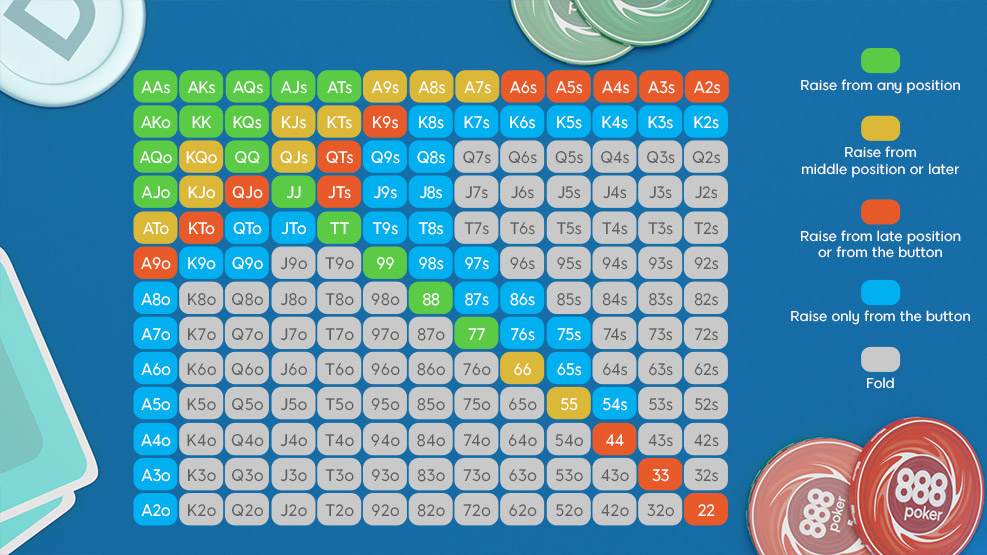
While not rigid rules, starting hand charts provide a solid framework for hand selection based on position. They prioritize hands that have strong equity and playability.
- Early Position: Focus on premium hands like AA, KK, QQ, AKs, and JJ.
- Middle Position: Broaden your range slightly to include hands like TT, 99, AQo, and suited connectors like JTs.
- Late Position: You can play a much wider range of hands, including speculative hands like suited aces, smaller pairs, and suited connectors, as you have more information and leverage.
The Power of the Raise
Limping (just calling the big blind) is generally a weak play online. Raising preflop achieves several objectives:
- Builds the Pot: When you have a strong hand, raising builds a larger pot for you to win.
- Gains Initiative: The player who raises preflop often has the betting lead (initiative) on the flop, allowing them to continue aggression if they connect with the board or to represent strength on scary boards.
- Forces Opponents to Fold: You can win the pot immediately if your opponents fold, saving you the risk of playing postflop with a marginal hand.
- Gathers Information: Observing how opponents react to your preflop raises provides valuable insights into their hand strength and tendencies.
Postflop Play: Continuation Betting and Pot Control
Once the flop is dealt, the game transitions to postflop play, where tactical betting and strategic decisions become even more critical.
Continuation Betting (C-betting)
A continuation bet is a bet made on the flop by the player who made the last aggressive action (the raiser) preflop. C-betting is a fundamental tool in online poker for several reasons:

- Represents Strength: It simulates having a strong hand, forcing opponents with marginal hands to fold.
- Takes Initiative: It allows you to continue your aggression and potentially win the pot without showing your cards.
- Exploits Weaknesses: Against players who fold too often to continuation bets, it becomes a highly profitable play.
Key Considerations for C-betting:
- Board Texture: C-betting is more effective on dry, uncoordinated boards (e.g., K-7-2 rainbow) where it’s less likely your opponents have connected. On wet, coordinated boards (e.g., J-T-9 suited), your opponents are more likely to have hit something, making continuation betting riskier.
- Opponent Tendencies: Adjust your C-betting frequency based on how often your opponents fold to them. Against tight players, C-bet more. Against calling stations, C-bet less and focus on value betting.
- Bet Sizing: Bet sizing is crucial. Standard C-bet sizes are typically between one-half and two-thirds of the pot. Smaller bets might invite too many callers, while larger bets can be perceived as very strong and might fold out bluffs.
Pot Control
Pot control is the strategy of managing the size of the pot, particularly when you have a medium-strength hand or are unsure of your opponent’s strength.
- Checking Behind: On the turn or river, if you have a hand that is too strong to fold but not strong enough to bet for value against a likely stronger hand, checking behind can be a wise decision. This keeps the pot smaller and prevents you from losing more chips if you are beaten.
- Small Bets: In certain situations, making small bets can serve as a form of pot control. It can be used to gather information or to get a price to see the next card.
Bluffing and Value Betting: The Art of Deception and Exploitation
Winning at Texas Holdem involves both extracting value from your strong hands and successfully bluffing your opponents out of pots they might otherwise win.
Value Betting
This is the cornerstone of making money in poker. Value betting involves betting when you believe your hand is likely the best and that your opponent will call with worse hands.
- Identify Your Opponent: Against weaker opponents, you can often bet larger for value. Against more observant or aggressive players, smaller, well-timed value bets might be more effective.
- Bet Sizing for Value: Your bet size should be designed to extract the maximum chips from your opponent’s worse hands, without scaring them away. This often means betting roughly two-thirds to full pot size on later streets.
- Double and Triple Barreling: If you bet the flop and turn with a hand you believe to be strong, consider continuing to bet on the river (double and triple barreling) for value. This represents significant strength and can be very effective if your opponent is on a drawing hand or has a weak pair.
Bluffing Strategically
Bluffing is essential, but it must be done with a purpose and a high degree of strategic consideration.
- Semi-Bluffing: This involves betting or raising with a hand that is not yet strong but has the potential to improve to a strong hand (e.g., a flush or straight draw). Semi-bluffs have two ways to win: your opponent folds, or you improve your hand on a later street.
- Bluffing Opportunities: Look for spots where your opponents are likely to be weak or have missed their draws. Betting into a board that strongly suggests a certain hand, or betting on the river when an opponent has shown weakness throughout the hand, can be profitable.
- Image and Credibility: Your table image plays a significant role in bluffing success. If you have been playing tight and only betting when you have strong hands, your bluffs are more likely to be respected. Conversely, if you are seen as a frequent bluffer, your bluffs will be called more often.
Advanced Techniques and Game Theory
For players looking to consistently win at higher stakes or against tougher competition, understanding advanced concepts is crucial.
Game Theory Optimal (GTO) Play
GTO is a theoretical approach to poker where players make decisions that are unexploitable, regardless of their opponents’ strategies. While achieving perfect GTO play is complex, understanding its principles can significantly improve your decision-making.
- Balanced Ranges: GTO involves constructing balanced betting ranges, meaning you should bet and raise with both strong hands (for value) and weaker hands or bluffs in similar proportions. This makes it difficult for opponents to deduce your hand strength.
- Exploitative Play vs. GTO: While GTO aims to be unexploitable, exploitative play focuses on identifying and attacking specific weaknesses in an opponent’s strategy. Against weaker opponents, exploitative play is often more profitable than strict GTO. However, understanding GTO provides a solid baseline for what constitutes optimal play.
Bankroll Management and Tilt Control
These are not strategic poker skills in the traditional sense, but they are absolutely critical for long-term success.
Bankroll Management
This involves setting aside a specific amount of money dedicated solely to playing poker and only playing at stakes where you can afford to absorb the natural swings of the game.
- The 20-50 Buy-in Rule: A common guideline is to have at least 20-50 buy-ins for the stakes you are playing. For example, if you are playing $1/$2 no-limit Texas Holdem with a $200 buy-in, you should have between $4,000 and $10,000 in your bankroll.
- Moving Down Stakes: If you experience significant downswings, be prepared to move down in stakes to protect your bankroll. This is a sign of discipline, not weakness.

Tilt Control
Tilt is when emotional frustration leads to poor decision-making, often resulting in significant losses.
- Recognize the Signs: Learn to identify your personal triggers for tilt (e.g., bad beats, consecutive losses, frustrating opponents).
- Take Breaks: When you feel yourself getting emotional, immediately step away from the table. Take a walk, clear your head, and return only when you are calm and rational.
- Self-Reflection: After a session, review your play, especially the hands where you felt emotional. Understanding why you made those decisions can help prevent them in the future.
Winning online Texas Holdem is a journey that requires continuous learning, adaptation, and discipline. By focusing on solid preflop hand selection, mastering positional play, employing intelligent postflop strategies, and diligently managing your bankroll and emotions, you can significantly increase your chances of success in the competitive online poker arena.
LifeOutOfTheBox is a participant in the Amazon Services LLC Associates Program, an affiliate advertising program designed to provide a means for sites to earn advertising fees by advertising and linking to Amazon.com. Amazon, the Amazon logo, AmazonSupply, and the AmazonSupply logo are trademarks of Amazon.com, Inc. or its affiliates. As an Amazon Associate we earn affiliate commissions from qualifying purchases.