
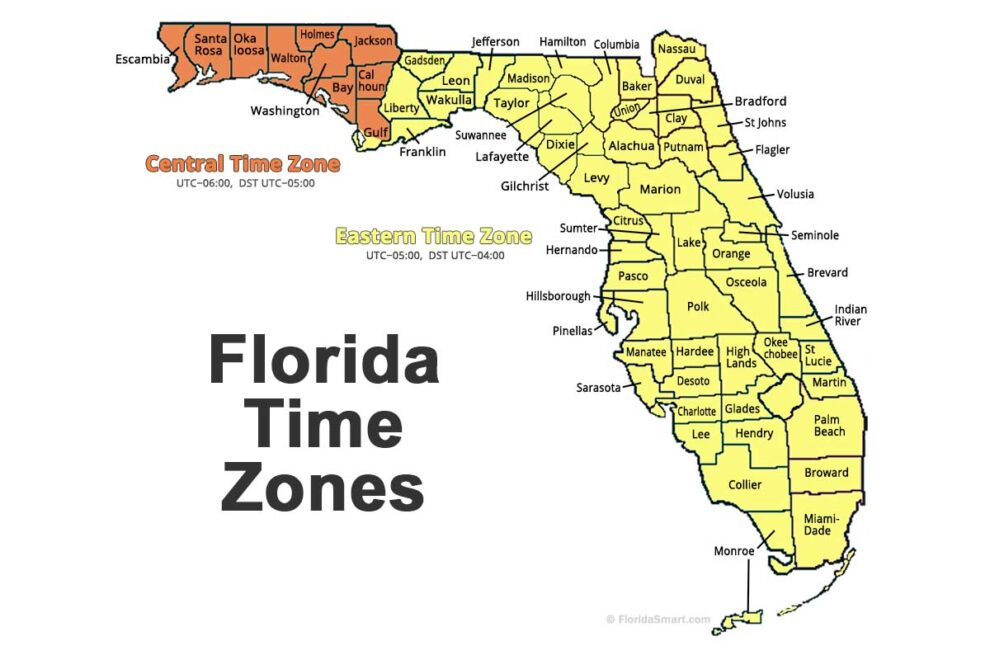
Yes, Florida does indeed have two time zones. While often perceived as a singular entity operating on a uniform clock, the Sunshine State is bisected by a time zone boundary, a detail that can be a pleasant surprise or a logistical hiccup for unsuspecting travelers. The vast majority of Florida observes the Eastern Time Zone (ET), aligning with much of the East Coast of the United States. However, a significant portion of its western Florida Panhandle operates on the Central Time Zone (CT). This distinction is a crucial piece of information for anyone planning a trip, especially those embarking on a cross-state road trip or scheduling meetings that span the diverse geographical regions of Florida. Understanding where this invisible line falls and how it impacts your travel plans can save you from missed appointments, late arrivals, or simply confusion regarding local operating hours. From checking into a resort in Panama City to catching a flight from Orlando International Airport, an awareness of Florida’s dual time zones is an essential tool in any traveler’s arsenal, ensuring a smooth and punctual experience across this vibrant state.
Navigating Florida’s Dual Time Zones: A Traveler’s Guide
For travelers, the practical implications of Florida’s two time zones are paramount. Whether you’re planning a multi-city tour or simply need to make a timely connection, knowing which time zone you’re in, and when you might cross into another, is fundamental. The state’s unique geography, stretching from the Atlantic to the Gulf of Mexico and featuring a prominent panhandle, naturally lends itself to this time division.
Eastern Time Zone (ET): The Sunshine State’s Primary Clock
The vast majority of Florida operates on the Eastern Time Zone, making it the default expectation for most visitors. This includes the entire Florida Peninsula, which hosts the state’s largest cities, most famous attractions, and busiest transportation hubs. When you think of Florida’s iconic destinations, chances are they fall within ET.
Major cities and regions observing Eastern Time include:
- Miami: The vibrant cultural hub of South Florida, known for its beaches, nightlife, and arts scene.
- Orlando: Home to world-renowned theme parks like Walt Disney World Resort and Universal Orlando Resort.
- Tampa: A major city on the Gulf Coast with a thriving downtown and attractions like Busch Gardens Tampa Bay.
- Jacksonville: The largest city by population in Florida, located in the northeast corner of the state.
- Fort Lauderdale: Often called the “Venice of America” due to its extensive canal system.
- West Palm Beach: A sophisticated city known for its upscale shopping and cultural institutions.
- The Florida Keys: The iconic string of islands stretching southwest from the tip of the Florida Peninsula, including Key West.
For travelers arriving by air, the major international airports such as Miami International Airport, Orlando International Airport, and Tampa International Airport all operate on Eastern Time. Theme park opening hours, restaurant reservation times, and local event schedules across these regions will universally adhere to ET, making planning relatively straightforward for visitors sticking to the peninsula.
Central Time Zone (CT): The Panhandle’s Western Edge
The Central Time Zone encompasses the westernmost counties of the Florida Panhandle, distinguishing it from the rest of the state. This region shares its time with neighboring states like Alabama and Mississippi, reflecting its geographical and cultural ties to the deep South. While smaller in land area compared to Florida’s ET portion, this area is a popular destination for its pristine beaches, often referred to as the “Emerald Coast.”
Key cities and regions observing Central Time include:
- Pensacola: A historic city in the far west of the panhandle, known for its Naval Air Station and beautiful beaches.
- Destin: Famous for its sugar-white sands and emerald waters, a prime vacation spot.
- Panama City and Panama City Beach: Popular spring break destinations and family vacation spots.
- Fort Walton Beach: Another major city on the Emerald Coast.
- Niceville and Tallahassee (partially/bordering): While the state capital, Tallahassee, is predominantly in ET, its western outskirts and some nearby areas can flirt with the CT border, causing minor confusion.
Travelers heading to these areas from the Florida Peninsula will need to adjust their watches back by one hour. This is particularly relevant for those driving along Interstate 10 or flying into regional airports like Pensacola International Airport or Northwest Florida Beaches International Airport. Misinterpreting the time can lead to missing connections or appointments, so awareness is key.
The Time Zone Border: Where East Meets Central
The dividing line between Eastern Time and Central Time in Florida is not a perfectly straight, easily identifiable line on a map. Instead, it weaves through several counties in the Florida Panhandle, sometimes making for a somewhat irregular transition. This makes understanding the border zones particularly important for those traveling through the region.
Key Counties and Cities at the Divide
The time zone boundary largely follows the Apalachicola River for a significant portion, but it deviates in certain areas. Historically, decisions on which time zone a county observes are often made at the local level, sometimes influenced by economic or social ties to neighboring areas.
Counties that are either entirely or partially in the Central Time Zone, or sit directly on the border, include:
- Franklin County: Generally in ET, but parts to the west of the Apalachicola River might lean CT.
- Gulf County: Notably, the eastern part of Gulf County, including the city of Port St. Joe, observes ET. However, the western part of the county, especially around Mexico Beach, operates on CT. This is one of the most visible instances of a county being split.
- Calhoun County: Predominantly in CT.
- Bay County: Entirely in CT, home to Panama City.
- Walton County: Entirely in CT, featuring popular destinations like Seaside and Miramar Beach.
- Holmes County: Entirely in CT.
- Washington County: Entirely in CT.
- Jackson County: Predominantly in CT, but some eastern areas near Marianna might be close to the border.
- Gadsden County: Generally in ET, located immediately west of Tallahassee.
The unofficial, yet often observed, natural boundary for much of this transition is the Apalachicola River. Areas to the east of the river tend to be in ET, while those to the west generally fall into CT. However, the exception of Gulf County highlights the need for specific checks. This intricate border means that a short drive can lead to a time shift, a crucial consideration for precise planning.
Practical Scenarios for Travelers Crossing the Border
Understanding this time zone divide is critical for several travel scenarios:

- Road Trips Across the Florida Panhandle: If you’re driving from, say, Tallahassee (ET) to Pensacola (CT), you will effectively “gain” an hour as you cross the time zone line. Conversely, driving eastward will cause you to “lose” an hour. Be mindful of this when calculating arrival times or planning stops.
- Booking Accommodations and Activities in Border Areas: Always confirm the local time zone when making reservations in counties like Gulf County or Franklin County. A hotel check-in time or a tour departure time could be one hour different from what you expect based on your originating time zone.
- Communication with People in Different Time Zones within Florida: If you’re on the Florida Peninsula and coordinating with friends or family in the Panhandle’s Central Time Zone, remember the one-hour difference. A call scheduled for 3 PM your time (ET) will be 2 PM their time (CT).
Daylight Saving Time (DST) and Florida
Like most of the United States, Florida observes Daylight Saving Time (DST). This annual adjustment, where clocks are moved forward by one hour in the spring and back by one hour in the fall, applies to both the Eastern Time Zone and the Central Time Zone within the state.
How DST Affects Florida’s Time Zones
When Daylight Saving Time begins (typically on the second Sunday in March), clocks in both ET and CT areas of Florida spring forward by one hour. Eastern Time becomes Eastern Daylight Time (EDT), and Central Time becomes Central Daylight Time (CDT). When DST ends (typically on the first Sunday in November), clocks fall back, reverting to Eastern Standard Time (EST) and Central Standard Time (CST).
Crucially, the one-hour difference between the two zones remains consistent throughout the year, regardless of whether DST is in effect. So, if it’s 3 PM EDT in Orlando, it will be 2 PM CDT in Pensacola. This consistent difference simplifies things somewhat, as travelers don’t need to worry about the time gap changing seasonally.
“Sunshine Protection Act” and its Implications
Florida has been at the forefront of efforts to make Daylight Saving Time permanent. In 2018, the Florida Legislature passed the “Sunshine Protection Act,” which would make Daylight Saving Time year-round if approved by the United States Congress. This means Florida would stop “falling back” in the autumn, effectively observing permanent Eastern Daylight Time (or Central Daylight Time in the panhandle) throughout the year.
The primary motivation behind this legislation is to capitalize on Florida’s natural daylight, providing more evening daylight hours for tourism, recreation, and business. Proponents argue it could reduce energy consumption, boost retail sales, and enhance public safety.
However, as of the present, the “Sunshine Protection Act” has not received federal approval to become law. The power to establish time zones and regulate DST ultimately rests with the federal government. Therefore, Florida continues to observe the biannual time change like most other states. Travelers should stay informed of any potential future changes, but for now, the seasonal clock adjustments are a reality for all of Florida.
Essential Tips for Travelers Regarding Florida’s Time Zones
Navigating Florida’s dual time zones doesn’t have to be complicated. With a few proactive steps, travelers can ensure their journey is seamless and free from time-related confusion.
Double-Checking Schedules and Bookings
This is arguably the most crucial tip. Always confirm the local time zone when dealing with any scheduled event in Florida.
- Flights and Transportation: Verify all departure and arrival times, especially for connecting flights or ground transportation that crosses the time zone boundary. Airport schedules typically specify local times, but a quick double-check can prevent stress.
- Hotel Check-ins and Check-outs: Confirm the official local time for these crucial moments, particularly if your accommodation is in a border county.
- Tour and Activity Bookings: Theme park opening hours, swamp boat tours, fishing charters, and museum entry times are always given in local time. Ensure your personal clock aligns with the venue’s clock.
- Restaurant Reservations: A missed dinner reservation due to a time zone miscalculation can be disappointing. Confirm the specific time zone used for your booking.
- Appointments: Whether it’s a business meeting or a medical appointment, clarity on the time zone is non-negotiable.
When in doubt, a simple question to the booking agent or establishment about their specific time zone can save a lot of hassle.
Local Knowledge and Communication
Don’t hesitate to leverage local resources and communication:
- Ask Locals: If you’re in a border area and unsure, simply ask a local resident, hotel staff, or store clerk what time zone they are in. They are accustomed to the distinction and can provide accurate, real-time information.
- Communicate Clearly: When coordinating plans with people in different parts of Florida, explicitly state the time zone. For example, instead of “Let’s meet at 2 PM,” say “Let’s meet at 2 PM ET” or “2 PM CT,” depending on the location. This eliminates ambiguity.
- Time Zone Converter Apps: Many smartphone apps and online tools can instantly convert times between different zones. These can be incredibly helpful for complex itineraries or international travelers.

Device Settings and Automatic Updates
Modern technology is a traveler’s best friend when it comes to time zones:
- Automatic Time Zone Detection: Ensure your smartphone, tablet, smartwatch, and GPS devices are set to automatically detect and update time zones. Most devices do this by default when connected to a cellular network or Wi-Fi, using location services.
- Check Before Relying Solely on GPS: While GPS systems are generally reliable, it’s a good practice to quickly confirm your device’s time zone setting, especially if you’ve been traveling internationally or have recently manually changed settings.
- Manual Overrides: Avoid manually setting your time unless absolutely necessary, as this can override automatic updates and lead to errors when crossing boundaries.
- Non-Smart Devices: If you’re using a traditional watch or alarm clock, remember to adjust it manually when crossing the time zone boundary in the Florida Panhandle.
In conclusion, while Florida does indeed span two time zones – predominantly Eastern Time and a segment of the Panhandle on Central Time – navigating this distinction is straightforward with awareness and preparation. Travelers armed with this knowledge can effortlessly transition between the clocks, ensuring punctuality for all their adventures, from the vibrant cities of the peninsula to the tranquil beaches of the Emerald Coast. A little foresight goes a long way in making your Florida travels as smooth and enjoyable as the Sunshine State itself.
LifeOutOfTheBox is a participant in the Amazon Services LLC Associates Program, an affiliate advertising program designed to provide a means for sites to earn advertising fees by advertising and linking to Amazon.com. Amazon, the Amazon logo, AmazonSupply, and the AmazonSupply logo are trademarks of Amazon.com, Inc. or its affiliates. As an Amazon Associate we earn affiliate commissions from qualifying purchases.