
The sunken remains of the USS Arizona, a poignant symbol of the devastating attack on Pearl Harbor that propelled the United States into World War II, rest at a depth of approximately 40 feet (12 meters) below the surface of the water in Pearl Harbor, Oahu, Hawaii. This specific depth is not merely a technical detail; it is a critical element in understanding the landmark’s profound historical significance, its enduring preservation, and the unique experience of visiting the USS Arizona Memorial that straddles its hull. The shallow, clear waters allow visitors standing on the memorial platform to gaze directly down upon the battleship’s submerged structure, a stark and immediate connection to history frozen in time. The depth ensures visibility, allowing the ship to remain an accessible, tangible monument, constantly visible and perpetually mourned, yet forever unreachable. It is a sacred grave and an irreplaceable historical artifact, preserved by its watery shroud at a depth that maintains both its mystery and its undeniable presence.

The Tragic Fate and Enduring Legacy of a Battleship
Commissioned in 1916, the USS Arizona was a Pennsylvania-class battleship, a formidable vessel representing the pinnacle of naval power in its era. For decades, it served as a proud instrument of American might, participating in convoy duties during World War I and later becoming part of the legendary Battle Fleet, often operating out of San Pedro, California. Its namesake, the state of Arizona, imbued it with a sense of regional pride and national duty. Its final assignment brought it to the strategic naval base at Pearl Harbor in the mid-Pacific, a forward operating position deemed essential for projecting American influence and protecting its interests in a tense global climate.
On the fateful morning of December 7, 1941, the USS Arizona was moored along Ford Island when the surprise attack by the Imperial Japanese Navy commenced. Within minutes of the assault, a Japanese bomb penetrated the ship’s forward deck, igniting a massive explosion in the ship’s magazines. The resulting blast was catastrophic, ripping through the battleship and causing it to sink rapidly. The force of the explosion was so immense that it lifted the 33,000-ton vessel out of the water, breaking its keel and sending it to the bottom of Pearl Harbor in a matter of nine minutes. The destruction was nearly absolute, and with it, 1,177 of its crew members perished, representing almost half of the total American casualties suffered that day. The vast majority of these men remain entombed within the ship’s hull, a collective grave beneath the waves. The USS Arizona’s tragic sinking became an immediate and powerful symbol of the attack, galvanizing the United States to declare war and enter the global conflict. Its remains, largely intact but severely damaged, were deemed unrecoverable and left in place, transformed from a warship into an eternal testament to sacrifice.
The USS Arizona Memorial: A Landmark Above the Grave
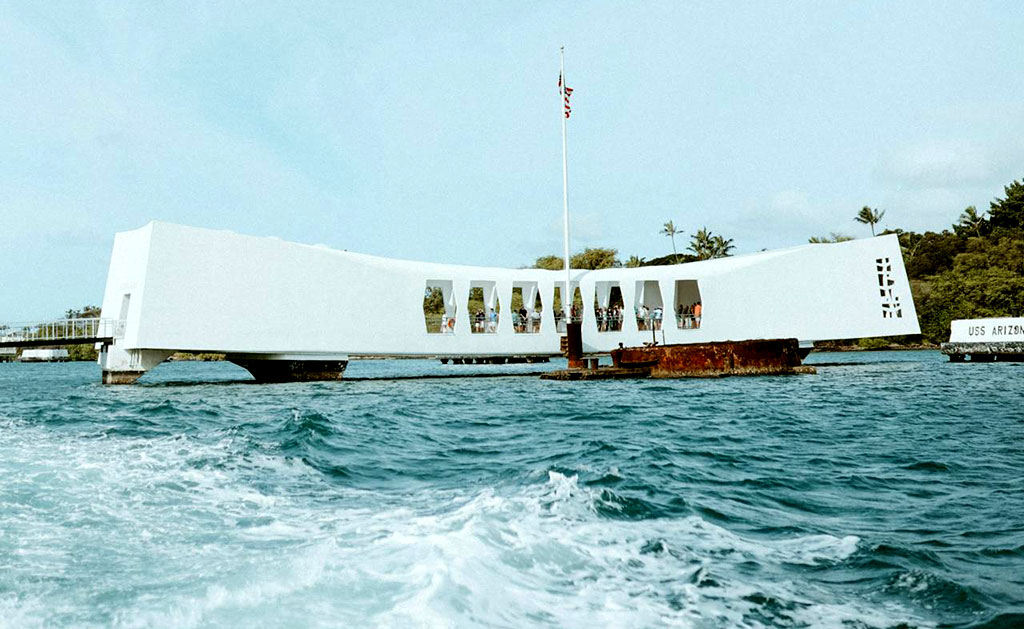
The decision to leave the USS Arizona submerged at its final resting place underscored the profound respect for the fallen and the desire to create a permanent monument to their sacrifice. However, the creation of a physical memorial above the wreck was not immediate. For years, the visible portion of the battleship’s superstructure, particularly the mainmast, remained a stark reminder. In 1962, the USS Arizona Memorial, designed by architect Alfred Preis, was dedicated. This iconic structure does not touch the sunken battleship; instead, it spans the ship’s midsection, allowing visitors to look down into the water and observe the wreck without disturbing it.

Preis’s design for the memorial is intentionally minimalist and deeply symbolic. Its concave shape, with ends that rise to a peak, represents both defeat and victory, the initial shock of the attack and the ultimate triumph of the United States in World War II. The memorial has 21 open-air windows, representing a 21-gun salute. At the far end of the memorial is the Shrine Room, where the names of all 1,177 crew members who died on the USS Arizona are etched into a marble wall. This intimate space provides a focal point for remembrance, linking individual sacrifice to the broader historical event. The memorial’s construction directly above the wreck, at a depth that maintains its visibility, is crucial to its impact. Visitors can see the battleship’s rusty hull, parts of its main deck, and the infamous “black tears of the Arizona”—oil that continues to seep from the ship’s fuel tanks, a poignant reminder of its lingering wounds and the lives lost. This direct visual connection elevates the memorial from an abstract monument to a tangible, living piece of history.
Preservation and Environmental Stewardship
The long-term preservation of the USS Arizona wreck is a complex and ongoing endeavor managed by the National Park Service, which oversees the Pearl Harbor National Memorial. The ship’s shallow depth is a double-edged sword: while it allows for unparalleled visibility, it also exposes the wreck to environmental factors such as corrosion, marine life, and human impact. The steel hull, having been submerged for over eight decades, is in a continuous state of slow degradation. The rate of deterioration is monitored through advanced scientific techniques, including sonar mapping, laser scanning, and regular dives by specialized teams of archeologists and divers.
These efforts aim to understand the structural integrity of the wreck, document its current condition, and predict its future state. The National Park Service employs non-invasive methods to preserve the site, focusing on managing the surrounding environment rather than attempting to restore the ship itself. The oil leaks, while symbolic, are also monitored for their environmental impact on the delicate ecosystem of Pearl Harbor. Research into microbiological activity on the wreck helps scientists understand the natural processes of steel degradation in saltwater, providing valuable insights for maritime archaeology worldwide. The objective is not to stop the natural decay, but to understand it, manage the site respectfully, and ensure that the USS Arizona remains a recognizable and evocative landmark for future generations, even as it slowly transforms under the sea. The shallow depth facilitates this ongoing research and monitoring, making it one of the most studied and respected underwater archaeological sites globally.
A Sacred Underwater Sanctuary and Educational Hub
The USS Arizona at its 40-foot depth is more than just a historical artifact; it is a sacred underwater sanctuary. For many, it represents the ultimate sacrifice made by servicemen and women in defense of freedom. The fact that the remains of over a thousand individuals lie within its hull transforms the wreck into a hallowed grave, demanding reverence and respect. Visitors to the USS Arizona Memorial often describe a profound sense of solemnity and reflection as they gaze upon the submerged ship. The oil seeping from the vessel, often described as the “tears of the Arizona,” creates an emotional connection to the ongoing legacy of the event, a living testament to the human cost of war.
Beyond its role as a memorial, the site serves as a vital educational hub. Annually, millions of people visit the Pearl Harbor National Memorial complex, which includes the USS Arizona Memorial. Through interpretive exhibits, historical accounts, and the direct visual evidence of the wreck, visitors learn about the complex causes and devastating consequences of the Pearl Harbor attack, the broader context of World War II, and the importance of peace and remembrance. The accessibility of the wreck due to its shallow depth is instrumental in this educational mission, providing a powerful, visceral learning experience that no mere photograph or description can replicate. It connects abstract historical narratives to a tangible, silent witness of a pivotal moment in human history. The sunken USS Arizona is a landmark not just of metal and water, but of memory, sacrifice, and the enduring lessons of history, perpetually reminding the world of the fragile nature of peace and the heavy price of conflict.
LifeOutOfTheBox is a participant in the Amazon Services LLC Associates Program, an affiliate advertising program designed to provide a means for sites to earn advertising fees by advertising and linking to Amazon.com. Amazon, the Amazon logo, AmazonSupply, and the AmazonSupply logo are trademarks of Amazon.com, Inc. or its affiliates. As an Amazon Associate we earn affiliate commissions from qualifying purchases.