
A Serendipitous Discovery at Sutter’s Mill
The genesis of the California Gold Rush, an event that irrevocably altered the trajectory of California and the United States, can be pinpointed to a cold morning on January 24, 1848. It was on this fateful day that James W. Marshall, a carpenter constructing a sawmill for Swiss pioneer John Sutter, noticed shimmering flecks in the tailrace of the newly built Sutter’s Mill. Located near what is now Coloma, along the American River in the foothills of the Sierra Nevada mountains, Marshall’s discovery was initially met with a mixture of skepticism and awe.

Marshall was supervising a crew of laborers, including Native Americans and Mormon battalion veterans, who were clearing debris from the mill’s channel when he spotted the distinctive glint of metal. He immediately suspected it was gold, a suspicion confirmed by rudimentary tests like hammering the soft metal and boiling it in lye. Upon confirming its authenticity, Marshall rushed to present his findings to John Sutter at Sutter’s Fort, a sprawling agricultural and trading post near present-day Sacramento. Sutter, a prominent figure in the region, initially attempted to keep the discovery under wraps. He feared a gold rush would disrupt his agricultural empire and deplete his labor force, concerns that would ultimately prove prescient. A secret agreement was made between Marshall and Sutter to maintain confidentiality for a period of six weeks, but the sheer allure of gold proved too powerful to contain. The immediate impact was localized, with workers at the mill and nearby residents quietly beginning their own prospecting efforts, often finding success. However, the true explosion of information was yet to come, laying the groundwork for one of history’s most dramatic mass migrations.
The Uncontainable News Spreads
Despite John Sutter’s earnest attempts to suppress the news of gold at Sutter’s Mill, the secret proved impossible to keep. Whispers turned into open declarations, largely thanks to the entrepreneurial spirit of one man: Sam Brannan. Brannan, a merchant and newspaper publisher in San Francisco, initially heard the rumors and decided to verify them for himself. Traveling to the gold discovery site, he observed firsthand the ease with which prospectors were unearthing gold. Recognizing an unparalleled business opportunity, Brannan shrewdly acquired all the mining tools, pans, and supplies he could lay his hands on.
Upon his return to San Francisco, Brannan executed a masterstroke of marketing. On May 12, 1848, he paraded through the streets, holding a quinine bottle filled with glittering gold dust above his head, shouting, “Gold! Gold! Gold from the American River!” This dramatic public announcement instantly ignited a frenzy. Brannan’s theatrical declaration was amplified by articles in local newspapers like The Californian and the California Star, though many initially dismissed the reports as exaggeration or hoax. However, as more prospectors returned with tangible evidence of their findings, skepticism rapidly transformed into widespread belief. The population of San Francisco plummeted as men—and some women—abandoned their jobs, businesses, and homes to rush to the gold fields. Ships were left deserted in the harbor, their crews having joined the exodus. This localized stampede marked the true beginning of the California Gold Rush, transforming a regional curiosity into an unstoppable human movement that would soon attract attention from across the globe.
The Call to the East and Beyond

While Sam Brannan’s pronouncement sparked the initial regional fervor, it was official confirmation from the highest levels of government that truly catapulted the California Gold Rush onto the national and international stage. On December 5, 1848, President James K. Polk addressed the United States Congress, confirming the astonishing reports of gold in California. He presented tangible evidence—a tea caddy containing 230 ounces of gold—sent by Colonel Richard Barnes Mason, the military governor of California. Polk declared that “the accounts of the abundance of gold are of such an extraordinary character as would scarcely command belief were they not corroborated by the authentic reports of officers in the public service.”
This presidential endorsement removed all doubt, transforming mere curiosity into an urgent, compelling call to action for millions. News of the vast gold deposits spread like wildfire across the United States and then around the world, igniting a mass migration unparalleled in modern history. These eager prospectors, who began arriving in large numbers in 1849, became known as the “Forty-Niners.” They embarked on arduous journeys to reach the distant gold fields, primarily through three main routes. Many traveled overland, braving the treacherous California Trail across the continent, a journey fraught with disease, starvation, and hostile encounters. Others opted for sea routes: either a long, dangerous voyage around Cape Horn at the southern tip of South America, or a faster but still perilous trip by sailing to Panama, crossing the malaria-ridden Isthmus by land, and then catching another ship up the Pacific coast to California. This diverse influx included not only Americans but also people from Europe, Asia, Australia, and other parts of the world, all lured by the dream of striking it rich.
Pre-Rush California: A Land on the Cusp
To fully appreciate the transformative impact of the California Gold Rush, it is essential to understand the state of California just prior to James W. Marshall’s discovery. In the mid-1840s, California was a remote and sparsely populated territory, culturally distinct and geographically isolated. It had only recently become a possession of the United States. The Mexican-American War, fought between 1846 and 1848, concluded with the signing of the Treaty of Guadalupe Hidalgo in February 1848 – coincidentally, just nine days after Marshall found gold at Sutter’s Mill. This treaty formally ceded vast territories, including California, to the United States.
Before this pivotal shift, California’s population was a mosaic of diverse groups. The dominant cultural and economic force were the Californios, descendants of Spanish and Mexican settlers, who primarily lived on sprawling ranches (ranchos) granted by the Mexican government. Their economy revolved around cattle ranching, producing hides and tallow for trade. Alongside them were a significant number of indigenous peoples, who had inhabited the land for millennia and whose lives were inextricably linked to its natural resources. A small but growing number of American and European settlers had also begun to arrive, often establishing farms or trading posts, like John Sutter’s empire centered at Sutter’s Fort near present-day Sacramento. These newcomers, few in number, were beginning to exert a cultural and political influence disproportionate to their population. The total non-indigenous population of California in 1848 was estimated to be around 15,000, a stark contrast to the hundreds of thousands who would arrive in the following years. This tranquil, agrarian society, on the very edge of geopolitical change, was utterly unprepared for the demographic, economic, and social earthquake that the discovery of gold would unleash. It was a land poised on the brink, unaware that its quiet existence was about to be shattered by the irresistible glimmer of precious metal.
The Immediate Aftermath and Transformation
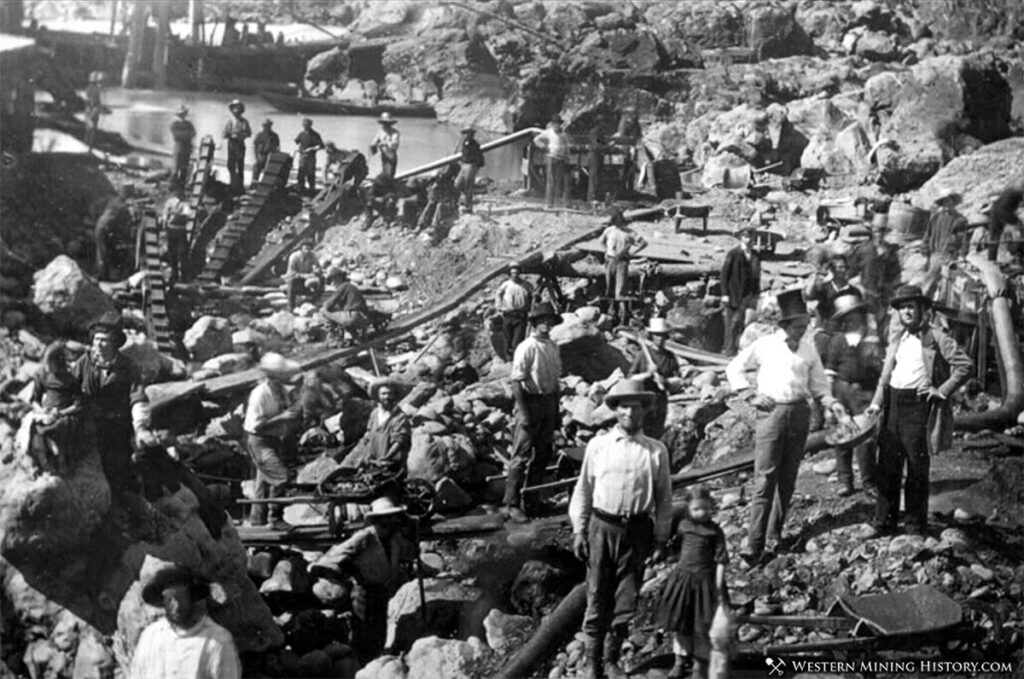
The immediate aftermath of the California Gold Rush’s onset was nothing short of revolutionary for California. Within a few years, the territory’s population exploded, growing from approximately 15,000 non-indigenous inhabitants in early 1848 to over 100,000 by 1850, and nearly 380,000 by 1860. This rapid demographic shift led to the swift establishment of rudimentary settlements and then bustling boomtowns. Places like Sacramento and San Francisco, once small outposts, became major cities almost overnight, driven by the demands of thousands of new arrivals needing supplies, accommodation, and services. San Francisco, in particular, transformed from a sleepy port into a global metropolis, its harbor famously jammed with abandoned ships whose crews had deserted for the gold fields.
Economically, the gold rush fundamentally reoriented California. The existing agrarian and hide-and-tallow economy of the Californios was largely overwhelmed. While few prospectors struck it rich, the ancillary industries that supported the miners thrived. Merchants like Sam Brannan, who sold shovels and provisions at inflated prices, often accumulated more wealth than the miners themselves. Transportation, shipping, and service industries boomed. The gold extracted fueled the United States’ economy, providing capital for industrial expansion and consolidating the nation’s financial strength. Socially, the influx created an incredibly diverse and often chaotic society. People from all corners of the globe converged, bringing with them a tapestry of languages, customs, and ambitions. This diversity, while enriching, also led to significant social tensions, conflicts over land and resources, and widespread discrimination against non-white miners. Politically, the rapid population growth and economic development accelerated California’s path to statehood. Just two years after the gold discovery, in September 1850, California was admitted to the Union as the 31st state, largely due to the pressing need for a stable government to manage the burgeoning population and economic activity generated by the gold. The gold rush, born from a glimmer in a mill’s tailrace, thus reshaped not only a territory but also contributed to the very fabric and expansion of a nation.
LifeOutOfTheBox is a participant in the Amazon Services LLC Associates Program, an affiliate advertising program designed to provide a means for sites to earn advertising fees by advertising and linking to Amazon.com. Amazon, the Amazon logo, AmazonSupply, and the AmazonSupply logo are trademarks of Amazon.com, Inc. or its affiliates. As an Amazon Associate we earn affiliate commissions from qualifying purchases.