
The Genesis of a Claim: Early Exploration and the Seeds of Ambition
The story of how the United States came to possess the vast and resource-rich Oregon Territory is a complex tapestry woven from exploration, diplomacy, and underlying national ambition. Long before formal claims were staked, the allure of the Pacific Northwest beckoned to adventurers and those seeking new frontiers. The initial seeds of American interest were sown through daring expeditions that charted unknown lands and established a nascent presence.
The Voyage of the Columbia and the Astor Expedition
A pivotal moment in asserting an American presence in the region was the voyage of the ship Columbia Rediviva in the early 1790s, captained by Robert Gray. This expedition, primarily focused on the lucrative sea otter fur trade, marked the first time an American flag was sailed around the world and, crucially, the first time an American vessel entered the mouth of the great river that would later bear the ship’s name: the Columbia River. Gray’s discovery and subsequent naming of the river provided a tangible geographic anchor for future American claims.

Following in this exploratory spirit, [John Jacob Astor](https://lifeoutofthebox.com/john-jacob- Astor) launched an ambitious venture in the early 19th century. His Pacific Fur Company established Fort Astoria near the mouth of the Columbia River in 1811. This outpost was intended to serve as the center of a vast fur trading empire stretching across the West. Although ultimately short-lived due to the War of 1812 and the sale of the company’s assets to the British North West Company, Fort Astoria represented a significant, albeit temporary, American settlement and a concrete assertion of interest in the region. These early endeavors, driven by commerce and the spirit of discovery, laid the groundwork for a more robust claim grounded in actual exploration and presence.
Competing Claims and Diplomatic Maneuvers
The Pacific Northwest, or the Oregon Country as it was then known, became a focal point for competing imperial ambitions throughout the early to mid-19th century. Several nations, including the United States, Great Britain, Spain, and Russia, all harbored interests and asserted varying degrees of claim to the territory. This overlapping of interests necessitated a series of diplomatic negotiations to resolve the competing claims and prevent potential conflict.
The Spanish and Russian Retreats
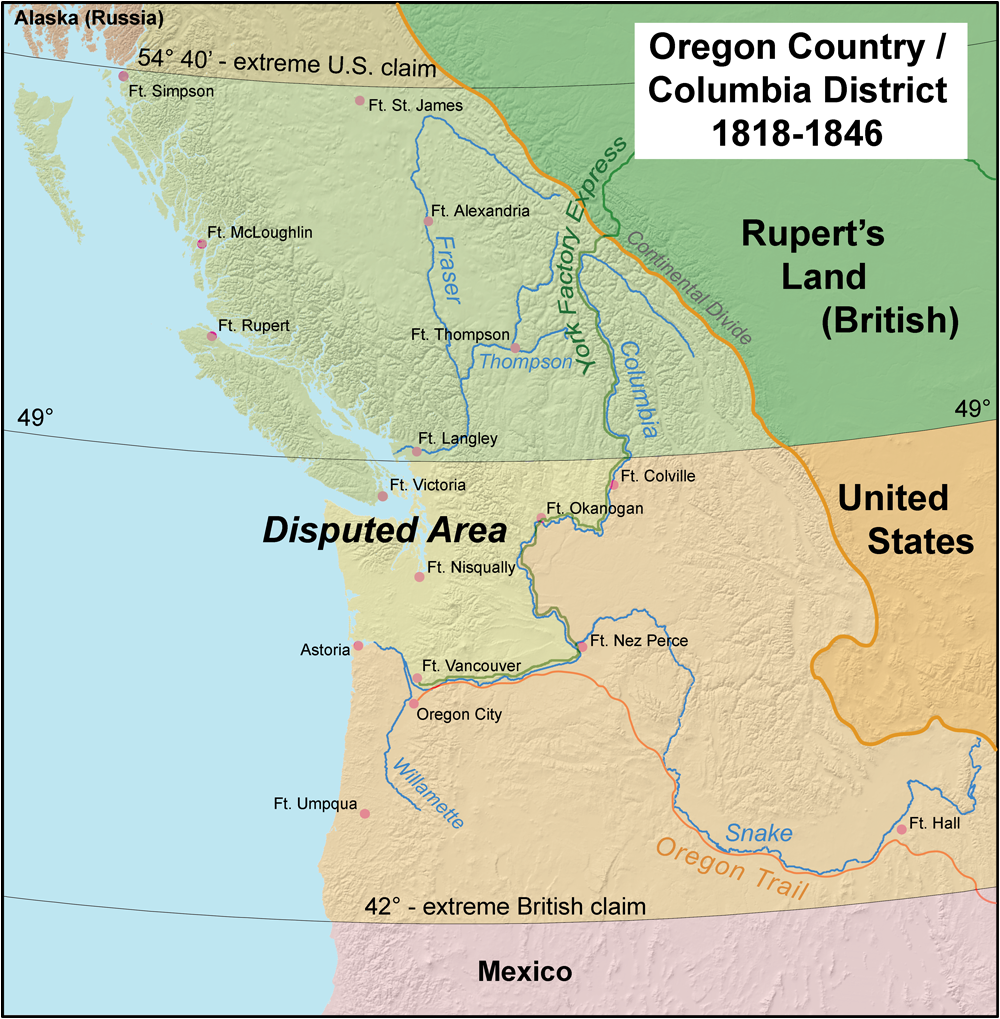
Initially, Spain laid claim to vast swathes of the Pacific coast, stretching from what is now California northward. However, Spain’s influence in the region waned significantly by the early 19th century. Through the Adams-Onís Treaty of 1819, Spain ceded its claims to lands north of the 42nd parallel to the United States, effectively relinquishing its stake in the future Oregon Territory. Similarly, Russia, which had established some trading posts along the Alaskan coast, also made claims extending southwards. However, facing increasing pressure and recognizing the dominance of British and American interests, Russia eventually withdrew its territorial claims south of 54°40′ north latitude through treaties with both the United States and Great Britain in the early 1820s. These withdrawals significantly simplified the diplomatic landscape, leaving the United States and Great Britain as the primary contenders for the Oregon Country.
The Treaty of 1818 and Joint Occupation
The United States and Great Britain formally addressed their overlapping claims in the Convention of 1818. This landmark treaty established the international boundary between the United States and British North America along the 49th parallel of latitude from the Lake of the Woods to the Rocky Mountains. Crucially, for the territory west of the Rockies, the treaty did not establish a definitive boundary. Instead, it instituted a policy of joint occupation, allowing citizens of both nations to trade and settle in the Oregon Country without prejudice to the ultimate territorial claims of either party. This arrangement was intended as a temporary measure, a way to manage competing interests while further negotiations could take place. However, it resulted in a period of de facto shared governance and growing American settlement in the region.
The Era of American Settlement and Manifest Destiny
The policy of joint occupation, while initially a diplomatic compromise, spurred increasing American migration to the Oregon Country. The compelling narratives of fertile lands, abundant resources, and the promise of a new life resonated deeply with the American public, fueled by the prevailing ideology of Manifest Destiny. This belief held that the United States was divinely ordained to expand its dominion and spread democracy across the North American continent.
The Oregon Trail and the Pioneers
The overland journey to Oregon, primarily via the arduous Oregon Trail, became a symbol of American westward expansion. Thousands of pioneers, often organized into wagon trains, embarked on the perilous trek, facing disease, harsh weather, and the challenges of crossing vast distances. Figures like Marcus Whitman and his wife Narcissa Whitman, missionaries who established the Waiilatpu Mission, played a significant role in promoting the attractions of Oregon and assisting settlers, though their mission tragically ended in violence. These settlers established farms and communities, creating an undeniable American demographic presence that strengthened the United States’ claim to the territory. The growing population meant that by the 1840s, American settlers significantly outnumbered British subjects in the Willamette Valley and surrounding areas, shifting the balance of influence on the ground.
Political Rhetoric and the “Fifty-Four Forty or Fight!” Slogan
As American settlement increased and the desire for territorial expansion intensified, the political discourse surrounding Oregon became more pronounced. The Democratic Party, in particular, embraced a more aggressive stance on territorial acquisition. The popular slogan “Fifty-Four Forty or Fight!” emerged during the presidential election of 1844, reflecting a maximalist claim to the entire Oregon Country up to the border of Russian America at 54°40′ north latitude. This rallying cry, championed by presidential candidate James K. Polk, tapped into a potent mix of national pride and expansionist fervor. While the slogan was primarily a political tool to mobilize voters and pressure Great Britain, it underscored the strong popular desire for undisputed American control over the entire region.
The Climax: Diplomacy and Final Acquisition
The escalating tensions, fueled by expansionist rhetoric and the growing American population on the ground, brought the Oregon question to a critical juncture. The United States, under President James K. Polk, found itself in a position where it could leverage its growing influence and the threat of conflict to achieve its territorial objectives. However, the pragmatism of avoiding a two-front war—especially with Mexico looming—ultimately led to a diplomatic resolution.
The Treaty of Oregon (1846)
Despite the fiery rhetoric of “Fifty-Four Forty or Fight!”, cooler heads and seasoned diplomats prevailed. President Polk, while publicly maintaining a firm stance, recognized the practical limitations and potential costs of a war with Great Britain, a formidable global power. Secret negotiations began, seeking a compromise that would satisfy American expansionist goals without igniting a major conflict. The Convention of 1818 had established the 49th parallel as the boundary west to the Rocky Mountains, and this line proved to be the most logical and acceptable compromise for both nations.
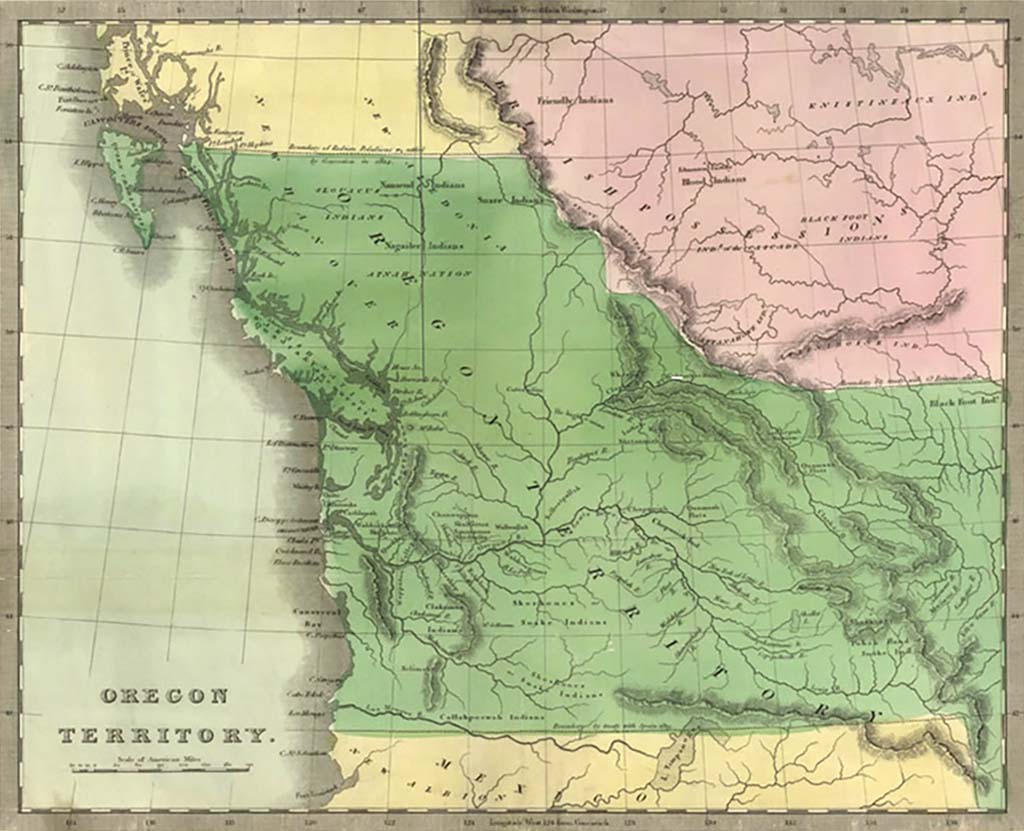
After considerable negotiation, the United States and Great Britain reached an agreement. The Treaty of Oregon, signed on June 15, 1846, established the 49th parallel of north latitude as the permanent boundary between the United States and British North America from the Rocky Mountains to the Strait of Georgia. This treaty effectively divided the disputed Oregon Country, with the United States gaining sovereignty over the land south of the 49th parallel—which would eventually form the states of Oregon, Washington, and parts of Idaho—and Great Britain retaining Vancouver Island and the lands to the north. The treaty also granted Great Britain navigation rights on the Columbia River.
The Legacy of the Acquisition
The acquisition of the Oregon Territory was a monumental achievement for the United States, significantly expanding its territory, resources, and access to the Pacific Ocean. It was a critical step in fulfilling the vision of Manifest Destiny and laid the foundation for the nation’s emergence as a major global power. The fertile lands of Oregon would become a vital agricultural heartland, and its strategic Pacific coastline would prove invaluable for trade and defense. The process of acquiring Oregon, a blend of exploration, settlement, and shrewd diplomacy, serves as a compelling case study in the complex dynamics of territorial expansion and international relations, shaping the map of North America as we know it today. The enduring impact of this acquisition continues to resonate, from the development of the Pacific Northwest to the broader narrative of American exceptionalism and continental dominion.
LifeOutOfTheBox is a participant in the Amazon Services LLC Associates Program, an affiliate advertising program designed to provide a means for sites to earn advertising fees by advertising and linking to Amazon.com. Amazon, the Amazon logo, AmazonSupply, and the AmazonSupply logo are trademarks of Amazon.com, Inc. or its affiliates. As an Amazon Associate we earn affiliate commissions from qualifying purchases.