
The annexation of Hawaii by the United States in 1898 represents a complex and often contentious chapter in American history, marking the end of an independent Polynesian monarchy and the beginning of Hawaii’s integration into the American sphere. Far from a simple territorial acquisition, this process was the culmination of decades of increasing foreign influence, economic ambition, and geopolitical maneuvering. What began with the arrival of missionaries and merchants in the early 19th century gradually eroded the sovereignty of the Kingdom of Hawaii, culminating in an overt overthrow and a subsequent annexation driven by strategic imperatives and expansionist ideologies. Understanding this historical trajectory requires an examination of the various forces at play, from internal political struggles within the kingdom to the evolving international landscape that ultimately sealed Hawaii’s fate.
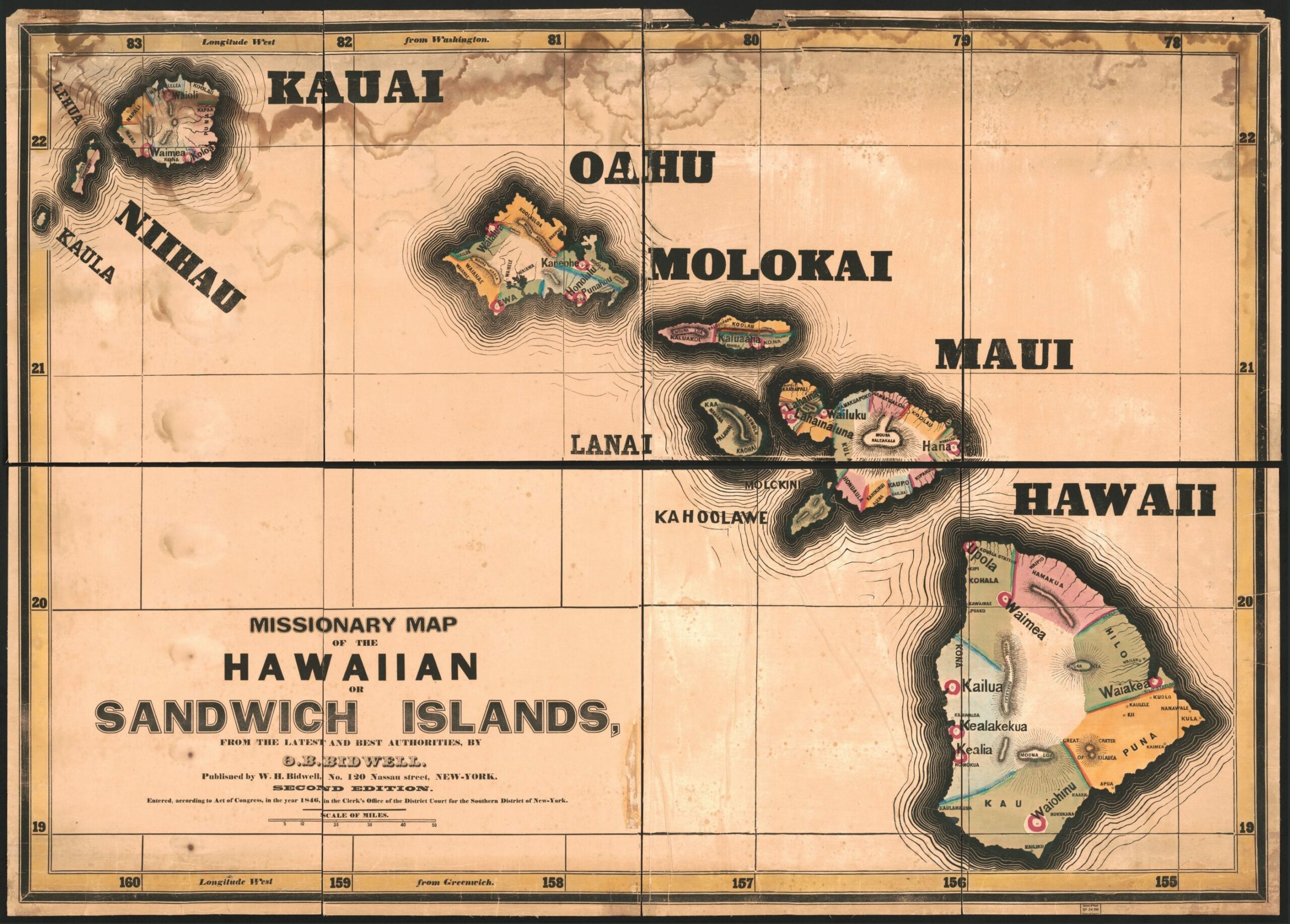
The Genesis of Foreign Influence and Erosion of Sovereignty
The isolation of the Hawaiian Islands, once a bastion of Polynesian culture and tradition, began to recede significantly with the arrival of Western explorers and traders in the late 18th century. Captain James Cook’s landing in 1778 opened the archipelago to the wider world, initiating a gradual but inexorable shift in its social, economic, and political structures.
Missionary and Business Endeavors
Early in the 19th century, American Protestant missionaries arrived in Hawaii, initially intending to spread Christianity. While their spiritual mission was central, their presence also introduced Western education, legal systems, and cultural norms that profoundly impacted Hawaiian society. Many missionary families’ descendants, having established deep roots and amassed significant landholdings, transitioned into powerful business interests, particularly in the burgeoning sugar industry. The fertile volcanic soil and favorable climate made Hawaii an ideal location for sugar cane cultivation, and these American entrepreneurs soon dominated the islands’ economy. Their plantations required extensive labor, leading to waves of immigration from China, Japan, the Philippines, and Portugal, further altering the demographic and social fabric of the kingdom. This economic leverage provided the American business community with considerable political influence, often overshadowing the authority of the Hawaiian monarchy.
Diplomatic Encroachments and Strategic Significance
As the 19th century progressed, the United States and other Western powers increasingly recognized Hawaii’s strategic importance. Situated at the crossroads of the Pacific Ocean, the islands offered a crucial coaling station, naval base, and commercial hub for trans-Pacific trade and military operations. This growing strategic value led to a series of treaties and agreements between the Kingdom of Hawaii and the United States. The Reciprocity Treaty of 1875, for instance, granted Hawaiian sugar duty-free access to the American market, boosting the sugar industry but also cementing Hawaii’s economic dependence on the United States. A subsequent amendment to this treaty in 1887 granted the United States exclusive rights to use Pearl Harbor as a naval base, a clear sign of American geopolitical ambitions in the Pacific. These diplomatic agreements, while seemingly beneficial, progressively undermined Hawaiian sovereignty by tying its fate ever more closely to American interests.
The Overthrow of the Monarchy: A Coup d’état
The increasing foreign dominance reached a critical juncture in the late 1880s and early 1890s, culminating in the illegal overthrow of the Hawaiian monarchy.
The Bayonet Constitution of 1887
A pivotal moment preceding the monarchy’s collapse was the imposition of the “Bayonet Constitution” in 1887. Drafted by a group of non-native Hawaiian businessmen and politicians, largely American and European, the constitution was forced upon King Kalākaua under duress, with armed militias threatening violence if he refused to sign. This document drastically curtailed the monarch’s power, transferring significant authority to the legislature, which was then dominated by wealthy American and European residents. Crucially, it also disenfranchised many native Hawaiians and Asian immigrants by imposing property and income qualifications for voting, while simultaneously granting suffrage to many non-native residents who met these criteria. The Bayonet Constitution effectively transformed Hawaii into a constitutional monarchy in name, but a plutocracy dominated by foreign interests in practice, laying the groundwork for further acts against Hawaiian sovereignty.
The 1893 Coup and Queen Liliʻuokalani‘s Deposition
The final act in the monarchy’s demise occurred in January 1893. Upon ascending to the throne in 1891, Queen Liliʻuokalani, a staunch nationalist, sought to restore power to the monarchy and native Hawaiians by promulgating a new constitution that would revoke the Bayonet Constitution and re-enfranchise her people. This attempt at reform was met with fierce opposition from the Annexation Club, later known as the Committee of Safety, a secret society composed primarily of American and European residents, many of whom were descendants of missionaries and powerful sugar planters.
On January 16, 1893, the Committee of Safety, fearing the loss of their political and economic dominance, orchestrated a coup. They falsely claimed that American lives and property were in danger and appealed to John L. Stevens, the U.S. Minister to Hawaii. Stevens, a known annexationist, responded by ordering 162 U.S. Marines from the USS Boston to land in Honolulu, ostensibly to protect American interests. Though the marines did not directly participate in the overthrow, their presence intimidated the Queen’s forces and signaled American support for the conspirators. Faced with superior force and to avoid bloodshed, Queen Liliʻuokalani reluctantly yielded her authority “under protest” to the United States government, hoping for a fair investigation and restoration. The monarchy was thus illegally overthrown, replaced by a provisional government led by Sanford B. Dole, an American lawyer and sugar planter.
The Path to Annexation: Political Debates and Geopolitical Shifts
The overthrow initiated a period of intense political debate in the United States regarding Hawaii’s future. The initial call for annexation by the provisional government was not immediately successful.
Cleveland’s Opposition and the Republic of Hawaii
Upon investigating the events of 1893, U.S. President Grover Cleveland, a Democrat, was appalled by the illegal nature of the overthrow. His special commissioner, James H. Blount, concluded that American diplomatic and military officials had acted improperly, assisting in a coup against a friendly nation. Cleveland consequently withdrew the annexation treaty from the Senate and even attempted to restore Queen Liliʻuokalani to her throne. However, the provisional government in Hawaii, firmly in control and backed by its own armed forces, refused to yield power. In 1894, recognizing that Cleveland would not annex the islands, the provisional government declared the establishment of the Republic of Hawaii, with Sanford B. Dole as its president. This new republic, essentially an oligarchic government dominated by American interests, maintained a strong desire for eventual annexation by the United States.
The Spanish-American War and Manifest Destiny
The political landscape in the United States shifted dramatically with the election of President William McKinley in 1896, a staunch Republican and proponent of American expansionism. The outbreak of the Spanish-American War in April 1898 provided the decisive impetus for annexation. During the war, Hawaii became a vital coaling station and strategic waypoint for U.S. naval forces prosecuting the war in the Pacific, particularly en route to the Philippines. The war vividly demonstrated Hawaii’s indispensable military value, making the arguments for annexation based on national security and strategic interest almost irresistible to many in Washington. The long-standing ideology of Manifest Destiny, which had driven American territorial expansion across the North American continent, now found a new expression in the Pacific.
Formal Annexation: The Newlands Resolution of 1898
With strong executive support and a compelling strategic justification, the path to formal annexation was cleared.
Circumventing Treaty Obstacles
Despite renewed efforts, a treaty of annexation faced significant opposition in the U.S. Senate, where it required a two-thirds majority vote. Anti-imperialist senators and those sympathetic to the deposed Queen argued against the legality and morality of annexing Hawaii following an illegal overthrow. To circumvent this opposition, proponents of annexation, led by President McKinley, opted for a different legislative route: a joint resolution of Congress. A joint resolution required only a simple majority vote in both the House of Representatives and the Senate, making it a much more feasible option. This legislative maneuver effectively bypassed the constitutional hurdles that had previously stalled annexation.

The Newlands Resolution
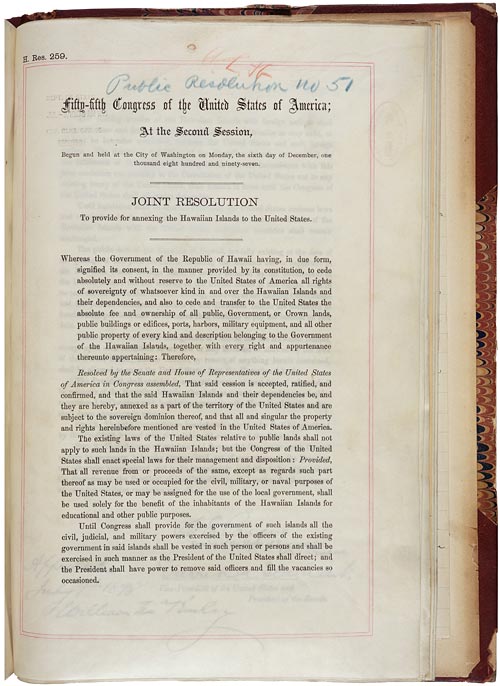
On July 7, 1898, President William McKinley signed the Newlands Resolution, officially annexing Hawaii to the United States. The resolution declared that the Republic of Hawaii thereby ceded “absolutely and without reserve to the United States all rights of sovereignty” over the Hawaiian Islands. The formal transfer of sovereignty took place on August 12, 1898, in a ceremony at ‘Iolani Palace in Honolulu, where the Hawaiian flag was lowered and the American flag was raised. Hawaii was subsequently organized as an incorporated territory of the United States in 1900, with Sanford B. Dole appointed as its first territorial governor. This act officially concluded over a century of Hawaiian independence and inaugurated a new era of American administration that would last until statehood in 1959.
The annexation of Hawaii was not a consensual act but rather a coercive takeover, driven by the economic interests of a non-native elite and the geopolitical ambitions of a burgeoning global power. While the United States justified the act through claims of strategic necessity and the supposed inability of the Hawaiian monarchy to govern effectively, the historical record reveals a clear pattern of external manipulation and disregard for native Hawaiian self-determination. The legacy of this annexation continues to resonate today, fueling ongoing discussions about sovereignty, historical justice, and the cultural identity of the Hawaiian people. It remains a stark reminder of the complexities inherent in the expansion of nations and the profound, long-lasting impacts of such historical events on indigenous populations and their homelands.
LifeOutOfTheBox is a participant in the Amazon Services LLC Associates Program, an affiliate advertising program designed to provide a means for sites to earn advertising fees by advertising and linking to Amazon.com. Amazon, the Amazon logo, AmazonSupply, and the AmazonSupply logo are trademarks of Amazon.com, Inc. or its affiliates. As an Amazon Associate we earn affiliate commissions from qualifying purchases.