
Changing one’s name is a significant personal decision, often driven by a multitude of life events and personal preferences. In California, a state known for its progressive legal framework and diverse population, the process to legally change your name is structured and requires careful adherence to specific procedures. Whether you’re adopting a new surname after marriage, reverting to a maiden name post-divorce, affirming a gender identity, or simply seeking a fresh start, understanding the judicial and administrative pathways is crucial for a smooth transition. This guide delves into the steps involved, offering a professional and insightful overview for anyone navigating this personal journey within the Golden State.

Understanding the Name Change Landscape in California
The reasons for a name change are as varied as the individuals pursuing them. Many people change their names due to marriage, divorce, or to align with a new gender identity. Others may seek a change for personal preference, to correct an error, to disassociate from a past identity, or for safety reasons. While informal name changes—simply using a new name without legal validation—are possible in some social contexts, a formal, legal name change is imperative for official documents, financial accounts, and virtually every aspect of modern life.
In California, the general formal name change process primarily involves petitioning the Superior Court in your county of residence. However, certain life events, such as marriage or divorce, offer simplified avenues that bypass the full court petition process. For those affirming their gender identity, California provides a streamlined and often more private judicial path. Regardless of the route, the goal is to obtain a legally recognized court order that officially declares your new name, which can then be used to update all your identification and records.
The Judicial Process: Petitioning the Court
For most general name changes not tied to marriage, divorce, or gender affirmation, the judicial process through the Superior Court is the standard. This path ensures your new name is legally recognized across all governmental and private entities.
Preparing Your Petition
The initial step involves gathering and completing the necessary legal forms. These forms are typically available on the California Courts self-help website or at your local county Superior Court clerk’s office. The primary forms include:
- Petition for Change of Name (Form NC-100): This is the core document where you state your current legal name, your desired new name, and the reason for the change. You will also provide information such as your date and place of birth, and your current mailing address.
- Order to Show Cause for Change of Name (Form NC-120): This form officially notifies the public of your intent to change your name and sets a date for your court hearing.
- Civil Case Cover Sheet (Form CM-010): A standard form required for all civil cases in California, used for statistical purposes and case management.
For certain situations, such as changing a minor’s name, additional forms and specific requirements apply, potentially including fingerprinting for a criminal background check of the adult petitioners. It’s crucial to accurately complete all sections, as errors can delay the process.
Filing and Fees
Once your forms are meticulously completed, you must file them with the Superior Court in the county where you reside. The court clerk will stamp your documents and provide you with a case number. Be prepared to pay a filing fee, which can vary by county but is typically several hundred dollars. If you cannot afford the fee, California offers fee waiver options (Form FW-001, Request to Waive Court Fees) that you can apply for simultaneously. Ensure you make several copies of all documents – one for the court, one for publication, and several certified copies for your personal records after the order is granted.
Publication Requirement
A critical step in the general name change process is the publication of your “Order to Show Cause for Change of Name.” This requirement serves to notify the public of your impending name change, primarily to prevent fraud or ensure no one with a legitimate objection to your name change is unaware. You must arrange for the Order to Show Cause (Form NC-120) to be published in a newspaper of general circulation in your county for four consecutive weeks.
The court clerk can often provide a list of approved newspapers in your area. The newspaper will typically handle the publication and provide you with a “Proof of Publication” document (Form NC-130) once the required period is complete. You must then file this Proof of Publication with the court before your scheduled hearing date. Failure to publish or file the proof will result in the court not granting your name change.
The Court Hearing
On the date specified in your Order to Show Cause, you must appear in court before a judge. While this can seem daunting, name change hearings are usually straightforward. The judge will review your petition, the proof of publication, and may ask a few questions to confirm your identity and reasons for the name change. If everything is in order and there are no objections, the judge will sign the “Decree Changing Name” (Form NC-130).
It is vital to obtain several certified copies of this decree immediately from the court clerk. These certified copies are your official proof of name change and will be required to update all your personal and financial records.
Alternative Name Changes: Marriage, Divorce, and Gender Affirmation
Not all name changes require a full court petition and publication. California provides streamlined processes for name changes associated with major life events.
Marriage-Related Name Changes
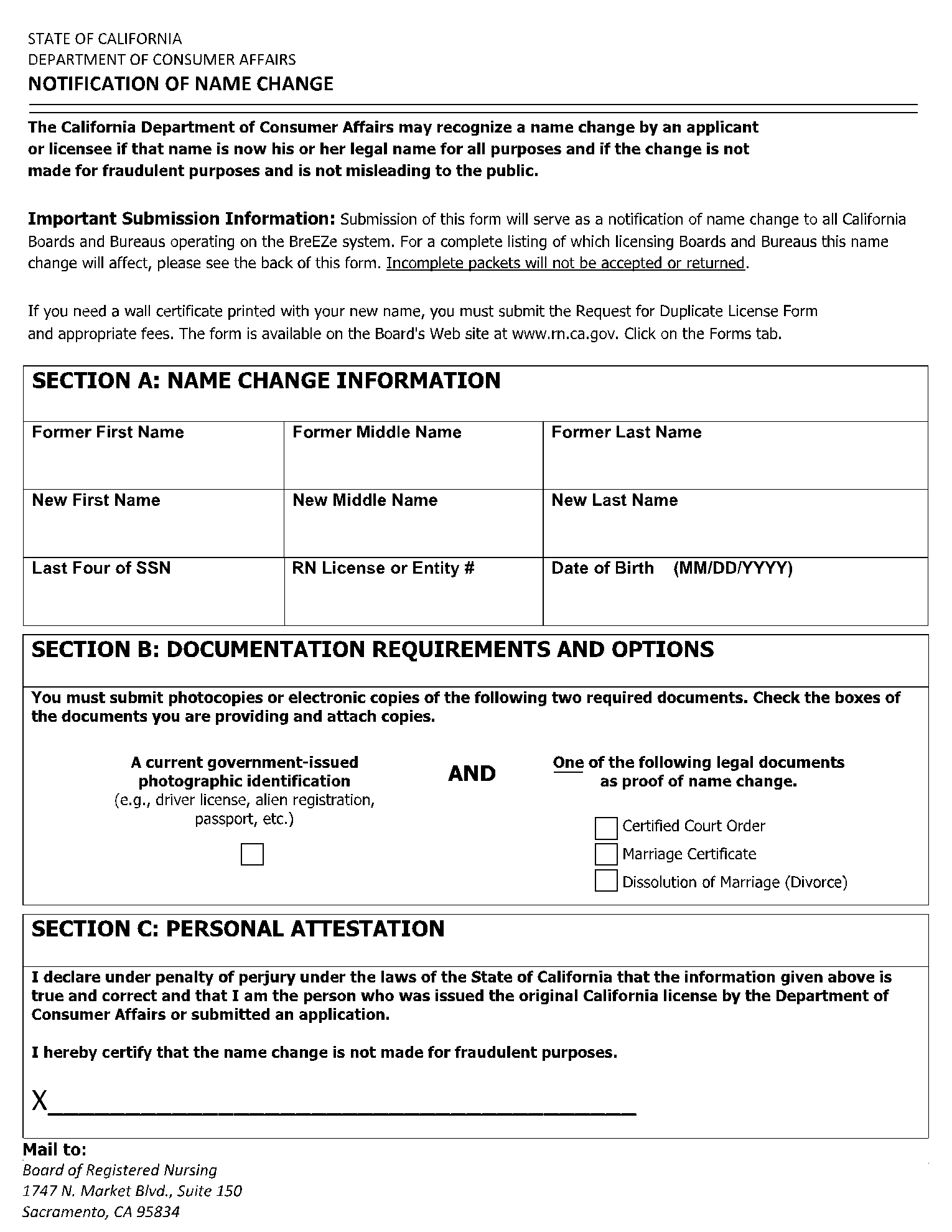
When you get married in California, you generally do not need to file a separate court petition to change your surname to your spouse’s, hyphenate your surnames, or move your current surname to a middle name. Your certified marriage certificate serves as sufficient legal documentation for this purpose. With the marriage certificate, you can directly update your Social Security Administration (SSA) records, driver’s license, and passport. If you wish to make a more complex change, such as creating an entirely new surname not directly tied to your spouse’s, or changing your first or middle name, you would typically need to follow the general court petition process.
Divorce-Related Name Changes
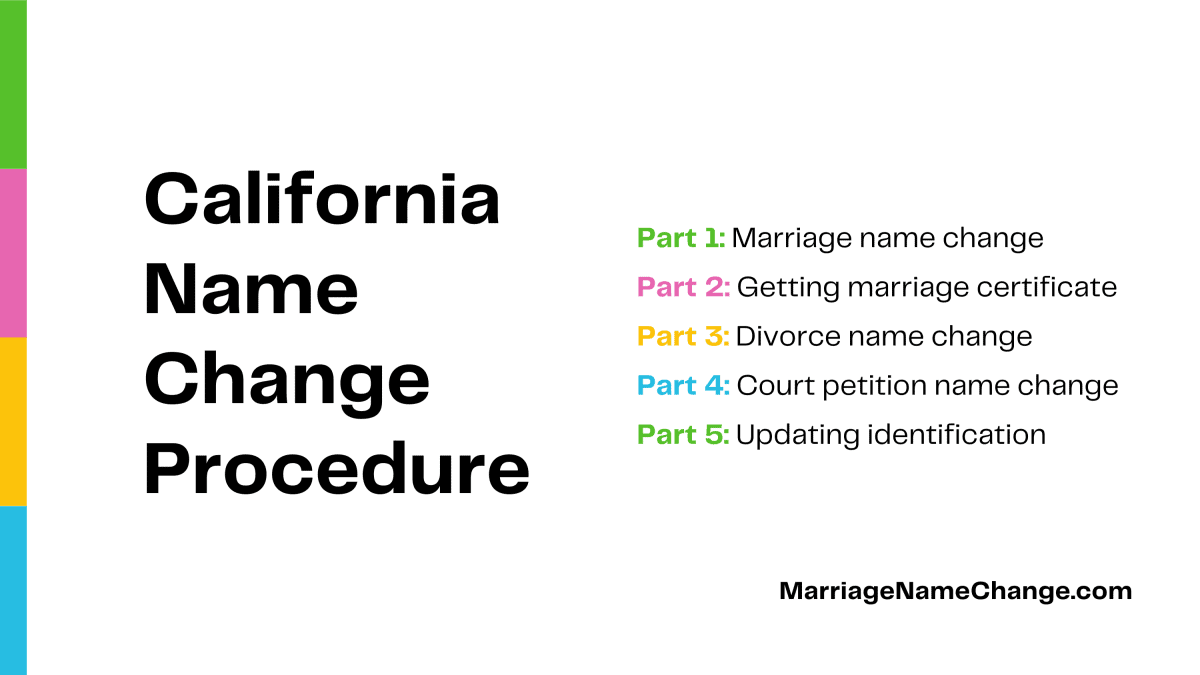
During divorce proceedings, it is common for individuals to wish to restore a previous name, often a maiden name. In California, this can usually be requested as part of the divorce petition (Form FL-100) or response (Form FL-120) and is included in the final “Judgment” (Form FL-180) or “Stipulated Judgment” (Form FL-190). The divorce decree itself then serves as the legal documentation for the name change, eliminating the need for a separate name change petition. If the divorce has already been finalized and the name change was not included, you would need to file a general name change petition.
Gender Affirmation Name Changes
California has specific, streamlined procedures for individuals seeking to change their name to align with their gender identity. This process is generally less cumbersome than the standard name change petition. Petitioners can use specific forms, such as the “Petition for Change of Gender and Name” (Form NC-300) and the “Order Changing Gender and Name” (Form NC-330).
A significant benefit of this pathway is that the court may waive the publication requirement, preserving privacy for the individual. The process still involves filing with the Superior Court and attending a hearing, but it is designed to be supportive and efficient for transgender and gender non-conforming individuals affirming their identities. California law also allows for gender marker changes on birth certificates and driver’s licenses to be processed alongside or independently of name changes.
Post-Court Steps: Updating Your Identity
Receiving your Decree Changing Name is a pivotal moment, but the process isn’t complete until all your official documents and records reflect your new legal name. This phase requires diligence and organization.
Social Security Administration
Your first priority should be updating your name with the Social Security Administration (SSA). This is crucial because many other agencies, particularly the Department of Motor Vehicles (DMV), verify your name against SSA records. You will need to complete an Application for a Social Security Card (Form SS-5) and present original or certified copies of your court order, proof of identity (like your current driver’s license), and proof of U.S. citizenship or immigration status. There is no fee for this service.
Department of Motor Vehicles (DMV)
Once your SSA records are updated, proceed to the California DMV to update your driver’s license or identification card. You will need to complete a Driver’s License or Identification Card Application (Form DL 44, available at the DMV office), provide your certified court order, and often your updated SSA card. A new photo and fee will be required.
Passport Agency
If you have a U.S. passport, updating it is essential for international travel. The specific form and requirements depend on how recently your current passport was issued. Generally, you will need to submit your certified court order, your current passport, passport photos, and a passport application form (DS-82 or DS-11). Fees apply.
Other Important Records
The list of other entities requiring notification is extensive. Maintain a checklist and work systematically:
- Banks and Financial Institutions: Contact all banks, credit card companies, investment firms, and loan providers.
- Employer and Payroll: Inform your employer’s HR department for payroll, benefits, and tax documents.
- Utilities and Leases: Update your name on utility bills, rental agreements, or property deeds.
- Medical and Insurance Providers: Notify your doctors, health insurance company, and other insurance providers (auto, home, life).
- Educational Institutions: If you have academic records, notify schools, colleges, or universities.
- Voter Registration: Update your voter registration to ensure you can continue exercising your right to vote.
- Professional Licenses: If you hold any professional licenses (e.g., medical, legal, real estate), contact the issuing board.
- Birth Certificate: Changing the name on your birth certificate typically involves a separate application process with the California Department of Public Health – Vital Records, and often requires specific court documentation.
Important Considerations and Tips
Navigating a name change in California can be a detailed process, and keeping a few key considerations in mind can help ensure a smoother experience.
Costs: Be prepared for various expenses. Filing fees, publication costs, and fees for new identification documents (driver’s license, passport) can add up. Research these costs beforehand and explore fee waiver options if necessary.
Timeline: The entire process, from filing the petition to updating all your records, can take several months. Court dockets, publication schedules, and processing times at various agencies contribute to this duration. Patience and persistence are key.
Accuracy: Double-check every form and document for accuracy before submission. Even minor errors can lead to significant delays. Ensure your new name is consistently spelled and formatted across all applications.
Legal Advice: While the process can often be managed independently, consulting with an attorney is advisable for complex situations, such as changing a minor’s name without full parental consent, or if you have a criminal record, or specific legal concerns that might impact your name change. Legal aid organizations can also be a valuable resource.
Consistency: The importance of updating all records cannot be overstated. Inconsistencies between your old and new names on different documents can cause significant complications with financial transactions, travel, employment, and legal matters down the line.
Proof: Always keep certified copies of your “Decree Changing Name” in a safe and accessible place. These documents are your definitive proof of your legal name change and will be requested by numerous entities. Consider scanning digital copies for backup, but always rely on the certified originals for official purposes.
Changing your name in California is a deliberate and empowering act. By understanding the judicial and administrative requirements, and approaching the process with meticulous attention to detail, you can successfully transition to your new legal identity, allowing your official records to reflect this important personal decision.
LifeOutOfTheBox is a participant in the Amazon Services LLC Associates Program, an affiliate advertising program designed to provide a means for sites to earn advertising fees by advertising and linking to Amazon.com. Amazon, the Amazon logo, AmazonSupply, and the AmazonSupply logo are trademarks of Amazon.com, Inc. or its affiliates. As an Amazon Associate we earn affiliate commissions from qualifying purchases.