
Even amidst the dynamic and diverse lifestyle offered by California, everyday disputes can unfortunately arise. Whether it’s an unpaid debt, a disagreement with a contractor, a landlord-tenant issue, or a dispute over property damage, knowing your legal options is a fundamental aspect of navigating life responsibly. For many individuals and small businesses, the California Small Claims Court offers an accessible and relatively straightforward avenue for resolving minor financial disagreements without the need for expensive attorneys. This guide is designed to provide a professional, insightful, and engaging overview of how to file a small claims suit in California, empowering you with the knowledge to protect your rights and seek justice efficiently.
Navigating California’s Small Claims System
The small claims court system in California is specifically designed to handle disputes involving relatively small amounts of money, providing a more informal and less intimidating environment than traditional courts. Understanding its purpose, limitations, and key participants is the first step toward a successful claim.
What is Small Claims Court?
California Small Claims Courts are divisions of the Superior Court, operating in every county. Their primary purpose is to offer ordinary citizens a simple, speedy, and inexpensive way to resolve monetary disputes. Cases are typically heard by a judge or a temporary judge (called a commissioner or pro tem judge), and neither party is allowed to have an attorney represent them during the hearing itself, though you can consult with an attorney beforehand. This lack of legal representation is a defining feature, intended to level the playing field between parties and keep costs down. It’s important to note that corporations, however, must be represented by an officer, director, or employee, not an attorney.
Key Eligibility Requirements
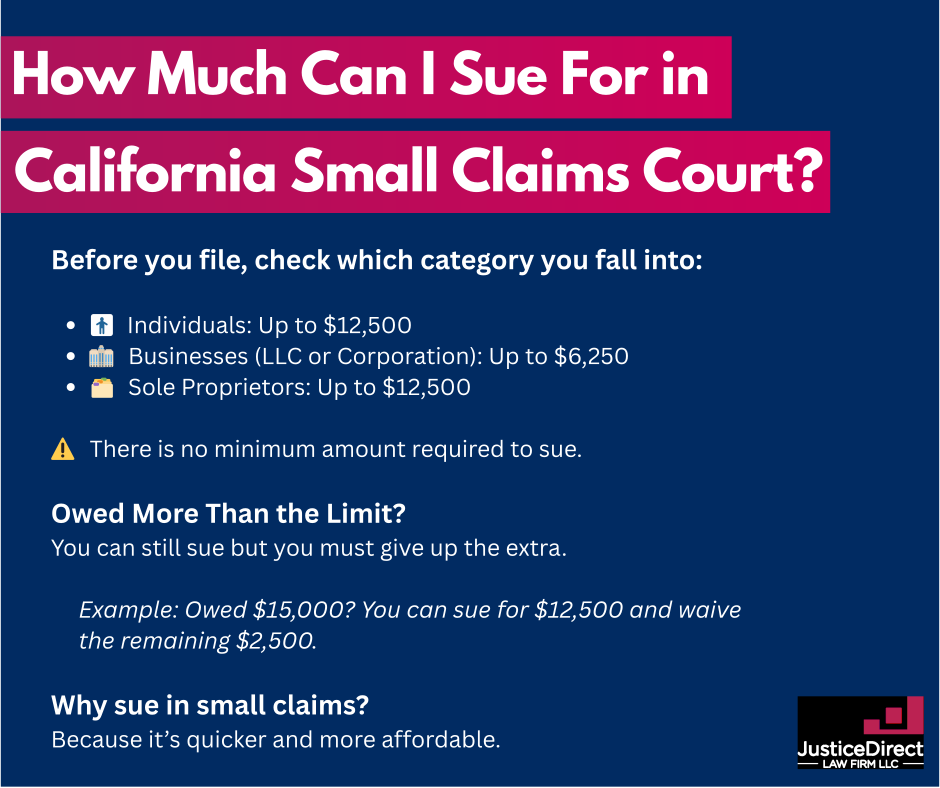
Before you embark on filing a small claims suit, it’s crucial to ascertain whether your case meets the specific eligibility criteria set forth by California law. The most critical factor is the maximum amount of money you can sue for:
- Individuals: An individual can sue for up to $12,500.
- Businesses and Other Entities: A business, corporation, or other legal entity (excluding individuals) can sue for up to $6,250.
- Two Filings Per Year: An individual or business generally cannot file more than two claims for an amount over $2,500 in any calendar year.
- The Defendant’s Location: The defendant must reside or operate within California or have a significant connection to the state, and the dispute must have originated there or have sufficient nexus to the state.
- Statute of Limitations: You must file your claim within a certain timeframe, known as the statute of limitations. This varies depending on the type of claim (e.g., typically 2 years for oral contracts, 4 years for written contracts, 3 years for property damage, 2 years for personal injury). Failing to file within this period will result in your case being dismissed.
Understanding Your Role: Plaintiff and Defendant
In a small claims action, the party initiating the suit is called the “Plaintiff,” and the party being sued is the “Defendant.” If the defendant believes the plaintiff owes them money, they can file a “Defendant’s Claim” (also known as a cross-complaint) against the plaintiff. This counter-claim is handled simultaneously with the original suit. Understanding these roles is key to correctly filling out forms and preparing your case.
The Initial Steps: Preparing Your Case
The success of your small claims suit largely depends on thorough preparation. This stage involves identifying the responsible party, meticulously gathering evidence, and accurately completing the necessary legal forms.
Identifying the Defendant and Claim Amount
Before you file, you must accurately identify the full legal name and address of the person or business you intend to sue. If you are suing a business, you might need to determine if it’s a sole proprietorship, partnership, or corporation, as this affects how you name them in the suit and how they must be served. If you’re unsure, you can often find this information through online business search tools or by calling the Secretary of State. You must also calculate the precise amount of money you are claiming, ensuring it does not exceed the small claims limit for your specific situation. This amount should be justifiable with evidence.
Gathering Evidence
Evidence is the backbone of your case. The more comprehensive and organized your evidence, the stronger your position will be. Start by collecting all relevant documents, such as:
- Contracts: Written agreements, leases, invoices, receipts.
- Correspondence: Emails, letters, text messages, voicemails (transcribed).
- Photos and Videos: Of damages, disputed work, or relevant conditions.
- Witness Statements: Written statements or contact information for anyone who can testify on your behalf.
- Bank Statements/Cancelled Checks: Proof of payments or non-payments.
- Estimates/Bills: For repairs or services related to your claim.
Organize these items chronologically and make multiple copies. You will need a copy for yourself, a copy for the court, and a copy for each defendant.
Completing the Required Forms
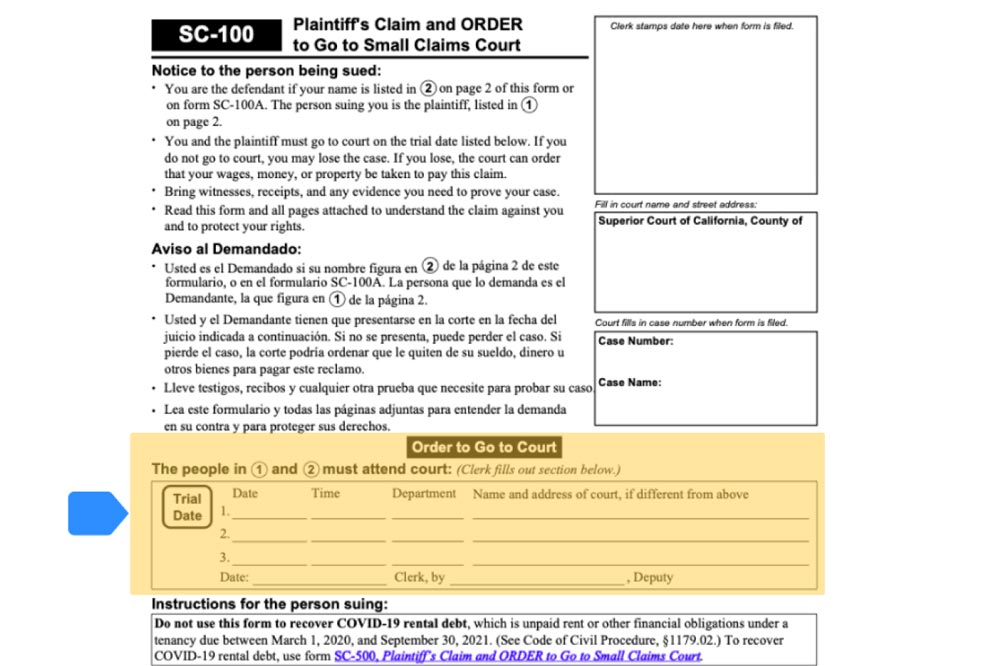
The primary form for filing a small claims suit in California is the Plaintiff’s Claim and Order to Go to Small Claims Court (Form SC-100). This form is available on the Judicial Council of California website or at your local Superior Court clerk’s office. On this form, you will provide:
- Your name and address.
- The defendant’s name and address.
- The amount you are claiming.
- A brief, clear explanation of why the defendant owes you money (your “statement of claim”). Be specific with dates, events, and amounts.
Depending on your situation, you may also need to complete other forms, such as a Request to Waive Court Fees (Form FW-001) if you cannot afford the filing fees.
Filing Your Claim and Paying Fees
Once Form SC-100 is completed, you must file it with the small claims clerk at the Superior Court in the proper venue. Venue refers to the correct court location for your case. Generally, you should file in the county where:
- The defendant lives or does business.
- The contract was entered into or was to be performed.
- The injury or damage occurred.
The clerk will stamp your forms and give you a court date. You will also need to pay a filing fee, which varies based on the amount of your claim and how many claims you’ve filed in the past 12 months. If you qualify, you can apply for a fee waiver.
Serving the Defendant: Ensuring Due Process
After filing your claim, the next critical step is legally notifying the defendant that they are being sued. This process is called “service of process,” and it must be done correctly to ensure the court has jurisdiction over the defendant and that the defendant’s due process rights are protected.
Methods of Service
California law requires that the defendant receive proper notice of the lawsuit. You, as the plaintiff, cannot serve the papers yourself. Service must be performed by someone who is at least 18 years old and not a party to the case. Common methods include:
- Personal Service: Handing the papers directly to the defendant. This is the most reliable method and ensures the defendant has actual notice.
- Substituted Service: If personal service is difficult, the server can leave the papers with a competent adult (at least 18) at the defendant’s home or business, then mail a copy to the defendant. This can only be done after several unsuccessful attempts at personal service.
- Certified Mail (by the Court Clerk): In many California counties, the court clerk can serve the defendant by certified mail for an additional fee. This is often the easiest and most cost-effective method for plaintiffs.
- Registered Process Server or Sheriff: You can hire a professional process server or ask the County Sheriff’s Department to serve the papers for a fee. These professionals are experienced in ensuring proper service and completing the necessary proof of service.

The defendant must be served a certain number of days before the court date (typically 15 days if they are in the same county as the court, or 20 days if they are in another county).
Proof of Service
Regardless of the method used, the person who served the papers must complete a Proof of Service (Form SC-104) and return it to you. You then file this form with the court clerk. This document tells the court when and how the defendant was served, proving that they received legal notice. Without a properly filed Proof of Service, your case cannot proceed, and the court may dismiss it.
What Happens if Service Fails?
If you are unable to successfully serve the defendant, your case cannot move forward. The court may reschedule your hearing date, giving you more time to attempt service, or it may dismiss your case. It is your responsibility as the plaintiff to ensure the defendant is properly served. If the defendant is actively evading service, you might need to seek alternative methods, possibly with the court’s permission, such as “service by publication,” although this is rare in small claims and generally more complex.
Preparing for Your Day in Court
Once the defendant has been served and your court date is approaching, it’s time to fine-tune your presentation. The small claims hearing is your opportunity to present your side of the story clearly and concisely.
Organizing Your Evidence
On the day of the hearing, present your evidence in an organized and easy-to-follow manner. Create a binder or folder with tabs for each piece of evidence. Arrange documents chronologically. Have at least three copies of all evidence: one for yourself, one for the judge, and one for the defendant. Prepare a brief outline of your key points, including dates, events, and the specific amount you are seeking. This will help you stay focused and ensure you don’t miss any critical details.
Witness Preparation
If you have witnesses, they must appear in court to testify. Written statements are generally considered “hearsay” and may not be given as much weight as live testimony, unless accompanied by other direct evidence. If a witness is reluctant to appear, you can ask the court clerk for a Small Claims Subpoena (Form SC-107) to compel their attendance. Before the hearing, review their testimony with them to ensure they understand the facts and can present them clearly and truthfully.
Mediation Opportunities
Many California Small Claims Courts offer free or low-cost mediation services, often on the day of the hearing itself. Mediation is a process where a neutral third party (the mediator) helps both sides try to reach a mutually agreeable settlement. While it’s voluntary, it can be an excellent way to resolve your dispute without going before a judge, potentially saving time and reducing stress. Even if you don’t settle, mediation can sometimes help clarify issues for the judge. Some courts may even have mandatory mediation programs.
Courtroom Etiquette and Presentation Tips
On your court date, arrive early, dress respectfully, and be prepared to present your case. When it’s your turn:
- Address the Judge Properly: Use “Your Honor.”
- Be Clear and Concise: Stick to the facts. Avoid emotional outbursts or personal attacks.
- Listen Actively: Pay attention when the judge or the defendant speaks.
- Present Your Evidence: Refer to your organized documents and explain their relevance.
- Be Respectful: Even if you disagree with the defendant, maintain a polite and professional demeanor.
- Be Prepared for Questions: The judge will likely ask questions to clarify points. Answer truthfully and directly.
Remember, the judge’s role is to hear both sides and make a fair decision based on the evidence presented and the law.
Post-Judgment Procedures: What Comes Next?
Winning your small claims suit is a significant step, but it doesn’t always mean the money automatically appears. Understanding the post-judgment process, including collection and appeals, is crucial for realizing the outcome of your efforts.
Understanding the Judgment
After the hearing, the judge will issue a “judgment.” This might happen immediately in court or be mailed to you later. The judgment will state who won, the amount of money awarded, and any specific orders. If you win, you become the “judgment creditor,” and the defendant becomes the “judgment debtor.” The judgment is typically valid for 10 years and can be renewed.
The defendant is expected to pay the judgment promptly. If they offer a payment plan that is acceptable to you, you can agree to it. If the judgment debtor does not pay voluntarily, you will need to take steps to collect the money.
Collecting Your Judgment
Collecting a judgment can sometimes be more challenging than winning the case itself. The court does not collect the money for you; it is your responsibility. However, California law provides several tools for judgment creditors:
- Abstract of Judgment: You can obtain an “Abstract of Judgment” from the court clerk and record it with the County Recorder’s Office. This creates a lien on any real property (land or buildings) the debtor owns in that county, making it difficult for them to sell or refinance without paying you.
- Wage Garnishment: If the debtor is employed, you can obtain a “Writ of Execution” and have the sheriff serve it on their employer. This allows a portion of their wages to be withheld and paid to you.
- Bank Levy: Similarly, you can obtain a Writ of Execution and have the sheriff serve it on a bank where the debtor has an account, seizing funds up to the amount of the judgment.
- Debtor’s Examination: If you don’t know where the debtor works or banks, you can ask the court for an “Order for Appearance and Examination.” This compels the debtor to appear in court and answer questions under oath about their assets and income.
These collection methods require additional forms, fees, and adherence to specific legal procedures outlined in the California Code of Civil Procedure. It’s essential to follow these steps carefully or seek guidance from a legal aid clinic or small claims advisor.
The Appeals Process
In California small claims cases, only the defendant has the right to appeal a judgment. A plaintiff cannot appeal if they lose their case or are awarded less than they claimed. If the defendant appeals, the case is heard by a different judge in the Superior Court, and it proceeds as a completely new trial (a “trial de novo”). Both parties can present their evidence again, and this time, attorneys are permitted to represent either side during the appeal hearing.
Navigating the California Small Claims Court system can seem daunting at first, but with careful preparation and a clear understanding of the process, it becomes a powerful tool for resolving disputes. By following these steps, you can effectively present your case and work towards a fair resolution, asserting your rights within the bounds of the law, and ensuring a smoother lifestyle experience.
LifeOutOfTheBox is a participant in the Amazon Services LLC Associates Program, an affiliate advertising program designed to provide a means for sites to earn advertising fees by advertising and linking to Amazon.com. Amazon, the Amazon logo, AmazonSupply, and the AmazonSupply logo are trademarks of Amazon.com, Inc. or its affiliates. As an Amazon Associate we earn affiliate commissions from qualifying purchases.