
California, a state renowned for its sun-drenched beaches, vibrant cities like Los Angeles and San Francisco, and an unparalleled lifestyle, also presents a complex legal landscape when it comes to family matters, particularly divorce and spousal support. Often referred to as alimony, spousal support in California is designed to ensure that neither party is left in a state of financial destitution after a marriage ends, helping both individuals transition into independent lives. Understanding the intricacies of how alimony works in the Golden State is crucial for anyone navigating the path of divorce, whether they are expecting to pay or receive support. For those who have built a life focused on travel, exploration, and unique accommodations, the financial implications of alimony can significantly shape future lifestyle choices and opportunities.
Understanding Spousal Support in the Golden State
The concept of spousal support, or alimony, is fundamentally about fairness and equity in the aftermath of a marriage’s dissolution. It acknowledges that during a marriage, one spouse may have sacrificed career opportunities, education, or financial independence to support the other, raise children, or maintain the household. California law aims to mitigate the financial disparities that often arise when two households are formed from one, particularly when there’s a significant difference in earning capacity or financial resources.
The Core Concept of Alimony
At its heart, alimony in California is a court-ordered payment from one spouse to the other after a divorce. It is not intended to punish either party but rather to provide financial assistance to the lower-earning spouse, enabling them to maintain a standard of living reasonably comparable to what they enjoyed during the marriage, for a period determined by the court. This support can be a lifeline, offering stability during a turbulent time and allowing individuals to rebuild their lives, perhaps even pursuing new travel adventures or settling into different types of accommodations. The determination of alimony is highly fact-specific, taking into account a myriad of circumstances unique to each couple.
Differentiating Alimony from Child Support
It’s essential to distinguish spousal support from child support, as they serve different purposes and are calculated using distinct guidelines. Child support is exclusively for the financial well-being of the children involved in the divorce, covering their basic needs, education, healthcare, and extracurricular activities. It is a non-negotiable obligation aimed at ensuring children do not suffer financially due to their parents’ divorce. Spousal support, on the other hand, is specifically for the benefit of one of the ex-spouses. While both can be ordered in a divorce case, the legal framework, calculation methods, and factors considered are separate. A common misconception is that receiving child support precludes spousal support, or vice versa, which is not the case in California. Both can, and often do, exist concurrently, impacting the financial planning for any future travel or lifestyle changes.
Types of Alimony Awards in California
California courts have the flexibility to award different types of spousal support, each serving a specific purpose and duration. The type of support ordered largely depends on the stage of the divorce proceedings, the length of the marriage, and the individual circumstances of the parties.
Temporary Spousal Support: Bridging the Gap
Temporary spousal support is awarded during the pendency of the divorce proceedings, from the moment one spouse files for divorce until the final judgment is entered. Its primary goal is to maintain the financial status quo and ensure that both parties can meet their living expenses while the divorce is being finalized. This support helps prevent one spouse from becoming financially disadvantaged during what can often be a lengthy legal process. Unlike permanent support, temporary support is often calculated using a formula, typically based on the income of both parties and potentially factoring in child support obligations. For individuals accustomed to a certain lifestyle, perhaps frequent stays in luxury hotels or regular international travel, temporary support can be crucial for maintaining some semblance of that life until a long-term plan is established.
Permanent Spousal Support: Long-Term Considerations
Despite its name, “permanent” spousal support in California is rarely indefinite. Instead, it refers to the support ordered as part of the final divorce judgment. For marriages of less than 10 years (a “short-term” marriage), the general guideline is that spousal support should last for half the length of the marriage. For “long-term” marriages (10 years or more), the court typically reserves jurisdiction over spousal support indefinitely, meaning there is no predetermined end date. However, even in long-term marriages, the court expects the supported spouse to make reasonable efforts to become self-supporting over time. The goal is not perpetual dependence but rather a period of support allowing the recipient to gain financial independence, potentially through re-education, career changes, or other means. This type of support significantly impacts an individual’s financial outlook, influencing decisions about future accommodation, the pursuit of tourism activities, or even whether they can afford a long-term stay in a desired destination.
Rehabilitative Alimony: Fostering Self-Sufficiency
Rehabilitative alimony is a form of spousal support specifically designed to provide the supported spouse with the financial resources needed to acquire education, training, or experience to become self-sufficient. This type of support is often awarded for a set period, calculated to allow the recipient to complete their rehabilitation goals. For instance, if one spouse put their career on hold to raise children or support the other’s professional ambitions, rehabilitative alimony might cover tuition, living expenses, and childcare costs while they pursue a degree or vocational training. This empowers the individual to rebuild their life, explore new career paths, and ultimately achieve financial independence, opening doors to new lifestyle choices and the ability to travel independently.
Reimbursement Alimony: Recognizing Contributions
California law also provides for reimbursement alimony, though it’s less common than other forms. This type of support is specifically awarded when one spouse contributed to the education or training of the other spouse, resulting in a significantly enhanced earning capacity for the educated spouse. For example, if one spouse worked to put the other through medical school or law school, the contributing spouse might be reimbursed for their financial contributions, including tuition, fees, and living expenses, plus interest. This ensures that the efforts and sacrifices made during the marriage are recognized and compensated, fostering a sense of fairness. This form of alimony directly addresses past financial sacrifices, potentially freeing up resources for the recipient to embark on a well-deserved journey or invest in a new lifestyle experience.
Key Factors Influencing Alimony Decisions
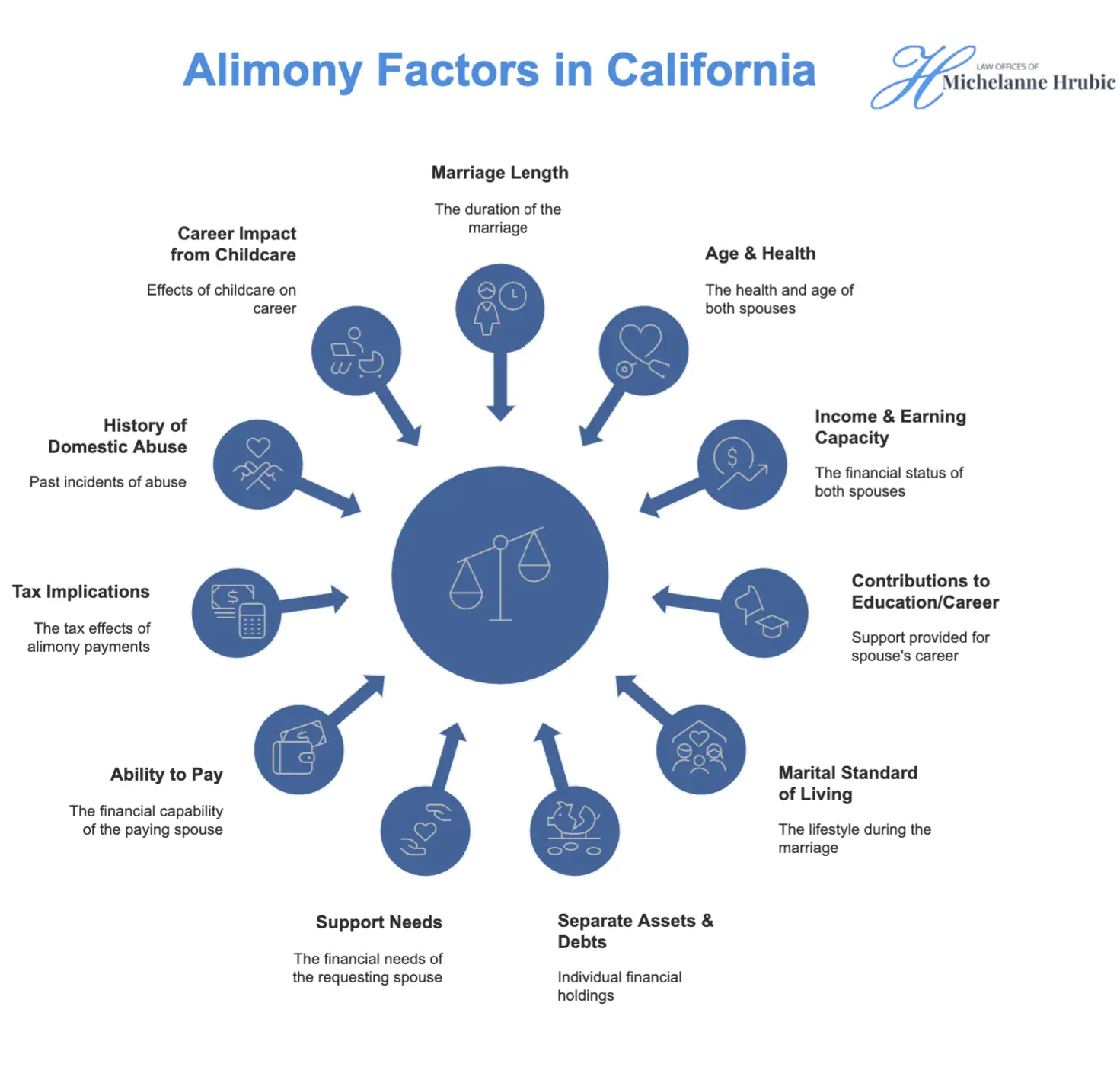
When determining the amount and duration of spousal support, California family courts do not rely on a strict formula (for permanent support). Instead, they consider a comprehensive list of factors outlined in California Family Code Section 4320. This allows judges significant discretion to tailor awards to the unique circumstances of each case.
The Guiding Principles of Family Code Section 4320
Family Code Section 4320 provides a robust framework for judges to evaluate spousal support cases. It mandates consideration of a wide array of factors to ensure a just and equitable outcome. These factors guide the court in assessing each party’s needs, ability to pay, and contributions to the marriage. Navigating these factors often requires skilled legal counsel, especially when complex assets, international properties, or diverse income streams (relevant for luxury travel and global accommodation choices) are involved.
Duration of Marriage: A Critical Determinant
The length of the marriage is one of the most significant factors. As mentioned, marriages under 10 years typically lead to support for half the marriage’s length, while marriages of 10 years or more often result in indefinite court jurisdiction over support. The longer the marriage, the greater the likelihood of a longer duration of spousal support, reflecting the deeper intertwining of lives and financial affairs. This aspect is crucial for long-term lifestyle planning, including retirement considerations and the ability to travel extensively in the future.
Standard of Living: Maintaining Equitability
The marital standard of living is a pivotal factor. Courts strive to ensure that the supported spouse can maintain a lifestyle reasonably comparable to what they enjoyed during the marriage, to the extent possible. This doesn’t mean an exact replication, especially if the couple lived lavishly beyond their means, but it aims to prevent a drastic decline in the supported spouse’s quality of life. This could mean the difference between affording boutique hotels versus budget accommodations, or traveling internationally versus domestically.

Earning Capacity and Marketable Skills
The court assesses each spouse’s present and future earning capacity, considering their education, skills, employment history, and the job market. If one spouse has a significantly higher earning capacity, they are more likely to be ordered to pay support. Conversely, the court also examines the supported spouse’s ability to become self-supporting, encouraging efforts towards gainful employment. This assessment helps determine if the supported spouse needs funds for retraining or education (rehabilitative support), impacting their ability to fund future travel and experiences.
Contributions to a Spouse’s Career or Education
As seen with reimbursement alimony, the court explicitly considers how one spouse contributed to the other’s education, training, career, or professional license. This recognizes the value of non-monetary contributions that often underpin a successful career, ensuring that sacrifices made are acknowledged financially. This factor can directly influence the financial security required for new lifestyle choices, perhaps even investing in a vacation property or a long-term rental in a dream destination.
Domestic Violence and its Impact
California law strongly considers any documented history of domestic violence by either party against the other. A perpetrator of domestic violence may face limitations on receiving spousal support, and a victim may be awarded greater support. This factor underscores the state’s commitment to protecting victims and holding perpetrators accountable. The trauma of domestic violence can severely impact an individual’s ability to work, travel, or engage in social activities, making robust spousal support critical for recovery and rebuilding.
Age, Health, and Debts: Comprehensive Assessment
The age and health of each spouse are also weighed, as these can affect earning capacity and future needs. An older spouse or one with significant health issues might require longer or higher support. Furthermore, the court considers the assets and debts of each party, including separate and community property. The balance of these financial elements impacts the ability to pay or the need to receive support, influencing all future financial decisions, including what kind of accommodation one can afford or whether specific travel destinations are financially viable.
Tax Implications: A Shifting Landscape
Historically, spousal support payments were tax-deductible for the payer and taxable income for the recipient. However, the Tax Cuts and Jobs Act of 2017 eliminated this deduction for divorce or separation agreements executed after December 31, 2018. This change has significant implications, as spousal support is no longer deductible for the payer and is not considered taxable income for the recipient under federal law. This shift directly impacts the net financial benefit for both parties, influencing settlement negotiations and ultimately affecting the disposable income available for lifestyle expenses, including hotels, tourism, and travel.
Modifying and Terminating Alimony Orders
Spousal support orders in California are not always set in stone. Life circumstances can change dramatically, necessitating adjustments to existing support arrangements.
When Circumstances Change: Seeking Modification
Either party can petition the court to modify a spousal support order if there has been a significant change in circumstances. This could include a substantial increase or decrease in either party’s income, job loss, disability, or a major change in living expenses. For instance, if the paying spouse loses a high-paying job, they might seek a reduction. Conversely, if the receiving spouse becomes incapacitated and unable to work, they might seek an increase. Courts generally require proof that the change is material and not just a temporary fluctuation. These modifications are critical for maintaining financial stability, especially for those whose lifestyle involves frequent travel or unique accommodation needs.
Automatic Termination Events: Remarriage and Death
Certain events automatically terminate spousal support orders. If the supported spouse remarries, spousal support typically ends, as the new marriage is presumed to provide financial support. Additionally, spousal support terminates upon the death of either the paying or receiving spouse. These clear-cut rules provide predictability, but it’s important to remember that cohabitation (living with a new partner without marriage) can also be a basis for modification or termination, as it implies a reduced need for support.
Reservations of Jurisdiction: The Court’s Ongoing Role
In long-term marriages, courts often “reserve jurisdiction” over spousal support. This means that even if no support is currently being paid (e.g., because both parties are self-sufficient), either party can return to court in the future to request or modify support if circumstances change. This reservation ensures a safety net for individuals who may face unforeseen financial hardship years after the divorce, providing peace of mind and the potential for stability in later life, which could be vital for maintaining a desired travel-centric lifestyle.
Alimony’s Impact on Lifestyle and Future Planning
Beyond the legal definitions and court processes, alimony profoundly impacts an individual’s lifestyle, financial independence, and future planning. For many, divorce marks a pivot point, and how alimony is structured can dictate the path forward.
Navigating Financial Independence
For the recipient, alimony can be a stepping stone towards financial independence, providing the necessary time and resources to develop new skills, pursue career goals, or simply adjust to a single-income household. It offers a crucial buffer, allowing individuals to avoid immediate financial distress and strategically plan their next chapter. This newfound stability can enable a focus on personal growth, including exploring hobbies, engaging in local tourism, or carefully planning future travel experiences that align with their evolving lifestyle.
The Freedom to Explore: Travel and Accommodation Post-Divorce
For many, the dream of travel, exploring new destinations, or experiencing different cultures is a significant part of their desired lifestyle. Spousal support, or the responsibility of paying it, directly impacts the financial freedom to pursue these aspirations. For the supported spouse, a stable income stream might open doors to budget travel opportunities, short-term rentals in scenic locations, or even long-term stays in foreign countries previously out of reach. Conversely, the paying spouse must factor these obligations into their financial planning, potentially adjusting their own travel habits, hotel choices, or accommodation preferences. Whether it’s a solo trip to San Diego’s vibrant neighborhoods, a family vacation to a California landmark, or a business stay in Sacramento, financial clarity post-divorce is paramount. Understanding your alimony situation allows for better budgeting, enabling you to continue enjoying life’s experiences, perhaps just in a different way. It might influence decisions on whether to book a luxury resort or a charming apartment, shaping the overall tourism experience.

Long-Term Planning: Securing Your Future in California
Ultimately, navigating alimony in California is about more than just monthly payments; it’s about securing a viable future. It influences decisions about housing (whether to stay in the family home, rent, or buy a new place), career trajectories, and retirement planning. Both parties must engage in careful financial planning, often with the help of financial advisors, to ensure their long-term stability. This might involve understanding how alimony impacts retirement savings, investment strategies, or even the ability to take extended periods off for travel or personal development. For those dreaming of a life filled with exploration and discovery, sound financial management post-divorce, heavily influenced by alimony arrangements, is the key to unlocking those experiences and truly embracing the diverse lifestyle opportunities that California and the wider world have to offer.
LifeOutOfTheBox is a participant in the Amazon Services LLC Associates Program, an affiliate advertising program designed to provide a means for sites to earn advertising fees by advertising and linking to Amazon.com. Amazon, the Amazon logo, AmazonSupply, and the AmazonSupply logo are trademarks of Amazon.com, Inc. or its affiliates. As an Amazon Associate we earn affiliate commissions from qualifying purchases.