
The proximity of Alaska to Russia has long captured the imagination of explorers, historians, and travelers alike. While separated by a vast expanse of water, these two landmasses are closer than many realize, a geographic curiosity that has shaped centuries of human interaction and continues to fuel interest in this unique corner of the world. Understanding this distance is key to appreciating the historical significance and potential for future exploration of the Bering Strait region.
The Bering Strait: A Narrow Divide
The Bering Strait is the body of water that separates Asia from North America, and more specifically, the easternmost point of Russia from the westernmost point of Alaska, United States. This strait is not a vast, impenetrable ocean, but rather a relatively narrow channel, particularly when compared to the sheer scale of the Pacific Ocean.

Minimum Distance
At its narrowest point, the Bering Strait measures approximately 82 kilometers (51 miles) between Cape Dezhnev on the Chukotka Peninsula of Russia and Cape Prince of Wales in Alaska. This distance, while substantial, is achievable for ambitious adventurers and has been crossed by various means throughout history and in modern times. The Diomede Islands, a pair of small islands located within the strait, further break down this distance.
- Big Diomede Island: This island is Russian territory and lies just over 3.8 kilometers (2.4 miles) from Little Diomede Island.
- Little Diomede Island: This island is part of Alaska and is the closest U.S. territory to Russia.
The International Date Line also runs between the two Diomede Islands, meaning that Little Diomede Island is almost a full day ahead of Big Diomede Island, despite their proximity. This creates a unique temporal anomaly, where one can literally step into tomorrow by crossing the few miles between them.
Average Distance and Width
While the narrowest point is a remarkable statistic, the average width of the Bering Strait is closer to 150 kilometers (93 miles). This broader expanse presents a more significant challenge for direct transit, requiring careful planning and appropriate vessels. The strait’s overall length, from the Arctic Ocean to the south to the Pacific Ocean to the north, is approximately 85 kilometers (53 miles).
Historical Significance and Exploration
The proximity of Alaska and Russia is not merely a geographical fact; it is a narrative woven into the fabric of human history and exploration. For millennia, indigenous peoples traversed these waters, establishing connections and trade routes long before European arrival.
Bering Land Bridge Theory
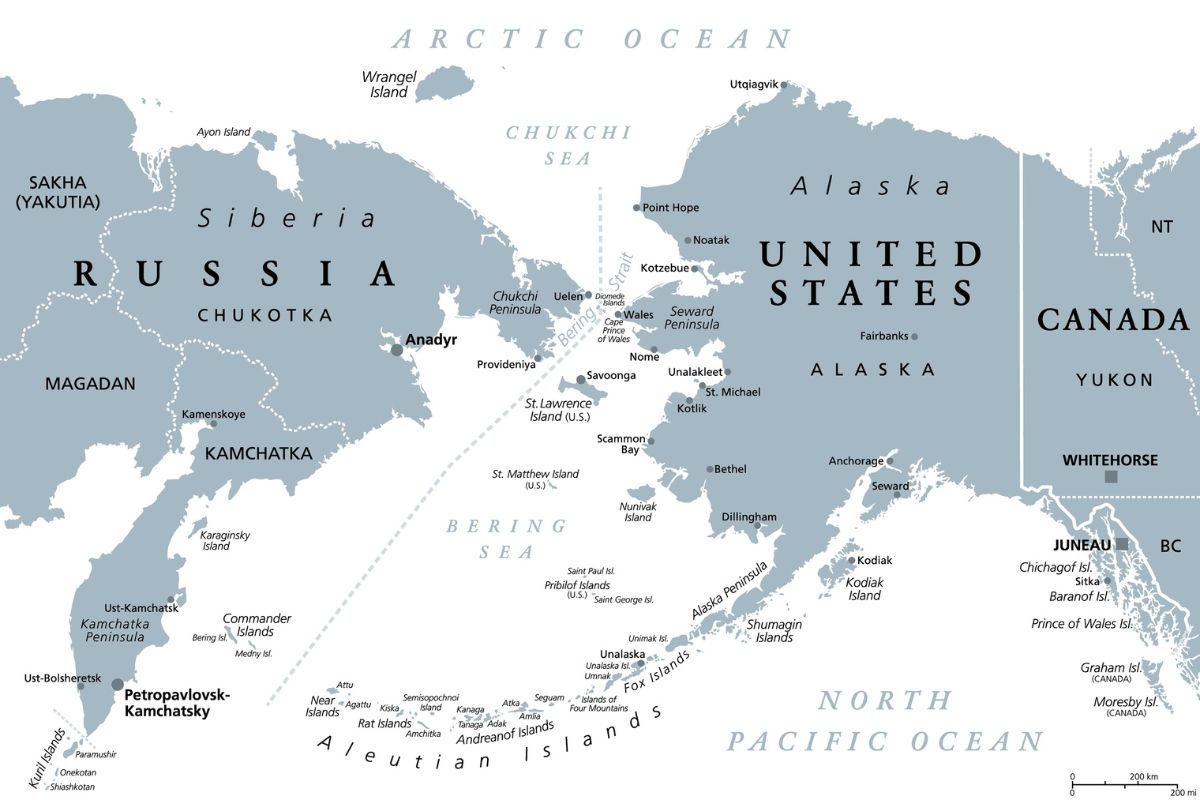
The Bering Strait is famously associated with the Bering Land Bridge, a now-submerged landmass that once connected Siberia and Alaska. During periods of glaciation, sea levels dropped significantly, exposing this land bridge, which is believed to have been a primary route for the migration of humans and animals from Asia into the Americas. This historical connection underscores the deep, ancient ties between the two continents.
European Exploration
European powers, driven by the pursuit of new trade routes and territorial claims, also recognized the strategic importance of this region. Vitus Bering, a Danish explorer in the service of the Russian navy, is credited with formally charting the strait in the early 18th century, lending his name to this crucial waterway. His expeditions, undertaken from Petropavlovsk-Kamchatsky, aimed to determine if Asia and North America were connected, a question that had intrigued scholars for centuries.
The Alaska Purchase
The sale of Alaska from Russia to the United States in 1867 for $7.2 million marked a pivotal moment in the geopolitical landscape of the region. This transaction, often referred to as “Seward’s Folly”, underscored Russia‘s strategic decision to divest itself of distant territories and America‘s growing interest in its Pacific frontier. The border established between the two nations across the Bering Strait remains a significant international maritime boundary.
Modern Travel and Adventure
Today, the question “How far from Alaska to Russia?” is often posed by those seeking unique travel experiences and adventures that push the boundaries of conventional tourism. While direct, easy access is limited, the journey is achievable for the intrepid traveler.
Crossing the Strait
Crossing the Bering Strait is not a typical tourist activity. It requires significant planning, permits, and specialized logistics.
- By Sea: The most common method for experiencing the strait is via expedition cruises. These voyages, often departing from Nome, Alaska, or other Alaskan ports, navigate the waters of the Bering Sea and the Bering Strait, offering opportunities to view the Diomede Islands and observe the stark beauty of the remote coastlines. Some longer itineraries may include stops in Chukotka, Russia, though these are subject to stringent visa and permit requirements.
- By Air: While direct flights between Alaska and Russia across the strait are not readily available for general tourism, chartered flights or special expeditions might offer aerial perspectives. The nearest major airports on the Russian side are in cities like Anadyr, while on the Alaskan side, communities like Nome or Kotzebue serve as hubs.
- By Ice (Seasonal and Extreme): In exceptionally cold winters, when the strait freezes over, the possibility of crossing by ice has been a feat of extreme endurance. However, this is highly dangerous, unpredictable, and not recommended or officially sanctioned. It is a testament to the historical crossings by indigenous peoples and the few daring individuals who have attempted it for record-breaking purposes.

Tourism Considerations
For travelers interested in this region, it’s crucial to understand that tourism here is far from mass-market. It is an adventure into some of the planet’s most remote and ecologically significant areas.
- Visa Requirements: For most nationalities, visiting Russia requires obtaining a visa. This process can be complex and lengthy, especially for travel to remote regions.
- Logistics and Permits: Access to the Russian side of the Bering Strait, particularly the Chukotka region, is often restricted and requires special permits due to its border status and limited infrastructure.
- Best Time to Visit: The summer months, from July to September, offer the most favorable weather conditions for sea travel and exploration, with less sea ice and more moderate temperatures. However, even in summer, conditions can be harsh and unpredictable.
- Cultural Immersion: The few communities on both the Alaskan and Russian sides of the strait are home to indigenous peoples, such as the Yupik, Siberian Yupik, and Chukchi. Experiencing the local cultures, traditions, and ways of life is a significant draw for visitors, offering insights into ancient human adaptations to extreme environments.
The journey to understand “How far from Alaska to Russia?” is as much about appreciating the vastness of our planet and the ingenuity of humanity as it is about measuring a specific distance. It is a region where geography, history, and culture converge in a powerful and unforgettable way.
LifeOutOfTheBox is a participant in the Amazon Services LLC Associates Program, an affiliate advertising program designed to provide a means for sites to earn advertising fees by advertising and linking to Amazon.com. Amazon, the Amazon logo, AmazonSupply, and the AmazonSupply logo are trademarks of Amazon.com, Inc. or its affiliates. As an Amazon Associate we earn affiliate commissions from qualifying purchases.