
The allure of [Hawaii]—its pristine beaches, vibrant culture, and dramatic volcanic landscapes—beckons millions of travelers each year. Yet, for many prospective visitors, a fundamental question often arises: “How far is [Hawaii] from the [United States]?” While technically a state within the [United States], its distinct geographic isolation in the middle of the [Pacific Ocean] poses unique considerations for travel. Understanding this distance is not merely about a number on a map; it’s about appreciating the journey, planning effectively, and preparing for an experience that feels wonderfully distinct from the mainland. This article delves into the geographic realities, flight dynamics, and practical implications of traveling to this island paradise, offering insights that transform a distant dream into a well-planned adventure.
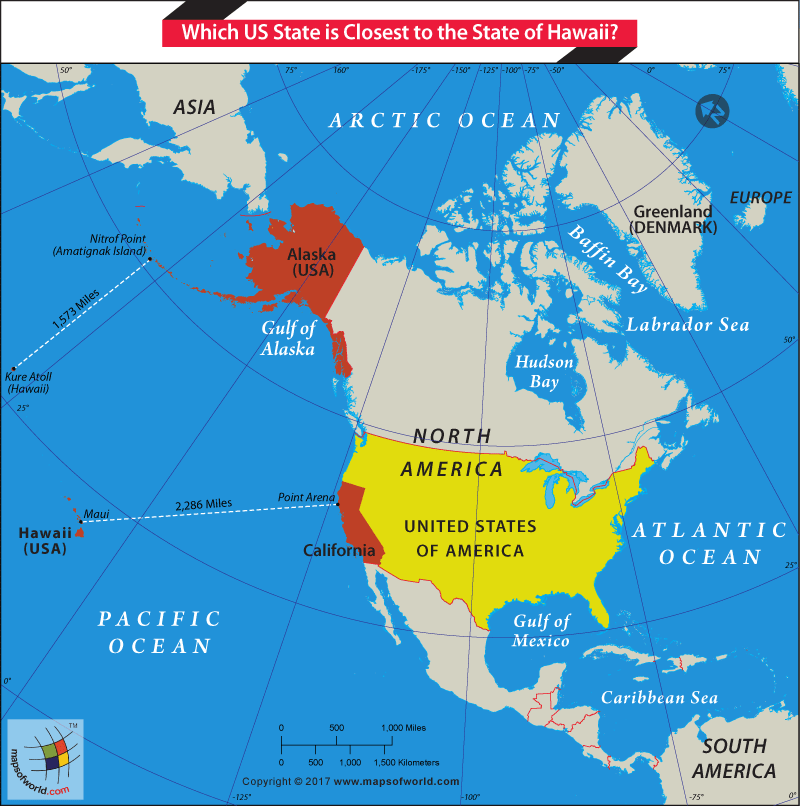
The Geographic Reality: Understanding Hawaii’s Isolation
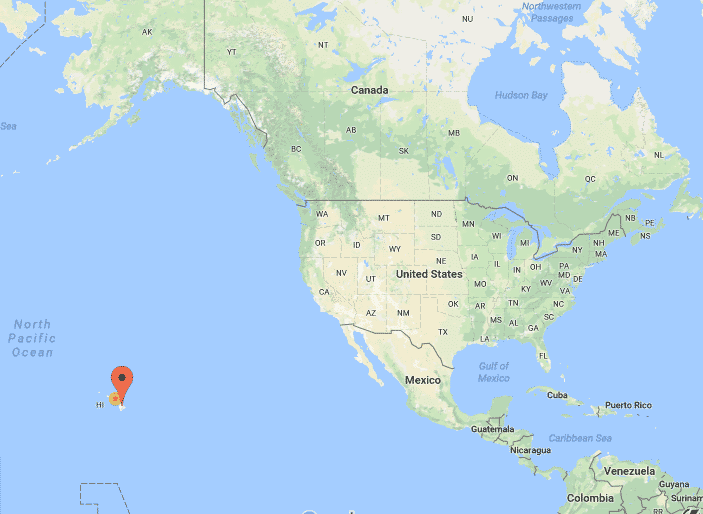
[Hawaii]’s location is perhaps its most defining characteristic outside of its tropical beauty. As the most isolated population center on Earth, it sits thousands of miles from any major landmass, making every journey there a significant traverse across the [Pacific Ocean].Defining “US Mainland” vs. “US”
It’s crucial to clarify that when discussing the distance of [Hawaii] from the [United States], people typically refer to the distance from the contiguous [United States], also known as the “US mainland.” [Hawaii] is, unequivocally, part of the [United States], having been granted statehood in 1959. However, its non-contiguous status, along with [Alaska], means that travel entails crossing vast stretches of water rather than land borders or shorter coastal routes. This distinction is important for understanding travel logistics and the feeling of truly “getting away” that [Hawaii] offers.
Key Distances from Major US Cities
The vastness of the [Pacific Ocean] truly becomes apparent when examining the distances from various points on the US mainland to [Honolulu], [Hawaii]’s capital and primary gateway. These distances are measured approximately in statute miles (nautical miles are slightly different but provide similar context for travel time):
- From [Los Angeles], California: Approximately 2,500 miles (4,023 kilometers). This is the shortest and most common flight path for travelers from the Western [United States].
- From [San Francisco], California: Roughly 2,390 miles (3,846 kilometers). Similar to [Los Angeles], [San Francisco] serves as a major hub for flights to [Hawaii].
- From [Seattle], Washington: About 2,680 miles (4,313 kilometers). Flights from the Pacific Northwest are slightly longer but still direct.
- From [Chicago], Illinois: Roughly 4,250 miles (6,840 kilometers). Travelers from the Midwest will typically have a layover, often on the West Coast, significantly increasing total travel time.
- From [New York City], New York: Approximately 4,900 miles (7,886 kilometers). As the furthest major US city, journeys from the East Coast are the longest, almost always involving at least one stop, usually in [Los Angeles] or [San Francisco].
These figures highlight that regardless of your starting point, a trip to [Hawaii] is a genuine long-haul journey, requiring significant commitment in terms of time and preparation.
The Pacific Ocean’s Vastness
To put [Hawaii]’s isolation into perspective, consider that the [Pacific Ocean] is the largest and deepest of Earth’s oceanic divisions. It stretches from the Arctic to the Southern oceans, bounded by [Asia] and [Australia] in the west and the [Americas] in the east. [Hawaii] sits roughly in the northeastern quadrant of this immense body of water, acting as a remote yet central hub for Pacific travel and exploration. Its position is a testament to the resilience of early Polynesian navigators who mastered long-distance oceanic voyages, long before modern aviation made the journey a matter of hours. This profound isolation is precisely what has allowed [Hawaii] to develop its unique ecosystems and cultural identity, largely untouched by external influences for millennia.
Flight Dynamics: Time, Routes, and Logistics
The distance to [Hawaii] directly translates into specific flight dynamics that every traveler should understand. From flight durations to airline choices and the inevitable time zone adjustments, these elements are crucial for a smooth and enjoyable trip.
Typical Flight Durations
The duration of your flight to [Hawaii] is, unsurprisingly, dependent on your departure city:
- From the West Coast (e.g., [Los Angeles], [San Francisco], [Seattle]): Direct flights typically range from 5 to 6 hours. This makes [Hawaii] a relatively accessible long-weekend or week-long getaway for West Coast residents.
- From Mid-America (e.g., [Dallas], [Denver], [Chicago]): Flights usually involve at least one stop on the West Coast, extending total travel time to 7-9 hours or more, including layover time. Some airlines are introducing more direct routes, but these are less common.
- From the East Coast (e.g., [New York City], [Boston], [Miami]): This is the longest journey. Expect total travel time, including at least one layover (usually in [Los Angeles] or [San Francisco]), to be 10-12 hours, and often upwards of 14-15 hours depending on connection times. These trips are often effectively full travel days.
It’s important to factor in the time zone changes, which can add to the feeling of a longer journey, particularly on the return trip.
Major Departure Hubs
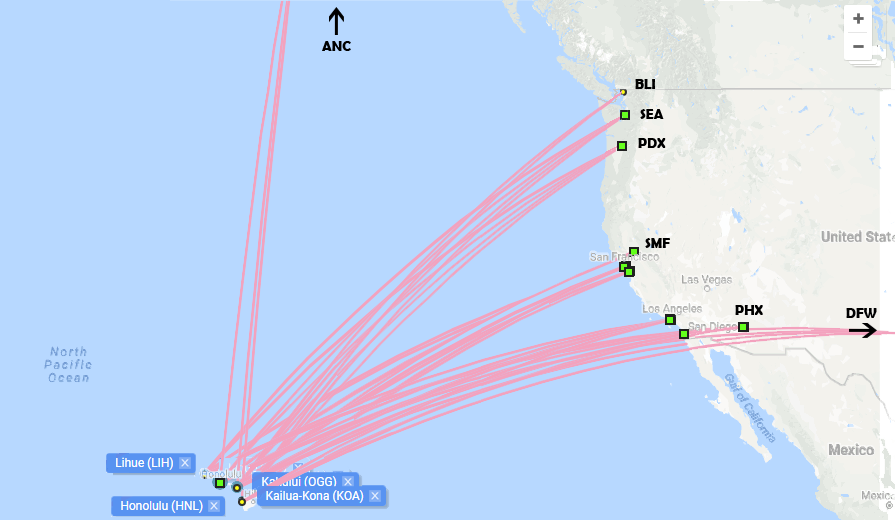
Several major airports across the US serve as primary departure hubs for flights to [Hawaii]:
- Los Angeles International Airport: Often considered the busiest gateway to [Hawaii], offering numerous daily direct flights to multiple Hawaiian islands.
- San Francisco International Airport: Another critical hub on the West Coast, providing extensive options for direct flights.
- Seattle-Tacoma International Airport: A key departure point for travelers from the Pacific Northwest and beyond.
- Phoenix Sky Harbor International Airport: Offers direct flights, serving the Southwest region.
- Denver International Airport: Increasingly offering direct flights, connecting the Mountain West to [Hawaii].
- Dallas/Fort Worth International Airport and Chicago O’Hare International Airport: Offer some direct routes, but connections through West Coast hubs are still very common.
When planning, consider flying into one of these hubs to maximize direct flight options and potentially reduce overall travel time and cost.
Airlines Serving Hawaii
A diverse array of airlines offer service to [Hawaii], catering to different preferences and budgets:
- [Hawaiian Airlines]: The flag carrier of [Hawaii], known for its authentic onboard experience and extensive inter-island flights.
- [United Airlines]: A major player, with numerous flights from its hubs, particularly [San Francisco] and [Los Angeles].
- [Delta Air Lines]: Offers service from its various hubs, including [Seattle] and [Los Angeles].
- [American Airlines]: Connects [Hawaii] from its major hubs like [Dallas/Fort Worth] and [Los Angeles].
- [Alaska Airlines]: Popular on the West Coast, providing excellent service from [Seattle] and other Pacific Northwest cities.
- [Southwest Airlines]: A newer entrant to the [Hawaii] market, offering competitive fares and inter-island service.
- [Sun Country Airlines] and [Spirit Airlines]: Budget carriers offering limited routes, primarily from the West Coast.
Researching these airlines for their routes, schedules, and amenities is key to finding the best option for your journey.
Time Zone Changes and Jet Lag
[Hawaii] observes Hawaii Standard Time year-round and does not participate in daylight saving time. This results in significant time differences from the US mainland:- 2 hours behind Pacific Standard Time (3 hours during Daylight Saving Time).
- 3 hours behind Mountain Standard Time (4 hours during Daylight Saving Time).
- 4 hours behind Central Standard Time (5 hours during Daylight Saving Time).
- 5 hours behind Eastern Standard Time (6 hours during Daylight Saving Time).
This substantial time difference, especially for East Coast travelers, means that jet lag can be a real factor. Tips for mitigating jet lag include:
- Adjusting your sleep schedule a few days before departure.
- Staying hydrated on the flight.
- Avoiding excessive alcohol and caffeine.
- Exposing yourself to natural light upon arrival.
- Trying to adapt to the local time zone as quickly as possible.
Planning for a relaxed first day in [Hawaii] can also help ease the transition.
Beyond the Miles: What the Distance Means for Your Trip
The sheer distance to [Hawaii] isn’t just a number; it profoundly influences how you plan, budget, and prepare for your island getaway. Embracing these implications can lead to a more fulfilling and less stressful travel experience.
Planning Your Itinerary
Given the significant travel time involved, particularly from the East Coast or Midwest, it’s wise to plan a sufficiently long trip to [Hawaii]. A short weekend trip might feel rushed and leave you more tired than refreshed. Most travel experts recommend a minimum stay of 7-10 days to truly unwind, adjust to the time zone, and experience at least one or two islands without feeling rushed. For those traveling from the East Coast, a 10-14 day itinerary is often ideal, allowing ample time for both relaxation and exploration. Factor in full travel days on both ends of your trip and consider scheduling an extra day for rest upon arrival and before departure to account for potential jet lag.
Cost Implications
Generally, airfare to [Hawaii] tends to be higher than for comparable domestic distances due to the longer flight times and specialized routes. However, prices fluctuate significantly based on seasonality, booking lead time, and departure location:
- Off-Season Travel: Visiting during shoulder seasons (spring and fall, excluding major holidays) often yields lower airfares and fewer crowds.
- Advance Booking: Booking flights 3-6 months in advance typically secures better prices, especially for peak travel times.
- Flexibility: Being flexible with your travel dates and considering mid-week flights can also result in savings.
- Overall Budget Impact: Higher airfare means that the travel budget for [Hawaii] needs to account for this initial cost. Saving on accommodation or activities might be necessary if airfare consumes a larger portion of your budget.
Preparing for the Journey
A long-haul flight requires specific preparations to ensure comfort and smooth transitions:
- What to Pack for a Long Flight: Essential items include a neck pillow, eye mask, earplugs/noise-canceling headphones, comfortable clothing, warm layers (cabins can get cold), and entertainment (books, loaded devices).
- Hydration and Movement: Drink plenty of water and periodically walk around the cabin to prevent stiffness and reduce the risk of deep vein thrombosis.
- Customs/Agriculture Checks: Although [Hawaii] is a US state, all passengers arriving from the mainland (and international flights) must undergo a pre-agricultural screening upon arrival. This involves declaring any plants, fruits, or animals you might be carrying to protect [Hawaii]’s delicate ecosystem from invasive species. Be prepared for this brief but mandatory process.
- Entry Requirements: For US citizens, standard domestic travel requirements apply (e.g., Real ID-compliant driver’s license or passport). International visitors will follow standard US entry protocols.
The Allure of the Archipelago: Why the Journey is Worth It
Despite the considerable distance and planning involved, millions of travelers attest that the journey to [Hawaii] is unequivocally worth every mile and every minute. The islands offer a unique blend of natural beauty, cultural richness, and diverse experiences found nowhere else in the world.
Diverse Islands, Unique Experiences
[Hawaii] is an archipelago of eight main islands, each boasting its own distinct character and attractions:- [Oahu]: Home to the state capital, [Honolulu], and the iconic shores of [Waikiki] Beach. It offers a bustling city experience combined with historical sites like [Pearl Harbor] and world-class surfing on the North Shore.
- [Maui]: Known as the “Valley Isle,” [Maui] is famous for its stunning beaches, the scenic [Road to Hana], and the breathtaking sunrise views from [Haleakala National Park]’s volcanic summit.
- [Kauai]: The “Garden Isle” is a lush, verdant paradise characterized by dramatic cliffs, such as the [Na Pali Coast], and the majestic [Waimea Canyon], often called the “Grand Canyon of the Pacific.”
- [Hawaii Island] (The Big Island): The largest and youngest island, offering incredible diversity from active volcanoes in [Volcanoes National Park] to black sand beaches, snow-capped mountains, and world-renowned coffee farms.
- [Molokai] and [Lanai]: For those seeking a more secluded and authentic Hawaiian experience, these smaller islands offer tranquility, untouched landscapes, and a deeper dive into traditional Hawaiian life.
This diversity means that whether you seek adventure, relaxation, cultural immersion, or simply breathtaking scenery, [Hawaii] has an island perfectly suited for your desires.
A Destination Like No Other
[Hawaii]’s appeal extends beyond its individual attractions. The collective experience of the islands is truly unique:- Tropical Climate: Consistently warm temperatures, gentle trade winds, and abundant sunshine make it an ideal year-round destination.
- Stunning Natural Beauty: From vibrant coral reefs to lush rainforests, towering volcanoes, and cascading waterfalls, the natural landscapes are simply awe-inspiring.
- Rich Polynesian Culture: [Hawaii] boasts a vibrant culture with deep roots in Polynesian traditions, expressed through music, dance (hula), language, food, and hospitality.
- Sense of Escape: Despite being part of the [United States], the geographic isolation and unique cultural ambiance create an unparalleled sense of escape and exoticism, transporting visitors to a different world.
Embracing the “Aloha Spirit”
Perhaps the most compelling reason the journey to [Hawaii] is worthwhile is the chance to experience the “Aloha Spirit.” This isn’t just a greeting; it’s a way of life—a philosophy of kindness, compassion, harmony, and respect for the land and its people. Visitors often speak of the warmth and genuine hospitality they encounter, which leaves a lasting impression long after they’ve returned home. Embracing this spirit allows for a deeper connection with the islands and their culture, transforming a simple vacation into a truly enriching experience.
In conclusion, while the answer to “How far is [Hawaii] from the [United States]?” involves thousands of miles and hours of flight time, the real question is not just about physical distance, but about the profound journey to a destination that promises unparalleled beauty, cultural immersion, and an unforgettable escape. The preparation, the long flights, and the time zone adjustments are all small prices to pay for the privilege of experiencing the magic of [Hawaii]. For any traveler seeking a truly distinctive and rewarding adventure, the Hawaiian islands stand ready to welcome you with open arms and the enduring spirit of Aloha.
LifeOutOfTheBox is a participant in the Amazon Services LLC Associates Program, an affiliate advertising program designed to provide a means for sites to earn advertising fees by advertising and linking to Amazon.com. Amazon, the Amazon logo, AmazonSupply, and the AmazonSupply logo are trademarks of Amazon.com, Inc. or its affiliates. As an Amazon Associate we earn affiliate commissions from qualifying purchases.