
The allure of Hawaii is undeniable – a mosaic of pristine beaches, lush volcanic landscapes, vibrant coral reefs, and a rich Polynesian culture that promises an escape unlike any other. For many, the journey to this Pacific paradise is a dream nurtured for years, and a fundamental question often arises early in the planning stages: “How long is a Hawaii flight?” The answer, while seemingly simple, is multifaceted, depending on your departure point, the specific island you choose to visit, and even factors like wind patterns and aircraft type. Understanding these variables is key to not only estimating your travel time but also to preparing for a comfortable and enjoyable journey to the Aloha State.
This article delves into the typical flight durations from various regions, examines the elements that can influence your travel time, and offers practical advice to make your long-haul flight as pleasant as possible. From selecting the perfect seat to combating jet lag and seamlessly transitioning from the airport to your dream Hawaiian resort, we’ll cover everything you need to know to ensure your adventure begins on the right note.
Understanding Flight Durations to the Hawaiian Islands
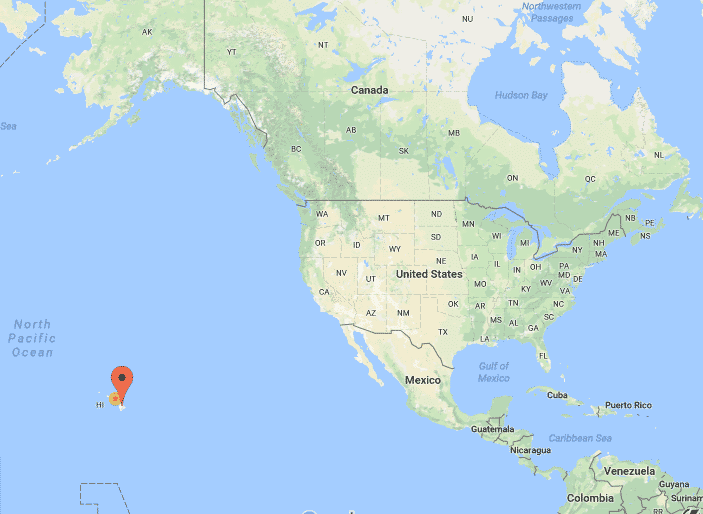
The Hawaiian Islands are located in the middle of the Pacific Ocean, making them a relatively distant destination for most travelers, especially those coming from the U.S. Mainland or international locations. The length of your flight will be primarily dictated by how far east, west, north, or south you are from this archipelago.
Flights from the U.S. Mainland
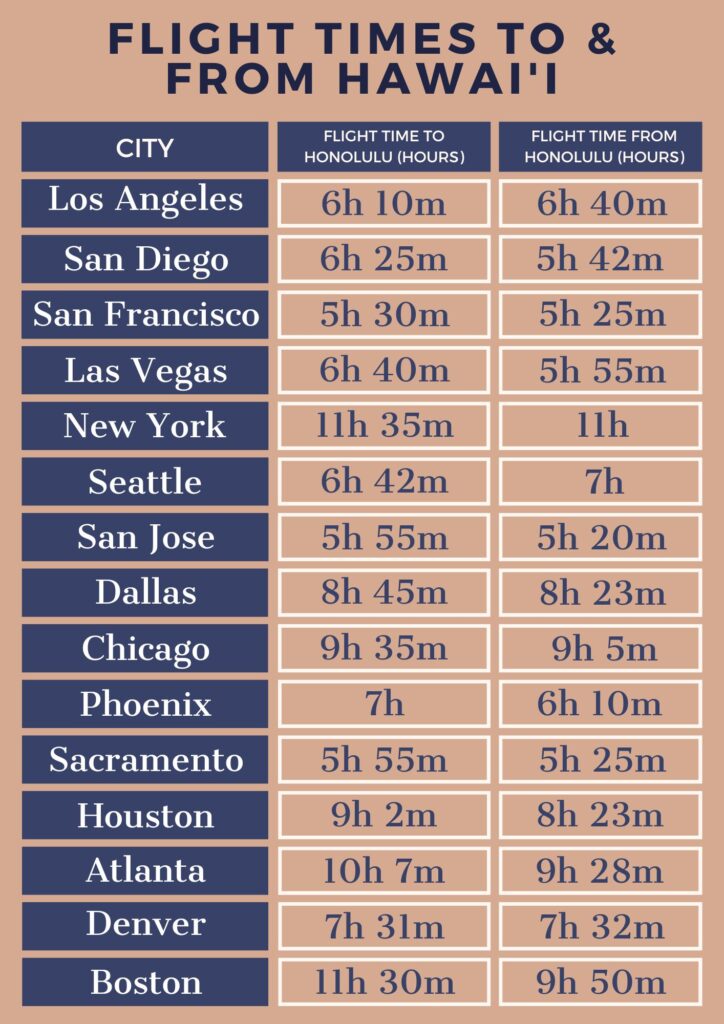
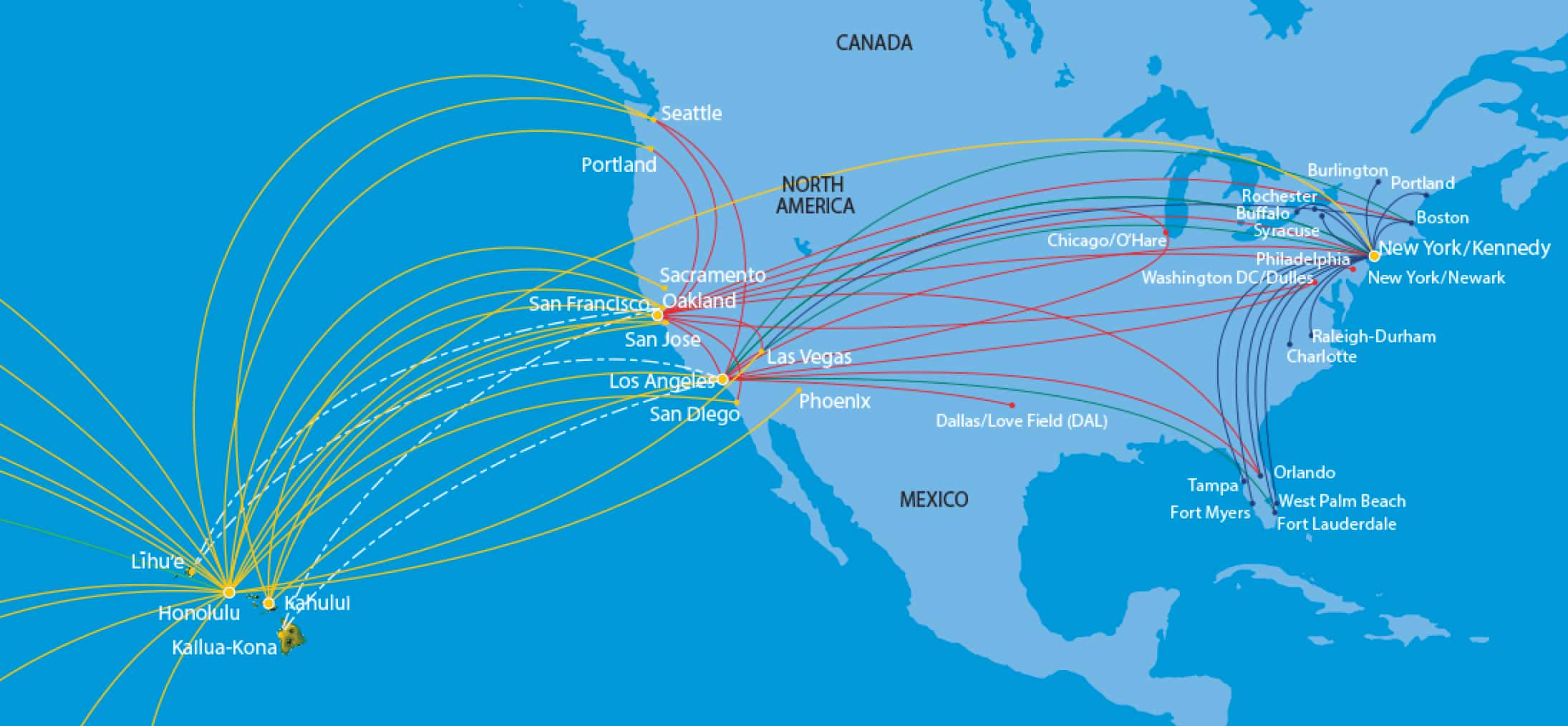
The United States is the largest source of tourism for Hawaii, and flight durations vary significantly depending on which coast you depart from.
-
West Coast Departures: Travelers from the U.S. West Coast enjoy the shortest flight times. Direct flights are readily available from major hubs, making Hawaii an accessible tropical getaway.
- From Los Angeles (LAX) or San Francisco (SFO) to Honolulu (HNL) on Oahu, Maui (OGG), or Kona (KOA) on the Big Island: Expect flights ranging from 5 hours and 30 minutes to 6 hours and 30 minutes.
- Cities like Seattle, Portland, and San Diego also offer direct routes with similar durations, perhaps adding an extra 30 minutes to an hour depending on the exact destination island. For instance, a flight from Seattle to Maui might be closer to 6 hours and 30 minutes.
-
Midwest Departures: Flying from the Midwest involves a longer journey, often with direct flights available from larger cities, but sometimes requiring a connection on the West Coast.
- From Chicago (ORD) or Denver (DEN) to Honolulu: Direct flights typically take between 8 hours and 30 minutes to 9 hours and 30 minutes.
- If a connection is necessary, total travel time could easily extend to 11-14 hours, including layovers. Cities like Dallas, Houston, and Phoenix fall into a similar category, with direct flights averaging around 7-8 hours.
-
East Coast Departures: Travelers from the U.S. East Coast face the longest flight times within the continental United States. Direct flights are less common, and most itineraries will involve at least one stop.
- From New York (JFK/EWR), Boston (BOS), Miami (MIA), or Washington D.C. (IAD) to Honolulu: Direct flights, if available, can take anywhere from 10 to 11 hours.
- However, most routes will include a stopover, typically in Los Angeles, San Francisco, or Phoenix. Total travel time, including layovers, can range from 12 to 18 hours or more, depending on the length of the connection. For example, a flight from Atlanta to Maui would almost certainly involve a stop and could be a full day’s journey.
International Flights to Hawaii
Hawaii is a global destination, attracting visitors from across the world.
- From Canada: Direct flights from Vancouver (YVR) to Honolulu or Maui are approximately 5 hours and 30 minutes to 6 hours. From Calgary, it’s around 7 hours. From eastern Canada (Toronto, Montreal), flights will involve a stop, usually on the West Coast, making the total travel time similar to U.S. East Coast departures (12-16+ hours).
- From Asia and Oceania: Hawaii is a popular stopover or destination for travelers from this region.
- From Tokyo (NRT/HND), Japan to Honolulu: Around 7 hours to 7 hours and 30 minutes.
- From Seoul, South Korea to Honolulu: Approximately 8 hours to 8 hours and 30 minutes.
- From Sydney, Australia to Honolulu: Typically 9 to 10 hours.
- From Europe: Hawaii is a considerably long journey from Europe, often requiring two or more stops. For instance, a flight from London, UK to Honolulu could take anywhere from 17 to 25+ hours, including layovers. The most common route would involve a stop in a major U.S. city like Los Angeles or San Francisco.
Factors Influencing Flight Times
Beyond the sheer distance, several other variables can subtly, or sometimes significantly, alter the actual duration of your Hawaii flight:
- Specific Hawaiian Island Destination: While Honolulu International Airport (HNL) on Oahu is the primary gateway, flights to other islands like Maui (Kahului Airport (OGG)), the Big Island (Kona International Airport (KOA) or Hilo International Airport (ITO)), and Kauai (Lihue Airport (LIH)) might be slightly longer or shorter. Direct flights to these outer islands are becoming more common from the West Coast, but from further afield, you might need an inter-island connection, adding 30-60 minutes to your total travel time.
- Direct vs. Connecting Flights: As highlighted, direct flights are always faster. Connecting flights introduce layover times, which can range from a quick 1-hour sprint through an airport to an overnight stay. When booking, pay close attention to the total elapsed time, not just the flight legs.
- Aircraft Type and Speed: Newer, more fuel-efficient aircraft like the Boeing 787 Dreamliner or Airbus A350 often fly slightly faster and can cover longer distances more efficiently than older models. While the difference might be marginal (15-30 minutes), it’s a factor.
- Wind Patterns (Jet Stream): The powerful jet stream generally flows from west to east. This means that eastbound flights (e.g., Hawaii to the U.S. Mainland) are often shorter than westbound flights (mainland to Hawaii). A flight from Honolulu to Los Angeles might only take 5 hours, while the return trip could be 6 hours. This difference can be even more pronounced on longer routes.
- Air Traffic Control and Weather Delays: Unforeseen circumstances like air traffic congestion, adverse weather conditions (both at departure and arrival), or mechanical issues can always add unanticipated delays, extending your total travel time.
Preparing for Your Long-Haul Hawaii Flight
Given the significant distances involved, especially for those not originating from the West Coast, preparing for your Hawaii flight is crucial for a pleasant start to your vacation. A long flight doesn’t have to be arduous; with the right planning, it can be a comfortable transition into island time.
In-Flight Comfort and Entertainment
Maximizing comfort during a lengthy flight is paramount for arriving refreshed and ready to explore.
- Seat Selection: If budget allows, consider upgrading to seats with extra legroom or premium economy. Even in economy, using online tools to select a window or aisle seat strategically can make a difference. An aisle seat offers freedom of movement, while a window seat provides a place to lean and often better views.
- Comfort Essentials: Pack a small travel pillow (inflatable ones are great for saving space), an eye mask, and earplugs or noise-canceling headphones. These simple items can significantly improve your ability to rest and block out distractions.
- Staying Hydrated and Fed: Airplane cabin air is notoriously dry. Drink plenty of water before, during, and after your flight to stay hydrated. Avoid excessive alcohol and caffeine, which can contribute to dehydration and disrupt sleep. While airlines provide meals, bringing your own healthy snacks can be a lifesaver, especially if you have dietary restrictions or preferences. Light meals are generally better for digestion on long flights.
- Entertainment: Load your tablet or phone with movies, TV shows, podcasts, audiobooks, and e-books. Don’t rely solely on the in-flight entertainment system, which can sometimes be limited or temperamental. A good old-fashioned book can also be a wonderful way to pass the time.
- Movement and Circulation: Get up and walk around the cabin every couple of hours to promote circulation. Perform simple stretches in your seat, such as ankle circles and neck rolls. Compression socks can also be beneficial in preventing swelling and discomfort, especially on very long flights.
- Combatting Jet Lag: Hawaii observes Hawaii Standard Time (HST), which does not observe daylight saving time. This means significant time differences for most travelers: 2 hours behind the West Coast during daylight saving, 3 hours during standard time, and 5 to 6 hours behind the East Coast. To minimize jet lag, try to adjust your sleep schedule a few days before departure, shifting it towards Hawaiian time. Once on the plane, immediately set your watch to Hawaiian time. Upon arrival, try to stay awake until evening and expose yourself to natural light to help reset your body clock.
What to Pack for the Journey
Your carry-on bag should be strategically packed for a long flight.
- Essential Documents: Passport, visa (if applicable), driver’s license, boarding passes, hotel reservations, and rental car confirmations. Keep digital copies on your phone or in cloud storage as a backup.
- Medication: Any prescription medications, over-the-counter pain relievers, allergy medicine, and motion sickness remedies should be easily accessible.
- Toiletries: A small bag with travel-sized toothbrush, toothpaste, moisturizer, lip balm, and hand sanitizer will help you feel fresh.
- Layers of Clothing: Cabin temperatures can fluctuate. Wear comfortable clothing and pack a light sweater or scarf that can be easily added or removed.
- Chargers and Adapters: Don’t forget chargers for all your electronic devices. A portable power bank can be a lifesaver for devices running low mid-flight.
- Comfortable Footwear: Wear slip-on shoes for easy removal during security checks and to allow your feet to breathe and swell comfortably during the flight.
Maximizing Your Hawaii Experience Upon Arrival
After a long journey, the goal is a seamless transition from airplane cabin to paradise. Hawaii’s airports are generally efficient, but a little pre-planning goes a long way in ensuring a smooth arrival and immediate immersion into your vacation.
Smooth Transitions: Airports to Accommodations
Hawaii has several major airports, each serving as a gateway to its respective island:
- Honolulu International Airport (HNL) on Oahu is the busiest and primary international entry point.
- Kahului Airport (OGG) on Maui.
- Kona International Airport (KOA) (officially Ellison Onizuka Kona International Airport at Keahole) and Hilo International Airport (ITO) on the Big Island.
- Lihue Airport (LIH) on Kauai.
Upon arrival, consider your transportation options:
- Rental Cars: Highly recommended, especially on islands like Maui, the Big Island, and Kauai, to explore at your own pace. Book well in advance, particularly during peak season.
- Shuttles & Ride-Sharing: Oahu, with its extensive public transportation and ride-sharing options, might not always require a rental car, especially if you’re staying in Waikiki. Shuttles are available to major hotel zones.
- Accommodation: Whether you’ve chosen a luxurious stay at the Four Seasons Resort Maui at Wailea, the Grand Hyatt Kauai Resort & Spa, or the historic The Royal Hawaiian, a Luxury Collection Resort, Waikiki, ensure you have your confirmation details ready. Many resorts offer airport transfers or can arrange transportation for you. If you’ve opted for a charming vacation rental or a boutique hotel, confirm check-in procedures beforehand.
Embracing Local Culture and Attractions
With the journey behind you, it’s time to fully embrace the Hawaiian experience. Each island offers its own unique charm and a plethora of activities, from vibrant city life to serene natural wonders.
- Oahu: The Gathering Place
- Landmarks: Explore the iconic Waikiki Beach, hike to the summit of Diamond Head for panoramic views, or pay respects at Pearl Harbor.
- Culture: Immerse yourself in Polynesian culture at the Polynesian Cultural Center, or stroll through the historic Downtown Honolulu.
- Maui: The Valley Isle
- Nature: Drive the scenic Road to Hana, witness a breathtaking sunrise from Haleakala National Park, or go whale watching (seasonal).
- Resorts: Enjoy the upscale resorts and beautiful beaches of Wailea and Kaanapali, or explore the historic town of Lahaina.
- Kauai: The Garden Isle
- Adventure: Hike or take a boat tour along the dramatic Na Pali Coast, marvel at the “Grand Canyon of the Pacific” (Waimea Canyon), or relax on the pristine beaches of Poipu or Princeville.
- Big Island (Island of Hawaii): The Volcanic Heart
- Unique Geology: Witness the power of nature at Hawaii Volcanoes National Park, explore black sand beaches, or stargaze from the summit of Mauna Kea.
- Diversity: Experience the diverse landscapes, from arid Kona coffee farms to the lush Hilo rainforests.
Beyond specific attractions, embrace the Hawaiian lifestyle. Savor local cuisine like fresh poke, kalua pig at a traditional luau, or refreshing shaved ice. Try surfing, snorkeling, paddleboarding, or simply relaxing on the beach and listening to the waves. Engage with the local people, learn a few Hawaiian phrases, and respect the natural beauty and cultural heritage of the islands.
The journey to Hawaii is an integral part of the adventure. While the flight duration can be substantial, especially from distant locales, careful planning and attention to comfort can transform it from a mere transit into a relaxed prelude to your tropical escape. From the moment you board your flight until you step onto the warm Hawaiian soil, every step brings you closer to an unforgettable experience. So, calculate your flight time, prepare for the journey, and get ready to say “Aloha” to paradise!
LifeOutOfTheBox is a participant in the Amazon Services LLC Associates Program, an affiliate advertising program designed to provide a means for sites to earn advertising fees by advertising and linking to Amazon.com. Amazon, the Amazon logo, AmazonSupply, and the AmazonSupply logo are trademarks of Amazon.com, Inc. or its affiliates. As an Amazon Associate we earn affiliate commissions from qualifying purchases.