
The Alaska Highway, also known as the Alcan Highway or officially as the Alaska–Canada Highway, is an iconic and historic route that stretches across northwestern Canada and into the heart of Alaska. Its length is a fundamental piece of information for any traveler planning an expedition along its storied pavement, offering a gateway to the vast, untamed landscapes of the North. Understanding its precise mileage is the first step in appreciating the sheer scale of this engineering marvel and the epic journey it facilitates.
Defining the Alaska Highway’s Span
The official length of the Alaska Highway is generally cited as 1,387 miles (2,232 kilometers). This measurement typically begins at its southeastern terminus in Dawson Creek, British Columbia, and concludes at its northwestern end in Delta Junction, Alaska. However, the concept of “length” can be nuanced, especially for a route as historically significant and with potential for branching routes or alternative segments.

The Official Mileage: A Fixed Point
The 1,387-mile figure is the most commonly accepted and used measurement. This mileage reflects the primary, continuous stretch of the highway that forms the backbone of travel from the contiguous United States and southern Canada to Alaska. This official length is vital for logistical planning, including estimating travel times, fuel stops, and accommodation needs. It serves as the benchmark for distance markers and official signage encountered along the route.
Historical Context and Length Variations
It’s important to note that the Alaska Highway has undergone several changes and improvements since its construction during World War II. While the core route remains, sections have been straightened, paved, and rerouted over the decades. Early maps and accounts might cite slightly different lengths due to these evolutions. The initial construction, completed in a remarkably short period of just over eight months in 1942, was a more rudimentary road. Subsequent upgrades, particularly the paving of much of the highway in the late 1940s and early 1950s, refined its course and standardized its dimensions. Therefore, while the 1,387 miles is the contemporary standard, a deeper historical dive might reveal earlier, slightly longer, or less direct paths.
The Journey Beyond the Terminus
While the official length defines the primary highway, the traveler’s journey often extends beyond Delta Junction. For many, the true destination is Fairbanks, Alaska, which is an additional 145 miles (233 kilometers) north of Delta Junction via the George Parks Highway. Therefore, when planning an expedition to Fairbanks, the total driving distance from Dawson Creek would be closer to 1,532 miles (2,465 kilometers). Furthermore, if one considers onward travel within Alaska to destinations like Anchorage, Homer, or even remote areas, the conceptual “length” of the journey, in terms of the overall travel experience enabled by the highway, expands considerably.
Planning Your Alaska Highway Expedition
The considerable length of the Alaska Highway necessitates careful planning. It’s not a route to be undertaken lightly, but rather a grand adventure that rewards preparation with unparalleled vistas and experiences.
Estimating Travel Time
A common question for travelers is, “How long does it take to drive the Alaska Highway?” The answer depends heavily on your pace, the time of year, and your interests.
Driving Pace and Stops
Driving the full 1,387 miles directly, with minimal stops, could theoretically be completed in as little as 4 to 5 days. However, this would be an exhausting and unenlightening experience. Most travelers opt for a more leisurely pace, allowing for exploration of the numerous attractions and natural wonders along the way. A typical journey might span 7 to 14 days, or even longer for those who wish to delve deeply into the culture and scenery of the regions they traverse. This allows for regular stops for sightseeing, photography, hiking, and enjoying the local hospitality.
Seasonal Considerations
The time of year dramatically impacts travel time and experience.
- Summer (June to August): This is the most popular season, with long daylight hours and generally favorable weather. Roads are typically clear of snow, and most tourist facilities are open. However, it’s also the busiest season, and accommodation should be booked well in advance.
- Spring (April to May): The shoulder season offers fewer crowds and the beauty of melting snow and budding landscapes. However, weather can be unpredictable, and some services might still be limited. Road conditions can vary, with potential for lingering snow and ice in higher elevations.
- Fall (September to October): Autumn brings spectacular fall colors, particularly in the Canadian portion of the highway. The weather can be crisp and clear, but daylight hours shorten, and the risk of early snow increases as October progresses. Many services begin to close down after Labor Day.
- Winter (November to March): Driving the Alaska Highway in winter is an extreme undertaking, reserved for experienced winter travelers with specialized vehicles and equipment. Many services are closed, and road conditions can be treacherous due to snow and ice. However, for the adventurous, it offers a unique perspective on the northern wilderness, especially for those interested in aurora viewing or winter sports.
Essential Preparations for the Long Haul
Given the vast distances and remote nature of much of the Alaska Highway, preparation is paramount for a safe and enjoyable journey.
Vehicle Readiness
Your vehicle is your lifeline on this extensive route. Ensure it is in top mechanical condition.
- Tires: Ensure tires are in excellent condition, properly inflated, and consider carrying a full-size spare. All-terrain tires can be beneficial.
- Fluids: Check all fluid levels (oil, coolant, brake fluid, windshield washer fluid) and consider carrying extra coolant and oil.
- Brakes: Have your brakes thoroughly inspected. You’ll encounter significant descents and ascents.
- Emergency Kit: Pack a comprehensive emergency kit including jumper cables, a tow rope, basic tools, a first-aid kit, flares, and a warm blanket.
- Fuel: Fuel stops can be infrequent, so always aim to fill up whenever you see a gas station. Carry extra fuel if you plan to venture onto less-traveled side roads.
Navigation and Communication
While the highway is well-marked, having reliable navigation is crucial.
- Maps: Carry physical maps in addition to GPS devices or smartphone apps. Technology can fail in remote areas.
- Communication: Cell service is spotty at best along large stretches of the highway. Consider a satellite phone or personal locator beacon (PLB) for emergencies, especially if traveling solo or in remote areas. Inform someone of your itinerary and expected check-in times.
Accommodation and Supplies
Booking accommodation in advance, especially during peak season, is highly recommended. Towns can be small and lodging limited. Carry sufficient snacks, water, and any necessary medications, as amenities can be sparse between settlements.
The Alaska Highway as a Gateway to Adventure
The length of the Alaska Highway is not just a statistic; it represents the immense geographical scope it unlocks. It is a corridor through some of North America’s most spectacular and wild landscapes, offering access to a multitude of attractions and experiences.
Key Stops and Attractions Along the Route
From its start in Dawson Creek, British Columbia, the highway winds through diverse terrains, passing through iconic locations and national parks.
British Columbia and the Yukon
- Dawson Creek, British Columbia: The official Mile 0. Here, travelers can find historical markers and begin their journey north.
- Fort St. John, British Columbia: A bustling city offering amenities and a good starting point for exploring the Peace River region.
- Watson Lake, Yukon: Famous for its Sign Post Forest, a quirky roadside attraction where travelers from around the world have left their mark.
- Liard River Hot Springs Provincial Park, British Columbia: A natural hot spring oasis, perfect for a relaxing soak amidst the wilderness.
- Whitehorse, Yukon: The capital of the Yukon, a vibrant city with a rich gold rush history, offering museums, cultural experiences, and services.
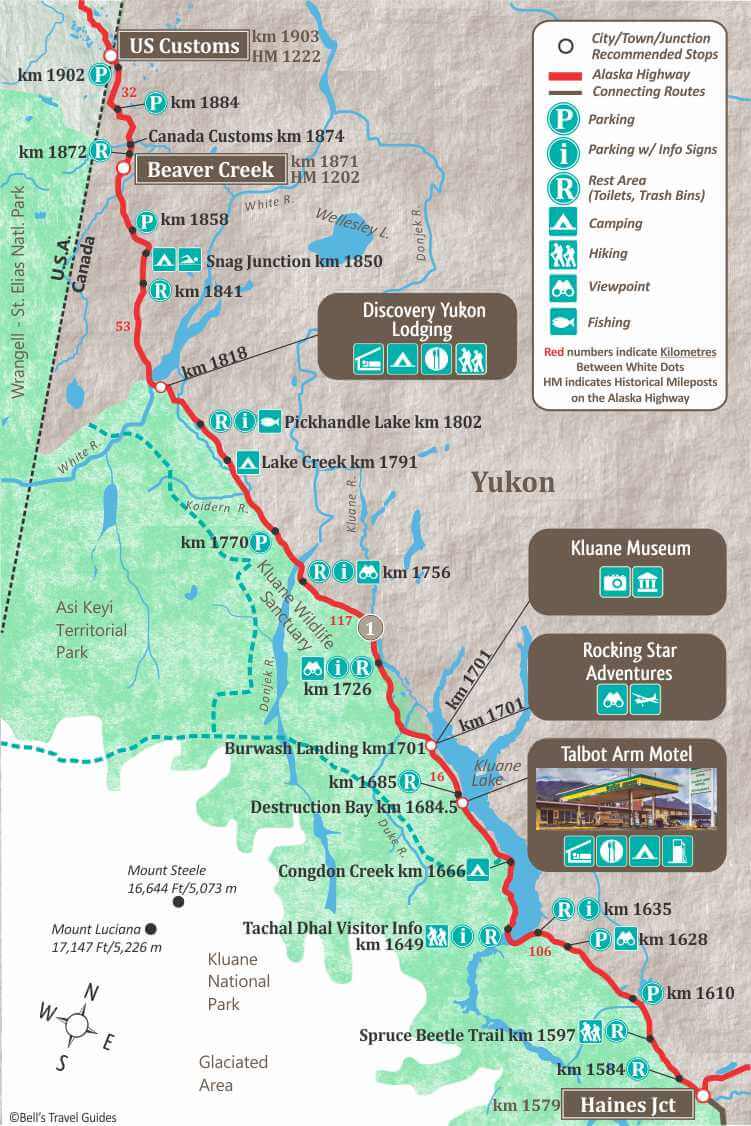
- Kluane National Park and Reserve, Yukon: Home to Mount Logan, Canada’s highest peak, this park offers breathtaking glacial scenery and opportunities for hiking and wildlife viewing.
Alaska
- Tok, Alaska: Often considered the “Gateway to Alaska,” where the Glenn Highway and Richardson Highway meet the Alaska Highway.
- Delta Junction, Alaska: The official end of the Alaska Highway. This small community marks the transition into interior Alaska.
- Fairbanks, Alaska: A major hub in interior Alaska, offering access to the Denali National Park and Preserve and a wealth of cultural and historical attractions related to the gold rush and its pioneering spirit.
The Experiential Length
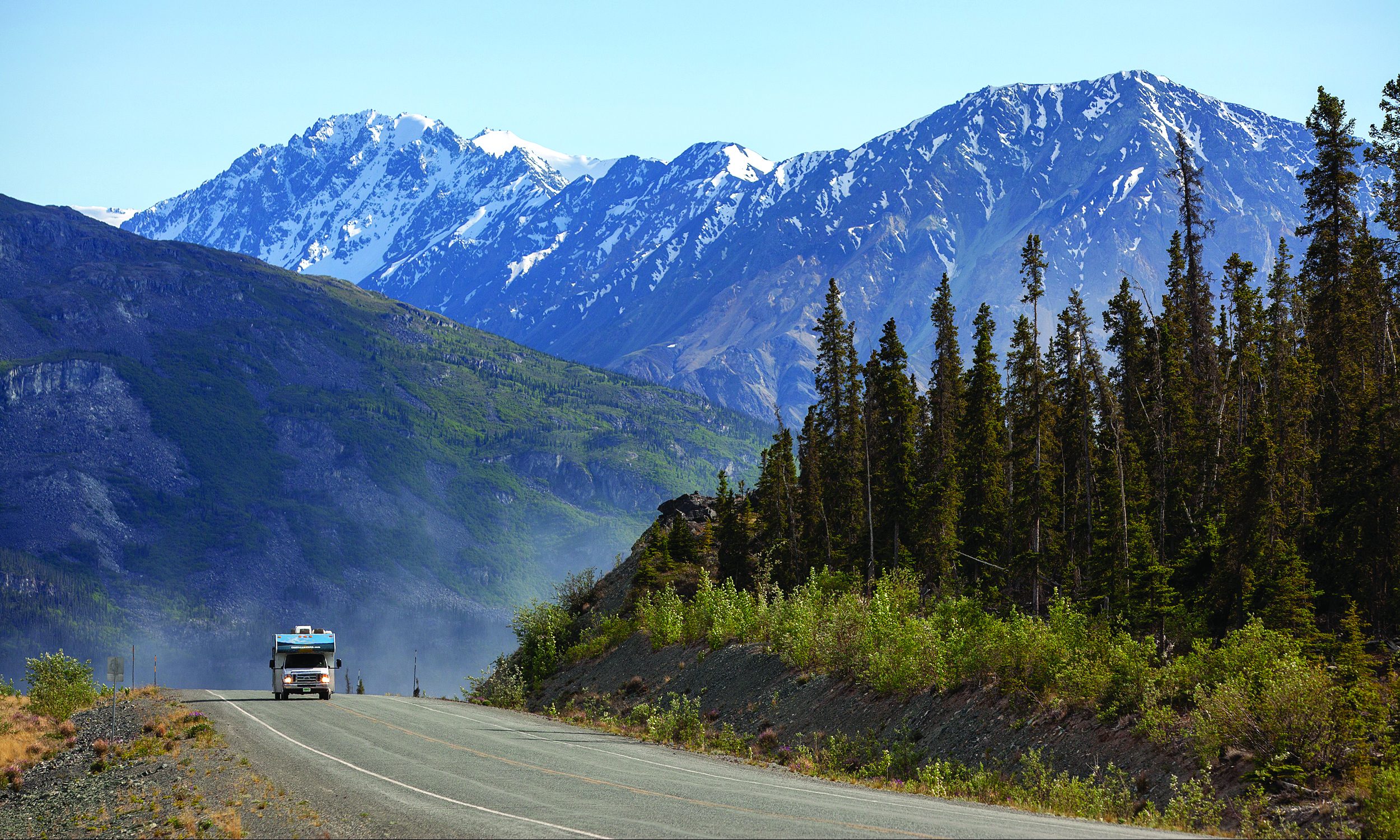
Beyond the mileage, the “length” of the Alaska Highway experience is measured in the sheer diversity of landscapes encountered. From the rolling hills and dense forests of British Columbia, through the dramatic mountains and boreal forests of the Yukon, to the vast tundras and majestic peaks of interior Alaska, the journey is a constant visual feast. Wildlife viewing opportunities are abundant, with chances to spot moose, caribou, bears, and a variety of bird species. The sense of remoteness and the connection to nature are profound. The highway is not merely a means of transit; it is an immersive journey that unfolds over its considerable distance, revealing the raw beauty and untamed spirit of the North. Its length, therefore, is an invitation to explore, to discover, and to experience the grandeur of the Last Frontier.
LifeOutOfTheBox is a participant in the Amazon Services LLC Associates Program, an affiliate advertising program designed to provide a means for sites to earn advertising fees by advertising and linking to Amazon.com. Amazon, the Amazon logo, AmazonSupply, and the AmazonSupply logo are trademarks of Amazon.com, Inc. or its affiliates. As an Amazon Associate we earn affiliate commissions from qualifying purchases.